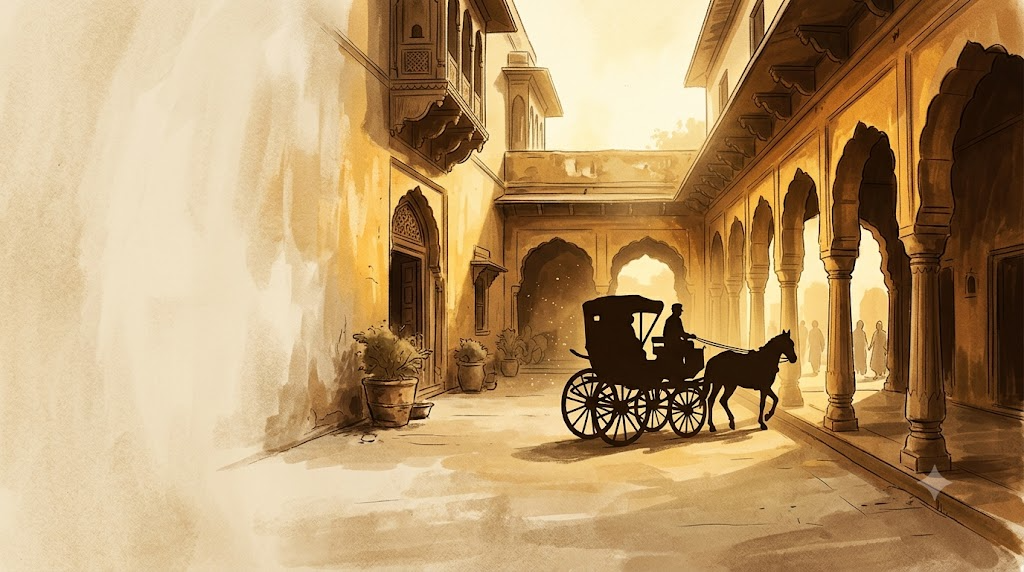
“Who is in the Palanquin?”

A confused, restless babble of voices rose from the men gathered in the courtyard. Suddenly, everyone seemed to be talking at once. Small pockets of argument and heated discussion broke out in a dozen different corners, and for a little while, young Vandhiyathevan, watching from his hiding place above, was hard put to catch a single clear word, let alone recognise the face of the man speaking. It was their host, Sambuvaraiyar, who first gathered his wits.
“Shouldn’t we furnish Lord Pazhuvettarayar with some sort of answer?” he called out, his voice ringing sharp and clear across the stone courtyard. “What is the use of arguing so endlessly among ourselves? The night has already slipped into its third jaamam; the moon swims high in the dark sky. We must come to a decision—and quickly.”
“I am plagued, if you will pardon me, with a certain doubt. And perhaps others here harbour the same feelings,” came that hoarse, grating voice which had spoken up earlier in the evening. “Should the Lord of Pazhuvoor not object, I should very much like to voice it and seek some clarification.”
“It is Vanangamudiyaar who speaks, is it not?” said Periya Pazhuvettarayar, his deep voice carrying a tone that brooked no argument. “Let him rise, then, and step forward into the light.”
“It is I, indeed. And here I stand.”
“I reserve my fury for battlefields and for my enemies—never for those I consider my allies and my friends,” said the elder chieftain gently. “You may speak your mind without the slightest hesitation.”
“I believe I will. The Lord of Pazhuvoor lists certain grave failings against Emperor Sundara Chozhar, but is it not true that there are those who level the very same charges against you, my lord Pazhuvettarayar?” asked Vanangamudiyaar, standing his ground. “I do not say that I believe these whispers—indeed, I do not—but I should very much like to know the truth of the matter, in any case.”
“Pray, enlighten me. What exactly is this truth that you wish to uncover?”
“This assembly is quite well aware of the fact that the Lord of Pazhuvoor took a young woman for his bride a few years ago—”
Sambuvaraiyar’s voice sliced through the cool night air, burning with sudden anger. “This is outrageous. I am certain I speak for everyone gathered here when I say that we firmly object to Vanangamudiyaar’s tactless remarks. To address our peerless leader in such a manner—to fling such an accusation at our great general, a man who holds only our best interests at heart—it is akin to blasphemy! In short—”
“Much as I appreciate your fierce loyalty, I must entreat Sambuvaraiyar to remain patient, and allow our friend to finish his questions,” Pazhuvettarayar said calmly. “There is nothing quite as poisonous as a mind left to fester with suspicion. It is far better to lance the boil and relieve oneself of these unending doubts. It is true. At the late age of fifty-five and more, I did marry a young woman. I admit this freely, with no qualms whatsoever. But tell me, my friends, when have I ever declared myself to be an incarnation of Lord Rama in this dark Kali Yuga (the present age of strife and moral decline)? Neither have I ever claimed the title of an Ekapathni Viradhan (a man bound by a solemn vow to have but one wife in his lifetime). I fell in love with her, and she with me. Finding our hearts united, we wedded each other according to the ancient customs of the Tamil lands. Pray, tell me, is this considered a crime?”
“No—not at all!” rose several gruff voices from the shadows, eager to agree.
“It was never my intention to accuse you simply of matrimony, my lord,” Vanangamudiyaar persisted gently. “Who among us here has bound himself to merely one wife, after all? And yet—yet—”
“Yes? There is no reason to hesitate now. Ask whatever you will.”
“There is talk, sir, that you listen far too much to your young queen, the Ilaiya Rani (the younger queen). Worse still, the whispers say that you consult her even regarding weighty affairs of state and the Chozha royalty. They say you take her with you wherever you go.”
Somewhere in the crowded courtyard, a sharp, mocking cackle erupted.
“Stop!” Sambuvaraiyar sprang to his feet again, his voice trembling with real fury. “Who dared to laugh just now? Show yourself! What gives any man here the right to jeer at our leader?” He unsheathed his heavy sword, the metal whispering in the dark, and looked around with a low growl.
“If it is any consolation to you, my friend, the laughter was mine,” admitted Pazhuvettarayar, a dry amusement in his voice. He turned back to Vanangamudiyaar. “Tell me—is it truly such a terrible crime to take my lawfully wedded wife, who bears my thaali (the sacred marriage thread) around her gentle neck, wherever I choose to travel? I will concede that I rarely stay away from her for long. But to accuse me of consulting a young woman regarding the serious affairs of state is deeply unjust. I have never done so, and I assure you, I never will.”
“If that be the case, then I pray my lord answers just one more question. Do that, and I shall pronounce myself entirely satisfied,” said Vanangamudiyaar. “What does a closed palanquin, a thing meant to stay hidden within the sheltered walls of an anthappuram, do here tonight? What place does it have among warriors gathered to discuss such grave matters as the succession of the empire? Is there someone sitting within it? And if it is empty, to whom belong the glass bangles we all heard clinking just a little while ago? Or the soft throat that cleared itself?”
A strange, uneasy hush settled like a heavy blanket over the courtyard. The night air suddenly felt very still. Truth be told, almost every man present had quietly entertained Vanangamudiyaar’s very suspicions at some point during the long meeting, and so no ringing voices of protest rose to defend their leader. Sambuvaraiyar’s lips did move, mumbling a few hurried words, but they were far too indistinct for anyone to catch. In the end, it was Pazhuvettarayar himself who chose to cleave the stifling silence, his voice ringing out strong and full of quiet confidence.
“An excellent question, and one that certainly deserves a proper explanation. You may rest assured that I shall give it to you before this meeting is at an end. But may I ask for half a naazhigai more? Surely my esteemed friends trust me enough to grant me this one small favour?”
“We do, we do!” exclaimed several voices, eager to smooth the ruffled waters. “We have complete faith in you, my lord!”
“I assure you that I cherish as much deep regard for Lord Pazhuvettarayar as any man assembled here today,” explained Vanangamudiyaar, softening his stance. “I posed these uncomfortable questions only because he bade me clear my mind of all doubts. I swear, here and now, that his every wish is my absolute command, and I am prepared to do anything to see it carried out. Should I be required to lay down my very life in his service, so be it!”
“I have the greatest faith in Vanangamudiyaar’s unwavering loyalty. In fact, I am well aware of the trustworthiness of every single man standing here tonight, and I cherish your high regard,” said Pazhuvettarayar gently. “And for that very reason, it becomes all the more important for us to remember exactly why we chose to meet in secret, and why we must come to a firm decision regarding the future of this land. Emperor Sundara Chozhar may live a long life and rule his empire exactly as he wishes—we all pray for it. But we have gathered here to consider the very real possibility that such a rosy future may never come to pass. If the royal physicians in Thanjavur are proven right—if that terrible, fiery comet trailing across the night sky proves to be a dark omen—then it behooves us to decide, here and now, upon the rightful successor to the Chozha throne.”
“We request that you give us your own honoured opinion on these matters, my lord,” someone called out. “None of us would ever venture a word against your wisdom.”
“On the contrary, my friends. At no other time has it been quite so vital for all of you to speak up and inform me of your true views,” replied the elder chieftain. “At this critical juncture, I should like to take a moment to remind us all of certain events from our shared past. Twenty-four years ago, that great warrior, saint, and pious ruler, Emperor Kandaradhithar, left us for his heavenly abode. His son, Madhuranthakar, was a mere infant then, scarcely a year old. Because the boy was so young, Kandaradhithar expressed a dying wish to place his younger brother, Arinjaya, on the great Chozha throne to rule after him. We were informed of these solemn sentiments by his devoted wife, the revered Queen Sembiyan Madevi. And it was our steadfast loyalty to the departed king that made us all agree to such an unusual arrangement.
“Unfortunately, a cruel and fickle destiny did not allow Arinjaya to rule for much more than a single year. When he passed, his son Paranthaka Sundara Chozhar was a strapping, handsome young man of twenty. We—the strong pillars of this vast empire, the ministers, aides, chieftains, lords, and the officials of every kottam and kootram (provincial districts and sub-districts)—gathered together. We discussed the best interests of the country, and we crowned the young man our king. There is no doubt in my mind that this was an excellent decision. For many years, until perhaps two years ago, Sundara Chozhar gave us no cause whatsoever to doubt the wisdom of his rule. He consulted us upon all important royal matters, and the land prospered as never before.
“Now, however, the emperor’s health is rapidly deteriorating—and this unhappy circumstance leaves us facing certain difficult questions. Kandaradhithar’s honoured son, Madhuranthaka Thevar, is now a grown man, an extremely capable prince. His deep piety, his many accomplishments, his fine intelligence and noble character make him a highly eligible contender for the throne. In the meanwhile, Aditha Karikalar, the emperor’s fiery firstborn, is stationed far away in Kanchi, serving as the Commander of the Northern Chozha Forces.
“Tell me, my friends—who, between these two young men, is truly worthy of being named the heir? I ask you to carefully consider our ancient royal traditions and practices; to consult the timeless wisdom of Manu Needhi (the ancient code of law and righteous conduct). What, according to the strict dictates of fairness and justice, would be your decision? Would you choose Madhuranthaka Thevar, the rightful son of the elder brother, Kandaradhithar? Or would you favour Aditha Karikalar, merely the grandson of the younger brother, Arinjaya Chozhar? Think on it. Think carefully. Search your hearts and your minds, and then give me your honest opinion.”
“Kandaradhithar’s son, Prince Madhuranthakar, is the only rightful heir to the throne,” answered Sambuvaraiyar promptly, his voice firm. “That decision alone, my lord, is the one that aligns with the dictates of justice, fairness, and true righteousness.”
“True!” cried one voice. “This is my decision as well,” said another. “I agree entirely,” murmured the other chieftains, nodding their heads one by one in the flickering torchlight.
“Your opinion matches mine. The Chozha throne does, indeed, rightfully belong to Madhuranthaka Thevar,” said Pazhuvettarayar. “But making such a decision in the quiet of the night is easy; enforcing it will entail enormous difficulty and danger. Tell me, is every man here prepared to undergo any hardship to make it a reality? Do we swear to sacrifice our bodies, our souls, and our wealth in fighting for the prince’s rights, to see them fully restored to him? Do I have your solemn assurance that you will all pledge yourselves to this noble cause, right here at the sacred feet of Goddess Durga?” The elder chieftain’s voice fairly rang against the stone walls with a sudden, powerful fervour.
A heavy silence descended on the gathering once again. The men exchanged cautious glances. Finally, Sambuvaraiyar cleared his throat and spoke up.
“We are prepared to swear, in the holy presence of God, that we shall sacrifice anything and everything to uphold Madhuranthaka Thevar’s rights. But all of us do wish to ask you something before we take such an oath. What are the prince’s own sentiments in this matter? Is he truly prepared and willing to ascend the great throne? We have all heard many tales of the deep piety of Kandaradhithar’s son—stories that he takes absolutely no joy in worldly pleasures, and devotes his days entirely to the worship of Lord Shiva. We have heard, too, that nothing could be further from his own desire than the burden of ruling this vast empire. What is more, it is said his mother, the revered Sembiyan Madevi, does not wish it for him either. We should very much like to know the truth of such statements, if you please.”
“An excellent question, my friend, and asked at exactly the right time. I shall answer it in a way that I hope will prove satisfactory to everyone present. In point of fact, it is a question I ought to have addressed much earlier in the evening, and I beg your pardon for the delay,” Pazhuvettarayar began gently, pacing a little. “The whole country knows that Sembiyan Madevi has done everything within her power to turn her son’s mind away from thoughts of the throne, guiding him instead towards the peaceful worship of the divine. But what the country, and its good people, do not know are her true reasons for doing so. You see, should it ever become widely known that young Madhuranthakar harboured a wish to ascend the throne, the old queen, the Periya Piratti, feared that such knowledge would swiftly put a brutal end to his very existence—”
“Ah! Is that truly so?” exclaimed several voices in shock, the men leaning forward in the dim light.
“Indeed it is. Any mother worth the title would much rather see her son alive and safely uncrowned, than watch him take the throne only to be brutally assassinated. Prince Madhuranthaka Thevar, to whom his mother’s every word is as sacred as the holy Vedas themselves, dutifully devoted himself entirely to God. He spurned all royal and worldly pleasures, spending his days in the quiet worship of Lord Shiva. Recently, however, over the past little while, his own sentiments have been undergoing a steady, quiet change. He has begun to feel that it is, after all, his birthright to ascend the Chozha throne, and he harbours a growing wish to govern this country in the best way possible. I assure you, he is perfectly prepared to voice these sentiments in public, just as soon as he is secure in the firm knowledge of your loyal fealty to him.”
“And what, my lord, is the proof of this sudden change of heart?” asked a skeptical voice.
“I am certainly prepared to provide as much proof, and more, as you could possibly wish for. But tell me this—if I do provide it, will you all swear, here and now, to pledge yourselves entirely to his cause and to his future rule?”
“We will! We swear it!” the gathering assented vociferously, the courtyard echoing with their sudden enthusiasm.
“I trust no one here entertains any further doubts?” “No, none at all!” “In that case, my friends, there is no reason to delay matters any further. Here is the very proof you have all been waiting for. And it gives me an excellent opportunity to clear up good Vanangamudiyaar’s earlier suspicions as well.”
Pazhuvettarayar rose from his seat, walked with slow, majestic steps towards the closed palanquin resting in the shadowy corner of the courtyard, and stopped respectfully beside it.
“My Prince,” he called softly, his deep voice taking on a tone of utmost humility, “we require your gracious presence among us. Pray, do step out of the palanquin and cast your eyes upon these brave warriors. Look upon these strong pillars of our empire, men who stand prepared to lay down their very lives to uphold your noble cause!”
Up on the balcony, hidden in the shadows, young Vandhiyathevan had been listening to the courtyard conversation with all his ears. Now, holding his breath, he leant forward carefully from behind his carved wooden pillar and peered down into the torchlit space below.
A slender, golden hand—the very same delicate, rose-leaf complexioned limb he had caught a glimpse of earlier that evening on the road—crept out from the dark interior of the palanquin and gently pushed aside the heavy silk screen. Except, as the light caught it, he realised that what he had mistakenly believed to be a woman’s glass bangle was, in fact, a jewelled kanganam (a thick, ornate bracelet usually worn by royal princes).
The next instant, a face that resembled the golden, luminous fullness of a radiant moon appeared from behind the draped silk. A young man, possessing a form and grace that might have rivaled the breathtaking beauty of Manmadhan himself, stepped out into the cool night air, offering a hesitant, gentle smile to the rugged warriors assembled in the courtyard.
Ah! Vandhiyathevan’s mind raced. Wasn’t this Prince Madhuranthakar, the pious son of the late Emperor Kandaradhithar? Finding him travelling hidden away within a closed, curtained palanquin had naturally made the young man mistake him for a shy princess. He threw a quick, anxious glance toward the distant fort wall. Was Azhwarkkadiyaan Nambi, who had evidently committed the exact same error, still perched up there, eavesdropping on this startling revelation? But thick, leafy tree branches shadowed that particular section of the high stone wall, swaying gently in the night breeze, and he could see nothing at all.
By this time, the courtyard below had erupted. It resounded with ferocious, full-throated shouts and passionate chants. “Long live Madhuranthaka Thevar! Long live the true Crown Prince!” Grizzled men unsheathed their heavy swords and raised their sharp spears, lifting their voices to the starry heavens in the old, blood-stirring battle cry of the Tamil lands. “Vetrivel! Veera vel!” (May the victorious spear of the gods strike true!)
It was clear that to remain crouching there any longer would only invite terrible complications. Heart hammering in his chest, Vandhiyathevan melted back into the deeper shadows, slipped away from the carved pillar, and made his way softly back to his solitary bed in the isolated balcony, where he lay down and stared thoughtfully up at the wooden rafters.
© 2026 Matribhasa Classics. Public Domain

Comments (0)
Log in to join the conversation.