The Runaway Spy

Two thousand years ago, the great Chozha king Karikal Peruvalathan raised the banks on either side of the Kaveri, tying the river to the earth. For years the waters stayed within their bounds, held in check, feeding the land dutifully. But empires, rather like rivers, have their own seasons. The brilliance of the Chozha reign dimmed for a time; their power retreated like a receding tide. Others who had waited patiently in the shadows for just such a moment—the Pandiyas, the Pallavas, the Kalappalas, and the Vaanars—rose to prominence.
And the Kaveri, stumbling without her kaavalan (the king and protector of the realm), began to break her banks. She shifted without direction, wandering blindly and washing over the fields. There were, of course, occasions when she did more than merely spill over the plains; sometimes, Ponni—as the river is affectionately known—changed her path entirely. Old riverbeds were reborn as the new Kaveri, and the reverse was just as true. So radically did she alter her route that dry, dusty tracts were miraculously transformed into nansei (rich, well-watered agricultural lands), while shallow depressions filled to become sprawling lakes, their little waves lapping greedily at newfound shores.
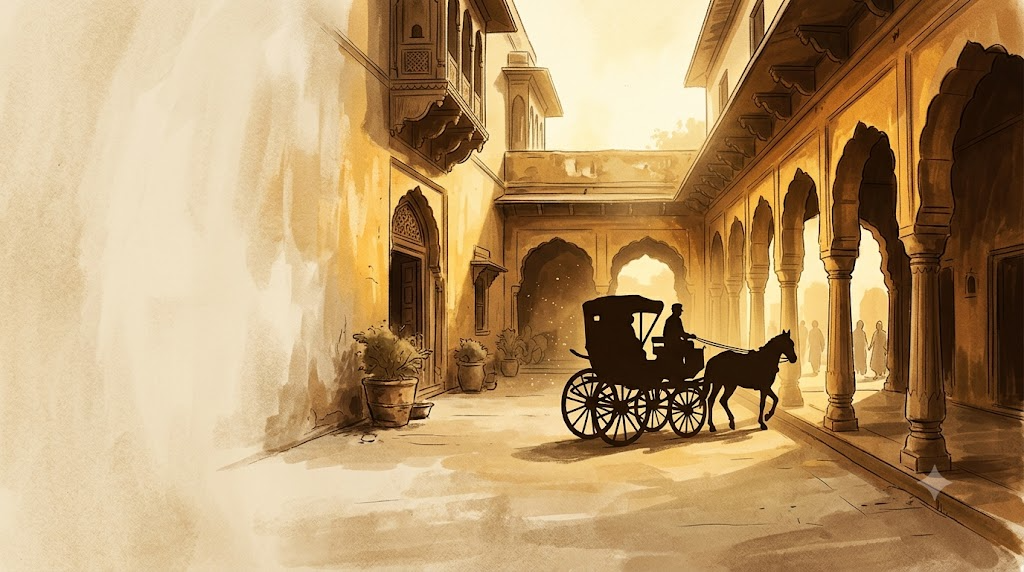
One such beautiful lagoon lay to the south of the many royal dwellings in Pazhaiyarai. Its closeness to the palaces made it a sparkling jewel in the Chozha crown. Originally born from the Kaveri’s wandering moods, later kings had deepened the natural depression, pushing back its banks to ensure it always brimmed with cool, green water. Beyond its quiet beauty, the lake served another, highly practical purpose: it acted as an immense natural moat, shielding the many royal residences along its edge, and particularly the anthappurams, from the gaze of outsiders. No one could cross the water except by ferry, and even then, passage was a rare privilege granted only to those on familiar, trusted terms with the royal household.
Beautiful uthiyaanavanams (royal pleasure gardens) hugged the banks of this pretty lagoon. Here, the ladies of the court promenaded along shaded pathways, admiring the lush greenery without the slightest fear of being watched. Hidden away, they could discard the stiff protocols of the palace. They danced with the sudden, joyous abandon of peacocks, or lifted their voices in song like nightingales in the mango groves. They stepped down into the water to swim in its cool depths, or rowed little wooden boats, laughing and splashing each other in play.
It was an old custom that when a king embraced death and a new ruler ascended the throne, the new sovereign would build a fresh palace for himself, while the queens and children of the departed king remained comfortably in their familiar homes. In Pazhaiyarai, next to Queen Sembiyan Madevi’s splendid edifice, stood Princess Kundhavai’s royal residence. It rose towards the heavens, awing all who saw it with its sheer magnificence and exquisite stone carvings. It had, after all, once been Emperor Sundara Chozhar’s own seat. Now that the Emperor had moved his court to Thanjavur, his beloved daughter reigned supreme in Pazhaiyarai in his stead.
Naturally, of all the royal gardens that dotted the landscape, Princess Kundhavai’s was the most breathtaking. Great, luxurious banyan trees lined the winding paths, dropping their many thick, vine-like roots into the earth like pillars. Tiny, neat bushes found their place in the shade. Sweetly fragrant creepers wound their tendrils around sturdy tree trunks that curved gracefully in search of sunlight, while cozy little arbours, entirely draped in flowering vines, offered perfect niches to sit and watch the water. Kundhavai and her coterie of friends spent most of their long, golden evenings in these gardens. Sometimes they whiled away the hours in a large group, laughing loudly as they traded choice pieces of palace gossip. At other times, they broke off into quiet cliques of two or three, sharing whispered secrets. Lately, however, it had become the custom for Kundhavai and the Kodumbalur princess, Vaanathi, to wander into the gardens entirely by themselves.
One such sleepy afternoon found the two of them in deep shade under a magnificent banyan tree, swinging gently together on a thick forest creeper tied to a sturdy branch. The tinkling laughter of women drifted over the water, vying with the delighted, melodic notes of birds hidden in the canopy above. The two princesses, however, saw no reason to laugh. Neither did they seem to find any pleasure in the gentle mirth floating around them. And if one were to wonder if they were simply sunk fathoms deep in serious conversation—well, that was not true, either.
From an arbour nearby, a woman’s voice rose, sweet and clear, in song. It was the birthday of Kannan, and so, naturally, she sang of him. The song painted a picture of the moon showering its gentle, milky rays upon the earth, and the melodious notes of Kannan’s flute wafting through the warm night air, falling upon the ears of a young woman. Her heart is utterly lost to him, and the beautiful music only wounds her. Wrung by sweet despair, she sings of her deep unhappiness, and a little green parrot in the branches above tries to offer her consolation:
Woman: Who is this lout, that plays a flute? Heartless, this painful moonlit night? Alone am I, a maiden, yet no mate, Cruel, cruel, to thus scorn my plight!
Parrot: He plays upon his flute, his notes so true, That the earth and skies may dance in bliss. Do they burn, my doe, pierce and taunt? Such strange whims—pray, what is amiss?
Woman: Welcome, welcome, my little bud— Let me garland you, with pretty Punnai blooms. For are you not here, as my spirit wilts, To console my heart; my soul, to soothe?
Parrot: In truth I come from afar, fair maiden, To speak of Kannan, who wanders lovelorn. In despair he sank, as you left his side, Sweet butter now sours, once love was born!
Princess Kundhavai shook her head in mock despair as the last notes faded into the leaves. “A precious God our wonderful Tamil land has been saddled with,” she remarked drily. “Plays upon his flute, gobbles butter by the potful, and spends all his time romping with women! How on earth is anything worthwhile supposed to get done, pray tell?”
No reply came from the other side of the swing. Kundhavai turned to look at her companion.
“Well, Vaanathi? Why this heavy silence? Surely Kannan’s beautiful flute hasn’t struck you dumb as well?”
“Akkaa?” Vaanathi blinked, waking slowly from her reverie, using the affectionate term for an elder sister. “Were you speaking to me? What was it that you asked?”
“What was it that I—good heavens, my girl, where have your wits gone begging?”
“Nowhere, Akkaa. They have been right here, with you.”
“Why, you little imp. Playing your pretty tricks on me, are you? Your heart isn’t here in this garden at all, my child. Shall I tell you exactly where it is?”
“If you are so certain, why not?”
“And why wouldn’t I be? It is far away on the battlefields of Ilankai. Fluttering around my young brother, that innocent boy Arulmozhi Varmar, scheming up ways to snare him with your spells.”
“You are half-right, Akkaa,” Vaanathi said softly. “My heart does escape to Ilankai often, I admit it. Not to ensnare him with my spells, though. All I can think about is how horrifying the battle must be. How terrible his living conditions are, and—oh, how he must suffer! The wounds his poor body might have sustained. Where and how does he eat, and sleep? These are all I can think about. My mind revolves endlessly around his afflictions in the war, while I lie here on soft silken cushions, dining off silver plates on fine food, dressed in gold! I can barely stand it, Akkaa. If I had wings I would fly across the sea to Ilankai this very instant!”
“And do what? Be even more of a nuisance to him, I suppose?”
“Never. I would emulate the great ladies from our epics, Subadhra and Sathyabhama. Just as they drove the chariots for their lords, I would drive his. And when his foes fire their treacherous arrows at him, I would intervene and bear them upon my own heart—”
“All of which courageous deeds he would just stand comfortably by and watch, I suppose?”
“Well… if such things aren’t quite to his taste, then I would await his return in the camp. I would anoint his tired wounds with rejuvenating salves and cool unguents. I would spread soft mattresses for him to rest upon, and prepare the absolute finest meals I can to tempt his palate. I would play upon my veena to soothe his bodily pain, and sing, lulling him to sleep with my music…”
“None of this is ever likely to happen, Vaanathi,” Kundhavai said gently, but firmly. “You may as well reconcile yourself to the fact. Chozha men do not let their women accompany them to battlefields. Ever.”
“But why not, Akkaa?”
“Because, my dear, they fear us women far more than they fear swords or wounds!”
“But why? What could we women possibly do to them?”
“Nothing to them, of course. But what if our fearsome foes catch sight of your exquisite beauty, drop their weapons, fall at your feet, and surrender in hordes? Our men wouldn’t have a single chance to display their valour, would they? The Chozhas do not ever wish to be known as a tribe that lets their women win their wars for them.”
Vaanathi smiled. “Do such things really happen, Akkaa? Truly? Are foes quite so silly as to surrender at the sight of a pretty woman?”
“Well, why not? Vaanathi, my girl—do you remember that young warrior we saw at the astrologer’s home in Kudandhai, and later on the banks of the Arisilaaru?”
“Yes. What of him?”
“Do you remember the way he stood upon the threshold? Looking as though he were drugged, completely paralysed at the very sight of us?”
“Indeed I do. But I must beg to differ about his inebriated state at the sight of ‘us’, Akkaa. If memory serves me right, it was your exquisite face that made him quite so giddy. He hardly spared a glance for the rest of us.”
Kundhavai let out a soft laugh. “You have certainly learnt to spin fabulous tales, Vaanathi. This isn’t a joke at my expense, is it?”
“No, never. But Akkaa—I wish to ask you something. Will you promise to answer me truthfully?”
“Let us hear this wonderful question of yours first, shall we?”
“Why were you thinking of that young warrior, just now?”
“Why, you brat! And why shouldn’t I, pray?”
“Do, by all means. I never took you to task about it, did I? It is entirely natural, in fact, that you should. I have been worried about him myself. About what might have befallen him, you see.”
“You have? Why on earth would that be your concern?”
“No? But if we happen to meet someone striking, and find ourselves thinking of him often, wouldn’t it be perfectly natural to wonder what became of him?”
“There is nothing even remotely natural about it. And we ought not to let our wits wander in such a chaotic fashion, either. We must rein in our hearts—hark, Vaanathi! There is the sound of a parai!”
A public announcement drum was thudding loudly in the distance, echoing through the dusty streets.
“What does the voice say?” Kundhavai whispered, holding her breath. “Listen carefully, will you?”
Indeed, a heavy parai pounded in the town, interspersed with the loud, rhythmic shouts of a herald. As the wind shifted, the words drifted clearly over the garden wall:
Dum! Dum! Dadum!
“An enemy spy entered the fort of Thanjavur with a counterfeit signet ring! He learnt royal secrets and has made his escape! Furthermore, this spy has caused grievous bodily harm to two men in his desperate bid for freedom! A young man, well-built, with the wits and sly tricks of the illusionist demon Indrajith himself! He is named Vallavarayan Vandhiyathevan! Those who grant him refuge will be sentenced to death! Those who apprehend him and turn him over to the authorities will receive a reward of a thousand gold coins! Announced, hereby, as per the supreme authority of the Thanjavur Fort Commander, Pazhuvettarayar Kalanthaka Kantar!”
The parai pounded once more, the heavy sound vibrating in the warm air.
Kundhavai’s slender frame trembled, a sudden chill running through her despite the afternoon heat.
“Devi?” A maid came hurrying up the garden path, breathless. “A Vaishnavite by the name of Azhwarkkadiyaan Nambi seeks an audience with you. A very urgent matter, he says.”
Kundhavai smoothed her silks and steadied her voice. “I shall be there in a moment.” She slipped off the creeper-swing, leaving it swaying gently under the banyan tree, and hurried away towards the palace.

© 2026 Matribhasa Classics. Public Domain


Comments (0)
Log in to join the conversation.