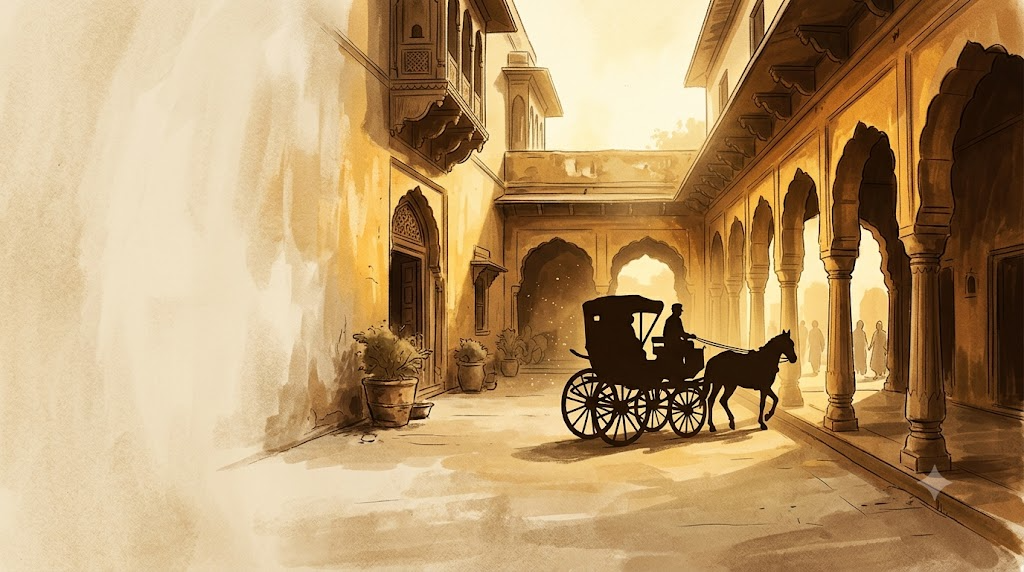
Azhwarkkadiyaan Nambi

Vandhiyathevan spurred his horse down from the high banks, taking a dusty path that ambled steadily towards the south. His heart, on this bright morning, felt as light as a feather. It was practically tumbling cartwheels inside his chest—much like the little sailboats he had seen skimming so effortlessly across the lake’s glittering surface. He was a young man of a naturally cheerful disposition, always far more willing to look forward to life’s pleasures than to brood over its possible pains. A sheer, bubbling exhilaration coursed through his veins. The warm breeze whispered to him that he was on the edge of a strange and wonderful journey.
If he could feel this delighted just putting one foot into the Chozha dominions, he thought, how much more marvellous would it be once he journeyed further down, beyond the Kollidam (a great, sweeping river that formed the northern boundary of the Chozha heartland)? How enchanting would those fertile lands be, overflowing with green shade and quiet water? And the people—especially the women—what would they be like? He imagined silver streams and delightful, clear-water ponds. What a magnificent sight the River Ponni (as the great Kaveri river was affectionately known) would present, enshrined as she was in countless old poems and epics! Her lush banks, shaded by the spreading boughs of Punnai, Konnai, and Kadhamba trees (those fragrant native trees that bloom so beautifully in the rains), would gladden the saddest of hearts. He was sure he would be greeted by village ponds dotted with red lotuses, as well as delicate kuvalai and kumutham (water lilies that unfurl their petals to the sun and the moon), their subtle scents carried to him on the soft wind.
Richly carved temples, built in finely chiselled stone by Chozha kings long renowned for their deep piety, would rise up on either side of the river banks, offering quiet, shaded courtyards for a moment’s devotion. Ah, Pazhaiyarai! Divine, beautiful Pazhaiyarai. The illustrious Chozha capital that had quietly wrested the pride of place from those older, famous Chozha cities like Poompuhar and Uraiyur. Compared to Pazhaiyarai, those older towns were practically sleepy villages nowadays. Pazhaiyarai boasted wide avenues, tall mansions, sprawling palaces, bustling soldiers’ quarters, and magnificently carved stone shrines for Siva, as well as grand Vinnagara temples (the towering abodes built for Lord Vishnu)—the likes of which were to be found nowhere else. Vandhiyathevan had heard fond tales of the simple, charming verses of the Thevaram and Thiruvaimozhi (the sacred hymns sung by the wandering saints of old), set to melody by versatile musicians, whose voices could melt the hardest of stones. Soon, he told himself, he would have the chance to sit and listen to such soul-stirring music with his own ears.
But that was not all. Soon, he would have the distinct honour of an audience with a man who was popularly held to be the equal of Manmadhan (the god of love) for his handsome looks, and Velan (the warrior god Murugan) for his fierce courage: none other than the Emperor himself, Maharaja Paranthaka Sundara Chozhar. Even more thrilling to a young man’s heart—he might just catch a glimpse of the Emperor’s daughter, the much-loved and widely revered Chozha Princess, Kundhavai Piratti.
All this, of course, provided he met with no great danger along the way. But what if he did? He gave his spear an affectionate tap. His trusty sword hung neatly sheathed at his waist; his leather armour sat comfortably on his shoulders. Best of all, he knew his own heart possessed enough courage to weather any storm.
There was, however, one small catch. The Crown Prince, Aditha Karikalar, had given him a very strict set of instructions, which might prove a bit of a stumbling block. He wasn’t to descend into brawling with anyone. No matter the provocation, he was to keep his fists to himself. For a young man of Vandhiyathevan’s fiery temperament, this was a difficult proposition indeed. Still, he reasoned with himself, he had managed to keep out of trouble so far, hadn’t he? He had covered a considerable distance in peace. Just two days more of this uncharacteristic good behaviour. Until then, he would simply have to keep his temper nicely in check.
It had been Vandhiyathevan’s intention to reach the palace of the local lord, Kadambur Sambuvaraiyar, by the time the sun sank in the west. He set a steady, rhythmic pace, and soon found himself trotting up to the precincts of the Veera Narayanapura Vinnagara Temple.
The annual Aadi Thirumanjanam (the holy bathing festival held in the monsoon month of Aadi) meant that the already popular shrine was teeming with people, the joyous crowds spilling out from the temple courtyard and filling up the surrounding mango and tamarind groves.
Makeshift stalls had sprouted up in every available patch of shade. Vendors were loudly hawking sticky-sweet slices of jackfruit, yellow bananas, freshly cut lengths of sugarcane, and all manner of sweetmeats and crispy savouries. Others sat cross-legged behind woven baskets filled with garlands of fragrant flowers, meant for the womenfolk’s hair, or tight pink lotus buds intended for divine worship. Some stalls were piled high with rough-husked coconuts, pale green ilaneer (sweet tender coconuts ready to be sliced open), fragrant incense like akhil, pots of yellow sandalwood paste, and daily necessities such as betel leaves, dark mounds of jaggery, and puffed rice. Trade was very brisk.
But a country fair is not just about eating and praying. At strategic corners sat the astrologers and palmistry experts, serious-faced men who advertised themselves as absolute masters at reading signs and divining the future. There were slick magicians, too, and village healers who swore up and down that their roots and powders could remedy the most venomous snakebite. People milled happily around all of them, soaking in the sights, the noise, and the good cheer.
Vandhiyathevan cruised slowly through this organised, cheerful pandemonium, enjoying himself immensely. At one point, however, the uproar seemed to reach a rather raucous crescendo. A dense crowd of people was pressing inward, and several voices were shouting so loudly that they drowned out the festive drums. Evidently, a serious argument was in progress—and judging by the heat of the shouts, it was a very lively one.
Every instinct in Vandhiyathevan’s young blood tugged at him to go and immerse himself in the dispute; he simply couldn’t resist a good show. He brought his horse to a halt by the dusty roadside, just outside the thickest part of the crowd, and swung himself down. He patted the animal’s warm neck, murmuring an instruction to stay put, which the well-trained beast understood perfectly. Then, finding an opportune gap, he ploughed his way cheerfully through the heaving ranks of onlookers.
When he arrived at the centre of the commotion, he stopped short in mild astonishment. The cause of all this massive argument, the source of yells that were practically reaching the heavens, was just three men. They might have been minuscule in number, but the surrounding crowd more than made up for it. Each verbal combatant, it seemed, had gathered his own ardent flock of supporters, who shrieked their approval whenever their man put forth a particularly brilliant point—and this, Vandhiyathevan realised, was the real reason for all the deafening clamour.
Once he had taken a moment to observe the layout, he bent his mind to the dispute at hand. One of the three men was short, stocky, and clearly built of hardened muscle. He carried a stout wooden staff and had his hair tied up in a tight top-knot at the front of his head. He was almost smothered in elaborate yellow sandalwood markings that denoted the symbol of Thirumaal, or Lord Vishnu.
The second man was a staunch Siva devotee, his lean chest and forehead adorned liberally with stark white stripes of viboothi (the sacred ash worn by followers of Lord Siva).
The third combatant happened to be a bald-headed ascetic, draped in saffron robes. He, the crowd soon gathered, was neither a Vaishnavite nor a Saivite, but professed to be entirely beyond such narrow definitions: a sanyasi (a wandering monk) who followed the lofty tenets of the Advaitha Vedantha philosophy.
“You, Azhwarkkadiyaan Nambi, listen here!” announced the ash-smeared Saivite, his voice ringing out. “Haven’t we all heard the ancient tales of Brahma and Vishnu searching in vain for the top of the head and the bottom of the feet of our great Siva Peruman? Didn’t they fail spectacularly to bind Him to such pitiful dimensions, and finally fall at His divine feet, begging forgiveness for their arrogant transgressions? How, in all honesty, can you stand there and argue that your Thirumaal is the worthier god?”
This, of course, was the sign for the stout Vaishnavite, Azhwarkkadiyaan Nambi, to brandish his thick staff in a wide, threatening arc.
“Stop this instant, you fool who worships the dust at Siva’s feet!” he bellowed, his face red with exertion. “Your blessed Siva Peruman was the one to foolishly rain boons on the undeserving head of Ilankai’s ten-headed demon-king, Ravana. But didn’t all those ridiculous magical powers come to absolutely nothing before the divine bow of Vishnu’s great incarnation, Lord Rama? How could you possibly argue that Siva is the more powerful?”
Before the Saivite could retaliate, the saffron-clothed Advaitha monk barged right into the fray. “Really, I fail to see the point of these petty, endless arguments,” he sighed, looking pityingly at the other two. “You may stand here and debate the greatness of Siva or Vishnu until the end of time, but there would be no real purpose to it. The only truth, the greatest of them all, lies in the Vedantha. You, who still prostrate yourselves at the feet of mere stone deities, are doomed to tramp along the paltry Bhakthi Maargam (the path of devotion). You are simply too ignorant to understand that the true spiritual path, the Gnana Maargam, lies far above; and the Gnyasa Maargam, even more so. Once you arrive at this high point, you will realise that there is no such thing as a separate Siva or Vishnu. Everything is Brahmam, the single cosmic consciousness. Sarvam Brahma Mayam Jagath. I should like to elaborate here on an excellent essay in the Brahma Sutra Bhashyam, written by our great Sankara Bhagavadpaatha, wherein he quotes—”
“Cease your ridiculous drivel!” yelled Azhwarkkadiyaan Nambi, cutting the monk off. “Do you even remember what your sacred Sankarachariyar did after scribbling endless essays and dry commentaries on the Upanishads, the Bhagavad Geetha, and the Brahma Sutra? Listen to this: ‘Baja Govindham, Baja Govindham, Baja Govindham, Moodamadhe!’ Hear that? He’s instructing mindless idiots like you—a true moodamadhi (a foolish mind)—to chant the name of Govindha and redeem yourselves. That’s exactly what he says!”
The Vaishnavite’s supporters erupted into loud jeers, laughter, and scornful clapping. But this comprehensively rude counter-attack did not seem to have the slightest effect on the tranquil sanyasi.
“Indeed, I have lost my mind, you top-knotted ruffian,” the monk replied calmly. “All you do is brandish your ridiculous stick in my face—and I truly must have abandoned my senses to even stand here arguing with the likes of you! I am, in fact, a moodamadhi!”
“Oy, I may have just a simple staff in my hands, you saffron-robed hermit,” snapped Azhwarkkadiyaan Nambi, “but it has its uses. Like breaking the stubborn heads of the likes of you!” And to the wild, paroxysmal delight of his supporters, he raised his staff high in the air, looking quite ready to bring it crashing down on the monk’s unsuspecting skull.
The Advaitha ascetic, remarkably, remained unfazed by this unbridled enthusiasm to bash his brains in.
“My man, kindly rein in your fanaticism and keep a firm hold on your staff,” the monk said gently. “I am entirely disinclined to take offence, even if you do wreak havoc on my head. Nothing you do or say will make me angry. I shall not descend to your earthly level and abuse you in return. That which strikes me is Brahmam; that which bears the strike is Brahmam as well. If you do break my head, you would only be injuring yourself!”
“Hear, hear, my dear friends!” crowed Azhwarkkadiyaan Nambi, turning to his chuckling audience. “The sacred staff will now descend upon Brahmam’s head, duly wielded by the supreme Brahmam itself. I’m going to bash myself up!”
With that, he stalked menacingly towards the monk. Watching this bizarre altercation, Vandhiyathevan felt an overwhelming desire to step in, wrench the heavy staff from the excitable Nambi, and deal the man a few well-placed, sacred blows upon his revered person himself.
But he needn’t have worried. The monk, for all his talk of cosmic consciousness, was suddenly nowhere to be found! He had smoothly taken advantage of the Nambi’s theatrical antics and the crowd’s general distraction, and made a very speedy, earthly escape through the throng.
Azhwarkkadiyaan Nambi’s devout supporters roared their wholehearted approval of this victory.
It was now the turn of the Veera Saiva Pathadhooli Battar to face the Vaishnavite’s victorious ire.
“Well, my beloved Siva devotee, what say you?” Nambi sneered. “Prepared to go head-to-head with me in a proper argument? Or would you prefer to hike up your dhoti and make a speedy escape, much like our friend the monk?”
“Ha! Certainly not!” declared the Battar indignantly. “I, unlike that verbose idiot, am no coward. Or perhaps you thought I might ape your blessed Lord Kannan—sneaking about stealing butter and curds from the homes of the poor Gopi milkmaids, getting thoroughly thrashed with butter-churners and—”
Azhwarkkadiyaan butted in before the Saivite could finish his insult. “And your precious Siva was utterly without blemish, I suppose? Who was the fellow who took the form of a common labourer, played around eating sweets instead of carrying earth to build a mud bund for the flooding River Vaigai, and got his back caned by the Pandiya king for his laziness?”
Once again, Azhwarkkadiyaan advanced, brandishing his trusty staff. It must be mentioned here that while the Nambi was a stout, heavily muscled fellow who looked like he enjoyed a good meal, the Pathadhooli Battar was built along rather gaunter, more ascetic lines. This mismatch seemed to be the perfect sign for the surrounding crowd to promptly gird their loins, roll up their sleeves, and prepare for an all-out, joyful battle in support of their respective idols.
For some reason, Vandhiyathevan felt a sudden, mischievous instinct to put an end to this ridiculous bout. He stepped forward into the clearing.
“Why on earth do you grown men fight amongst yourselves over such silly things?” he asked, his voice ringing out clear and pleasant. “Don’t you have anything better to do on a festival day? If it’s a battle you want, the island of Eezham (Lanka) is in the midst of a fierce war and has plenty of opportunities to test your mettle. Couldn’t you take yourselves across the sea and fight to your hearts’ content over there?”
The Nambi whipped around to face him. “Who’s this insolent fellow who dares to teach us our business?”
The crowd, however, turned their appreciative eyes on Vandhiyathevan. His tall, straight bearing, which suggested both martial valour and a certain easy nonchalance, appealed to them immensely—not to mention his open, handsome, smiling countenance.
“You are very right, Thambi,” several men called out encouragingly. “Do teach these quarrelling temple-cats a lesson! We will support you!”
“I shall happily tell you whatever little I know about such lofty things,” Vandhiyathevan elaborated, looking earnestly from the Saivite to the Vaishnavite. “It doesn’t seem to me that Siva Peruman or Narayanan are actually fighting amongst themselves. Up in the heavens, from what I can see, they seem to be on very friendly terms. Why, then, must this Nambi and this Battar try to break each other’s heads down here in the dust?”
This very reasonable, simply put observation drew a warm round of laughter from the crowd.
“You seem like a sensible lad, at any rate,” acknowledged the Battar, adjusting his ash-smeared beads. “But charming little speeches will not serve to end this profound theological argument, you know. Tell me, young man, since you are so wise: who is the greater god? Siva Peruman, or Thirumaal?”
“Both,” came Vallavarayan Vandhiyathevan’s prompt reply. “They are absolute equals, and everyone in this world is perfectly free to worship whomever they please. Why must we raise our sticks and fight over them?”
“How dare you?” bristled Azhwarkkadiyaan Nambi, his face darkening again. “What’s your proof that they’re equals, eh? Have you seen it?”
“You want proof? Well, that I can offer in plenty,” Vandhiyathevan said smoothly. “You see, I happened to be a guest at Vishnu’s divine abode, Vaikuntham, just yesterday. And whom should I see wandering about there but Siva Peruman, who was also visiting! They seemed to be the greatest of friends. I saw them seated on similar golden thrones, side by side, and I noticed that their height was exactly the same. Still, I didn’t want to entertain any silly doubts, so I decided to verify it for myself. I walked right up and used my own arm as a measuring tape—”
“Boy—how dare you make a mockery of us!” Azhwarkkadiyaan fairly growled, his grip tightening on his staff.
“Go on, Thambi, go on!” cheered the crowd, clapping their hands in delight at the sheer cheek of the youth.
“—and I found that my visual measurements were perfectly accurate,” Vandhiyathevan continued breezily. “They were of the exact same height. But I didn’t stop there. I decided to clarify the issue once and for all. I asked them, ‘Oh divine ones, which of you is the greatest?’ And do you know what they said to me?”
He paused dramatically, looking around the hushed circle.
“They recited a little verse for me. They said:
‘Sivan and Vishnu are alike as two peas in a pod, If any foolish mortal disbelieves this nod, Fill their silly, quarrelling mouths with mud!’
And they didn’t just stop with the poem,” Vandhiyathevan added, his eyes twinkling. “If anyone down here was stupid enough to still fight over them, they gave me this, and expressly ordered me to throw it right into their open mouths!”
With that, Vandhiyathevan opened his right fist. In it was a generous handful of fine, dry earth—which he promptly flung out into the air between the two disputants.
The crowd went into an absolute frenzy of joy at this. Before anyone could blink, people began to cheerfully scoop up handfuls of loose dust and mud from the road, flinging it gleefully at the Nambi and the Battar. A few sensible souls tried to hold them back, begging them not to descend to such vulgar village antics, but they were largely ignored.
“Ha! Scoundrels! Unbelievers!” shouted Azhwarkkadiyaan Nambi, spitting dust and ploughing his stout body blindly into the surging crowds, swinging his staff. “Infidels!”
The scene seemed perfectly ripe for a full-fledged, dust-choking riot. But then, something occurred, quite thankfully, to put an immediate stop to the rural mayhem.
“Make way! Make way!” announced a voice in deep, stentorian tones that cut through the noise like a heavy blade.
“The Warrior among Warriors! The Most Valiant Udaiyar who broke the stubborn ranks of the Pandiyas and beheaded Maara Pandiyan! He Who Sports Sixty-Four Scars from Twenty-Four Battlefields! The trusted Treasurer of the Chozha Empire and the Great Guardian of their Granaries! The Lord Who Levies Taxes! The Most Illustrious and Noble Periya Pazhuvettarayar comes among us! Parak! Parak! Make way!”
Once the kattiyakkaran’s (the royal herald’s) thunderous voice died away, the deep, rhythmic beating of a murasu (a large battle-drum) took over. The heavy thuds echoed around the temple groves, followed closely by ranks of tall men who bore the proud standard of Pazhuvoor—the great palm-tree flag, flapping in the breeze. Stern-faced warriors bearing gleaming spears marched neatly upon the heels of the flag-bearers.
And finally, in the wake of such imposing pomp and glory, appeared the veteran warrior himself. He was a dark, broad-shouldered man, carrying a fierce majesty and a deep, untouchable pride in every glance. He sat high atop a richly decorated temple elephant. It was truly a sight for sore eyes, akin to a dark, thundering raincloud nestling atop a craggy, jagged cliff.
The jostling, muddy crowd parted instantly and obediently, pressing themselves against the tree trunks to let the great man pass. Vandhiyathevan followed suit, stepping back into the shade, though he craned his neck eagerly to catch a good glimpse of the legendary warrior. There was no doubt in his mind that this was the elder statesman, Periya Pazhuvettarayar himself.
A long, elegantly carved wooden palanquin, heavily draped with thick silk screens, bobbed along upon the heels of the royal elephant. Vandhiyathevan felt a sharp prick of curiosity about the occupant hidden inside. But before his thoughts could go any further, two curious things happened in quick succession.
First, a slender woman’s hand, tinted a delicate, creamy shade of ivory, appeared from within the swaying palanquin. It pushed away the heavy silk screen just a fraction, the golden bangles at the wrist clinking melodiously in the quiet air. A dazzlingly beautiful young woman’s face peered out from the shadows—looking for all the world like a radiant, pearly moon slipping out from behind a dark, rain-laden cloud.
Now, Vandhiyathevan was not, in the usual way of young men, at all averse to womenfolk. Nor was he impervious to the natural charms of a pretty face. In fact, the very opposite was true. And the lady he saw possessed a truly brilliant complexion and perfectly sculpted features; she shone like a golden, full moon set against a velvety night sky.
And yet—Vandhiyathevan’s heart did not leap with sudden joy at this undoubtedly ravishing countenance. Instead, a cold ripple went down his spine. He was suddenly conscious of a vague, unsettling fear; a completely indefinable disgust.
The lady’s dark eyes swept the crowd and alighted on something by his side. Instantly, her eyes narrowed as she stared hard into the shadows. The very next moment, a horrifying, piercing shriek rent the air—and the palanquin’s silk screen fell sharply back into place, hiding her from the world.
Startled, Vandhiyathevan glanced swiftly all around. His sharp instincts warned him that she had shrieked at something she had seen right there, in his immediate vicinity.
It was then that he caught sight of the Vaishnavite, Azhwarkkadiyaan Nambi, standing just a little behind him, leaning heavily against the rough bark of a tamarind tree. The staunch devotee’s face was almost unrecognisable. It was completely distorted with a terrible, consuming fury, and a bottomless hatred.
Vandhiyathevan could only stare at him—astonished, bewildered, and somehow, deeply repulsed.
© 2026 Matribhasa Classics. Public Domain

Comments (0)
Log in to join the conversation.