Explosive Entrances

The Kumbakonam of today is so well known that you will even find it mentioned in English dictionaries, but at the time of our story, it went by the name of Kudandhai, or sometimes Kudamooku. It was a town of great renown, famous for its grand temples and deep religious currents. And, to add to these attractions, there was the simple fact that our learned astrologer had chosen to make it his home.
A little to the south-west lay Pazhaiyarai—the provisional capital of the vast Chozha Empire. It was a magnificent sight, a city where the high towers, the elegant maadams (raised pavilions), and the soaring temple gopurams (ornate gateways) seemed to pierce the very sky. Now, it was one of our astrologer’s central missions in life to collect and pore over the horoscope of every royal resident who lived in the many palaces of that majestic city. And so, quite naturally, the birth-chart of the young Princess of Kodumbalur had found its way into his prized collection.
For a long while, the old man gazed down at this important palm-leaf document. He looked keenly into Vaanathi’s face. Then he went back to studying the horoscope, and then up at the young woman once more. But although he spent a good many minutes shifting his intense gaze between the dried leaf and the princess, not a single word passed his lips.
“Well, Jothidar (astrologer)?” asked Kundhavai at last, her patience wearing thin. “Are you ever going to grace us with your predictions?”
“What can I say, my lady?” the old man replied slowly. “I recall picking up this particular horoscope once before, and I was so utterly astounded by what I saw in it that I could scarce believe my own eyes. I doubted that such arrangements of the stars could even exist. But now—when I look at both the gracious lady in question and her birth-chart together, I cannot help but gape in wonder!”
“Do gape, by all means, to your heart’s content,” said Kundhavai lightly. “But will you deign to tell us something when you have finished?”
“Ah, this is a horoscope that simply overflows with good fortune, my lady. If you will not mind my saying so—it is, in several respects, a shade brighter than even yours! I have never in all my years seen destiny and good fortune come together in such a marvellous fashion.”
A smile touched Kundhavai’s face, while Vaanathi flushed a deep pink with embarrassment.
“Akka, I really don’t see how he can call this ill-fated creature the world’s most fortunate woman!” Vaanathi protested. “Is this how he usually makes his predictions?”
“What is this you say, Amma (a respectful term for a woman)?” cried the astrologer, feigning hurt. “I declare to you—if any of my predictions are proven wrong, I shall give up my profession entirely!”
“Kindly don’t swear any such solemn oaths, Ayya—especially if you only do it to mumble a few comforting words to anyone who comes to your door,” Vaanathi said. “You see, Vaanathi is seized by doubt, because all your predictions so far have been vague in the extreme.”
“You wish for something specific, my lady? Very well, here it is,” he said, leaning forward. “Four months ago, a certain event occurred that might easily have been misconstrued as a terrible omen—but it was no such thing. In fact, that very event laid the firm foundations for this fortunate damsel’s magnificent destiny!”
“There! What did I tell you, Vaanathi?” exulted Kundhavai, her eyes sparkling.
“It looks very much as though you have already told him everything he needs to say,” murmured the younger woman, still looking down.
“Just listen to his words, Ayya,” Kundhavai teased. “She will say whatever she pleases. But wait until she marries the king of kings—”
“Now, that is the way to talk,” said the astrologer with a wide smile. “What young woman wouldn’t be delighted to hear of her future marriage?”
“That is precisely my opinion as well, my lady,” he added, “but I could not very well begin by speaking of marriage, could I? You would have chastised me as a lecherous old man!”
“When and where is this gracious young lady’s husband to be found?” inquired Kundhavai, genuinely curious now. “How might we identify him? Are you able to predict all this?”
“Why not, Amma? All things are possible when it comes to horoscopes!” And the astrologer bent his head over Vaanathi’s birth-chart with renewed concentration. Of course, he might just have been pretending to study it so deeply—but of that, we shall never really know the truth.
Presently, he raised his head. “Ammani, the one who is to wed this young girl does not need to come from very far away. He lives quite near her, to tell the truth. But this warrior of warriors is not in this country at the present moment—he has journeyed to a land across the seas.”
Kundhavai glanced sideways at Vaanathi. The young princess quickly lowered her head in a bid to hide the sudden, thrilling rush of delight that coursed through her. But she wasn’t terribly successful; the soft glow on her face gave her ecstasy away.
“And—? Who is he? What is his clan? Is there any way to know these things from her horoscope?”
“Indeed there is. The man fortunate enough to wed this young lady will be blessed with the lines of a conch and a discus upon his palms, Amma!”
Kundhavai glanced at Vaanathi once more. The young woman kept her gaze fastened studiously on the floor.
“In that case, wouldn’t her own hands bear some sort of sign, too?” Kundhavai pressed. “Lines that correspond to his?”
“My lady, I wonder if you have ever had the occasion to look at her soles—”
“Good heavens, are you suggesting that I fall at her feet?”
“No, no, that was not what I meant. But it is entirely true that thousands of well-born ladies, crown princesses, queens, empresses, and others will perform penances, some day, for precisely such an amazing honour!”
“Akka, did you really bring me here just to listen to this old man make fun of me?” retorted Vaanathi, who was, this time, genuinely angry. “Let us leave, please!”
“Hush, now. Why do you fly into a rage? What does it matter what he says?”
“But it does matter, my lady,” the astrologer said earnestly. “I do not forecast these things indiscriminately—I speak only of what this horoscope reveals. You may have heard court poets sing praises of ‘lotus feet’—and perhaps you thought they were merely offering soft, flattering words. But do, if you can, look at this young woman’s soles. You will find the delicate lines of a red lotus adorning them.”
“Enough, Jothidar!” Kundhavai laughed. “Say any more, and she might just grab my hands and drag me out of here by sheer force of will. Do tell us something now about her husband.”
“Ah, certainly! The man who weds this damsel is a warrior among warriors; he will meet his enemies face to face, and destroy them in a hundred battles. Vaagai (the traditional garland of victory) will descend upon his neck by the dozens, and he will be an Emperor among Emperors. Thousands of kings will lay their heads at his feet, and he will rule from his bejewelled throne for many long years—”
“I don’t believe you,” put in Kundhavai, her expressive face a tumultuous blend of eagerness, delight, doubt, and concern. “How can this ever come to pass?”
“He is just rattling off the first thing that comes into his head,” interjected Vaanathi. “Perhaps he believes these grand predictions will make you happy.”
“Your disbelief does not matter in the least, Amma,” the astrologer said gently. “One day, you will realise the truth of my predictions. All I ask is that when that time comes, you kindly do not forget this poor astrologer—”
“Akka—shall we leave?” Tears trembled on the dark lashes of Vaanathi’s eyes.
“Just a moment—you may go, once I have told you this,” the astrologer said, his tone turning serious. “The warrior who weds this princess is about to face a great many dangers and untold disasters. He will incur the terrible ire of powerful enemies—”
“Ayyo!” Vaanathi gasped.
“But in the end, every single one of his foes will be defeated. Every calamity will dissipate like dust in the wind. This young lady’s prince will vanquish all obstacles and ascend to a greatness unheard of among men. My lady—do not take offence at what I am about to tell you; I am an old man, and I believe I have a right that is denied to the young. Do, please, observe this young woman’s abdomen, if you can. And if you do not find the fine lines of an aal leaf (the banyan leaf, a symbol of divine rest) upon it, I swear I shall give up my profession!”
“What is the significance of that?”
“Do we not know the Lord who rests upon a banyan leaf, my lady? The Kodumbalur princess is truly blessed; she is to have the rare honour of giving birth to a boy who will be the very image of Thirumaal (Lord Vishnu) Himself. Her husband might be burdened with obstacles, catastrophes, and disasters, but her son—ah! He shall be the very incarnation of God on earth! Nothing shall be beyond him. Everything he touches will turn to gold; he shall own and rule all the lands upon which he sets foot. The tiger flag will flutter gloriously wherever he casts his sight. The young man born of this princess will lead armies that flow over countries in vast numbers, just as the river Ponni overflows its banks and washes over the land. Goddess Jayalakshmi (the divine benefactor of victory) will bow to him with deep respect. His will be the hand that brings prosperity and lasting fame to this land. This empire will know its greatest glory under his magnificent reign; the Chozha dynasty will be renowned all over the three worlds—and he will be the reason for its magnificence!”
Kundhavai sat opposite him all this while, her eyes burning into his, drinking in the old man’s every fervent word as though her very life depended on it. A feeble voice brought her back to earth.
“Akka?”
Kundhavai turned, startled.
“I—I don’t feel—I can’t—” Vaanathi stuttered, and then she crumpled quietly to the floor, quite unconscious.
Kundhavai sat up briskly. “Ayya, fetch some water, if you please.” She knelt, raised Vaanathi gently, and settled the girl’s head in her lap.
The astrologer duly hurried over with a small brass pot of water. Kundhavai took it and sprinkled a few cool drops onto her companion’s pale face.
“There is nothing to worry about, Amma,” the astrologer reassured her.
“Indeed not. She has been making something of a habit of fainting away—it must be the fifth or sixth time already. Mark my words: she will wake up in a few moments and ask me whether we are on earth or up in Kailasam (the heavenly abode of Lord Shiva)!”
Then, Kundhavai turned her attention back to him, and her voice dropped to a low, serious murmur. “I came here, Ayya, to consult you about something deeply important. I have been hearing disturbing talk among the people lately; the towns and cities are full of rumours that upset me. I see a comet in the night sky too, these days—do such omens carry any real import? Will they truly spell calamity for the empire? Perhaps—perhaps ill fortune truly is upon us?”
“My lady, kindly do not ask me about empires, affairs of state, or kingly dominions. Such grand things do not possess horoscopes; neither do they lend themselves easily to forecasts. Perhaps the only men who can divine their futures are the sages, saints, and wandering yogis who possess the spiritual power to see such things. I am but a poor astrologer with meagre resources; the fate of nations is beyond me. Stars, birth-charts, planets, and the moon all become powerless before the sheer might of an empire and its complex machinations.”
“How very diplomatic, Ayya,” Kundhavai noted. “And cleverly phrased, too. Predicting an empire’s future might be beyond your meagre means—but surely not those of my father and my brothers? Divining their futures would be much the same as divining the empire’s, wouldn’t it?”
“Certainly, Amma, but that is a heavy task for another day. In general, I can tell you that these are hazardous times for us all, filled with deep confusion and danger. It would serve us well to exercise great caution.”
“My father’s sudden move from Pazhaiyarai to Thanjavur worries me greatly.”
“I have said this before, Amma; a great adversity is about to befall the Emperor—indeed, these are trying times for everyone in your family. They will face the gravest of dangers. By the grace of the Goddess, though, every single stroke of ill fortune shall dissipate, and the fates will smile upon you once again.”
A frail voice reached them at that moment.
“Akka? Where are we?”
Vaanathi gazed up from where she lay in Kundhavai’s lap. Her dark eyes were wide, opening like a flower unfurling its delicate petals, her eyelids fluttering like a little bird’s wings.
“My heart’s dearest! The celestial Pushpaka Vimanam (the mythical flying chariot of the gods) hasn’t arrived to whisk us away to heaven, unfortunately. We are doomed to remain on earth for a while longer; more’s the pity. Do get up, now—we will just have to make do with our own paltry horses and chariot to return to the palace.”
Vaanathi sat up slowly, looking a little dazed. “Did I faint?”
“Certainly not, my love. You simply decided to take a pleasant nap in my lap for a while. I even sang you a lullaby—didn’t the lilting notes fall upon your charming ears?”
“Pray—pray don’t be angry, Akka. I couldn’t help myself. My head spun so—”
“I am not surprised your head spun a pretty dance—mine would have too, if this wily astrologer had rattled off such dazzling predictions to me.”
“Dazzling predictions—Akka, you don’t really think I would believe such things, do you?”
“Regardless of what you believe, my dear, you did succeed in frightening him out of his wits! I’ve decided never to take such a little coward anywhere, ever again—”
“I did tell you that I didn’t want to come here, Akka. But you said—”
“My fault, of course. Now, get up. Will my lady take a few steps to the front door—or must I tuck you onto my hip and carry you?”
“Oh, no, please! I can walk by myself.”
“Just a moment, Amma. Kindly accept the deity’s prasadham (sacred offerings) before you leave.” The astrologer began to gather his inscribed palm-leaves together, tying them up neatly with a string.
“Jothidar, you have predicted so much about my life—but you haven’t said a word about Akka’s future,” Vaanathi spoke up.
“Amma, I have forecast hers as well. Besides, there is nothing I can tell Ilaiya Piratti’s that she does not already know. What more could I say?”
“The warrior of warriors who is to wed Akka—”
“A nightmare to his foes!” cut in Kundhavai with a bright laugh. “An asakaayasoorar (an invincible hero)—”
“And why not? Of course he would be the greatest of them all, a paraakramasaali (a man of immense valour); a mighty prince who is—”
“—so handsome that he is the very embodiment of all thirty-two signs of the Saamudhrika Lakshanam (the physical marks of perfection); a man who rivals Brihaspathi (the preceptor of the gods) in brains, and equals Goddess Saraswathi in the arts. He would surely compete with Manmadhan for his looks—wait, no, let us say Arjunan (the legendary warrior prince)!”
“Ilaiya Piratti’s prince, this sukumaarar (refined and handsome youth), is to come soon, isn’t he?” asked Vaanathi eagerly. “When? And where will he be from?”
“Indeed, he will arrive, my lady. Very, very soon.”
“Ah, but the question is—how will he make his superb entrance? Will he stomp in on a great elephant? Trot in on a splendid horse? Clatter by in a golden radham? Tramp by on foot?” quipped Kundhavai gaily. “Or will he simply crash through the roof like a God and reveal his divine presence?”
“There—! I can hear hooves!” exclaimed Vaanathi suddenly.
“Such excellent faculties you have, my dear, to catch the sound of something that doesn’t exist.”
“I am not teasing you, Akka—do listen!”
And indeed, they did hear the sharp clatter of hooves striking the street at a furious, hurried pace.
“What of it? This is the bustling city of Kudandhai, after all; horses must be commonplace on these streets,” explained Kundhavai.
“No, Akka—I believe this one is coming here!”
“You and your silly fantasies. Get up now; it is time to leave.”
Precisely at that moment, a loud clamour of voices reached them from the entrance. A fierce altercation seemed to be in progress, interspersed with angry shouts and a cacophony of scuffling sounds.
“This is the astrologer’s home, isn’t it?”
“Yes—and who are you?”
“Is he in?”
“You cannot enter right now.”
“I will.”
“I will not let you.”
“I must see the astrologer.”
“Come back later.”
“I have no time for later—I will see him now!”
“Dei—dei—stop! Stop at once!”
“Shoo! Get away—or I will mow you down—!”
“Ayya, please do not enter the house! Please do not—!”
Dadaar! The wooden door was flung open with an almighty crash. A young man made an explosive, headlong entrance into the room. Another man was almost at his heels, catching him desperately by the shoulders in a vain bid to pull him back out.
The young man wrenched himself free from the disciple’s grasp and took a forceful, determined step across the threshold, straight into the room.
Our readers may have guessed the identity of this intrepid youngster by now—it was, indeed, our valiant Vandhiyathevan.
The eyes of all three people within the quiet room focused themselves upon the new entrant at once. Vandhiyathevan, in turn, directed his attention to those within. No, that would not be quite correct. His eyes fastened onto only one person in the room—and even then, he did not quite manage to see Princess Kundhavai all at once.
He took in her fair countenance, as radiant as the golden full moon. Ah, but not even all of her face at the same time! He saw her lips, gleaming like red corals, parted slightly in sheer surprise; he saw her eyes—large, brilliant, and brimming with laughter, mischief, astonishment, and yes, that unmistakable aura of majesty that pervaded her. He saw every perfect eyelash, and the delicate brows that curved gently above them; the smooth forehead, softly tinted in ivory; the rosy cheeks, dimpling into the faintest smile; a slender neck, with the silken smoothness of a conch, almost translucent in its beauty.
He saw all these things at once, yet as separate, dazzling images. And that was exactly how they fixed themselves in his mind—with startling, brilliant clarity.
All this happened within the fleeting space of a few seconds. Now, Vandhiyathevan seemed to shake himself out of his daze, and he turned to glare fiercely at the astrologer’s disciple.
“Why, you little—why couldn’t you have warned me that there were womenfolk inside—! I wouldn’t have barged in like this if I had known—” And he pushed the man away almost roughly, retreating in some confusion towards the entrance. He did, however, seize the opportunity to dart one last, lingering glance at Kundhavai before he stepped out.
“Good grief—it sounds as though a sudden tempest has just wreaked its havoc and blown itself out,” sighed the princess.
“Not yet—do listen,” pointed out Vaanathi.
Vandhiyathevan, it seemed, was still locked in a fierce verbal duel with the hapless disciple outside.
“Ayya, who might this be?” asked Kundhavai, turning to the old man.
“I do not know, my lady. He does not seem to be from these parts. He looks to be quite a ruffian, too.”
Abruptly, Kundhavai seemed to recall something—and she went into merry, unrestrained peals of laughter.
“Why do you laugh, Akka?”
“If you must know, I just remembered what we had been discussing about my future husband and his grand entry—whether he would stomp by on an elephant, come riding a horse, or simply drop through the roof!”
This time, Vaanathi was hard put to control her own laughter. Their collective mirth rang clearly through the hall, flowing out in merry waves through the open doorway, easily drowning out the loud argument in the street.
The astrologer seemed lost in his own deep thoughts as he provided the princesses with a pinch of kungumam. The ladies rose gracefully, took their leave, and walked out of the house; the astrologer followed respectfully behind.
Vandhiyathevan, who had moved hastily aside the moment they appeared at the entrance, snatched the chance to explain his rather boorish behaviour.
“My deepest apologies,” he announced in a loud, clear voice. “I did not realise that there were ladies within—this idiot never thought to mention it. Had I known, I would never have made such a hasty entrance—I apologise, once again!”
Kundhavai glanced up at him, her fair face alight with warm good humour. Mischief and laughter mingled with a certain undeniable dignity in her very expressive eyes. She spoke not a single word to him, but took one of Vaanathi’s hands instead, and walked calmly towards their chariot waiting under the shade of the old banyan tree.
“Kudandhai’s womenfolk don’t seem to have a single smidgen of manners,” Vandhiyathevan’s loud complaint floated back towards them from a distance. “Not even a pleasant word for a man who takes the time and effort to speak to them? Terrible!”
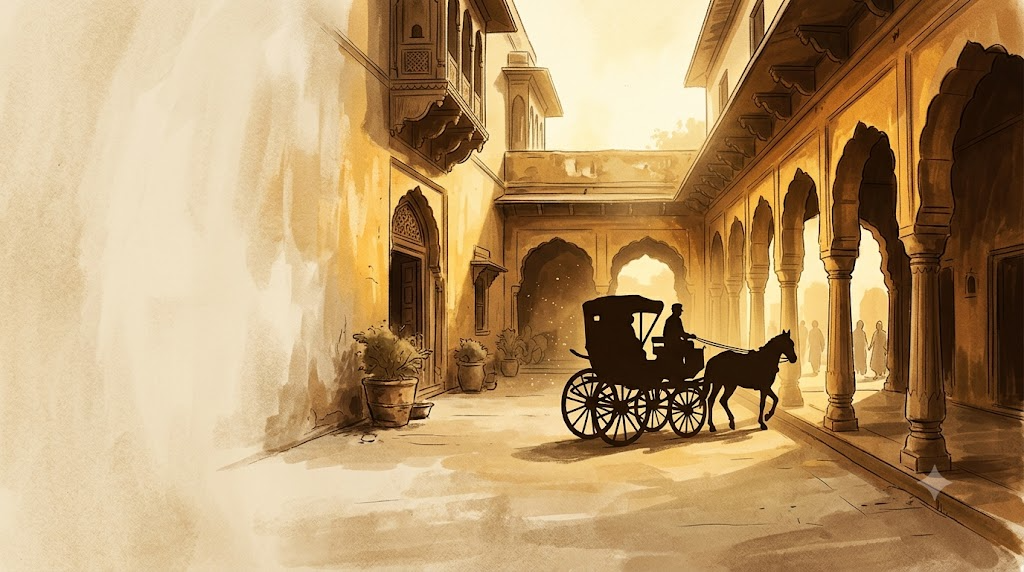
The charioteer stood in readiness, having patiently harnessed his horses. The princesses climbed comfortably into the radham; the driver took his place at the front. With a gentle flick of the reins, the equipage sped away down the dusty road, heading towards the cool, flowing waters of the river Arisilaaru.
Vandhiyathevan stood quietly in the street, watching the chariot until it vanished completely into the hazy distance.
© 2026 Matribhasa Classics. Public Domain


Comments (0)
Log in to join the conversation.