Arulmozhi Varmar

Around nine hundred and eighty years ago, the warm, sun-drenched plains of the south flourished under the inimitable rule of Emperor Rajakesari Varmar, Sundara Chozhar. It had been roughly twelve years since he first ascended the throne when our story opens. Over the preceding century, the Chozha Empire had grown beautifully, putting out new branches with every passing generation. And yet, affairs were in a rather turbulent state when Sundara Chozhar came to power; rival kings and old foes were gathering strength to both the north and the south of the empire.
Sundara Chozhar’s predecessor, Kandaradhithar, had been a deeply pious man. He had pledged his heart and soul to Siva Peruman, losing himself entirely in the sweet devotion of temple bells and chanted hymns. Such was his piety that he had earned the respectful, affectionate title Siva Gnana Kandaradhithar. But deep devotion, lovely as it is, often means that the dusty, practical matters of the world are left behind. The Empire’s administration naturally suffered, for the king had very little time to spare for affairs of state, nor did he bend his mind or his energies towards expanding his dominions. Arinjayar, who succeeded his pious brother to the throne, stayed upon it for merely a year before breathing his last in the town of Atrur, in Thondai Mandalam. This earned him a rather unique and melancholic sobriquet—Atruril Thunjiya Thevar, the Lord Who Slept in Atrur—which meant that his son, Paranthaka Sundara Chozhar, became his heir and successor.
The young ruler seemed to possess every fine characteristic that defined a great Emperor, destined to raise his people and his lands to marvellous heights. Naturally inclined towards the life of a soldier and highly proficient in martial strategy, one of the first things he did upon ascending the throne was to march to war in the south. The Chozha and Pandiya forces clashed in a terrible, dust-choked battle at Sevur. Despite the assistance of the Ilankai King Mahindan’s army, which had journeyed all the way across the sea to help them, Veera Pandiyan’s hordes suffered a crushing defeat at the hands of the far greater Chozha forces. Lost, stripped of his crown, his kingdom, and his cohorts, Veera Pandiyan managed to escape with nothing but his life. He hid himself away in a dark, rocky cave in the arid lands, nursing his wounds in bitter humiliation.
The forces from Eezham suffered heavy casualties as well. The few soldiers who managed to survive decided that military glory was far too large a price to pay for their lives, and took to their heels, sailing straight back home.
Now, such had been the situation for quite a while: it had become an acknowledged, irritating habit for the kings of Eezham to aid the Pandiyas whenever the latter picked a fight with the Chozhas. Sundara Chozhar, understandably enough, wanted to put a firm stop to this. He decided that the Sinhala kings needed to be taught a sharp lesson, and so he sent a large force across the water to deliver it, placing it under the command of Paranthaka Velaan the Younger, of the noble Kodumbalur dynasty. Their intentions may have been bold and exceptional, but the army stumbled badly when it came to strategy and execution. Despite their vast numbers, the Chozha forces did not arrive on the island shores all at once; a lack of sturdy ships forced them to stagger their crossing. The first group, rather than waiting quietly in the coastal groves for the rest of their brothers to arrive and regroup, made the rash decision to advance alone.
They paid for their lack of forethought dearly. The Sinhala forces, led by King Mahindan’s trusted Commander Sena, surrounded them in the tropical forests. A bloody battle broke out and raged furiously—and it was here, in a foreign land, that Paranthaka Velaan the Younger lost his life. He carved a name for himself in the history and the stone inscriptions of the Tamil lands forevermore, remembered by a brave and sorrowful title: Eezhathu Patta Paranthakan Siriya Velaan, or Paranthaka Velaan the Younger, Who Embraced Death at Eezham.
No sooner did Veera Pandiyan, still hiding in his mountain cave, hear this news than he crawled out to gather his scattered forces, his heart renewed with a fresh burst of courage and hope. But he was destined to taste a defeat far more bitter than the last. Not only was his army utterly routed, but he himself lost his life. This was the very battle that saw the sudden, brilliant emergence of Sundara Chozhar’s eldest son, Aditha Karikalar, as a decisive warrior. The Crown Prince took charge, decimated the enemy ranks, and performed a great many valiant deeds on the battlefield, earning himself the prestigious title of Veera Pandiyan Thalaikonda Kopparakesari—the Kopparakesari Who Beheaded Veera Pandiyan.
They might have proven their point quite thoroughly with the Pandiya forces, but the urge to teach the Sinhala king Mahindan a proper lesson still burned fiercely. It burned not just in Sundara Chozhar’s heart, but in the hearts of his commanders, his aides, and right down to the last, raw foot-soldier. Accordingly, a massive army was assembled once again. But this time, a rather tricky question cropped up: who would lead them?
Sundara Chozhar’s firstborn, Crown Prince Aditha Karikalar, was stationed with his forces far away at the northern frontiers. Lately, the Rashtrakuta forces had been usurping power and causing trouble in Thirumunaippaadi and Thondai Mandalam; the Prince had taken them to task severely, driving them out of the territory. His mission complete, he had made Kanchi his headquarters and was deeply immersed in preparations for further campaigns in the north. This being the case, a wonderful chance had opened up for others to prove their mettle.
The seasoned commanders of the Chozha forces began to compete among themselves in earnest for the great honour of leading the army across the sea. Much jealousy was roused in the camps; there were many quiet incidents of back-stabbing and bitter resentment. In those hoary, spirited days, it was far more common for warriors to fight each other for the privilege of going to the battlefield than for the right to stay safely at home. Quarrels and disputes often rose like sudden summer storms when it came to expressing valour.
One young man, however, stepped forward to hush the bickering and put an end to the altercations: Sundara Chozhar’s younger son, Prince Arulmozhi Varmar.
“Appa,” he addressed his father gently. “I’ve spent quite enough time being coddled by my aunts and grandmothers at Pazhaiyarai. Kindly appoint me the Commander of the Southern Chozha Forces. Allow me to leave for Ilankai—and I promise, I shall lead our men to victory!”
Barely nineteen years old at the time, he was the cherished youngest child of the Emperor, absolutely adored by the many queens and royal ladies of the Pazhaiyarai palaces—and indeed, he was the much-beloved son of the entire Chozha Nadu.
Emperor Sundara Chozhar was, by all accounts, a remarkably handsome man. His own father, Arinjayar, had been entirely infatuated with the luminous beauty of Kalyani, a princess of the Vaithumbarayar clan—who happened to be the legendary foes of the Chozha dynasty. Arinjayar had married her forthwith, and their son had been formally named Paranthakar. The ordinary people of the Chozha lands, however, who were completely dazzled by the boy’s chiselled features and bright good looks, promptly renamed him Sundarar—The Beauteous One. The name found great favour, and stuck to him for the rest of his life.
It was only natural that all of Sundarar’s offspring be famed for their striking appearances, but the youngest, Arulmozhi Varmar, easily outshone them all. His features possessed a quiet, glowing beauty that seemed not merely human, but almost divine in its perfection. As an infant, he was coddled and petted endlessly by the women of the royal household. So many sweet kisses were showered upon his chubby little cheeks that they were almost blistered red. But the one person who cherished him the most, perhaps, was his elder sister, Kundhavai.
She may have been only a couple of years older than him, but somehow, the firm idea that she was personally responsible for her younger brother’s well-being had lodged itself deep in young Kundhavai’s consciousness. Even more astonishing was the fact that Arulmozhi Varmar cherished an equal, if not greater, regard and affection for his sister. He would not entertain a single thought or utter a word that might displease her. Kundhavai’s slightest wish was his absolute command; her every word carried an almost divine authority in his ears. Not even the combined forces of the holy trinity—Brahma, Vishnu, and Siva—could have served to turn him against her, or made him ignore her instructions. The very thought was entirely repugnant to him.
She, for her part, spent many naazhigais watching him keenly—not just when he was awake and playing, but as he slept quietly in the afternoons. He possesses divine gifts, this boy—a strange power, a lovely magnetism, she would muse often, as her dark eyes scrutinised his chiselled face. It is my solemn duty to ensure that his true potential is nurtured to fruition!
She would often turn his small palms upwards as he slept, gazing intently at the delicate lines that crisscrossed the skin. In her vivid, loving imagination, those lines perfectly resembled the divine conch and the fiery discus, the sacred symbols of the supreme Lord Thirumaal himself. Ah, this young man was obviously meant to bring the whole wide world under his benign and gentle rule!
But then, looking at the practical state of affairs, there seemed to be no real indication whatsoever that he would ever ascend the Chozha throne. There were already two strong contenders for the Empire who were senior to him. Where, then, was the question of Arulmozhi ever becoming a ruler? Which throne would he ever grace?
On the other hand, humans are rarely capable of understanding the will of the Almighty, or His grand, hidden plans. The world was wonderfully huge; thousands of rajyams and mighty empires dotted its vast surface. There were wondrous, fireside tales of brave heroes travelling from one kingdom to another, winning each and ascending alien thrones with nothing but incredible courage and an indomitable will, weren’t there? Hadn’t a young prince from the distant country of Vanga, practically thrown out from his own fertile, Ganga-enriched plains, made his daring escape on a boat, reached the shores of Ilankai, and managed to rule that island-country wisely and well? Hadn’t his descendants, the proud Sinhala royal family, carried his name for a thousand years?
Thus, Princess Kundhavai Piratti spent her sunny days foreseeing and planning endlessly for her young sibling’s future. Eventually, when the heated discussions about commanding the forces to Eezham began echoing through the halls, she decided that Arulmozhi was by far the best contender for the position.
“Thambi,” she said softly to him one evening, calling him little brother. “It hurts me greatly to be parted from you, but I am afraid I must be the one to send you away. You must go to Ilankai—you will be the Commander of the Southern Chozha forces!”
The Prince submitted to this dictum with wonderful enthusiasm. Hitherto, he had been stifled, trapped among the overpowering, sweet affection of the royal mothers. When, oh when, would he ever be rid of their smothering silken ties? And now, his very own sister had given him explicit permission to leave—what more did he need? There would be no obstacles to his going, either. Was there a single soul in the entire Chozha Empire who would dare gainsay her? Did she not reign supreme in Emperor Sundara Chozhar’s heart? And did the Emperor not think the absolute world of his daughter’s good sense?
In due course, Prince Arulmozhi Varmar was officially appointed the Thenthisai Maathanda Naayakar, the Commander of the Southern Chozha forces. He left for Ilankai, and did head the armed forces there for an appreciable bit of time. The war, however, was not quite finished with him, and there seemed to be a great deal of difference between his approach to the battlefield and the approach of older, harder men. There were a good many supplies and implements he had considerable difficulty procuring in that war-torn land. He desperately needed these provisions from his home country, for which he duly made a quiet visit back across the water, petitioning his father the Emperor.
Having successfully made all the arrangements to suit his purpose, he soon prepared to set off for Ilankai once again. Princess Kundhavai made absolutely sure that her brother departed Pazhaiyarai in grand pomp and splendour. She had organised quite a few lovely events in the principal palace for his edification.
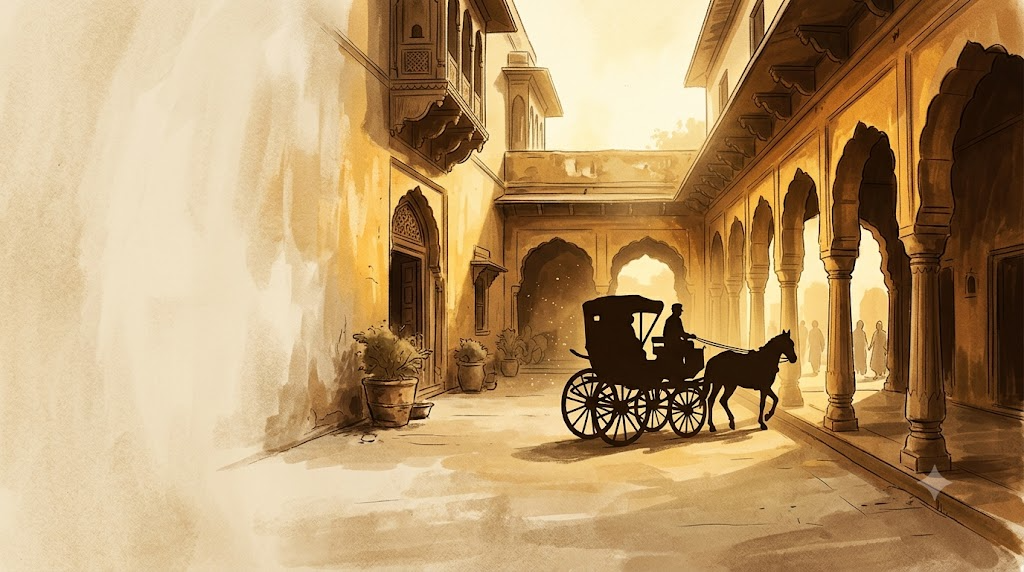
When Arulmozhi finally stepped out into the royal courtyard, white conches blew deafeningly into the warm air. The large murasu drums thundered victoriously, accompanied by the rapid, joyful beats of the smaller siruparai drums, while loud chants of triumph seemed to cleave the very skies. Every one of the royal mothers blessed their favourite son, fondly smearing sacred ash upon his forehead. They fussed over him, muttering old prayers and performing little rituals to ward off the dhrishti (the evil eye)—circling his handsome face with lit camphor, and cracking their knuckles gently against their own temples—before finally giving him leave to return to battle.
At the palace’s grand main entrance, just as Prince Arulmozhi Varmar prepared to step from the cool shade of the complex out towards the sunlit street, stood Kundhavai Devi’s handmaidens. Each girl held a heavy golden plate in her hands, and on each plate, a small oil lamp burned bright and steady. These were no ordinary young women, either. Each was a treasured daughter of some of the land’s most prominent royal families; each considered it the absolute epitome of good fortune to serve at the feet of the elder queen Periya Piratti Sembiyan Madevi, and to be counted as the friend and confidante of Kundhavai Piratti.
One among them was the lovely, timid Kodumbalur princess, Vaanathi, the daughter of the late Paranthaka Velaan the Younger.
As the prince neared them, the young ladies felt their hearts flutter like caged birds in excitement and delight. They raised their golden plates together and began to gracefully perform the aarathi, welcoming and blessing him with the sacred light.
Abruptly, for some inexplicable reason, Vaanathi’s slender frame began to shake and shiver.
Clang! The heavy golden plate slipped from her nerveless fingers and crashed onto the stone floor in a startling explosion of sound.
Ah, how terribly inauspicious! was the dreadful thought that flitted instantly through the minds of everyone gathered there. And yet, despite the plate having tumbled down in such a violent fashion, the little wick continued to burn brightly and steadily on the stones.
An almost audible sigh of relief swept in a warm gust through the gathering. This, pronounced many of the wise elders present, was an excellent omen indeed.
A gentle, amused smile blossomed on the face of Prince Arulmozhi Varmar as he looked at the terrified young woman who had let slip her plate in such a clumsy fashion. He moved smoothly past her, and the very next instant, Vaanathi—who was obviously entirely overwhelmed with embarrassment at her little disaster—crumpled to the ground in a dead faint.
The rest of the women, swiftly following Kundhavai’s concerned command, gathered the poor girl up, carried her into a quiet room, and laid her gently upon a raised wooden platform. Ilaiya Piratti Kundhavai herself stayed by Vaanathi’s side, trying her best to bring the girl around, rubbing her wrists and patting her cheeks. So utterly absorbed was the princess in this tender task that she did not even go out to watch her brother finally take his leave.
Arulmozhi Varmar, who had caught sight of Vaanathi fainting at the doorstep, paused by the courtyard gates before climbing onto his horse. He sent a messenger quickly back to his sister: “What ails the young woman who fainted just now? Is she feeling any better?”
“Ask the Prince to step in here for just a moment,” was Princess Kundhavai’s rather terse reply.
Accustomed to obeying her every command without question, Arulmozhi Varmar returned to the palace corridors at once. He walked softly into the dim room where Vaanathi was laid out, and saw his sister trying desperately to bring the pale young woman around as she lay resting against Kundhavai’s own shoulder. The sight was quite enough to melt his kind heart.
“Who is this young woman, Akka?” asked the Prince quietly. “What’s her name?”
“Vaanathi. She is the daughter of Kodumbalur Paranthaka Velaan the Younger,” answered Kundhavai, her mind still somewhat abstracted by worry. “She frightens so easily.”
“Ah, now I understand the sad reason for her weakness. Wasn’t her father the brave warrior who led our Chozha forces to Ilankai and embraced death in battle? Perhaps the memories of his departure were altogether too much for her to bear.”
“Perhaps. But I shall take good care of her, never fear. May you be victorious in the war, Thambi! Return to us safely, and keep me apprised of everything through your messengers,” advised Kundhavai.
“As you wish,” acknowledged the Prince with a warm smile. “Please do the same for me as well.”
Perhaps it was the magical effect of his deep, melodious voice drifting through the room, but Vaanathi began to slowly regain her consciousness. Her dark eyelids fluttered like butterfly wings. The very first sight that met her opening eyes was the Prince standing gently before her, which made them widen considerably. Her lovely face bloomed with unexpected, innocent delight. Lips as red as polished coral parted just a little, and a shy, beautiful smile appeared, dimpling her cheeks.
But with returning consciousness came sudden, sharp awareness. She tried to rise, suddenly terribly bashful, realising to her horror that she had been lying heavily against Princess Kundhavai all this while. Embarrassment washed over her in a hot wave as the memory of the clattering golden plate and the gathered crowd rushed back in an instant.
“Akka, what have I done?” she whispered, her large eyes quickly brimming with tears.
The Prince stepped in before Kundhavai could say a word. “There is absolutely no need to fret, Vaanathi,” he said softly. “These things happen to the best of us. And you, in particular, have more reason than anyone to feel overwhelmed. In fact, I was just saying as much to Ilaiya Piratti.”
Vaanathi could barely believe her ears. Was it really the great Prince himself consoling her in this wonderful manner? He was widely reputed to be a young man who never cast his gaze upon women. To those unfamiliar with the noble codes of the time, this might seem a little baffling, but it simply meant that he never looked upon any woman as an object of desire. Unfamiliar women were granted the gentle courtesy of lowered eyes—a mark of profound respect and graciousness, inspired no doubt by his deep reverence for his sister. Was it really him, soothing her with such sweet, kind words? Ah, how could she possibly bear such tremendous good fortune? What on earth had she done to deserve this?
Why, her skin was breaking out in happy goosebumps. Her head began to spin wondrously—she felt quite certain she was about to faint all over again.
“Akka, my men await me outside,” the Prince spoke once more, turning to the door. “When next you send a missive, kindly inform me about this young woman’s health as well. Do take care of her—she has no one else in the world, you see.”
And with those words, he was gone, off to the sea and the wars.
The rest of Princess Kundhavai’s handmaidens had, of course, observed this entire, quiet exchange with extraordinarily keen interest, watching like little hawks from various balconies and through the carved wooden windows that liberally dotted the old palace walls. A tiny, hot spark of jealousy was instantly kindled in their hearts—a spark which very swiftly burst into a roaring, unmanageable flame.
For, ever since that fateful afternoon, Kundhavai made Vaanathi her most especial friend, and began to take a remarkably keen interest in the young Kodumbalur lady. The two became virtually inseparable; Kundhavai showered Vaanathi with sisterly affection. Fine arts, lovely music, delicate skills—she taught the younger girl everything she knew, and they were rarely seen apart.
Kundhavai often took her young friend out to stroll in the shaded royal gardens, where she spoke at great length about her brother’s fortunes, her own secret dreams, and the impossibly grand future she had imagined for him. To all of these stories, Vaanathi listened with rapt, gratifying, and absolute attention.
The poor Kodumbalur maiden actually fainted four or five times more after that initial incident. Kundhavai attended to her personally always, patiently bringing her back to the waking world. The younger girl would come to, sobbing as if her gentle heart would break, each and every time.
“Silly girl!” Kundhavai would remonstrate lightly, smoothing the girl’s hair and consoling her as best as she could. “Come, now. Dry your tears, do. Why on earth do you weep this way?”
“I—I don’t know, Akka,” Vaanathi would sob all the harder. “Forgive me, please!”
And Kundhavai would embrace her warmly, soothing her with soft words of reassurance and comfort as the afternoon shadows grew long.
All of this, naturally enough, only served to fan the flames of jealousy even higher in the hearts of the other handmaidens. Considering everything that had occurred in the palace so far, wasn’t it only human that they behave the way they did, once Kundhavai and Vaanathi finally set out together for the town of Kudandhai?
© 2026 Matribhasa Classics. Public Domain


Comments (0)
Log in to join the conversation.