Deadlier than venom, is she!

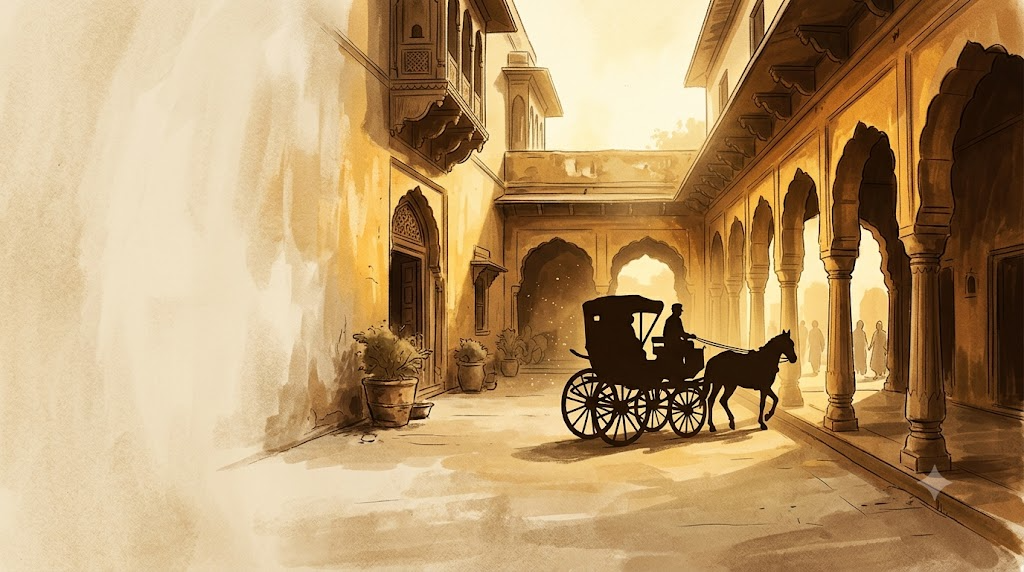
The three warriors spent the night in a sprawling, weathered stone edifice, a rambling old structure that had once belonged to the Pallava emperors of a bygone age. Once the last simple meal of the evening had been eaten and the leaf-plates cleared away, the old chieftain Malayaman took his leave. He was eager to wander out into the town and attend a performance of the Aravaan tale—the grand epic of a warrior’s sacrifice—held down by the Aindhu Radhams.
Left to their own devices, Aditha Karikalar and his friend Parthibendran climbed the worn steps to one of the upper balconies. Beneath them lay the night-time vista of Maamallapuram, quietly going to sleep. The Crown Prince stood at the stone parapet, looking down for a long time from his high vantage point. Small oil lamps flickered feebly here and there, making brave but vain attempts to push back the deepening darkness. The sandy streets were mostly empty now. The ardhajaamapoojai (the final, quiet prayer service of the night) was well and truly over, and somewhere in the shadows, the massive wooden doors of the temple groaned slowly shut. From far off came the dull, rhythmic roar of the sea, bringing with it a sense of desolation and a rather heavy loneliness.
In the distance, out by the Five Chariots, a cluster of people had gathered around the villuppattu artist (a traditional singer who struck a long, resounding bow as he wove his story). He was singing the legend of the valorous Aravaan, his voice carrying on the cool sea breeze. Beyond the ring of smoky oil-torches, the listeners cast dark, misshapen shadows on the sand.
“Old as the hills, he is, and yet he’s gone out in the dark just to listen to ancient tales and songs!” exclaimed Aditha Karikalar, a faint smile touching his lips. “Men like Malayaman are hard to find these days, aren’t they? He may be getting on in years, but for sheer determination and iron grit, there are very few who can match the ancients.”
“Good lord, Your Highness, not you too. Pray don’t start waxing lyrical on the glory of the past,” groaned Parthibendran, leaning back against the cool stone. “What did they accomplish, after all, that we haven’t managed ourselves? And if it comes down to it, I certainly haven’t heard of any warrior, past or present, who went into battle and performed the sorts of illustrious, breathtaking deeds that you yourself have.”
“It augurs rather well for you, my dear Parthiba, that I know you to be an honest man. Your lips, thankfully, do not speak the direct opposite of what your heart harbours. Were it otherwise, I should have been forced to consider you my very greatest enemy,” Aditha Karikalar smiled, turning away from the sea. “These extraordinary praises of yours; the way you so readily pander to my ego! There is really nothing more powerful when it comes to utterly destroying a man, my friend. There is nothing else that would so thoroughly assure his swift and inglorious descent into Pathalam (the goriest, darkest of the netherworlds)!”
“Indeed, Ayya, if one were to praise and please a man with completely spurious motives; to raise him to the skies without any just cause—ah, that, then, would be false and pretentious. If you were to approach Madhuranthakar, for instance, who is nothing but a shameless slave to the Pazhuvettarayars, and tell him that he was a ‘Warrior Among Warriors,’ that would undoubtedly be mukasthuthi. And if you ever genuinely believed me to be guilty of such a terrible crime, pray do not hesitate to cut me down where I stand with your own sword. Tell me, was any of what I said about you an exaggeration? Was it a blatant untruth? Who among those much-lauded ancients, after all, has ever come close to matching your own martial accomplishments? One could, perhaps, consider your great-grandfather, the brave Rajadithyar, who embraced death whilst seated atop a war elephant, as coming somewhat close to you with respect to sheer valour; but even so, he couldn’t possibly have been greater…”
“Enough, Parthiba, for God’s sake, enough!” cried Aditha Karikalar, holding up a hand. “Comparing me with the great Rajadithyar—how could you even think of such a thing? You and I, my friend, aren’t even worthy to speak the name of a man who destroyed the massive Rashtrakuta hordes—a scourge upon millions, a terrible, crashing ocean spewing evil in its wake—with nothing but a minuscule army! And who ascended straight to the heaven of warriors, right there on the blood-soaked battlefield. To pit ourselves against him? Do we even dare harbour such thoughts? Ignore the Chozhas for a moment, if you will, and let us speak instead of your own ancestors, the Pallavas. Think of the absolute legends they sired. Are we ever to see the likes of King Mahendra Varmar and the great Maamallar again? To think of Narasimha Varmar, who single-handedly crushed the mighty Pulikesi—a man who ruled a vast empire stretching from the river Narmadha in the north all the way to the Thungabhadhra in the south—and even marched in to erect a column of victory right in the enemy capital of Vathapi! And you wish to mention us in the same breath as him? Do you really think anyone in our lifetime, or even in the centuries after us, could ever bring into existence a stone fantasyland such as this Maamallapuram? Adada, just look around you once, Parthiba. Cast a glance at the flickering torches of the villuppattu recital over there in the distance. The men who could turn ordinary, unyielding boulders into such breathtakingly beautiful works of art; who could carve whole rocks into magnificent chariots; who could accomplish such great, enduring feats—just imagine, if you will, what a wondrous, joyous place Maamallapuram must have been, some three hundred and fifty years ago. How vibrantly alive! My skin prickles with goosebumps at the very thought of it. Don’t you feel it too in the night air? Doesn’t your heart soar, don’t your shoulders swell with quiet pride at the mere thought of your magnificent ancestors?”
“Only some moments ago, you were accusing me of mukasthuthi, your highness,” replied Parthibendran dryly. “It has slipped your mind, perhaps, that I have always been careful to leaven my praises with a healthy, sobering dose of criticism as well. It appears to me that this terrible, consuming passion for arts, crafts, and sculpture—a passion that tends to destroy sensible people and swallow their whole lives—has somehow infected you, too. My ancestors were quite afflicted by it, and thus, all their hard-won victories and triumphs rather lost their merit. Yes, Maamallar did erect a jayasthambam (a grand stone pillar of victory) at Vathapi as a sign of his momentous triumph; that much is true. But what of him, later? What did the great warrior do with his time? He sat around sculpting rocks and drilling holes in the granite boulders strewn about him, of course! And we all know perfectly well what happened as a result. The Chalukyas gained in strength, built themselves a new empire, gathered their massive forces, and swept down south, thirsting for revenge. The great cities of Kanchi and Uraiyur were reduced to smouldering ashes; the invaders descended even as far south as Madurai. Had the brave Nedumara Pandiyan not decided to make a stand and destroy them in the battle of Nelveli, all these southern lands would still be groaning under Chalukya suzerainty by now, wouldn’t they?”
“Not at all, Parthiba,” said Aditha Karikalar gently. “Remember your history, my friend. Have we ever, anywhere in the world, heard of any one dynasty ruling endlessly, completely beyond all bounds of time? Never! Even the illustrious Ishvaku clan, which once boasted the great Lord Rama himself, eventually died out. The Rettaimandalathar kings simply rose up to bring the Chalukya reign to its inevitable end. Empires and dynasties do have a habit of rising to tremendous, dizzying greatness, only to eventually crash back down to the hollowest depths. It is entirely natural, like the changing of the seasons, don’t you think? There are kingdoms that have ruled securely for centuries, and then vanished into the dust, disappearing without a single trace. Take my own forebears, such as the great Karikal Valavan and Killi Valavan, for instance. They ruled illustriously in their time—but what do we really know of them today, after all? Only their names, and a little fragment of what they accomplished; largely because a few wandering poets managed to sing verses upon them. And as for those verses—who really knows if they were the complete, undiluted truth, or just outrageous, colourful lies spewed for the edification of the public, composed after a few enjoyable rounds of country liquor? But the fabulous, silent sculptures carved out of the living rock by Mahendra Pallavar and Maamallar—now these will stand the test of time for thousands of years, patiently extolling their greatness to the whole world. What have you and I done, I ask you, to even remotely be compared to them? To be sure, we have slaughtered tens of thousands of men; we have made quite sure that battlefields were entirely submerged under sticky rivers of blood. But what else have we done? What else, to ensure that our names might stay on in the quiet pages of history?”
Parthibendran sat very still in the sea-breeze for a while, quite dumbstruck. Was this really the fierce tiger Aditha Karikalar speaking? Then, he heaved a long sigh. “If these are truly your opinions, your highness, about wars and great heroes… then, well, what can I possibly say? You are distressed today. Your mind is not at peace, like a lake troubled by a hidden wind. Perhaps that is the reason for all this sudden disillusionment. Couldn’t you possibly open your heart to me, Ayya?” He pressed on, leaning forward eagerly. “Couldn’t you possibly let me know the dark secret that is locked away inside that iron heart of yours?”
“And if I did, Parthiba,” the prince murmured, his eyes fixed on the distant shadows. “If I really did break open my heart to you… what, or who, do you think you would find sitting in it?”
“That is exactly what I wish to find out, Swami.”
“You would not find my parents there, Parthiba. Not my beloved brother Arulmozhi Varmar or my dear sister Kundhavai, though they are dearer to me than my own life. Not even you and Vandhiyathevan, the very best of my friends. No, my friend—you would find a woman. The very embodiment of evil itself. That wretched, accursed Ilaiya Rani of Pazhuvoor—that is whom you shall find curled up inside. Ah, the terrible trials and tribulations she has put me through! The pure torment I have been meted out by Nandhini, cruel, cruel Nandhini, who is far more venomous than the deadliest poison!” Aditha Karikalar’s voice reverberated in the quiet night with a barely controlled fury; each word seemed to burn upon the air like hot, glowing coals. “She is the one living within my heart, breaking it to pieces with every passing moment. And I have never, until now, breathed a single word of what I have undergone, all this long time, to a living soul. No one, except you.”
“I had rather guessed this might be the case, Ayya,” said Parthibendran softly. “Whenever the younger queen of Pazhuvoor was mentioned in passing, I noticed your face darken like a storm cloud. Your eyes would turn quite bloodshot, and as for the sheer agony I glimpsed in them… well, it was hard to miss. But do tell me, how did such a fatal, consuming attraction ever find a place in your heart? You, the proud scion of a dynasty that reveres every woman as though she were his own mother? Periya Pazhuvettarayar, too, has very close ties with your royal family, and his house has done so for many generations; he is getting on in years as well. They might be our bitter foes today, but surely that wasn’t always the case? Your father and your grandfather held the old man in the highest regard, I know that for a fact. And to even think of the young woman he married, with the sacred fire of Agni Bhagavan as his holy witness—no matter how abandoned or wicked she might be… is that really the right thing for you to do?”
“It isn’t, Parthiba, it isn’t!” cried Aditha Karikalar, his voice heavy with despair. “Do you really think I don’t know that? I suffer so terribly precisely because I do know it. You see, it isn’t quite as it seems. She didn’t make a place for herself in my heart after her marriage to the old Pazhuvettarayar, but long, long before. My poor heart was completely poisoned by her bewitching ways aeons ago, when we were but children. I tried—believe me, Parthiba, I tried with all my might to weed out her memories like troublesome thorns—but I simply couldn’t. I know I speak right now as though she is the only one to blame in all this. But the truth is… well, no one really knows the whole truth except God above. If anything, He is the one who ought to be blamed for every ill that befalls us. Or, perhaps, it is just blind fate itself, that capricious wind, that made us meet in the first place, only to part us later in such a cruel, unforgiving fashion!”
“You met her before she became the young queen of Pazhuvoor, your highness?” asked Parthibendran, his eyes widening in surprise. “But—how? When, and where on earth did this happen?”
“Ah, that is a very long story, my friend. Are you quite sure you want to listen to it all today, with the hour being so late?”
“Indeed I do. In fact, I don’t think I shall find any peace tonight until I know the whole truth of it. You have asked me to set sail for Ilankai tomorrow, haven’t you? I am not entirely sure I can carry out my duties there well, without first listening to your story, and trying to find some small way to soothe your troubled heart.”
“Soothe my heart, is it?” Aditha Karikalar gave a short, bitter laugh. “My dear friend, there is no semblance of peace left for me—not in this lifetime, at any rate. I’m not even sure if I shall find it in my next. But you clearly wish to hear this, and so I shall oblige. I don’t want you to leave for Ilankai carrying the heavy thought that I harbour some dark secret that I cannot even bring myself to trust you with!”
Aditha Karikalar paused for a long while, looking out once more over the sleeping, shadow-draped town and the restless sea beyond. Then, heaving a great, weary sigh, he began his tale.
© 2026 Matribhasa Classics. Public Domain


Comments (0)
Log in to join the conversation.