Eesana Siva Battar

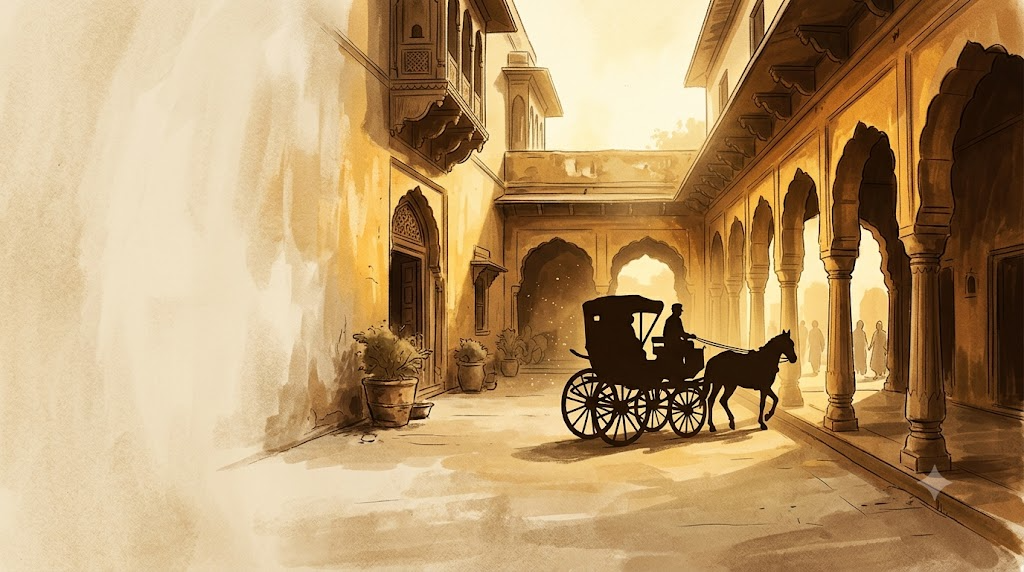
His audience with Princess Kundhavai having come to a quiet close, Azhwarkkadiyaan made his way from her royal residence towards the home of his elder brother, Eesana Siva Battar. The house sat in the peaceful vicinity of the Vada Metrali Siva Temple, roughly half a kaadham away. It said a good deal for the splendour of Pazhaiyarai that its sheer scale and magnificence could be felt simply by walking from the palaces to the temple. The Krishna Jayanthi celebrations had almost run their course, Azhwarkkadiyaan noticed, leaving behind that faintly tired but happy air that always follows a great festival.
But the sights he witnessed as he strolled past the homes in the residential quarters were rather more unexpected. Women had gathered in little knots out in the open, embroiled in furious, animated discussion. Each of them had garlanded a much-beloved son or husband with bright vanji flowers, wishing them a safe and triumphant return from the battlefields of Ilankai. Almost every family in these streets claimed at least one brave casualty in the endless wars waged by the Chozhas in all four directions. Now, a heavy gloom had shrouded these households. The women murmured and muttered their woes, their voices thick with dissatisfaction. How was all this going to end? Thirumalaiyappan walked on, a frown of genuine concern creasing his forehead.
The soft evening darkness had fallen by the time he reached the temple. This was, indeed, the celebrated shrine that the great saint Appar had glorified in his devotional songs. In Appar’s day, it had been surrounded by man-made hills riddled with caves and catacombs, hollowed out with painstaking care for the austere Thigambara (sky-clad) Jain monks who retreated there to conduct their penances. Even today, there is a quiet village in Pazhaiyarai’s vicinity called Muzhaiyur—the village of caves—serving as a reminder of those times.
When Appar had first arrived in the city, drawn by tales of Pazhaiyarai’s spiritual grace, those muzhais (or stone caves) had risen so high that they completely concealed the Vada Metrali Temple within. It was a sight that deeply dismayed the saint, whose superior spiritual vision had already divined the existence of the ancient shrine. He made an earnest plea to the Pallava chieftain who ruled the city at the time, and the ruler took swift action, tearing down a few of the concealing caves to reveal the beautiful shrine to the public once more. Overcome with ecstasy, Appar had broken into a spontaneous song of praise for Siva Peruman. The Chozha kings who ascended the throne in later years took great pains to renovate the simple structure, rebuilding it in sturdy stone and adding to its magnificence. Yet, the old Jain caves remained, standing thick and tall around the temple like a protective madhil. Contrary to the usual custom of providing four entrances to a temple, this one boasted only a single doorway, set beneath its towering gopuram.
The easiest route to Eesana Siva Battar’s home was through this main entrance and straight across the temple precincts; the alternative was a circuitous walk that consumed a good deal of time. And so Azhwarkkadiyaan stepped into the temple on his way home. He caught sight of a few devotees gathered near the inner sanctum—and, much to his surprise, they appeared to be members of the theatre troupe from earlier that day, still colourfully costumed as Krishna and Balaraman.
Ha, Azhwarkkadiyaan thought to himself. Now, how did these people end up here, of all places?
He had barely formulated the thought when Eesana Siva Battar hastened out of the sanctum. Before Thirumalai could even fully cross the threshold, his brother grabbed him by the hands and practically dragged him back outside.
“Why, Anna, what’s this?”
“You wish to know, do you? I shall tell you, Thirumalai, and in such clear terms that they will permeate even your very thick skull. I have decided, henceforth, that our relationship is confined strictly to the exterior of this temple. You, my fellow, are a blaspheming, Godless heathen—you who hate Siva Peruman with all your soul and do not hesitate to display your deplorable feelings for all to see! Your endless Siva nindhanai (insults against the Lord) means that you do not deserve to set a single foot within a Sivan temple. I have been patient far too long, Thirumalai, but I cannot bear it any more—not after your despicable speech in the great Queen’s presence! You are welcome to haunt my home and fill your disgustingly large stomach if you wish, but not a foot will you set inside this sacred temple. Disobey—and I shall transform into the wrathful Sandeswara Naayanar himself!”
“But, Anna—Anna!”
Eesana Siva Battar caught his beloved brother by the scruff of his neck and practically towed him out, his face a portrait of towering rage. None of Thirumalai’s pleas seemed to move him, and before his distraught younger brother could offer another word of protest, the Battar had stalked back inside and banged the huge doors shut, drawing the heavy bolt securely into place.
“So that’s how it is, is it?” Azhwarkkadiyaan muttered to himself, loitering in front of the temple for a little while. Then, he decided to circle the entire precinct, Jain caves and all, two or three times. He took great care to walk to the left instead of the right—to do it the other way around might have accidentally resulted in a proper pradhakshinam (a salutary, clockwise circumambulation) to the much-hated Sivan within, a prospect the fierce Vaishnavite could not countenance at any cost. This painstaking observation tour revealed something quite interesting: every single one of the man-made caves had been closed tight.
Later, he made his way to his brother’s home, where he was made heartily welcome by the good Battar’s wife, a kind woman who relished Thirumalai’s witticisms a great deal. Azhwarkkadiyaan did not disappoint her; that evening, he was at his sarcastic best, regaling her with thrilling accounts and gentle jokes, all while taking care to eat the Battar and his wife out of house and home. His gargantuan stomach finally filled, almost bursting at the seams with prasadham, Thirumalai let out a contented belch, waddled out to the thinnai, and sprawled upon it comfortably.
Somewhere between sleep and wakefulness, his mind drifted over the happenings of the previous day, and alighted upon one particular, puzzling event.
He had been ambling along the quiet banks of the river Kudamurutti when his ears were assaulted by the sudden thundering of horse-hooves on the opposite shore. Quick to think on his feet, Thirumalai had slunk behind a thicket of luxurious, feathery bamboo. A horse was careening along the riverbank, seemingly without direction. It looked drenched—whether from sweat or having swum across the river, Thirumalai could not guess. A young man, barely more than a boy, was bound to its back. He looked frankly terrified, yet beneath the fear lay a stubborn streak of determination. Four or five other horses galloped up close behind him, all bearing soldiers armed with sharp spears; they were closing the distance with every passing moment. One of the men rose slightly from his perch, his spear held aloft as if preparing to throw it, but his companion leaned over and stopped his arm.
Just then, the boy’s steed passed beneath a thick cluster of bamboo. One of the slender branches, already drooping low toward the ground, tangled violently in the youngster’s tresses. As the horse strained to push forward, the branch yanked mercilessly at the rider’s hair. Just as Thirumalai shuddered at the boy’s painful predicament, his pursuers galloped up and surrounded him. They took one look at his youthful, pale features, and appeared utterly overcome by surprise and dismay. Pelted with their sharp, angry questions, their quarry stammered and stuttered his replies, most of which were lost to the wind.
“Where’s he? Where?” the men repeated over and over.
The boy sobbed and heaved pitifully. “He’s gone—the waters took him—the floods swept him away!”
The men soon trussed the boy up, secured his horse, and marched them both away along the riverbank. None of this had made much sense to Azhwarkkadiyaan at the time—but lying there in the dark, the pieces began to shift, finally revealing some glimmer of their significance.
Into the midst of this memory intruded the vision of the Balaraman and Krishna theatre troupe he had stumbled upon that day. He recalled, in particular, the tall man donning the costume of Kamsan, his face veiled entirely by a painted wooden mask. Something about his body language and the cadence of his speech had seemed vaguely familiar. Now—ah, now, he could see the bright glimmerings of light regarding the true identity of the so-called actor.
The first thing Eesana Siva Battar saw when he returned home late that night, having completed the ardhajaamampoojai (the midnight ritual of worship) at the temple, was his erstwhile beloved younger brother sprawled snoring upon the thinnai.
“Thirumalai!” he called out, his voice practically ringing with fury in the quiet street. “Thirumalai!”
Azhwarkkadiyaan moved not a muscle, feigning the deep, untroubled sleep of an infant. The Battar gave him up as a lost cause, stalked into his home, and banged the heavy front door shut in a manner calculated to rouse the entire neighbourhood: Padaar!
His raised voice from within the house reached even Thirumalai on the porch. The Battar seemed to have launched into a heated verbal altercation with his wife—the subject of which, Thirumalai quite accurately guessed, was himself.
The next morning found Eesana Siva Battar accosting his errant brother once more.
“When will you begin gallivanting about the country again?”
“Once your anger has died down, Anna.”
“Do not call me that. You—I am no longer your elder brother, and you, certainly, have no claim upon me as my thambi. You blaspheming scoundrel! Neechan—sandaalan—you lowly wretch—!”
“Pray, why do you curse the poor man so?” the Battar’s wife hurried out, quick as ever to speak up for her brother-in-law. “What has he done now, that he has not done a hundred times before? It is you who have turned into a Sivan fanatic!”
“Quiet, woman! If you only knew what he spoke in the great Queen’s presence yesterday! ‘Why does this Paramasivan, a mad ascetic dancing among skulls and ash in a cemetery, need grand temples?’ he asks! Hearing of it was as though someone had poured boiling hot lead into my ears. And I hear Her Majesty did not sleep a wink last night, the poor, gentle lady!”
“Thirumalai will repeat no such thing in the future. Indeed, I shall make sure he learns from his mistakes. And why would he not, as long as we instruct him in the right way?”
“Right and wrong ways, my foot! What he must do right away is journey to Rameswaram and beg the pardon of the divine Siva Peruman, worshipped by Rama himself, to wash away his terrible sins. That, and only that, will be the means of his redemption. And until he does, I shall certainly never set eyes on this heinous creature’s face!” finished Eesana Siva Battar, in a truly magnificent display of temper.
Thirumalai’s lips twitched. He felt the overwhelming impulse to return every one of his brother’s colourful taunts with interest, but he knew now was not the time. Should he speak a single word out of turn, all his painstaking efforts would go to waste.
“Of course—why would he not?” butted in the Battar’s wife, once again playing the peacemaker. “He will be certain to obey any command of yours. Come to think of it, would it not be an excellent plan if we were to accompany him? We have been married so many years and do not have a child of our own—doubtless, we have committed some grave sin in a past life that must be remedied with proper worship. Thirumalai,” she said, turning her warm eyes to her brother-in-law, “why do we not all journey to Rameswaram together?”
Eesana Siva Battar glared at them both, and stalked away without a word.
Some time later, he confronted Thirumalai again—but this time, he appeared to be in a somewhat more tranquil frame of mind.
“Our elders always say Kobam, Paapam, Sandaalam—anger leads to nothing but destruction and sin. And I am afraid I have given way to my wrath,” he admitted softly. “You have not taken my hasty words to heart, I hope?”
“Not at all, Anna.”
“In that case, stay right here. I shall return once I have completed the midday worship. There are a few important matters I wish to discuss with you, and upon which I require your sharp opinion. You will stay here, won’t you?”
“I’ve no intention of leaving you—now, or ever, Anna.”
The Battar departed, looking quite satisfied.
“So that’s how it is to be, is it?” Azhwarkkadiyaan mumbled to himself a few times. And then, abruptly, he left the house.
He made his way around the Vada Metrali Temple and its surrounding caves twice or thrice, stepping lightly and making sure to conceal himself behind the stonework at the slightest hint of a sound. His patient wait was not in vain. Within a few moments, one of the heavy wooden gates leading to the Jain caves creaked open—and Eesana Siva Battar peered out. He stared keenly up and down the path before stepping out gingerly.
Someone else followed him out into the daylight. Ah, now who might this be? By the broad set of his shoulders and the way he moved, it certainly seemed to be the man who had earlier donned Kamsan’s costume. But who was he beneath the paint?
Ha, so this was the real reason for the Battar’s elaborate deception—all those loud taunts and convoluted temper tantrums performed for the benefit of anyone listening. Well, well, well!
The two men from the muzhai began to walk swiftly. Azhwarkkadiyaan was careful to keep his distance, staying well out of their line of sight as he dogged their steps. They walked for quite a while before reaching a quiet quay—one set upon the great artificial lake that edged the royal residences, its surface choppy with small waves that made it look almost like an ocean. This particular quay happened to be situated in the far west, a good distance from the bustle of the main palaces. The banks here boasted a luxurious growth of thick, old trees; Azhwarkkadiyaan slunk behind a wide trunk, peering out cautiously from between two low-hanging branches.
A small boat bobbed upon the choppy surface. It looked, upon closer inspection, like a royal craft. A lone boatman waited upon the grassy shore. The moment he spied the Battar and his tall companion, he dragged the boat closer to the edge, clearly having waited in readiness for them. The men promptly climbed in.
Once the little craft began to float away from the bank, the Battar’s companion turned his head to look back toward the shore. For an instant, his features were clearly visible in the sunlight—and Azhwarkkadiyaan recognised him at once. Not that the revelation came as any great surprise; he had already arrived at a fairly accurate conclusion as to the man’s identity. It was, in fact, none other than the valiant, talkative young man he had first met in Veera Narayanapuram, and later crossed paths with on the sandy banks of the river Kollidam! Azhwarkkadiyaan had no doubt, moreover, that the masked “Kamsan” had been this very same young warrior. All that remained now was to discern the purpose of this secret assignation—or rather, to confirm that his own shrewd guesses regarding their destination were entirely correct.
Among the many palatial residences that lined Pazhaiyarai’s royal avenue, rearing their proud roofs toward the sky, one in particular at the very end of the street lay silent and empty. Once the honourable seat of the Emperor Sundara Chozhar’s Chief Minister, Aniruddha Brahmaraayar, the sprawling palace was now under lock and key. The venerable minister was away on one of his many state visits to Madurai, the Pandiya capital, where he was busy providing much-needed restoration to the ruined royal administration. His family currently resided in Thanjavur, which meant that no one of consequence remained here in Pazhaiyarai.
It was to this quiet, deserted mansion that Azhwarkkadiyaan finally made his way. The guards stationed at the entrance bowed in deep deference at his arrival, opening the heavy doors wide at his command. Once within, he instructed them to close and lock the doors from the outside. Azhwarkkadiyaan quickly crossed all three kattus (the distinct, open courtyards of the traditional mansion) and stepped out into the overgrown gardens. He swiftly routed out a slender track that cut across the luxurious, untamed bushes and the many flowering creepers that twined round one another, glorying in the prolonged absence of a gardener. He walked steadily along the narrow path until he reached the boundary of Princess Kundhavai’s own royal gardens, where he located a cunningly placed alcove in the foliage and hid himself away.
Judging by what followed, not a single one of his painstaking efforts had been in vain.
For something beautiful did happen—a quiet, dramatic moment worthy of the poetic skills and elegant verses of a masterful bard like Mahakavi Kalidasa himself.
The little boat crept across the waters, nosing gently into the shore. When it came to a halt, Eesana Siva Battar and Vandhiyathevan climbed out, and began to make their way up the stone steps leading into the gardens. Waiting at a little distance from the top of the stairs, seated majestically upon a carved marble bench, was Ilaiya Piratti Kundhavai Devi.
The travellers ascended steadily from the water’s edge, and Princess Kundhavai rose to her feet the moment they reached the final step. It was then that Vandhiyathevan raised his head and caught his first clear glimpse of the gracious young lady.
He stopped dead in his tracks and stood perfectly still, transfixed by the radiant vision before him. A delicate vine crept up the stonework just then, its tender, green tendrils reaching out in the space between the young man and Kundhavai, as though playfully seeking to obstruct their view of one another. A beautiful butterfly, its dazzling, fragile wings catching the dappled sunlight, fluttered down and alighted gently upon a leaf.
Kundhavai tilted her radiant, golden face just a fraction, gazing down at the butterfly, utterly entranced. Vandhiyathevan, on the other hand, stood drinking in her delicate, blooming beauty, quite unable to even blink.
Beyond them, the great lake churned with restless, foaming little waves. But in the gardens, the birds in the heavens seemed to cease their restless twittering. Time and space, it seemed, stood perfectly still. And aeons passed.

© 2026 Matribhasa Classics. Public Domain


Comments (0)
Log in to join the conversation.