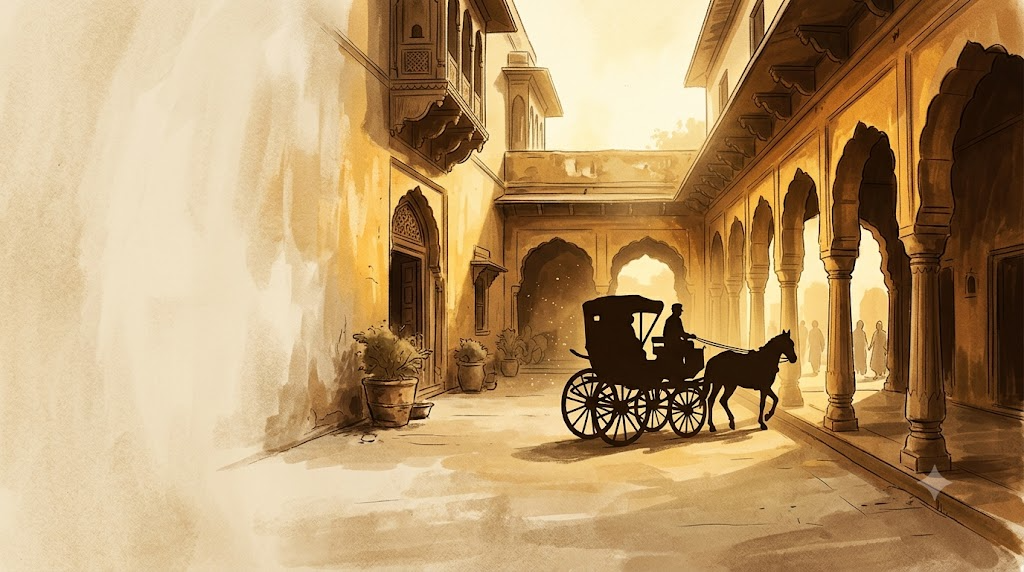
“Abaayam! Abaayam!”

Vandhiyathevan stepped into the aasthaana mandapam, just a little ahead of the chattering poets. There, seated upon a high throne, was a man whose every pore seemed to exude majesty and fierce pride. It wasn’t hard for our young friend to guess that this must be Chinna Pazhuvettarayar. A fair crowd surrounded him, the men keeping their palms respectfully cupped over their mouths in that ultimate sign of courtly deference. One fellow stood waiting with the day’s inscribed palm-leaves in his hands; another, clearly the kanakkaayar (the head clerk), looked eager to present his ledgers and accounts. The heads of the palace security stood by, quietly waiting for their daily instructions. A few attendants hovered in the background, ready to fetch or carry, while others stood behind the great wooden throne, gently fanning the warm air with white saamarams (ceremonial fly-whisks). Yet another servant stood patiently with a small brass box of fresh betel-leaves and chopped areca-nuts. (It might seem a little odd to find a man standing about with a betel-box, or vetrilaippetti, in the middle of a busy military court. But these items of comfort were ubiquitous among the privileged, who loved a leisurely chew of betel, nut, and lime. So common were the servants employed simply to carry these boxes, that in time, their actual names were often forgotten, and they came to be known as vetrilaippetti themselves!)
Now, Vandhiyathevan was second to none when it came to carrying himself with a bit of a proud swagger, but in the presence of this seasoned warrior-lord, he found himself setting his own consequence quietly aside. If anything, the younger Pazhuvettarayar possessed a regal, unbending pride of bearing that was perhaps a notch above even his elder brother’s. But the moment his stern gaze fell upon our young man, his face brightened noticeably.
“Who might you be, Thambi?” he asked. “Where do you come from?”
A soldier by birth and breeding, Chinna Pazhuvettarayar’s interests revolved naturally around war, battlefields, and, consequently, strong young men. He was always keen on gathering as many stout-hearted lads as he could find into his own army. Hence his sudden enthusiasm at the sight of the broad-shouldered Vandhiyathevan.
“I come from Kanchi, Commander,” said Vallavarayan Vandhiyathevan, using his politest, most reasonable voice. “Crown Prince Aditha Karikalar bade me deliver this palm-leaf message to his father.”
Chinna Pazhuvettarayar’s face darkened like a monsoon sky at the mere mention of Kanchi.
“What? What is that you say?” he snapped.
“I have travelled from Kanchi with an olai from Prince Aditha Karikalar.”
“Oh? Well, hand it over.” The commander’s manner tried to be negligent, but his deep voice betrayed a sudden, thrumming tension.
“Very well,” replied Vallavarayan, slowly drawing the slender palm-leaf from the folds of his waistband. “But Commander, it is meant for the Emperor—”
Chinna Pazhuvettarayar paid no attention to this mild protest at all. He took the leaf eagerly, threw a quick, sharp glance over the scratched script, and then thrust it at the man standing beside him, bidding him read the contents out loud.
“Nothing new here,” the commander murmured to himself, half-listening as the short message was read out.
“Commander, my olai…” Vandhiyathevan’s voice trailed away.
“What of it? I shall deliver it to the Emperor myself.”
“It isn’t that—it’s just that I was given strict orders to deliver it into the hands of the Chakravarthy myself.”
“Ah—so you were told to place no trust in me?” The Thanjavur commander’s face gathered into a perfect storm of fury. “Were those your explicit orders from Prince Adithar?”
“Not at all. Those were your elder brother’s orders, however.”
“Wait—what?” Chinna Pazhuvettarayar leaned forward, frowning. “Where did you meet the Periyavar (the elder)?”
“At the Kadambur palace, where I happened to spend a night. And it was he who gave me this signet ring, as well.”
“Why could you not have told me all this earlier, boy? So, you stayed at Kadambur? And who else was present there?”
“Oh, quite a few lords from Mazha Nadu, the mid-lands, and Thirumunaippaadi—”
“Now wait, just a moment.” The commander waved a thick hand, cutting him off. “You may as well go in and give this into the hands of the Emperor yourself—otherwise those blasted court poets will demand an audience with him, too, and yap away forever. You can come back and tell me the rest of it when you have delivered your message. Now, you—” Chinna Pazhuvettarayar sought out one of the sturdy palace guards standing nearby. “Escort this youngster to the Chakravarthy.”
Vandhiyathevan followed his silent guide ever deeper into the cool, shadowed corridors of the great palace.
The magnificent Chozha throne, the gleaming seat of an empire that stretched from the eastern coast to the west, washed by the rumbling oceans on three sides—had, sadly, lately become little more than a sickbed. And it was here that Emperor Paranthaka Sundara Chozhar lay, his frail body propped up by a mountain of soft silk cushions. A good deal of his time was spent resting, drinking down copious doses of bitter herbal medicines; much of his heavy royal duties had been delegated to others. But there were still dignitaries to whom he simply had to grant an audience, and various pressing claims upon his waning time. It was important for the peace and well-being of the empire that the ministers, the regional commanders, and the chiefs of the Velakkara Regiment meet with him at least once a day.
The man who had earned the fierce respect of his subjects with his valorous deeds on countless dusty battlefields—an asagaayasooran (a warrior of peerless, unassisted valour); the man so famed for his striking good looks that he had been named Sundara, and deemed an equal to Manmadhan, the very God of Love, by his adoring people—now lay there, feeble and fragile. He looked as though a stiff evening breeze might just break him in half.
Vandhiyathevan stood staring at the great ruler of the Chozha empire, entirely speechless. His eyes suddenly brimmed with hot tears, quite overcome by the pitiful sight. He stepped forward very softly, barefoot on the smooth stone floor, and offered the palm-leaf with the utmost respect.
“Where are you from, child?” quavered the Emperor. His voice was thin and faint with fatigue. “Whose olai is this?”
“Prabhu (Lord), I come from Kanchi,” Vandhiyathevan replied, his own voice unusually husky with emotion. “I bring you this message from Prince Aditha Karikalar.”
The sick Emperor’s drawn face brightened at once. “Devi,” he called, turning his heavy head towards his consort, the Empress Vanavan Maadevi, who had been born a princess of the Malayaman clan. “Your son has sent us a palm-leaf.”
His trembling hands opened the missive and he began to read.
“Ah. His highness has built a golden palace in Kanchi,” he murmured, and just as quickly, the brief, hopeful lustre faded from his tired eyes. “He wishes us to come and stay there, for a while.” Sundara Chozhar’s face grew even more pinched and hollowed than before, if such a thing were possible. “Devi, my own grandfather, the illustrious Emperor Paranthaka, once gathered every speck of gold in his many palaces and donated it all towards a beautiful roof for the great Lord Shiva who dances in Thillai; he transformed it into a golden ambalam (a temple hall). None of our family was ever remotely interested in hoarding wealth to build golden palaces for ourselves—our fervour always lay in raising beautiful stone temples for the gods. And here is Adithan, committing such a heinous, worldly act against everything we hold sacred! Ah, how are we ever to redeem ourselves from this vanity?”
The Empress, whose gentle face had gained a little warm colour at the mention of a letter from her eldest son, seemed to wilt at these words. Her spirit fell even more, if possible. She turned her face away, quite unable to speak a single word of comfort.
Vandhiyathevan, watching this quiet domestic tragedy unfold, decided that it was high time he intervened.
“Your Majesty,” he began, screwing up every little bit of courage and swiftness of tongue he possessed. “Surely your son hasn’t committed a grievous sin that fairly demands redemption? He has, after all, only obeyed the natural dictates of a loving son’s heart. Parents are always as gods to their children, aren’t they? Is it not, then, a rather commendable action to have built a beautiful temple for his own personal deities to dwell in?”
A very wan, ghostly smile appeared on Sundara Chozhar’s face.
“I know not who you might be, Thambi, but you seem an eminently sensible young man, and you possess a very intelligent, quick tongue in your head. But tell me this: a son may indeed consider his parents as gods, but surely they are not so to the rest of the wide world? Golden temples may only be dedicated to the omnipresent and omniscient supreme power, worshipped by all, may they not?”
“Prabhu—a son may consider his father a god, it is true, but so do the common people consider their king. I have heard it told, and I have read in our own ancient epics and sacred texts, that an Emperor is the very incarnation of Thirumaal, the Great Lord who guards and preserves us all. I should say that in this particular case, your son’s intentions in building you a golden palace were laudable in the extreme.”
The old Emperor threw an affectionate, tired glance at his queen. “Did you listen to this intelligent young man, my dear? Ah, if our Adithan has loyal friends such as these at his side, then we need not fear so much for his future anymore. Nor worry overmuch about his tendency to rush in where angels fear to tread!”
Then he turned his head slowly back to Vandhiyathevan. “Thambi—what matters now is hardly the merit, or otherwise, of building a golden palace. You see how I am situated, do you not? I can barely move about this room, let alone travel. A long, dusty journey is certainly out of the question. We are desperate to see him, but at this moment, he is the one who will have to visit me. Come back tomorrow, young man, and I shall ensure that you have a proper reply to take with you.”
Just then, a confused babble of voices and the slapping of many sandals reached them from the corridor outside, and Vandhiyathevan realised with a sinking heart that the gaggle of court poets was about to enter the mandapam. Ah, if those men arrived now, the chances were very high that Chinna Pazhuvettarayar would accompany them in—and he might as well bid a long farewell to any chance of passing on a secret message. He would just have to seize this fleeting moment and whisper a few desperate words of warning.
Having weighed all this up in the space of a heartbeat, Vandhiyathevan leaned in and broke into hurried, hushed speech.
“Chakravarthy, I beg you, grant me a favour. Kindly do listen to me: you must leave Thanjavur at once! Great, terrible peril surrounds you in this place—abaayam (danger)! Abaayam!”
But Chinna Pazhuvettarayar had stepped into the hall even as the boy gasped out those last few frantic words, the flock of court poets trailing right behind him. Vandhiyathevan’s hasty, desperate warning fell loud and clear upon the commander’s ears.
His face bloomed with a dark, terrible fury.
© 2026 Matribhasa Classics. Public Domain


Comments (0)
Log in to join the conversation.