Auspicious Aadi

We must ask you, our amiable readers, to kindly disregard the present for a little while, and climb with us into the boat of imagination. Let us take a small journey across time, unmarred by rigid beginnings and endings. We shall cross a century in a convenient second, and reach a year roughly nine hundred and eighty-two years before our own time (this being written, of course, back in 1950).
Between the hoary lands of Thondai Nadu and Chozha Nadu lies the kingdom of Thirumunaippaadi. In its southern region, roughly two kaadhams (an old Tamil measure of distance, roughly ten miles each) west of the famed Chidambaram Temple, sprawls the huge Veera Narayanan Lake. It is as large as an ocean. It measures something like one-and-a-half kaadhams from north to south, and half a kaadham from east to west. These days, it is known no longer by its full, original name, but by a much shortened, colloquial version—Veeraanathu Eri, or Lake. Those who saw this massive body of water during the months of Aadi (mid-July to mid-August, when the floods come) and Aavani (the month that follows, keeping the waters high), when the fresh floods poured in and the surface churned and tossed, almost overflowing the earthen banks, could not help but marvel. They would heave sighs of delight at the great feats accomplished by their ancestors in ancient Thamizhagam (the traditional Tamil country). For such deeds were not merely for their own advancement, or even just for the betterment of those living in their times, were they? Their benefit was passed down through generations. Much like munificent plantain trees bequeathing their resources to their young, these great builders enriched their descendants a thousand years into the future, didn’t they?
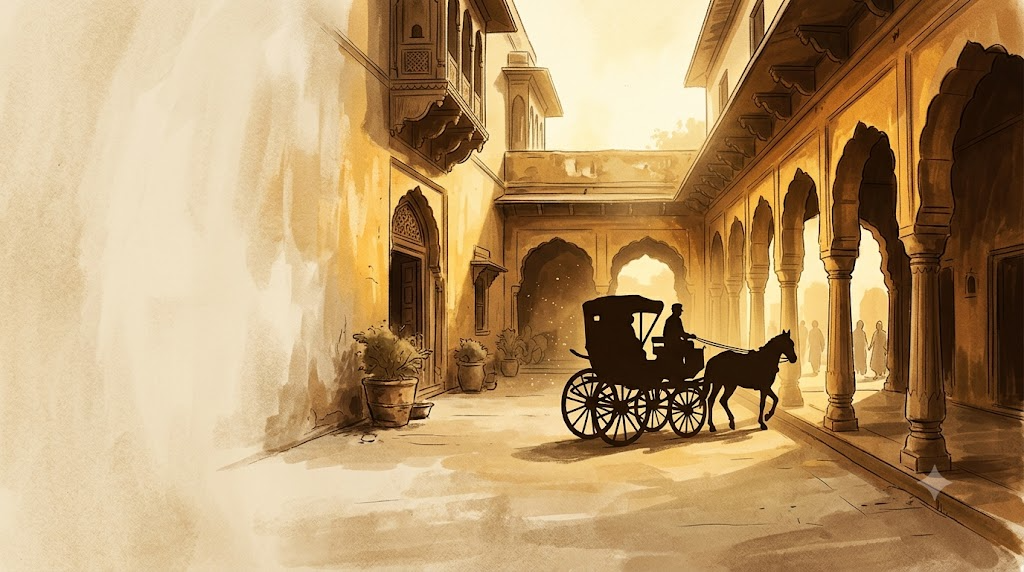
On the auspicious eighteenth day of Aadi, sometime in the early evening, a young man rode his horse along the banks of the Veera Narayana Eri, which looked almost ocean-like in its vastness. A scion of one of Thamizhagam’s most distinguished clans—the Vaanarkulam—was our young man; his name was Vallavarayan Vandhiyathevan. They had travelled a great distance without pause. His horse was weary and stumbled slowly along the path. Not that our young traveller was much distressed by this. He was far too fascinated by the lake and its enormous proportions to set much store by his steed’s fatigue.
Aadi Perukku (the traditional festival celebrating the monsoon floods) was important for more than one reason. On this day, every river in Chozha Nadu overflowed its banks; consequently, every lake that fed from the rivers was filled to the brim as well, the waters tossing and churning the surface. The river known as Vada Kaveri by devotees, and Kollidam colloquially, fed straight into the Veera Narayanan Eri through the Vadavaaru—and the latter was more an ocean in its dimensions. Water gushed through the seventy-four canals that ringed the lake, bubbling and foaming, adding to the vast expanse, and irrigating broad swathes of the surrounding land. Agriculture was the mainstay here. Farmers were engaged in ploughing, seeding, and planting their respective fields, as the lake’s waters flowed out into their lands. Men and women, neck-deep in their work, went about with sweet songs on their lips to alleviate the heavy burden of labour.
Vandhiyathevan chose to linger on his way, listening to their singing. Besides, he was engaged in another, slightly more important task: verifying whether the lake did indeed possess seventy-four canals, as he had so often heard tell. Thus far, he had travelled one-and-a-half kaadhams, and had counted only around seventy.
It was then that the true magnitude, the sheer vastness of the lake burst upon him in all its glory. Ha—such length and breadth! How enormous it was, seemingly endless. Why, even the so-called large lakes dug by the Pallava Emperors were nothing but tiny ponds in comparison! And then, consider the incredible foresight of Prince Rajadithyar, son of Madurai’s conqueror, the illustrious Paranthakar, who had conceived the grand plan of diverting the Vada Kaveri’s vast waters into a lake of such proportions! Indeed, who could claim to be his equal when it came to sheer foresight and the execution of plans? For that matter, there was no one who could match his courage and valour, either. Wasn’t he the warrior who had chosen to personally lead his armies into battle at Thakkolam? Hadn’t he borne an enemy’s spear in his chest as he rode his war-elephant, and ascended to heaven as a valiant soldier? Didn’t he fully deserve the title “He Who Embraced Death on His Elephant,” as a result of his great deeds?
In truth, these Chozha kings were a strange and wonderful breed. They were as outstanding in valour as they were in war; as committed to justice as they were to God. And he, Vandhiyathevan, actually had the great good fortune of mingling with, nay, claiming friendship with them!
Vandhiyathevan’s shoulders swelled. His heart threatened to burst with pride, buffeted by waves of sheer exhilaration, just as the surface of the Veera Narayana Lake heaved and tossed, striking the earthen banks, whipped by the brisk west wind.
By the time Vandhiyathevan reached this point in his ruminations, he had arrived at the southern end of the lake, and saw the magnificent sight of the Vadavaaru emptying itself into the great water body. The lake bed extended for a small stretch between the banks and the water’s surface; thorny karuvela and vila (local wild trees) had been planted in the earth to prevent damages to the shore from the floods. Sturdy naanal (tall river reeds) clustered thickly at the water’s edge. In all, the sight of the Vadavaaru, with water rushing between tree-laden banks and emptying with a roar into the Veera Narayana Lake, made a very pretty, colourful picture indeed, from afar.
Vandhiyathevan was delighted with nature’s painting—but there were a few other sights, too, that considerably increased his admiration and joy in his surroundings.
The auspicious day meant that villagers from in and around the lake were in the mood for celebrations. Scores of men, women, children, and even a few aged ones took advantage of the festive occasion, dressed in their best clothes and finery, dragging along sapparams (small temple chariots) made of delicate, ivory-white coconut fronds. Women wore fragrant blossoms of jasmine, mullai, thaazhambu, sevvandhi, iruvatchi, and shenbagam (the sweetly scented local flowers of the season), spreading their heavy perfume all around. Of food, there was plenty as well, primarily in the form of delicious kootanchoru (a rich, country-style dish of rice cooked with vegetables and spices). Some strolled along the banks, having ladled their warm food into cups fashioned from kamugu (the broad leaves of the areca palm); others, slightly more adventurous sightseers, walked right up to where the Vadavaaru poured into the lake, and ate their food while watching the thrilling sight. Children threw their used kamugu cups into the canals, watched the flimsy green containers tumble through the choppy waters, and clapped their hands with glee. Some young men exhibited their playful nature—pulling flowers off their beloveds’ tresses without their knowledge, throwing them into the canal, and laughing to see them burst through on the lake’s side.
Vallavarayan stayed on the banks for a while, enjoying the sights and sounds of the celebration. He took in the sweet, appealing melodies of the women—they ranged from boat-songs to kummi and sindhu (traditional folk styles of song and dance), and even some special verses celebrating the floods, in all their delightful variety.
“Come, sing in welcome— The Vadavaaru leaps towards us Watch, and dance in welcome— The Vellaaru springs towards us See, delight and welcome— The Kaveri rises towards us!”
These and many more songs were sung with joy, celebrating the arrival of the new waters, and Vandhiyathevan listened for all he was worth, the sweetness in the tone and verses gladdening his young heart.
War-like fervour found favour among other celebrants in the lively groups. Some women enshrined in song the valour of Vijayalaya Chozhar, who sported ninety and six scars on his battle-worn body, earned from thirty-two hard-fought wars; yet another woman chose to sing about the piety and compassion of his son, Adithya Chozhar, who built sixty-four temples for Siva Peruman all along the course of the Kaveri, from its birthplace to where it merged with the sea. Paranthaka Chozhar’s incredible feats, as he subjugated the Pandiyas, Pallavas, and Cheras, and won massive victories in Ilankai, were sung by a young lady with enormous zest and vigour. Everyone’s performance was heard with gratifying attention; sometimes, listeners gave themselves completely to the moment, uttering spontaneous exclamations of, “Ah! Ah!”
Lost in the revelry, Vandhiyathevan gradually became aware of an old woman’s quiet, steady scrutiny.
“You look like you have travelled far and hard, Thambi (little brother, an affectionate term for a young man). You must be very tired. Would you like to get down from that horse of yours and share some of our nourishing kootanchoru?”
This seemed to be the signal for every young woman in the vicinity to direct keen, mischievous glances at our young man. Their laughing eyes settled on him; they giggled and tittered among themselves, quite obviously discussing his appearance.
Vandhiyathevan would have been paralysed by bashfulness, had not a part of him been entirely overjoyed at the female attention. He wondered, briefly, if he should take up the old woman on her kind offer and gorge himself on food—but surely, if he did, those young women would surround him on all sides and swamp him with teasing ridicule. But what of it? Opportunities to be swamped by a bevy of young ladies did not often come by. Even if they did ridicule him, surely the sound of their teasing laughter would defeat the mellifluous music of celestial beings! To Vandhiyathevan’s besotted young eyes, every maiden on the shore seemed to be no less a beauty than the divine dancers Rambha and Menaka, who adorned Lord Indra’s court.
Before he could accept the old woman’s invitation, though, something else caught his attention and made him hesitate.
In the distance, a heavenly sight met his eyes: seven or eight large boats glided swiftly along the Vadavaaru from the south-west, their white, silky sails fluttering in the brisk west wind, oars spread wide like the wings of a graceful swan. Men and women, indulging in celebration along the banks, gradually fell silent, their attention riveted by the approaching spectacle. One among the cavalcade outran the rest, making its way swiftly towards the northern bend of the lake. Soldiers lined its wooden decks; sunlight caught the glint of their spears and javelins, dazzling the onlookers. Some of them jumped on shore and began to herd everyone away with rough alacrity:
“Clear out! Move away, all of you!”
The celebrants themselves, obviously, did not want to lay themselves open to such bracing treatment; they were swift to pick up their belongings and move well away from the banks.
Vandhiyathevan watched the boats and the warriors, deeply puzzled. Who were they, and what sort of passengers did the boats behind them carry? Were they, perhaps, members of the royal family? He sidled up to an old man who stood on the banks, leaning quietly on his stick.
“Ayya (sir, a respectful term for an older man), whose men are these? Whom do those swan-like boats belong to? Why do these soldiers drive away the people? And why does everyone obey them so quickly?” The questions fairly tripped off his over-eager tongue.
“Why, Thambi, do you tell me that you do not recognise them?” the old man raised his eyebrows. “Do you see the boat in the midst of the rest? And the flag that flutters on it? Tell me—what is the emblem it bears?”
“It seems to be a palm tree.”
“Indeed. And do you not know that it is the emblem of the Pazhuvettarayars, my lad?”
“Good God,” Vandhiyathevan exclaimed, properly startled. “Is it truly him? The great warrior Pazhuvettarayar?”
“It must be. Who else would dare to brandish the palm-tree flag with such absolute authority?”
Vallavarayan’s eyes turned towards the approaching boats again, wide with astonishment. Such were the tales he had heard about the warrior among warriors, Pazhuvettarayar. But then, who had not? The names and fame of the amazingly valiant Pazhuvettarayar brothers, both Elder and Younger, had spread through the length and breadth of the Chozha Empire, from Eezham in the South, to Kalinga in the North.
The brothers hailed from the city of Pazhuvoor on the northern banks of the River Vada Kaveri, near Uraiyur; their clan had earned a great name for valour all the way from the times of Vijayalayar. The Pazhuvoor family claimed intimate ties with the Chozhas through marital alliances. Their royal connections and their solid reputation for courage had made them one of the first families of the land, a clan that was almost, if not quite, the equal of the ancient Chozha dynasty itself. Such an illustrious status also meant that they were among the very few who could boast the privilege of a flag of their own.
Of the current duo, the Elder was more renowned, having earned legendary status in twenty-four bloody battles; for sheer bravery, it was common knowledge that he had no equal in Chozha Nadu. More than fifty years old, he no longer graced the battlefields but held several truly exalted positions in the Chozha Empire: Dhana and Dhaanya Athikaari—the Royal Treasurer, and Guardian of the Granaries. His was the right to guard the resources of the land, both in cash and in kind; his also was the privilege to assess the demands of the government, and to decide on the thirai (tribute or tax) to be levied upon and collected from the people.
He could march up to any kottam (administrative district) official, affluent landlord, or minister, and demand to be paid whatever tax he levied that year. In other words, Pazhuvettarayar was considered next in importance to none other than Maharaja Sundara Chozhar himself in the empire.
Naturally, Vandhiyathevan’s heart was filled with the unquenchable urge to catch a glimpse of this supremely important personality, this warrior who claimed the respect of every Chozha citizen. But then—he remembered the confidential message entrusted to him by Crown Prince Aditha Karikalar, in Kanchi’s Golden Palace.
“Vandhiyatheva! I’m well aware of your prowess as a warrior. I’m also aware of your keen intelligence—which is why I’m entrusting this responsibility to you. Here are two palm-leaves: one is to be delivered to my father, the Maharaja; the other to my sister, Ilaiya Piratti (the younger princess). I hear such disturbing tales about even highly-placed officials in the empire—you must, therefore, make sure that my message does not fall into their hands. No matter what position of authority they hold, not a whisper of suspicion must enter their heads that you carry a message from me. Do not, I repeat, do not pick fights along the way. It isn’t enough if you don’t quarrel with anyone—make sure that you ignore anyone who forces a quarrel on you. Vallavaraya—I know you to be an excellent warrior, so you may be easy about your reputation. Rest assured that ignoring a few disputes isn’t going to be a blemish on your honour.”
There had been a pause. “In particular, my lad—you must be very wary of the Pazhuvettarayars, and my uncle Madhuranthakar. Not on any account must they know the purpose of your mission!”
Such was the solemn message entrusted to him, not just by the Crown Prince of the Chozha Empire, but by the man who held the vastly important position of Maathanda Naayakar (Supreme Commander) of the Northern Chozha Forces. Aditha Karikalar had taken such great pains to impress ways of good conduct and careful behaviour upon him, not to mention precise instructions to be carried out, that Vallavarayan could not find it in himself to ignore those words of caution.
Meeting Pazhuvettarayar, therefore, was a desire he would have to suppress. Vandhiyathevan heaved a quiet sigh and spurred his horse forward. That noble animal, already worn down by hard travel, could do little more than ooze slowly along the muddy path. Well, that left him with only one option: he would spend the night at the Kadambur Sambuvaraiyar Palace, and leave the next morning—with a brand-new horse, able and fit for travel.
© 2026 Matribhasa Classics. Public Domain


Comments (0)
Log in to join the conversation.