An Iron Grip

Once the initial wave of amazement had washed over the room—rather like an unexpected flash flood rushing down a dry hill stream—Nallan Saathanaar spoke up. There was a good deal of hesitation in his voice. “Then, the poet who composed that song, Prabhu, was it—?”
“It was the Emperor of the Three Worlds who lies before you this very moment, unable to even move his legs,” supplied Sundara Chozhar gently.
“Ah!” A clamour of soft exclamations rippled among the bards. Some shook their heads, swaying their bodies in those strange, expressive contortions that learned men sometimes make when words fail them. Others sat perfectly still, quite overwhelmed by their own feelings.
“Honoured bards,” Sundara Chozhar continued, settling back to share his tale. “Once, poets and learned men of words were gracious enough to visit me in Pazhaiyarai—perhaps some of you were there that day as well. They took turns singing of the greatness of my ancestors and the glorious Chozha dynasty. They sang of me, too, heaping generous praises—saying that I gave away such-and-such a thing, or showered riches upon someone else. The young princess Kundhavai was standing by my side then. When the poets finally left with their rewards, she expressed enormous admiration for their wonderful songs. I, being rather foolishly proud, argued that I was a great deal more talented than them, and could sing just as well. That was when I composed this little verse on the spur of the moment—and then I petitioned her gracious Highness for a reward. My little girl climbed onto my back, said, ‘Here is your prize!’ and delivered two smart slaps to my cheeks! Ah, I remember the sting of it as though it happened only yesterday. And yet, it has been more than eight years…”
“Wonderful!” came the murmurs. “Astonishing, indeed!” Exclamations of sheer delight burst forth from the gathered poets.
Kundhavai! The very name sent a sudden thrill of exhilaration racing through Vallavarayan Vandhiyathevan’s veins. He had heard countless tales of the young princess’s beauty, her refinement, and her sharp intelligence. And here, resting quietly in front of him, was the fortunate man who had fathered her; and the elderly woman sitting by him, Udaya Piratti, her mother. How the Emperor’s frail voice shook with pride and longing at the mere mention of his beloved daughter!
Without quite meaning to, Vandhiyathevan’s right hand slipped down towards the broad silk sash wound around his waist. He felt gently along the folds; tucked safely within should have been the precious olai that he was supposed to deliver to Kundhavai.
His fingers stopped, completely paralysed. His heart gave a horrible little stutter of shock.
Ayyo! The olai—the palm-leaf was missing! Where could it be? Could it have slipped out and fallen somewhere on the floor? Perhaps it had dropped when he pulled out the other palm-leaf meant for the Emperor? But where, then? Was it out there in the aasthaana mandapam? What if the younger Pazhuvettarayar got his wretched, grasping hands on it? Oh, the sheer peril of it falling into his clutches! What a terrible misfortune—how on earth was he going to get himself out of this one?
Now that he knew the princess’s letter had vanished into the unknown, the royal court and its reciting poets were the absolute last things on the young man’s mind. He could barely sit still. None of the polite, scholarly conversations around him made a lick of sense anymore, and frankly, he didn’t care a jot.
Meanwhile, Sundara Chozhar was quite happily continuing his recital to the admiring bards. “I suspect that Kundhavai regaled someone with this silly little verse of mine—most probably Eesanya Bhattacharyar, the priest from Pazhaiyarai’s Thirumetrali Temple. And he, no doubt, spread it around to give everyone a good laugh at my expense!”
“Prabhu, even if you were, indeed, the true author of this piece—what of it?” said Nallan Saathanaar smoothly. “It is a truly marvellous little verse. In addition to being the Emperor of this world, you are now the Chakravarthy of Poetry as well!”
“And yet,” said the Emperor, a wistful smile playing on his lips, “were I to compose a verse now, I would not stop at merely giving away elephants to Indra, horses to Surya, or palanquins to Siva Peruman. Do you remember the old tale of Markandeyan, the boy who appealed to the great Lord to save his life? Well, Siva Peruman duly obliged. He kicked away Yama (the God of Death), but Yama’s pitiful mount, the great black buffalo, expired from the terrible ire of the deity. And the Sundara Chozhar of Pazhaiyarai, hearing of poor Yama’s terrible plight as he wanders without a steed, has duly donated one to Him! And now, Death travels upon His majestic mount once more, seeking me out. Not even Thanjavur’s great Commander, Chinna Pazhuvettarayar, can stop Him and His precious buffalo, can he?”
As these quiet words fell from the Emperor’s lips, tears began to spill down the sallow cheeks of Udaya Piratti. Some of the poets sitting nearby began to sob into the folds of their upper garments, unable to bear the heavy sorrow in the room. The younger Pazhuvettarayar, it seemed, was the only one who maintained some semblance of stern courage.
“Prabhu, I am prepared to battle even Yama himself in the course of my service to you!” the Commander announced, his voice ringing out.
“I entertain no doubts on that score, Commander,” said the Emperor gently. “I do know, however, that no man is capable of winning a war against Him. All we can do is pray that we find the strength to face our fate without fear. After all, didn’t one of Thamizh’s greatest poets sing, ‘I do not fear Death’?”
A poet rose to his feet at once, and his voice filled the quiet room as he began to recite that famous, stirring verse of Saint Appar’s, singing of his willingness to face extreme torture and even death without a flicker of fear, despite the fierce persecution of his faith:
“Naamaarkkum kudiyallom, Namanai anjom Naragathil idarppadom Nadalai yallom Emappom, pini yariyom—“
The Emperor raised a frail hand to interrupt him at this point. “Such devotion! Such complete and utter conviction. Ah, who but a man who has truly glimpsed God could have sung with such an indomitable spirit? Saint Appar suffered terribly from the dreaded soolai (a severe and griping ailment of the stomach)—but Iraivan (the Supreme Lord, Siva) cured him completely of his illness. No wonder he sings so exultantly, declaring that he fears pain, illness, and Death no longer. My dear friends, it is far better that you sing such beautiful verses extolling the divine, rather than waste your breath in praise of pitiful creatures such as I. Great men of God like Appar, Sundarar, and Sambandhar have sung thousands of songs, brimming with pure devotion in beautiful, chaste Thamizh. How wonderful it might be to gather them all into one complete, enduring collection? Why, a whole lifetime would not suffice to learn, sing, and rapturously lose oneself in them all!”
“If it pleases you, King of Kings, we shall be honoured to begin this sacred task at once,” offered one of the bards.
“No,” sighed the Emperor, looking suddenly very weary. “I am afraid that such an enormous undertaking could hardly be accomplished in my time. Later, perhaps, however…” His voice simply trailed away as he lapsed deep into thought.
The royal physician, noticing this, tiptoed over to Chinna Pazhuvettarayar and murmured something soft and urgent into the Commander’s ear. Sundara Chozhar, catching sight of the whispering duo, stared out at his audience. His eyes grew wide and puzzled, as though he had just snapped out of a deep trance. He seemed, in that fleeting moment, a gaunt and pitiful creature, snatched back just an instant from the gaping maws of death.
“Sire, you did desire to listen to a song from the Sangam era,” queried the Commander gently. “These learned men may leave once they have recited one, may they not?”
“Ah yes, of course I did,” the Emperor sighed, passing a hand over his tired brow. “It seems to me that my mind is losing its battle with awareness, just as quickly as my body. Please—do continue.”
At a swift, commanding sign from Chinna Pazhuvettarayar, Nallan Saathanaar rose to his feet.
“Oh King of Kings, chief among your noble ancestors, and perhaps the most famous of them all, was the great Emperor Karikal Peruvalathaar, who hoisted his Tiger flag upon the very snowy summits of the Himalayas. The beautiful city of Poompuhar—known also as Kaverippoompattinam—was the capital of the Chozha Empire during his prosperous reign. Ships would dock at that great sea-port carrying so many rich goods and produce that it was an onerous task simply to keep count of them all. Here is a song by a poet belonging to the ancient Sangam era, and to those glorious times, describing Puhar’s immense wealth, its far-reaching international trade, and its prosperity—all told through the goods that reached the globally famed port from various countries:
Vadamalai pirantha maniyum ponnum, Kudamalai pirantha aaramum akilum Thenkadal muthum, kunakadal thukirum Gangai vaariyum Kaavirippayanum Eezhathu unavum kaazhagath thaakkamum—
[Gold and precious gems from the mountainous lands of the North; sandalwood, akil (fragrant eaglewood) and other incenses from the hills of Podhigai; pearls and corals from the southern seas; produce from the banks of rivers such as the Ganga and Kaveri; food-grains from Eezham and goods from far-flung places such as Kadaaram…]”
Sundara Chozhar gestured for the poet to stop right there. A dry smile touched his face.
“During the glorious times of Karikalar, it was Chozha Nadu that received food and grains from Eezham—you allowed these poets in specifically to impress that point upon me, didn’t you, Commander?”
“Yes, Sire,” came the voice of Chinna Pazhuvettarayar. Admittedly, for a man so fierce, it was in a markedly feeble tone.
“You have made your point. Reward these bards, please, and send them safely on their way.”
Thanjavur’s Commander turned towards the gathered men and delivered the royal dismissal. The poets bowed low and began to shuffle out, chanting their praises into the dimming light of the hall. *“Vaazhi!* (Long may you live!)”
Already listless, and thoroughly panicked at the sudden, inexplicable disappearance of the olai meant for Kundhavai, Vandhiyathevan decided that this was his perfect chance to make an escape. He sidled up towards the group, hoping to blend in and slip out right in the middle of the departing crowd.
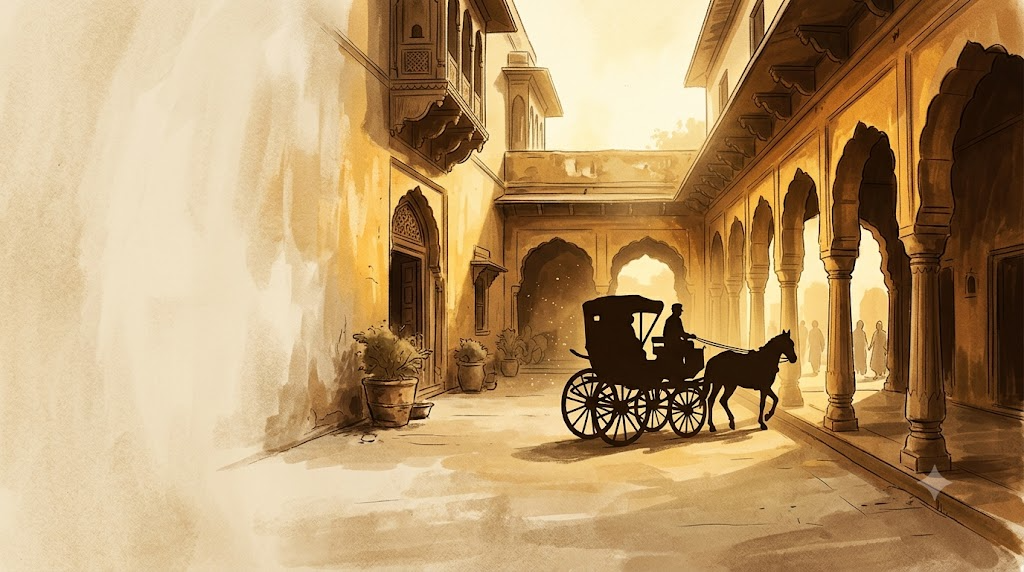
He was doomed to disappointment, however. Just as he neared the heavy wooden doors of the entrance, a strong hand crept out and clutched his wrist in a sudden, iron grip.
Now, Vandhiyathevan was a courageous young man in the normal run of things. But that terrifying grip shook him entirely, sending an icy jolt right from the top of his head down to the tips of his toes, and paralysed him into standing perfectly still. He slowly looked up—and found that the hand belonged to none other than Chinna Pazhuvettarayar himself. The court poets streamed steadily out of the audience hall, leaving him trapped behind.
© 2026 Matribhasa Classics. Public Domain
Comments (0)
Log in to join the conversation.