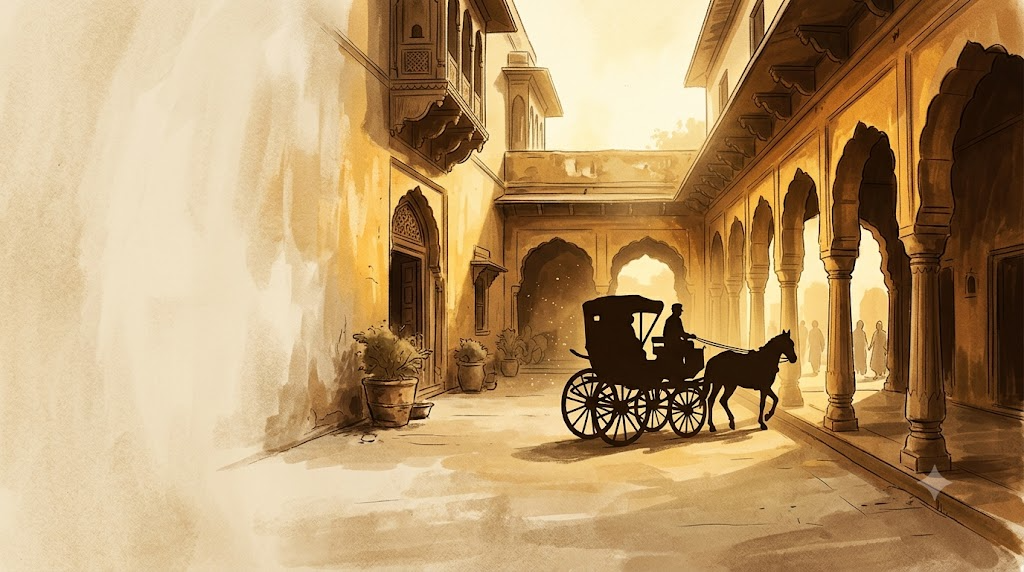
Nandhini’s Lover

“I was twelve when I saw Nandhini for the first time,” Aditha Karikalar began, his voice dropping to a quiet murmur. “My younger sister Kundhavai, our little brother Arulmozhi Varmar, and I had been paddling boats in the small pond behind the royal palace in Pazhaiyarai. We had finished our games, moored the little wooden boats to the bank, and were making our way back to the palace through the sun-dappled gardens. Somewhere along the path, the gentle voice of our periyapaatti (our elder grandmother, the revered Sembiyan Madevi) floated out to us on the afternoon breeze. We made a great fuss over her, all of us; we had grown up safe and warm in her fond embrace, after all.
“We ran up to the little shaded arbour where she sat, eager to tumble out the stories of our play. There were three other people sitting with her. One was a young girl, right around our own age. The other two were quite obviously her parents. They had been speaking to the dowager queen about their daughter. As we erupted into that quiet, leafy space, the conversation stopped, and everyone turned to look at us. But I—the only thing I saw was the girl’s large, luminous eyes, widening even more like a startled deer’s at the sight of us. I can picture the scene even now, so perfectly clear, in my mind’s eye…”
Aditha Karikalar’s voice trailed away. He raised his eyes to the heavens, falling into a deep, brooding silence. Perhaps he had caught a glimpse of that little maid’s face from long ago, taking shape once more among the wispy clouds that floated so serenely across the night sky.
“Ayya?” came Parthibendran’s gentle prompting. “Please go on.”
Aditha Karikalar returned to the earth, sighing as he picked up the thread of his tale. “It was Kundhavai who babbled out the whole story about our boats and our afternoon’s adventures. My grandmother listened with all her usual patience, and then gestured toward the new girl. ‘Do you see her, my heart? How bright she looks! She and her people have arrived from the Pandiya country. They will be staying here a while, at the home of Eesana Siva Battar, the temple priest. This young lady’s name is Nandhini. Include her in your amusements sometimes, won’t you? I am sure she will make you an excellent playmate.’
“I realised, almost immediately, that my sister was entirely revolted by the idea. ‘Anna, did you take a look at the girl we met just now?’ she muttered to me as soon as we had stepped out of the arbour. ‘How ugly she looked, to be sure! Why do you think her face looked so terrible—just like a hideous owl staring out of a tree? Why does Paatti wish us to play with her? Good heavens, how can I even look at her without laughing? What do I do?’
“I understood something very old and very important in that single instant: women, it seems, are born with a sliver of jealousy tucked into their hearts. No matter how exquisite a girl might be, she simply cannot bear the sight of another possessing her own loveliness. My sister’s beauty was famed amongst all our Chozha clan, but even she felt threatened. What else could possibly be the reason behind all her catty little remarks? But then, being a brother, I wouldn’t leave her in peace either; I deliberately exaggerated the new girl’s charms just to infuriate my sister. We argued and quarrelled about her, frequently and loudly. Our young brother Arulmozhi Varmar would just stare at us, thoroughly puzzled, entirely unaware of the true reason for our sudden animosity.
“Some time after that, my father, Emperor Sundara Chozhar, left for the Pandiya War, and I accompanied him. Together, we battled and triumphed time and again over the Pandiyas, as well as the armies from Ilankai that had been sent across the sea to assist them. And then, finally, the Pandiya king, Veera Pandiyan, ran from the battlefield and concealed himself in the shadows. At the time, we weren’t quite sure if he had slunk into hiding or if he had actually fallen on the field. Either way, it was the signal for the Ilankai soldiers to retreat. We pursued them all the way to the coast at Sethukkarai. Those who managed to escape our swords scrambled hotfoot onto their ships and fled our shores.
“My father, the Emperor Sundara Chozhar, wished to teach the Ilankai king a lesson. The man had been sending troops to aid the Pandiyas for far too long, causing us endless grief. So, my father decided to send a massive expeditionary force across the sea, commanded by Kodumbalur Siriya Velaar. Gathering the men, the ships, and the supplies for such a vast undertaking took a good deal of time, but we stayed on the coast until every vessel was loaded and safely on its way. We only turned our horses back towards Chozha Nadu when we received word that our soldiers had disembarked, safe and sound, at Maathottam.
“By the time I finally returned to Pazhaiyarai, two years had slipped by. I had altogether forgotten the poor little priest’s daughter who had come to us from Madurai or thereabouts. But when I walked into the palace and saw her with my sister, I stopped in my tracks. They had changed beyond all recognition. To my surprise, the two of them were very friendly these days. And Nandhini… she had not merely grown. Dressed in fine silks and gleaming ornaments—this, I gathered, had been my sister’s doing—she fairly dazzled the eye.
“Yet, Nandhini refused to meet my gaze. She would not speak to me as she had when we were younger. I confess, I tried very hard to remove those quiet hindrances. My greatest joy lay in being near her, in gently teasing away her bashfulness until she smiled. I cannot quite explain the hold she had on me then; I certainly could not make sense of the wild exhilaration I felt in my youth. In those days, my heart was brimming with a kind of bright, rushing ecstasy, much like the Kaveri river when the new floods break its banks.
“But I also began to notice that our growing closeness did not please the people around me. The moment I returned and began paying attention to Nandhini, Kundhavai began to detest her again. And then, one day, Maadevadigal (a respectful title for the queen) called me aside. ‘She is a priest’s daughter,’ she told me gently but firmly. ‘You, however, are the son of the Emperor. You have both come of age. It is no longer advisable for you to be friends.’
“Until that day, I had revered my grandmother as though she were a deity, placing great faith in her judgement. But her words filled me with a sudden, hot anger, and I stubbornly refused to listen. I went against her express commands, actively seeking Nandhini out, taking a defiant delight in pursuing her friendship.
“It did not last long, of course. One morning, I woke to learn that she and her parents had suddenly packed up and left for their village in Pandiya Nadu. I was utterly crushed by sorrow, and then by a blinding fury. I locked my misery away in the dark, but I made my sister the target of all my anger. Thanks to God, I suppose, it came about that the demands of the empire soon called me away to the North. I rode with the Chozha armies to face the Rashtrakuta forces that had poured into Thirumunaippaadi and Thondai Mandalam. That was when you and I met, my friend, and became inseparable.
“Together, with the aid of the noble Malayamaan, we fought the Rashtrakutas. We sent them running north, chasing them back beyond the River Paalaaru, and successfully recaptured Kanchi.
“It was in that very moment of victory that bad news found us. Word came from Ilankai that our forces had been completely routed out, and that the brave Kodumbalur Siriya Velaar had lost his life. And the very moment he heard the news, Veera Pandiyan, who had slunk away and curled up like a frightened snake inside a desert cave, crept back out. He gathered his scattered forces, invaded Madurai, and once again hoisted the Fish flag over the fort.
“You remember our fury when that news reached us, don’t you? The sheer rage of it, the way we wanted to crush that little upstart beneath our heels like an insect? We rode straight back to Pazhaiyarai. We found my father already ailing; a creeping numbness had begun to paralyse his legs. All this notwithstanding, he was still prepared to mount a horse and set off for the battlefield himself. I stood in his way. I flatly refused to entertain the idea, and right there, in his presence, I swore a terrible, bloody oath: I would not return to Chozha Nadu without annihilating the Pandiyan army, recapturing Madurai, and lopping off that traitorous Veera Pandiyan’s head as a prized trophy.
“You were standing there with me at that time. My father honoured my pledge and sent us both to battle, subject to the single condition that we accept the leadership of Kodumbalur Boodhi Vikrama Kesari, who had already marched south with his battalions. We agreed. On our way, we crossed paths with Periya Pazhuvettarayar. He made no secret of his bitter disgust at being passed over to lead the attack, and chafed openly at the indignity of the Kodumbalur king being delegated that responsibility. Adding insult to injury, indeed.
“Once we joined the army, Senathipathi Boodhi Vikrama Kesari saw our war fervour and kindly granted us permission to conduct the war in our own way. It would not be too much to boast, my friend, that you and I managed to accomplish quite a few extraordinary feats in that battle. We did not merely destroy the Pandiyan army and annex Madurai again. We weren’t satisfied with simply sending those devils packing; we wished to raze them to their very roots. We commanded our soldiers to hunt down the cowards who were scattering in all four directions, and kill them without mercy, one by one.
“As for us, we gathered an elite band of warriors and set out to pursue the Pandiya king. It was not too difficult at first; the Fish flag fluttering aloft showed us his direction, and we followed, hotfoot. Our enemy was surrounded by his Abathudhavis—those fierce, fanatical bodyguards sworn by a blood oath to protect their king with their own lives. They were, I must admit, a shade more terrifying than even our own famed Chozha Velakkara regiments. If they failed, and the Pandiya king suffered grievous physical harm, they were bound to cut off their own heads in atonement. These were the warriors we were ranged against.
“They carried out their duty well, I must say; we killed them all, to the last man. The corpses of those dead at our hands grew and grew, piling up like a mountain—but not even amidst them could we catch a glimpse of the king. We had been tricked by the Fish flag, for it was an elephant that bore it, standing patiently by. Not a sign of Veera Pandiyan on it, or anywhere in its vicinity! Well, he was an adept at scampering from battlefields and concealing himself in dark corners, wasn’t he? Suspecting he had done so this time as well, we split our army into several factions and sent them in all four directions to find him.
“You and your forces thundered along the twin banks of the River Vaigai in pursuit. I was not sitting idle either; I guided my horse down into the dry riverbed, struck across the sand, and went south. Every now and then, I caught sight of the faint hoof-prints of a solitary horse. There were dark spots of blood trailing alongside, too. I followed both, and by and by, I came upon a small, lush oasis of vegetation standing right in the middle of the Vaigai’s dry bed.
“Hidden inside the trees was a tiny shrine dedicated to Lord Thirumaal, with one or two humble huts nearby belonging to the temple’s priests. The little patch of land fairly bloomed with flowering trees, meant for the exclusive use of the deity. There was a tiny lotus pond, too, brimming with fragrant pink blooms.
“Perhaps you might remember, my friend, that I had declared that particular oasis off-limits to our soldiers, at all costs. It was partly because I did not want the deity’s daily worship halted by the exigencies of war. But mostly, it was because of the presence of someone living in the temple priest’s simple home. The lady who had bewitched my soul; the queen of my heart.
“You see, I had already caught sight of Nandhini once before, when I had entered the oasis. She presented a very different appearance then. She had bound her dark hair up into a large, crown-like knot, pulling it slightly to the front and adorning it with a string of flowers, rather like the saint-poetess Andal. A heavy garland of blossoms hung around her neck as well.
“‘What is all this in aid of?’ I had asked her.
“She had sworn, she told me, never to marry another human being after our separation. She had decided that Kannan, the blue god of the shrine, would be her husband, just as he was for Andal herself. I confess, I found it decidedly ridiculous. How on earth was a human girl going to marry God? Even so, I felt this was not the right time to descend into an argument with her. Once the war was done, I reasoned, I could enter into all these matters and more. I simply asked if she needed any help.
“‘Please ensure that your soldiers do not barge into this little haven, by any chance,’ she had said. ‘My old, blind parents are the only ones here with me; my hale and hearty brother has gone on a pilgrimage to Thirupathi.’
“I promised her that I wouldn’t let any of my men set foot on her little island, and I left. I made my way there twice or thrice after that, and did manage to see her. Ah, what I felt for her then… my infatuation was now ten times what it used to be; a raging fire that consumed my heart! But I resolved to be patient. There was work to be done first. I must return to Pazhaiyarai with Veera Pandiyan’s head. And in return, I would ask my father for Nandhini’s hand in marriage.
“So far had I come in my ruminations. Imagine my sheer surprise and fury, then, when I saw those solitary horse-hooves leading straight into that little oasis! I plunged further through the dense trees and saw the horse, tethered to one of them. The runaway must certainly be here, hiding in one of these very huts.
“I crept quietly up to Nandhini’s dwelling and peeped through the palagani. What I saw then… Ah, my friend, it is branded into my very mind’s eye forever, like the burn of red-hot iron onto my chest!
“Veera Pandiyan lay on a tattered rope-cot. And Nandhini was leaning over him, giving him little sips of water to quench his thirst. Her face glowed in the shadows with an unearthly beauty, and tears trembled like exquisite, fragile pearls in her eyes.
“I could not bear it any more. I kicked the door open with a bang.
“Nandhini, who had been tenderly dressing his wounds, stood up and came forward. She prostrated full-length on the floor at my feet, and slowly rose.
“‘I beg of you, Ayya,’ she pleaded, folding her hands tightly. ‘In the name of the affection you once cherished for me… do not harm him! He lies injured here—let him not meet death at your hands!’
“‘What?’ I spluttered, thick with shock. ‘What’s he to you? Why would you beg me to spare his life?’
“‘He’s my lover; my God,’ she answered. ‘A vision of mercy, who has promised to marry me!’
“In that single breath, I lost whatever frail shred of compassion I had felt for the injured Veera Pandiyan lying on his old bed. Ah, this bastard—this sandaalan (a vile, wretched outcast)—what a terrible revenge he had taken upon me! I wouldn’t have cared if he had stolen every last piece of my kingdom, but he had succeeded in spiriting away my beloved, the one who had taken my heart! How could I spare him? Mercy? Compassion? Never, never!
“I kicked Nandhini aside. I advanced upon Veera Pandiyan on his bed, raised my sword, and chopped off his head with one brutal blow.
“Shame fills me even now when I think about that brutal, inhuman deed. But then—at that moment—I was consumed not just by the red wrath of war, but by a terrible, searing personal vengeance. Fury took over; I used its terrible power to kill Veera Pandiyan.
“When I stalked back to the doorway, I turned around to see Nandhini.
“She stared back at me, utterly unblinking. I swear to you, Parthibendran, I have never before seen such a look in my life. You have heard, haven’t you, of the six terrible emotions, the destructive forces that rule our lives? Kama, Krodha, Lobha, Moha, Madha, and Maarchariyam—lust, anger, greed, attachment, pride, and jealousy. I saw every single one of them raging like an open inferno in her eyes in that moment. Since then, I have tried so hard to divine the true meaning of that glance, but I have never understood it. Not to this day.
“By then, you and the others burst into the clearing, having searched for me. You saw Veera Pandiyan’s corpse, saw his blood-splattered head, and roared in victory.
“But I… I was conscious of only one thing. The weight of all the Vindhya Mountains, pressing down and crushing my chest.”
© 2026 Matribhasa Classics. Public Domain


Comments (0)
Log in to join the conversation.