A Meeting at Midnight

A grand royal banquet had been laid out once the energetic Kuravai Koothu and the Devaralan’s frantic, spirit-possessed dancing finally came to an end. It seemed the Sambuvaraiyar clan had well and truly outdone themselves as hosts. But for young Vandhiyathevan, sitting down to this magnificent feast, the rich food might as well have been ashes in his mouth. None of the exquisite dishes, spread out so generously for the guests’ delight, held any appeal for him. His body ached with exhaustion, and his mind was clouded by a restless mixture of worry, confusion, and a vague, creeping disquiet that he was hard put to explain.
Still, he could hardly ignore his dear friend. He managed to put on a very creditable show of enthusiasm, listening as Kandamaaran—brimming with justifiable pride at the gathering of such honoured guests—eagerly listed every single one of them. Aside from the great Periya Pazhuvettarayar and their own host, Sambuvaraiyar, there was Mazhavarayar, carrying his proud title of Mazhapadi Thennavan. The venerable Mummudi Pallavarayar was present as well. Leaning close, Kandamaaran took care to whisper the names of the other renowned guests into Vandhiyathevan’s ear, pointing them out with subtle nods: Thanthongi Kalingarayar; Vanangamudi Munaiyaraiyar; Devasenapathi Poovaraiyar; the Anjaatha Singam, or the Lion-hearted Mutharaiyar; Rettai Kudai Rajaliyaar; and even the Kolli Malai Peru Nila Velaar, amongst several others.
None of these men could be termed ordinary in any sense of the word. It was no small feat to gather them all under one roof. Each of them was a ruler of his own dominion, large or small as the case may be, or had earned the high status of kingship through years of valorous deeds and steadfast service to the country. The old words for king, “Raja” or “Arasar,” had, through long and continuous usage, softened into the title of “Araiyar.” It was quite the norm in those days to refer to the chiefs of important clans, or men of equal stature, by that prestigious name—a respectful nod to their ruling capabilities. Sometimes, the title was even attached to the places they governed. In truth, these seasoned warriors were treated more as kings in their own right, rather than mere chieftains or feudal lords. And it was not for nothing that they were awarded such privileges. Princes and kings born into royal families, lounging in luxury and taking every comfort for granted, were not the only ones worthy of respect; after all, a grand title meant very little if a man could not defend his people. The men assembled in Sambuvaraiyar’s palace that night were all warriors of formidable repute. They sported numerous old scars across their battle-hardened bodies, quiet evidence of their distinguished service in war. Each had proven himself, time and time again, as fully capable of guarding his fort and his country with his own life, should the need arise. All of them had pledged their unconditional support and submission to Emperor Sundara Chozhar of Pazhaiyarai, ruling their individual territories strictly under his suzerainty. Some of them also occupied positions of great authority within the Empire itself, carrying out vital administrative duties and steering the course of the realm.
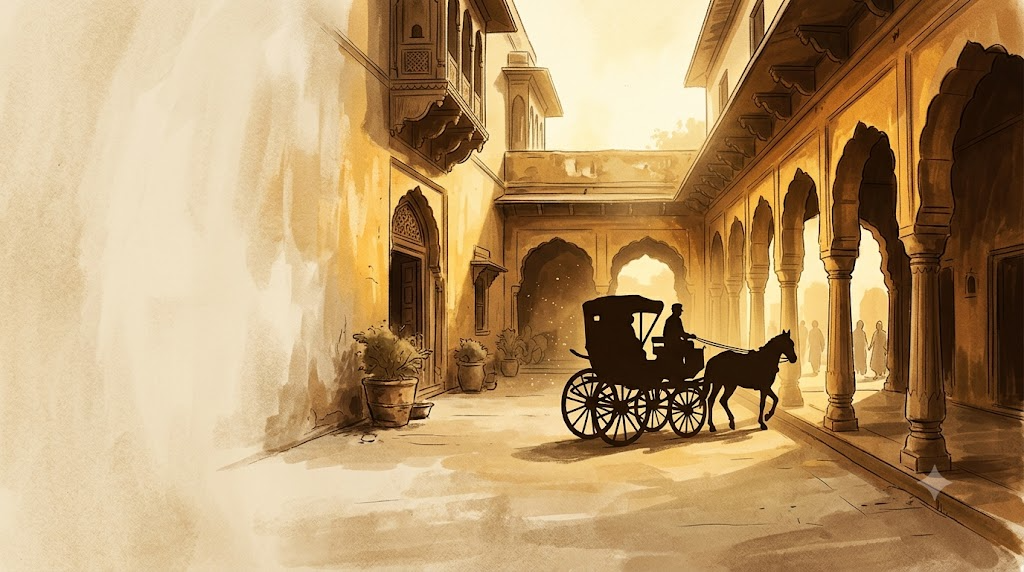
By rights, a young man like Vandhiyathevan ought to have felt his heart leaping with wild joy at the mere sight of such august personages sharing the same banquet hall. Yet, he felt not the slightest flicker of enthusiasm. Why are so many of these powerful kings gathered here? he wondered to himself, more than once. Why now, of all times? Vague suspicions and dark conjectures began to crop up in his mind, leaving him thoroughly confounded. This heavy sense of disquiet had not abated by the time he finally washed his hands after the meal and retired to the isolated space Kandamaaran had arranged for him for the night. Because Sambuvaraiyar’s sprawling royal palace was quite swamped with esteemed guests, Vandhiyathevan had been allotted a modest spot in a mandapam (an open pillared pavilion) on one of the upper balconies, open to the cool night breeze.
“Sleep well—you must be quite exhausted,” Kandamaaran assured him affectionately. “I shall join you here shortly, just as soon as I’ve seen our older guests settled safely into their rooms.” And with that, he slipped away.
A heavy drowsiness assailed Vandhiyathevan the very moment he rested his head on the floor; Nithradevi (the gentle Goddess of Sleep) swept him into her quiet arms almost at once. And yet, not even the Goddess of Sleep can exercise complete control over a troubled mind. The body might be perfectly at rest, the eyes firmly closed in repose, but the restless thoughts that crawl about in the subconscious often choose these very moments to reveal themselves. Dreams begin to rise, shaking off the careful suppression of the waking mind, looping together unconnected worries, lingering fears, and the day’s experiences to form surprisingly disturbing pictures.
In his sleep, he heard it. Far away in the distance, a lonely jackal began to bay. Then one voice multiplied into ten, a hundred, and soon a thousand, raising their collective voices in a chilling howl that made his skin prickle with cold terror. And that was not all; the pack was approaching him, step by excruciating step. Out of the deep, stifling dark, their little eyes smouldered in their shadowy faces like bright, red embers of burning coal. There was only one way left to escape. Vandhiyathevan turned in the opposite direction and began to run, only to stop abruptly. A thousand shrieking hounds now accosted him, their sharp teeth practically dripping with a wild urge to tear him apart. Their eyes gleamed menacingly, spitting angry sparks of fury in the pitch blackness. Vandhiyathevan shuddered violently, barely able to string a single thought together as he contemplated his terrible fate, caught helplessly between slavering hounds on one side and a relentless pack of jackals on the other.
But then—oh, thank the heavens!—a temple suddenly appeared almost directly in front of him. Shaking off his paralysing terror, Vandhiyathevan practically flew through its heavy wooden doors and bolted them securely behind him. When he finally turned to take in his new surroundings, he realised that his chosen refuge was a temple dedicated to Kali. The fierce Mother Goddess seemed to be carved at her terrifying best, her teeth descending into sharp fangs, her tongue hanging out in a truly bloodthirsty fashion. Before the breathless young man could do much more than gape at the imposing statue, a temple priest danced out from the shadows behind it. He gripped a fearsome, curved scythe in his hands.
“So—finally arrived, have you? Come here!” the priest rasped, sidling closer, and closer, and closer to our young hero. “You are a prince, are you not? Recite your family history!” he demanded, his voice echoing in the stone chamber. “How long did your ancestors rule? Speak the truth—now!”
“The… the Vallavarayars of the Vaanar clan ruled for three hundred years,” Vandhiyathevan managed to stammer, his throat dry. “We lost our kingdom because of the Vaithumbarayars, back in my father’s time.”
“You are not a sacrifice worthy of the Goddess!” roared the priest, raising his blade. “Leave!”
And then, as happens only in dreams, the scene shifted abruptly. The terrifying stone form of Kali melted and changed into the gentle, smiling figure of Lord Krishna. A pair of lovely young women danced lightly around the idol, holding fresh flower garlands in their hands, with the saint-poetess Andal’s melodious pasurams sweet upon their lips. Vandhiyathevan almost smiled, completely mesmerised by this far more appealing performance, when he heard a gruff male voice singing right behind him: “Kandom, kandom, kandom…”
He turned around and saw Azhwarkkadiyaan Nambi. But no, it was not the man himself—it was just his severed head, stuck squarely on the temple’s balipeedam (a rounded stone altar placed before the sanctum, used for offerings)! Thoroughly nauseated and unable to stomach this truly hideous sight, Vandhiyathevan turned away so sharply that he struck his head hard against a thick stone pillar.
The jolt woke him. The misty, swirling wreaths of the dreamscape dissolved into the cool night air, but as his eyes fluttered open, he happened to see something that seemed to seamlessly bind the terrible strands of his nightmare straight into waking reality. The high Kadambur fort wall circled the palace at a little distance, and there, resting right on the top of the wall, directly opposite the open balcony where Vandhiyathevan lay, was a head. And yes, it unquestionably belonged to the Vaishnavite fanatic, Azhwarkkadiyaan Nambi.
This time, though, Vandhiyathevan was absolutely sure that the sight was neither a lingering nightmare nor the product of a tired, over-active imagination. No matter how many times he blinked his eyes or shook his aching head, the round face remained firmly in place. It was equally obvious, much to his relief, that this time the head was securely attached to a rather stout living body. Nambi’s thick fingers were clutching the rough edges of the stone parapet in a veritable death-grip. His small, sharp eyes were entirely focused downwards, intently observing something in the courtyard below him. What on earth was the fellow watching, his forehead furrowed with such deep concentration? Something, Vandhiyathevan felt certain, was terribly wrong here.
Azhwarkkadiyaan could certainly not have arrived in the dead of night out of the goodness of his heart. The man had some nefarious intention tucked away beneath his robes, some sneaky plan in mind, Vandhiyathevan was sure of it. And was it not his own bounden duty, as Kandamaaran’s dearest and most loyal friend, to save the Kadambur palace from any impending harm? What kind of a man would he be to simply loll about in his bed, while the very people who had just offered him such a magnificent feast were perhaps about to be robbed or wounded?
Without another thought, Vandhiyathevan sprang up from the floor. He tucked his sheathed sword securely into his waistband and began walking stealthily towards the spot where he had spotted Azhwarkkadiyaan’s head. His makeshift bed was situated in a quiet corner of an upper balcony, well away from the main passages currently in use. To reach the outer fort wall, Vandhiyathevan had to quietly pass through, skirt around, and walk by a great many shadowed corridors, thick stone pillars, the flat rooftops of several mandapams, stone benches, and carved sthubams (decorative pillars). He had been creeping along for quite a while down one such eternally meandering passage when the low murmur of voices drifted up to him. Vandhiyathevan paused, holding his breath.
He tiptoed carefully towards a stout stone pillar, concealed himself safely behind it, leant forward, and gazed down into the gloom. Below him lay a narrow, secluded courtyard, neatly enclosed on three sides by towering walls. About ten or twelve men were seated together within its confines. The great fort wall rose so high that it completely blocked out the half-moon’s soft, pearly rays, but a single, strategically placed iron lamp managed to shed a pool of warm, flickering light over the group.
To his great surprise, the courtyard’s midnight occupants were none other than Kadambur’s most esteemed guests. Vandhiyathevan had seen these very men—the great kings, lords, and high officials of the Empire—feasting at the banquet barely a few hours ago. It was perfectly obvious that they had foregathered at this ungodly hour to discuss matters of the utmost importance in absolute secrecy. And Azhwarkkadiyaan, the cunning fox, was clearly doing his very best to eavesdrop on their private conversation. The spy’s position up on the wall was strategically perfect; the fort and palace walls met at just such an angle that he could easily observe the gathering below and catch every word of their speech, while the men below would never think to look up and spot him. Ah, Azhwarkkadiyaan was a clever rogue indeed, there was no doubt about it.
But the spy had reckoned without the Prince of Vallam, the valiant Vandhiyathevan! No one could palm their clever tricks off on him so easily, least of all this stout, interfering scoundrel. He decided he would creep up, catch the wily Nambi right by the scruff of his neck, stop him from spying on decent people, and march him straight down to their hosts—but wait, how exactly was he to do that? To reach the spy’s perch, he would have to jump down into the courtyard and walk right across it, and he could hardly manage such a feat without instantly attracting the attention of the fierce warriors gathered there. Heaven knew there were dangers enough in attempting such a foolish thing.
Sambuvaraiyar’s morose, unwelcoming words from earlier in the evening—“I see no reason for your friend’s arrival today!”—suddenly echoed unpleasantly in his ears. These great men, these very pillars that upheld all of Chozha Nadu, were keenly intent on discussing gravely important matters of state. That they wished to do so in the strictest confidence was blindingly obvious from their hidden location. His sudden, clumsy arrival in their midst would only rouse all their worst suspicions. It would be quite impossible to explain his real motives to them, for Azhwarkkadiyaan would undoubtedly melt into the shadows and be long gone by then. He, Vandhiyathevan, would be the one instantly branded and chastised as a spy, the one forced to suffer the deep ignominy of a harsh interrogation. And, in all honesty, what possible, believable answer could he give them should they demand to know the reason for his creeping about the rooftops in the middle of the night? There would be only one possible outcome: his good friend Kandamaaran would be put to a terrible blush.
Ah, and there Kandamaaran was, seated quietly at the very periphery of the crowd! He, too, seemed to be an active part of this hushed discussion. Well, it was no matter, decided Vandhiyathevan. He would simply corner his friend and ask him all about it in the morning light.
Just then, his wandering attention was caught by a large, closed palanquin that sat quietly towards one side of the courtyard. Ah, wasn’t this the very same palanquin that had so closely followed Periya Pazhuvettarayar on his grand procession into Kadambur? The mysterious lady within—the one who had briefly pulled aside the silk screen with her slender, golden hands—where was she now, in this sprawling palace? Hadn’t Kandamaaran laughingly mentioned that the old warrior didn’t even dare leave his young wife behind in the anthappuram? Ah, such was always the sad case when men married so late in their autumn years, and it was a thousand times worse when the new bride happened to be ravishingly beautiful. Formidable men, heroes like Pazhuvettarayar, were reduced to the rather pathetic state of dragging their wives along wherever they travelled, so deeply tortured were they by wild, gnawing suspicions and jealous doubts. And now, here was this grand old warrior, bearing sixty-four battle scars, reduced to the quiet disgrace of being hopelessly infatuated by a pretty young woman. He was little better than a helpless slave to her beauty.
And yet, thought Vandhiyathevan, she was no Rathi, nor Menakai, nor the celestial dancer Rambhai, at any rate. Our young friend had certainly not forgotten the strange, cold revulsion that had washed over him when he’d briefly caught sight of her face. God alone knew what the great Pazhuvettarayar saw in this supposed paragon of beauty. Even more puzzling was Azhwarkkadiyaan’s bizarre fascination with the woman. Why else would that fat spy risk his neck to eavesdrop so desperately on this gathering, if not because the palanquin was resting right there? But then, who could say what their true relationship might be? Perhaps they were secret siblings, or even old lovers? Had Pazhuvettarayar, perhaps, taken the girl by brute force? The arrogant old lord was certainly quite capable of such high-handed, cavalier treatment. If that were indeed the case, it would neatly explain Azhwarkkadiyaan’s dangerous preoccupation with the lady; quite possibly, he was lurking about in the dark, merely seeking a fleeting opportunity to speak with her.
Ah, but what did any of this matter to him? Sweet sleep was beckoning, the night wind was cool, and there was absolutely nothing to be gained by poking his nose into tricky affairs that did not concern him in the least. Just as the young man decided that his hard stone bed was looking more inviting by the minute, a stray, clear word from the hushed conversation below drifted up and caught his ear. Someone had just mentioned his name. Vandhiyathevan froze in his tracks, leaning closer to the pillar, and began to listen to the speech with all his might.
“The young man who arrived today, the one claiming to be your son’s friend—where exactly has he been quartered?” an authoritative voice was asking. “It is of the absolute utmost importance that not a single whisper of our conversation tonight reaches his ears. Remember, his master is the Commander-in-Chief of the Northern Chozha Forces. The very last thing we need right now is for word of our plans to leak to him. Should any of us suspect that boy of having the slightest knowledge of our gathering, you must make absolutely sure that he does not leave this fort alive. In fact, it might be better and safer if he is simply silenced, once and for all…”
Well, our gentle readers may very easily imagine poor Vandhiyathevan’s lively sentiments upon overhearing this delightful speech. He decided, right then and there, that he was going absolutely nowhere, and he settled down as comfortably as he could against the cold stone to listen to the rest of it.
Prince Aditha Karikalar happened to be the Commander-in-Chief of those Northern Chozha Forces; he was the firstborn son of Emperor Sundara Chozhar, and the undisputed heir apparent to the great Empire. What on earth could be their objection to Vandhiyathevan serving loyally under him? And what dark, secretive matters could they possibly be discussing, that the crown prince of the realm could not be allowed to know of, at any cost?
“Vandhiyathevan is fast asleep in an open balcony well above-stairs,” Kandamaaran’s familiar, earnest voice floated up through the darkness, bravely defending his friend. “Not a single word of our conversation is bound to reach him up there. He really isn’t the kind of fellow who pokes his nose into business that doesn’t concern him, anyway. And even if he should somehow get wind of our meeting, I give you my word that I will make sure he doesn’t prove a hindrance to any of your plans. You may all rest easy—he is my guest, and my responsibility.”
“Such touching faith in your young friend, Kandamaaraa!” came the deep, rumbling voice of Periya Pazhuvettarayar. “It is heartwarming indeed. For your sake, I am glad of it, for we older men know absolutely nothing of him, after all. But these stern warnings are entirely necessary. We are about to speak on a supremely confidential subject tonight, one that will undoubtedly decide the very fate of this entire Empire. Our sole purpose in gathering here in the dark is to discuss the succession to the Chozha throne. Remember this well—the slightest whisper of our meeting reaching the wrong ears would end in truly disastrous consequences for every single one of us!”

© 2026 Matribhasa Classics. Public Domain


Comments (0)
Log in to join the conversation.