The Crocodile on the Banks

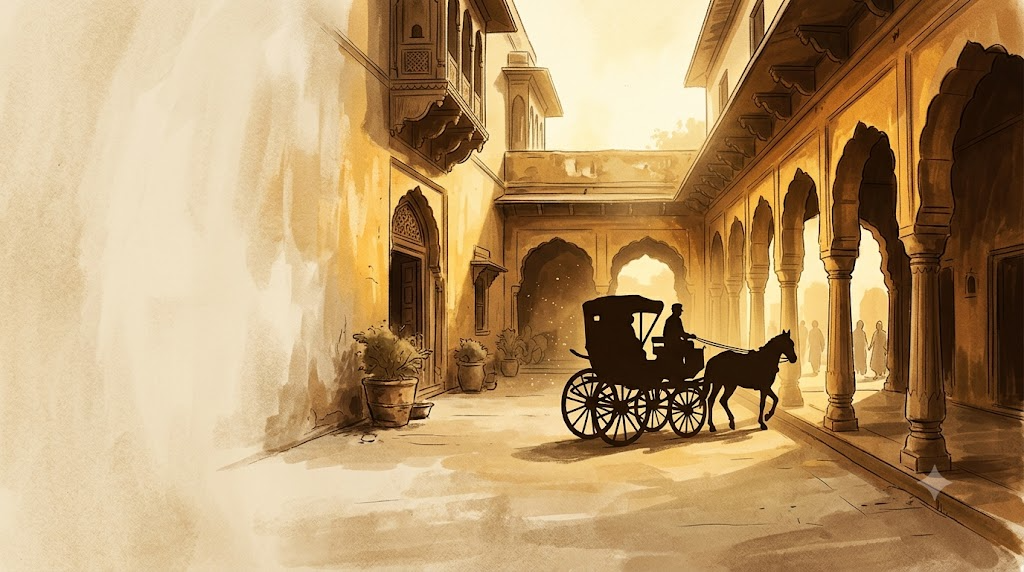
In those days, it was the custom among travellers making their way from Kudandhai to Thanjavur to journey along the green banks of the Arisilaaru (the Arisil river), or alongside the great River Ponni, towards Thiruvayaaru. From there, they would turn south, making for the capital. The reason for choosing this path was simple enough: ferries were plentiful here, making it an easy matter to cross the series of rivers that cut across the route—the Kudamurutti, the Vettaru, the Vennaru, and the Vadavaaru.
Vandhiyathevan was no different. The very first thing he did upon leaving Kudandhai was to strike out towards the Arisilaaru. And it would be quite safe to say that everything he had seen so far of Chozha Nadu’s splendour had far exceeded his wildest expectations. It is only natural, isn’t it, to gasp in pure wonder when one first sets eyes upon such visions of beauty? He cantered his horse past lush farms that flourished with the rich, earthy scent of ginger and turmeric. There were sprawling fields of sugarcane and plantain, and shady, rustling groves of tall coconut and slender areca-nut palms. Gentle streams, burbling brooks, placid little ponds, and running canals seemed to follow one another in quick, cheerful succession.
Water hyacinths and lilies grew in wild, tangled profusion in the brooks, while the ponds practically overflowed with red and white lotuses, alongside sengazhuneer (red water-lilies) and neelothpalam (blue lotuses) flowers, creating a marvellous riot of both colour and scent. Flocks of storks rose into the sky, vast off-white patches drifting against the vibrant hues of the earth below. Naarai birds (tall, graceful cranes) stood perfectly still on one red leg in the shallow waters, lost, it seemed, in deep meditation. Smaller canals, crisscrossing the farmland, gushed with cool water. The fields themselves, well-enriched with manure, fallen leaves, and tender shoots, were a deep, dark, earthy colour, overflowing with fertile slush. Farmers worked these lands happily from dawn to dusk, tilling the soil with a steady rhythm. Women, bent low over the earth, were busily engaged in planting new shoots, even as they raised their voices in glorious, full-throated folk songs that drifted on the breeze.
Lush, fully grown sugarcanes from the previous year’s planting were being cut in the fields and carted to the nearby mills, where they were promptly pressed, giving up their sweet, sticky juice. In the same vicinity, fresh jaggery was being boiled down in great vats, and the sweet, heavy scents mingled in the air, assaulting the senses in the most tantalising fashion.
Tiny, charming little huts—some with simple thatched roofs, others boasting neat tiles—peeped out shyly from the midst of the luxurious coconut groves. Their front entrances, washed and carefully paved with fresh cow-dung, were kept in pristine condition, almost gleaming like mirrors in the morning light. Some homes had yellow paddy strewn out to dry across their front yards. Plump roosters would often peck at the scattered grains, let out a lusty “Kokkorakko!” to announce their satisfaction, and then prance away. The village children, who were supposedly given the task of guarding the grain, barely spared it a glance. They were far too busy playing with seashells, or engrossed in the fascinating, rhythmic game of pallanguzhi (a traditional indoor game played with shells on a wooden board dotted with pits). Perhaps their view of the matter was that a few roosters couldn’t possibly eat all that much; whatever their reasoning, the thieving birds were largely left to their own devices.
Fragrant woodsmoke billowed softly above the huts. The homely, comforting aromas of boiling rice, frying kambu (pearl millet) grain, and roasted meat wafted out to the road, and Vandhiyathevan’s mouth fairly watered at the smell. Most warriors of those times were robust carnivores, and the hungry young man was certainly no different.
Smithies dotted the roadside at regular intervals, the glowing red coals burning fiercely within their shadowed depths. Danaar! Danaar!—that was the ringing din of hot iron being steadily forged. Alongside common farming implements such as heavy ploughs, iron spades, and crowbars, there lay large heaps of newly fashioned swords, broad shields, taut bows, and sharp spears. Honest farmers and rugged soldiers alike jostled with each other in the warm dust, eager to claim their chosen tools and weapons.
Even the tiniest of villages boasted neat, well-kept temples that proudly matched their modest stature. These holy places resounded with the auspicious clanging of semakkalams (flat brass gongs), the deep, booming beats of the nagara (a large temple drum), sacred chanting, and the sweet, melodic strains of Thevaram (sacred Shaivite hymns). Local village deities, such as the mother-goddess Mariamman, were reverently placed on soft cushions and paraded down the streets. Priests danced joyfully in the procession, often carrying colourful karagams (decorated pots balanced on the head for folk dances) or beating a rapid rhythm on tiny percussion instruments known as udukkai (a small, hourglass-shaped drum), as a joyful sign of their devotion. Naturally, they received liberal offerings of fresh paddy from the villagers as well.
Gentle cows ambled slowly through the village lanes, the brass bells tied around their necks tinkling musically as the young cowherd boys drove them towards the green pastures. A few of the boys even played a sweet accompaniment on their bamboo flutes. Farmers, their faces shining with honest sweat, mopped their brows as they worked, resting in the cool, dappled shade of the great banyan and tamarind trees during their brief intervals. These were the moments they chose to enjoy rowdy ram-fights, setting the sturdy, horned animals against each other and egging them on with loud, cheerful shouts.
Peahens shrieked lustily from their high perches atop the thatched huts. The peacocks, utterly fascinated by their calls, dragged their magnificent, heavy plumage with some difficulty, swung themselves awkwardly through the air, and eventually settled down among their mates. Beautiful grey doves stalked here and there, twisting their neat little necks to look about them with bright, curious eyes. As for the colourful parrots and sweet-voiced nightingales, locked away in their bamboo cages—ah, those pitiful little creatures sang the most sorrowful songs from within their wooden prisons.
Yes, there was plenty to see, and Vandhiyathevan drank in the marvellous sights, his horse clip-clopping at a slow, unhurried pace along the dusty road. He kept his mind actively engaged in capturing and storing away as much of this vibrant life as he could. But even as he tried his best to lose himself in the bustling outside world, he was keenly aware, deep down in the quiet corners of his subconscious mind, of a lingering picture. It was the face of a beautiful young woman, shrouded in the shifting mists of his recent memory.
Ah, why couldn’t she have just parted her coral lips and addressed a few simple words to him? Surely that would have been no great loss to her? Who could she possibly have been? No matter, he told himself—she was obviously someone not very conversant with good manners. Else, she would have paid at least a little attention to him, wouldn’t she? Was he, Vallavarayan Vandhiyathevan, such a remarkably insignificant specimen of a man that she must ignore him so completely?
And that wily old astrologer hadn’t breathed a single word about her true identity! A clever, cunning old man indeed, diverting the young warrior’s attention so smoothly to other, larger concerns. How wonderfully perceptive the astrologer had been, and how vast his experience of the world! To tell the absolute truth, the man had managed to escape saying anything of real, solid worth; his various predictions concerning royal affairs had been vague in the extreme, filled with an old man’s caution. The few things he did choose to reveal were largely public knowledge anyway.
Still, the astrologer had distinctly mentioned that Vandhiyathevan’s own stars were currently on the rise, hadn’t he? For that comfort alone, the old fellow deserved some good fortune. Long live the Kudandhai astrologer!
Vandhiyathevan travelled on in this manner, his restless mind occupied with everything he had heard and seen so far on his journey. Sometimes, the vibrant outside world caught his wandering attention, and he gave his mind over to the trees and the birds in brief, happy intervals.
Eventually, the road brought him to his intended destination, the leafy banks of the Arisilaaru. In the near distance, he heard a few distinct sounds, and immediately brought his horse to a halt. It was the sound of feminine laughter—bright and clear—accompanied by the musical tinkling of glass bangles. Vandhiyathevan stared towards the riverbanks, thoroughly intrigued, but the dense, green foliage of the trees screened the ladies quite effectively from the road. A sudden urge to seek them out struck him, and he trotted his horse quietly along the riverside, peering eagerly through the gaps in the trees, trying to discover where they might be hiding.
Abruptly, the quiet of the afternoon was shattered by a piercing scream.
“Ayyo! Ayyo! A crocodile—help, please!”
Instantly, Vandhiyathevan spurred his horse forward, rushing towards the source of that terribly frightened voice. There! He could just see a few women gathered through a small gap in the thick trees. Absolute terror painted their faces vividly—and ah, what a surprise it was! Two of them were the very same young women he had seen earlier at the astrologer’s home.
It took only a few fleeting moments for Vandhiyathevan to take all of this in—but the women were not the only things he saw. Underneath the spreading branches of a large tree, clothed in the deep, damp shadows of the riverbank, lay a large, frightening crocodile. It rested half on the muddy land and half in the shallow water, looking for all the world as though it were part of the enormous tree’s thick, gnarled roots. Its massive mouth gaped wide open, displaying rows of teeth that were jagged and terribly sharp.
Vandhiyathevan had seen one such terrifying reptile himself in the muddy waters of the Kollidam; he had also heard plenty of stories about what frightening, ruthless predators they were. This particular beast, sitting so quietly in the shadows, brought all his worst fears bubbling to the surface and set his nerves jangling with sudden tension. Not only did the creature seem entirely ready for a human feast, but it was positioned very close to the young women who had been laughing just moments ago, its mouth held open wide as if preparing to chomp down upon them. All it had to do was pounce forward—and they would be torn to pieces!
The riverbanks here were thick with tangled clusters of trees and thorny bushes; there was really no clear way for the frightened women to break through the undergrowth and make their escape. His heart may have been murky with confused, romantic feelings a moment ago, but Vandhiyathevan’s courage and resolve did not falter for a single instant. Neither did he waste precious time pondering his course of action. In one smooth motion, he hefted his trusty, sharp spear, took careful aim, and threw it with all his might.
The heavy weapon cleaved cleanly through the afternoon air and struck the crocodile, sure and true. It penetrated the beast’s thick, leathery skin, plunging in just a little. At once, Vandhiyathevan sprang forward from his horse, drawing his sword, fully intending to rip the monster apart once and for all.
But—but why were these young women suddenly laughing, just as they had been doing before? Vandhiyathevan could barely stomach the sound. Why on earth were they giggling at a time like this?
He stopped short in his tracks, suddenly unsure of himself. Not a single vestige of fear remained on the pretty faces of the women clustered around him; instead, they looked terribly amused, their dark eyes gleaming with suppressed mirth. They certainly did not seem to be the same helpless young ladies who had shrieked with such convincing terror just a few moments ago.
One of them—the majestic, commanding young woman he had been so taken with at the astrologer’s home—spoke out in a clear, melodious voice.
“Girls, quiet, all of you! Laughing at such a moment—!”
Her stern, beautiful words echoed somewhat vaguely in Vandhiyathevan’s ears, as though he were caught inside a strange dream. His sword still held aloft, he slowly directed his attention back to the crocodile. Then, he turned and stared hard at the group of chuckling women. A slow, dreadful suspicion reared its head in his mind—a suspicion that utterly froze him, making both his mind and body curl up in acute, burning embarrassment.
The majestic young woman walked gracefully forward once more and stood directly opposite the menacing crocodile, placing herself as though she were guarding it.
“Many thanks to you, Ayya—but there is really no need to trouble yourself.”
© 2026 Matribhasa Classics. Public Domain


Comments (0)
Log in to join the conversation.