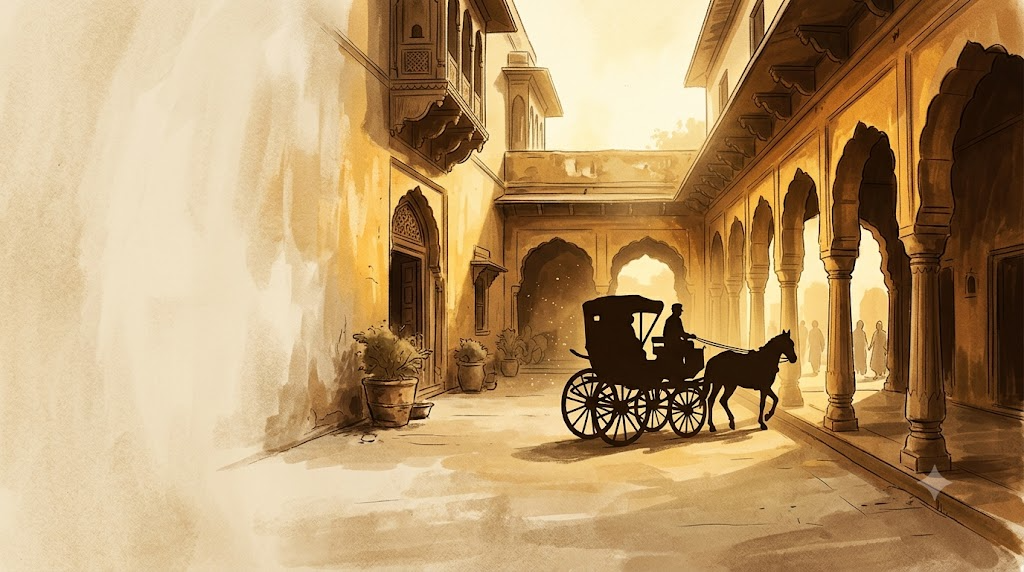
“Our honoured guest…”

The departure of the poets brought a sudden, heavy quietness to the bedchamber, which the royal physician took as his cue. He stepped forward softly, bearing a small bowl of some dark medicinal concoction that smelled faintly of bitter herbs and old bark. The Empress, Vanavan Maadevi—a princess of the proud Malayamaan clan—received the bowl from him with gentle hands and proffered it lovingly to her husband.
Chinna Pazhuvettarayar, who had been bottling up his impatience with considerable effort all this while, seized the moment. He hurried to the Emperor’s bedside, practically dragging young Vandhiyathevan along by the hand.
“Prabhu?” the commander inquired, his voice tight. “Has the new medicine had any effect?”
Sundara Chozhar offered a tired, wistful smile. “The physician certainly swears by it, my friend. So does Her Majesty. I, however, must admit that I feel nothing of the sort. To confess the truth, Commander, all this fuss is a pitiful waste of time and energy. My days are numbered; Yama, the Lord of Death, nips at my heels. At this very moment, I know he seeks me in the old capital of Pazhaiyarai, and once he realises that I no longer reside there, he will come knocking at my doors here—”
“You must not speak so, Prabhu,” Chinna Pazhuvettarayar interrupted, looking genuinely pained. “Witness, if you please, how your words sink our spirits! Your ancestors—”
“Ah, you remind me, of course, that none of my ancestors feared Death. But if I were to have the good fortune of embracing a valiant end in a battlefield like my forebears, Commander, neither would I. Nor would I bemoan my fate. I would, in fact, welcome it with open arms and an enthusiastic heart. My uncle, Rajadithyar, embraced death as he plunged into the thick of war at Thakkolam; he carved his name into the annals of Chozha history and gained pride of place for eternity as ‘He Who Embraced Death on his Elephant’. As for me—I suppose I shall gain the rather noble title of ‘Sundara Chozhar Who Feebly Welcomed Yama on his Sickbed’. Yet another uncle of mine, the Emperor Kandaradhithar, was solely immersed in the worship of Shiva Peruman; death held no fears for him. He went on pilgrimages to lands along the western seas and attained the Lord’s Feet, earning the lovely sobriquet: ‘He Who Embraced Death in the West’. I claim no special devotion towards God, neither am I in any position to make long pilgrimages. How many more days am I fated to lie abed, a sore trial to both myself and those around me? And yet, something tells me—I am not long for this world.”
“Sire, the royal physician is confident that your health is in no danger; the astrologers are of the exact same opinion.” The commander paused, his eyes narrowing slightly as he glanced at the young man beside him. “And yet, this youngster spoke of danger a while ago, did he not?”
“Ah, the youngster from Kanchi?” The Emperor looked up. “Yes, I do remember him saying something about peril. What were you speaking of, Thambi? My state of health, perhaps?”
Vallavarayan Vandhiyathevan stared at the Emperor, his brain racing at the speed of summer lightning. If he admitted that he did, indeed, warn the Chakravarthy of danger, he was completely done for. Every dark suspicion of the Pazhuvettarayars would be aroused, and he would be the one courting peril in every conceivable form. Very well, he thought; if there was ever a time to put his wits to good use, it was now. He would have to play around with the very sounds of the words, cannily employing Tamil grammar to change the long vowel to the short—transforming the nedil into the kuril—and pray that he could pull off the ruse.
“Your Gracious Majesty, who am I to speak of danger in your exalted presence?” Vandhiyathevan began, his voice ringing with practised innocence. “Our valiant Chinna Pazhuvettarayar guards this formidable fort; the royal physicians are always at hand, and here is our Empress caring for your noble person—the very incarnation of Savithri Amman, the legendary wife who wrestled her husband’s life from Death himself. What sort of danger could possibly dare to accost you here? No, Sire. All I cried out was Abayam! Abayam!—I was crying out for sanctuary, not warning of danger. I simply wished to submit a prayer at your illustrious feet; to beg your indulgence, your compassion. Grant me sanctuary, gracious Highness. I am but a stranger here, the last of our once-hoary Vaanar clan, its only living representative. Thus far, I have served under your son and gladdened his heart. Now, I petition you, Sire, to consider my request and grant me at least a fraction of the lands my ancestors once ruled over. Oh King of Kings, all I can do is prostrate myself at your feet and pray that a boon be granted to this ignorant servant. Abayam, Your Majesty! This orphan begs your protection!”
Vandhiyathevan finally stopped to take a breath, his chest heaving slightly after the non-stop, impassioned speech. Judging by Chinna Pazhuvettarayar’s pinched, sour expression, the commander was far from happy with the boy’s quick-tongued effusion. The Emperor’s haggard face, however, relaxed into a genuine smile, and the Queen’s eyes crinkled with obvious pleasure.
“It would seem that the Goddess of Learning showered this young man with Her divine grace, and wrote upon his tongue the very day of his birth,” marvelled the Empress, her voice soft and admiring. “He certainly has a way with words, hasn’t he?”
Well, he had come this far. There was no harm in seizing the day, was there? Vandhiyathevan decided he might as well push his luck.
“Your Gracious Majesty,” he said, turning his bright eyes to the Empress. “I appeal to you, Thaaye—gracious mother—to address my wants and further my cause with the Emperor. I am an orphan, you see, a man with no relations in the world. I must swallow my pride and speak for myself. I have heard lovely tales from our epics that Goddess Parvathi appealed to her lord Shiva Peruman, and the Goddess Lakshmi to her consort Thirumaal, on behalf of their devotees. I plead with Her Majesty to speak for me. Pray, grant me at least ten little villages of my ancestors’ lands, and I shall consider myself fortunate beyond belief!”
Sundara Chozhar could not help but chuckle, delighted by the boy’s well-mannered, submissive, yet utterly brazen speech.
“I find myself liking this young man a great deal, Commander,” the Emperor addressed Chinna Pazhuvettarayar. “As for the Devi, I believe she is considering adopting him as a third son, perhaps! About his request—we may grant it, I suppose? There should be no real impediment, should there?”
“I do not quite see where my opinion ever enters this issue, Sire,” the commander replied stiffly. “Surely it is Prince Aditha Karikalar whose consent, or otherwise, is required at this juncture?”
“Sire, I’ve petitioned the Crown Prince, but he bids me ask the Pazhuvoor lords,” Vandhiyathevan chimed in, perfectly playing the middleman. “Now that I am here, Thanjavur’s Commander wishes me to submit myself back to the Prince. And here I am, quite caught in the middle.”
“Never fear, child. We shall find an opportunity to hear them both out,” the Emperor promised gently. Then, he turned his tired eyes back to his commander. “This youngster, I am sure you are aware, brought me an olai—a palm-leaf message—from the Prince. There was nothing new in it, I am afraid. Just a message informing me that he is constructing a golden palace in Kanchi. Apparently, he would like it very much if I resided there for a while.”
“It shall be as you please, Sire,” came Chinna Pazhuvettarayar’s measured answer.
“Ah, you shall carry out everything as I please, of course. But my legs… my ridiculously weak legs refuse to accede to my wishes in the same way. Journeying to Kanchi at this time is simply impossible. And I cannot even conceive of travelling in closed palanquins, shut away like the womenfolk. The very thought is disgusting. All I can do is send a reply to Aditha Karikalar, bidding him to come here.”
“Surely the Prince is required to stay on in Kanchi for the time being?” the commander pressed, a subtle edge to his voice. “Our foes in the north are still powerful, aren’t they?”
“Parthibendran and Malayamaan are more than capable of taking care of them. I do not quite know why, but something deep within whispers to me that the Prince must be by my side now. And that is not all. I wish to send a message to Eezham, asking the Ilango—the Young King, Arulmozhi Varmar—to return home as well. I need them both with me, to discuss something very important. Besides, Commander, you will get an opportunity to communicate your strong objections to sending food to Ilankai while Arulmozhi is actually here to listen.”
“Forgive me, Sire, but as far as sending food to Eezham is concerned, neither mine nor the Dhanaadhikaari’s—the Lord Treasurer’s—is the objection. Rather, it is the people of Chozha Nadu who protest at such a drain on our resources. The last harvest yielded disappointing results, Sire, and there was barely enough rice to feed our own people. When such is the circumstance, sending ship after ship of grain to Eezham seems to our citizens to be a colossal waste. At the moment, they are careful to keep their objections to a low, grumbling murmur. But soon, their voices will swell to an angry shout. Why, they might even penetrate the thick walls of your palace and resound in your very ears!”
“Never would Arulmozhi embark upon something to which his people objected so strenuously,” the Emperor said with quiet faith. “In any case, it would be much better if he does visit us, just once. We must decide on sending a swift messenger to Ilankai as soon as Periya Pazhuvettarayar returns to us. Do you happen to know when that is likely to be?”
“Tonight, certainly, Sire.”
“Then I shall send a reply to Kanchi tomorrow. This youngster may carry it back, may he not?”
“Someone else would be better suited to the task, I think,” Chinna Pazhuvettarayar said smoothly. “The boy has travelled all the way from Kanchi in a single breath. Perhaps it would be better if he rested in the fort for a while.”
“Excellent. Why, he could even remain as our guest until the Prince comes to us.”
At this moment, the Empress chose to rise, the rustle of her silks signalling that the Emperor’s strength was fading.
“Forgive me, Sire,” apologised Chinna Pazhuvettarayar at once, bowing his head. “I have stayed talking far too long today, and have forced Her Majesty to issue a silent warning.”
“This young man is our honoured guest, Commander. Please do ensure that his every need is taken care of,” instructed Malayamaan’s daughter, her tone leaving no room for argument. “Ah, had the Emperor only enjoyed good health, he might have stayed right here in this very palace!”
“Rest assured that I shall take care of him, Your Majesty,” promised Chinna Pazhuvettarayar, a strange, dark gleam in his eye. “I shall take great care of him, indeed.”
And as he said it, his thick hand rose, almost without his knowledge, to touch his impressive moustache—his fingers lingering, just for a moment, to slowly twirl the ends.
© 2026 Matribhasa Classics. Public Domain


Comments (0)
Log in to join the conversation.