The Court Poets

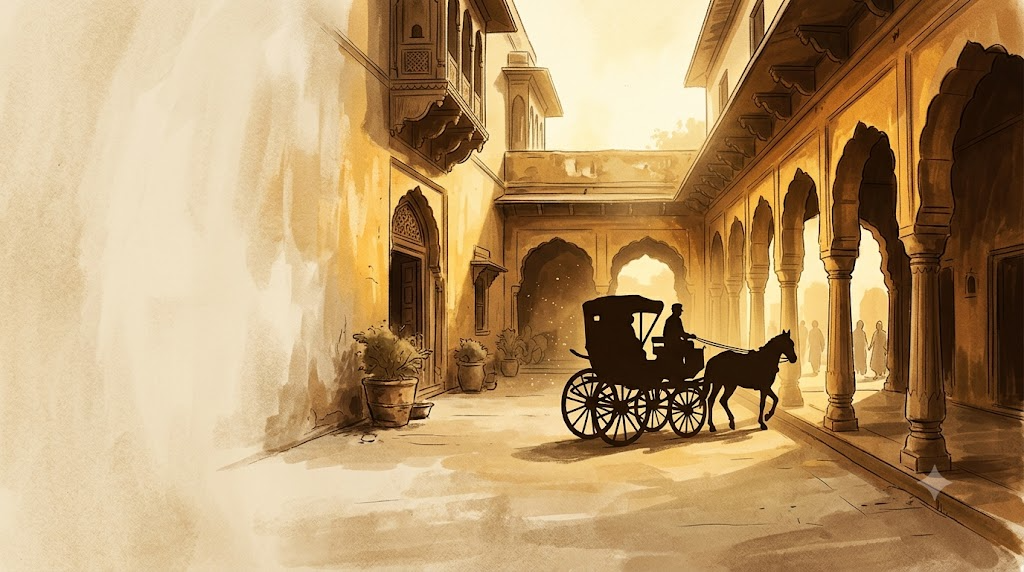
“Paraak! Paraak! Make way!” Here came the court poets, the royal bards. These were eminent men, whose knowledge of the divine Thamizh language was said to be as boundless as the ocean. They styled themselves the distinguished descendants of the great sage Agasthiyar. They had read the numerous pages of ancient classics like the Tholkaappiyam from cover to cover. They had well-nigh gobbled up great epics like the Silappathikaaram, and claimed to know more about the renowned Thirukkural than its very author. These were men who would cheerfully prescribe rules of grammar to literature itself, and quote the classics until the world’s end just to confound the grammarians. And yet, despite all these fantastic qualifications, they could actually compose verses of their own! The true measure of their talent, perhaps, lay in the fact that millions of white ants might comfortably subsist for centuries upon the palm-leaf manuscripts of their numerous, wonderful, and timeless creations.
Now, this group of superbly talented men gathered before the Chakravarthy, chorusing in one voice: “Vaazhga! Long may he live! Long live the Emperor Who Rules over the Seven Worlds! Long live Sundara Chozhar, Who Brought the Pandiya to his knees! May he who guards and cherishes poets live long! May the grandson of Panditha Vathsalar, the illustrious Emperor Paranthaka Chozhar, royal patron of the arts, flourish forever and ever!”
Judging by the weary expression on Sundara Chozhar’s face, he was not entirely delighted by these grandiloquent greetings. But his natural courtesy and good breeding made him attempt to rise from his couch to welcome them.
Chinna Pazhuvettarayar, observing this effort, stepped forward at once. “Prabhu,” he said softly, “our poets’ intention was certainly not to discommode you in any way, but simply to seek an audience with your gracious Majesty. I pray that you remain in repose. Please do not inconvenience yourself.”
“Indeed, yes, O King of Kings!” exclaimed Nallan Saathanaar, who was quite obviously the leader of the poetic gathering. “Never let it be said that we were the cause of Your Majesty’s agitation!”
“I am very glad to see you, of course, after such a long time,” acknowledged the Emperor, who had always cherished a great and genuine fondness for Thamizh. “I should be quite happy to listen to a few verses, if you will oblige me.”
The group settled themselves down on the jewel-toned jamakkaalam (a thick, woven carpet) spread out in front of the throne. Vandhiyathevan, deciding to seize the moment, quietly took a seat among them. His message was not yet complete, and he had no real desire to leave if there was even the slightest chance of delivering it fully.
Chinna Pazhuvettarayar saw him sitting there, and his ire rose. It took a great deal of self-control to push down the sudden fury that threatened to consume him, but he managed it. His first instinct was to have the insolent boy thrown out by the guards. But then, wiser counsel prevailed. He would have much more scope to understand this upstart’s true intentions if the fellow remained right here, under his very nose, so to speak. Very well. He would appear to ignore the youth for a while. But once these dratted poets took their leave, he would seize upon the boy and find out exactly what tall tales he had been pouring into the Emperor’s ears. “Danger! Abaayam!” The young man’s urgent voice still rang mockingly in the Commander’s ears.
“My good friends, I have not had the pleasure of your company in a long while. My ears hunger for the taste of beautiful Thamizh verses,” began Sundara Chozhar in his tired voice. “Have any of you written a new song, perhaps?”
At once, one of the many masters of poetry gathered there sprang up. “Prabhu, this servant comes to your feet from the Buddhist Palli, the monastery in Ulagapuram that carries your illustrious name. I bring you welcome news. The monks are delighted beyond measure at your magnanimous grants, marvelling at the nobility of a devout Saivite who showers wealth upon their madams (monastic establishments). They are, however, deeply grieved to know of your ill-health, and have been praying endlessly for your recovery. Your gracious Majesty must permit me to recite one of their verses.”
“By all means; I am waiting to hear it,” assented the Emperor.
The poet obliged at once, reciting a simple, melodic song that exulted in the grace and compassion of Sundara Chozhar, King of Nandhipuri (for Pazhaiyarai was known by that name in bygone years, under the old Pallava rule). The verse prayed that the Emperor’s strength, large-heartedness, and beauty might live long:
Pothiyanthirunizhalpunidha! Nirparavuthum MethaguNandhipuriMannarSundara Chozharvanmaiyumvanappum thinmaiyumulagirchiranthuvaazhgenave!
“Excellent!” his compeers erupted in praise, the moment the poem ended.
“It is indeed astonishing that Buddhist monks should be capable of such immense gratitude,” wondered one particularly staunch Saivite poet aloud.
“True enough, for the service I rendered the Ulagapuram monastery was rather meagre, in my own opinion,” admitted the Emperor humbly.
“Ah, never say that, Sire. Who among us who has experienced Your Majesty’s compassion and bounty can help but sing its praises? Why, even Indra, Lord of the Devas, the Sun God, and Siva Peruman Himself have known that great felicity!” put forward one earnest worthy.
“But how is this?” An amused smile twisted Sundara Chozhar’s pale lips. “Surely all these divine entities could not have had occasion to find themselves beholden to me?”
“Your Majesty must permit me to recite a certain poem,” requested the bard, puffing out his chest.
“Certainly.”
Indiranerakkarialithaar— Pari ezhalithaar Senthirumeniththinagararku— Sivanaarmanathup Painthugilerappallakalithaar— Pazhaiyaarainagar SundaraChozharaiyaavaroppaargalith Thonnilathe!
“Excellent!” “Marvellous!” The court echoed with loud applause, accompanied by a great many nods of assent and numerous exclamations of approval at this highly extravagant verse.
Sundara Chozhar looked at them, his eyes unexpectedly bright with emotion. “Could one of you please elaborate on this song’s meaning for me?”
Half a dozen men rose at exactly the same time, and for a short while, a confused babble of voices filled the room. Eventually, everyone except Nallan Saathanaar took their seats again. The head poet cleared his throat and began to explain:
“Once, Indra, Lord of the celestial Devas, was engaged in a furious battle with the demon Vriddhaasuran. So fiercely raged the combat that the Deva actually lost his famed and powerful elephant, Airaavadham. He searched high and low for a suitable replacement, but could not seem to find a single beast to match it in the whole world. Finally, desperate for a mount, he came down to earth to Emperor Sundara Chozhar of Pazhaiyarai, and petitioned him for an elephant that was as powerful as his lost mount. To which the gracious Emperor replied that he was very sorry, but he had none that was the equal of the great Airaavadham.
“‘But I have a great many that are far superior!’ the Emperor added, and he led the way to his vast elephant enclosures, where stood thousands of magnificent animals, resembling large, dark hillocks. Devendran stared at them, quite at a loss for words, for he knew not which to choose! Sundara Chozhar took pity on the stupefied Lord of the Devas, and graciously chose an elephant for him. But Indra was struck again by a fresh anxiety: how was he ever going to ride such a mammoth creature? Not even his famed Vajrayudham, his signature thunderbolt weapon, could control such a mighty mount! And then, Emperor Sundara Chozhar came to his rescue once again, and gifted him with a splendid, sturdy goad as well, to assist him!
“Yet another time, the Sun God, Surya Bhagavan, Who rules the sky with His dazzling red and gold rays, was bound in fierce combat with the dreaded snake-king Rahu. The evil demon tried his very best to swallow Surya in one gulp, but the God’s brilliant beams almost blinded him, and he could not. The demon’s terrible venom, Kaalakodi, did, however, kill all seven horses harnessed to the Sun God’s chariot. Surya Bhagavan stood completely bewildered—for how was He to shower His rays upon the world every day, without His chariot and trusty steeds? And then, Emperor Sundara Chozhar, the very epitome of compassion, approached Him with seven of his finest stallions, and requested Him to continue nurturing the world with His life-giving light. Surya Bhagavan duly appreciated this signal service from one who was, after all, His own regal descendant.
“And there was the time when Siva Peruman and His divine consort Parvathi Devi were to be wedded in Their snowy heavenly abode of Kailasam. The bride’s party arrived with Her seer varisai—the traditional, elaborate wedding-gifts that usually accompany a new wife. But they lacked just one thing: a palanquin. The entire bridal party broke out in worried chatter. Soon, a grand wedding procession would have to take place, and there was nothing, except for the Lord’s bull, for the newly married couple to ride in! Sundara Chozhar, who learnt of this distressing situation, sent at once for his finest pearl-encrusted palanquin from Pazhaiyarai. With the great deference and devotion due to God, he made a present of it on the auspicious occasion of Siva Peruman’s own wedding. Who, I ask you, can possibly be the equal of Emperor Sundara Chozhar for compassion and benevolence, in this entire vast world surrounded by roaring oceans?”
Sundara Chozhar, listening intently to this wonderfully involved and colourful explanation, suddenly broke into a merry peal of laughter. Long months of painful illness and silent suffering had lined his wan face; not even his devoted consort, Empress Vanavan Maadevi, had heard him utter so much as a chuckle in all this time. Her husband’s sudden joy served to lift her own sagging spirits just a little. Even her maids and assistants gathered nearby were cheered by the heartwarming sight.
Chinna Pazhuvettarayar, who had remained standing stiffly all this while, now stepped forward. “I believe I have committed a grievous error,” he said, bringing his palms together in a respectful gesture. “Will Your Majesty forgive me?”
“Ah, is that Thanjavur’s Commander?” said the Emperor, still smiling. “Now what is this heinous error for which you beg my pardon? Perhaps you snatched back the elephant and horses I so graciously donated to Indra and Surya Bhagavan? Or is it the palanquin that you looted from poor Siva Peruman’s bridal treasures? You are certainly capable of such devious acts, you know.” And the Emperor was consumed by mirth once again.
This time, the court poets cheerfully joined him. But it was young Vandhiyathevan, perhaps, who seemed to appreciate the joke just a little too much, laughing the loudest of all. Chinna Pazhuvettarayar noticed it, and sent a scorching, withering glance in the youth’s direction, before turning his attention to the Emperor again.
“My mistake, Your Majesty, was this,” he continued smoothly. “I gave a great deal of credence to the royal physicians all this while, and deliberately kept our good poets from visiting you. I believed their company might be detrimental to your health. But I was entirely mistaken. Their presence clearly amuses you; this court has witnessed your hearty laughter after aeons, I should think. Even the gracious Empress, Udaya Piratti, and her maids are smiling at your happiness. And I myself delighted in it, as well. It was an unforgivable crime, was it not, to have prevented such a pleasurable exercise all this while?”
“You make an excellent point, Commander—and you have proven the truth of my own words, as well,” replied the Emperor. “I did ask you, did I not, to disregard the cautious physicians and allow the court poets to meet me, instead of barricading me against them?”
The royal physician, hovering nearby, judged this the right moment to rise. Covering his mouth with his palms in a gesture of extreme deference, he launched into a long and highly involved medical explanation, but the Emperor did not seem very interested in his excuses. Instead, he turned his gaze back towards the eager poets.
“Does anyone here know the creator of such a wonderful verse?” he asked them mildly. “Do tell me, if you do.”
“Ah, now that is what we could never quite find out,” lamented Nallan Saathanaar, shaking his head. “Sire, if we ever do find him, we have firmly resolved to award him the grand title of the Chakravarthy of Poetry, and to carry him around in a decorated palanquin upon our very own shoulders! Alas, our efforts have so far yielded no result.”
“Not surprising in the least,” was Sundara Chozhar’s rather sardonic reply. “Any poet who can possibly stack so many outrageous lies one upon another in these silly verses certainly wouldn’t be willing to reveal his true identity, would he?”
The poets stared blankly at one another, completely nonplussed at this unexpected remark. Not a single one of them could think of a suitable, face-saving reply.
It was at this precise moment that our young Vandhiyathevan threw himself valiantly into the breach.
“Ah, Prabhu, they’re not quite lies,” he piped up cheerfully. “After all, should ordinary people utter such things, they would naturally be classified as rank falsehoods. But the very same statements, if made by royal strategists, would be lauded as cunning ruses worthy of the great Chanakya! As for the bards, they would simply consider it highly imaginative, and excuse it by calling it by various beautiful and confounding poetic terms, such as ani alangaaram (ornamental embellishment) or il poruluvamai (comparing a subject to something that does not exist in reality)…”
“Excellent!” The court poets turned towards him as one man, and expressed their wholehearted approval in no uncertain terms. “Very well said!”
The Emperor stared at Vandhiyathevan as well. “Ah, you are the young man who brought me an olai from Kanchi, are you not? Well, well, you have certainly rendered my arguments quite futile with your highly intelligent answer.” Then, with a twinkle in his eye, he turned back towards the poets. “My learned friends, there is really no need to expend a great deal of your valuable time in trying to find this elusive poet, or to confer upon him the grand title of Chakravarthy of Poetry. For he already bears the crushing weight of the Chozha crown upon his own head, and struggles daily to live with heavy titles such as Emperor of the Three Worlds, or even worse, the Seven Worlds, King of Kings, and other such grandiose appellations. I am really not sure he could survive one more!”
And if I were to tell you, dear readers, that the eminent poets who listened to this highly unexpected claim almost drowned in a sea of utter amazement—well, you will simply have to believe me. After all, it could just be my own imaginative and creative turn of phrase, and a rather fine example of those beautiful poetic terms such as il poruluvamai or ani alangaaram, could it not?
© 2026 Matribhasa Classics. Public Domain
Comments (0)
Log in to join the conversation.