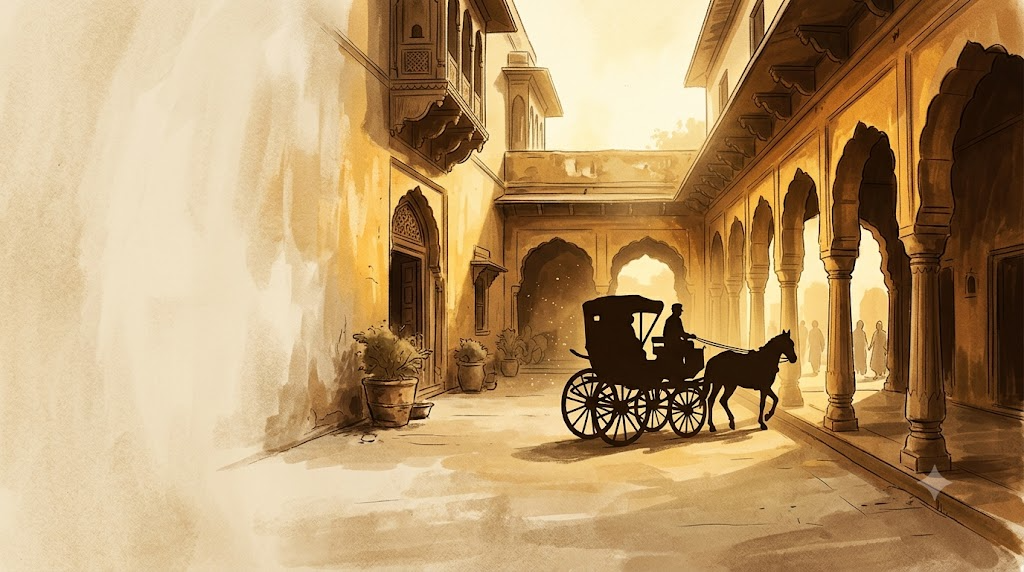
The Kadambur Palace

The short rest had done Vandhiyathevan’s horse a world of good. Setting a brisk, even pace, the young man found himself before the grand gates of the Kadambur palace within a naazhigai (a traditional measure of time, about twenty-four minutes).
Sengannar Sambuvaraiyar was one of the many ancient clan chieftains who wielded power under the sweeping banner of the imperial Chozhas, and his home was built to show it. The entrance to the palace rivalled the massive, forbidding gates of a great city. On either side, the walls rose up thick and unyielding, curling away like a proper madhil (a fortified temple wall).
The place was teeming with life in the fading evening light. Elephants, horses, and sturdy bulls stood cheek by jowl, breathing heavily in the dust. Their trainers jostled for space with the water-bearers, while torchbearers held their flames high, calling out to the men moving about with heavy brass urns of oil.
The courtyard rang with enthusiastic exclamations and the cheerful hubbub of celebration. Vandhiyathevan paused at the edge of the clearing, a sudden flutter of hesitation and despondence in his chest. It was obvious he had arrived right in the middle of some grand revelry, and somehow, he felt this might not work in his favour.
And yet, a boyish curiosity tugged at him; he badly wanted to know the reason for all this festivity. The great gates stood wide open, true, but they were blocked by thick-set guards in heavy armour, their swords and spears held at the ready. To tell the truth, in the leaping torchlight, they looked less like mere men and more like fierce demons guarding the gates of the underworld.
Standing about and hesitating would serve no purpose, our valiant young man decided. If he crept up slowly, he would be noticed and stopped at once. No, the only way in was to put on a brave face, ride full tilt at the soldiers, and dash right through.
For Vandhiyathevan, to think was to act, and he immediately urged his horse forward. But alas, what a disappointment! The moment he clattered up to the entrance, two of the burly sentries neatly crossed their long spears to bar his way, while four others grabbed his horse’s reins. One of them craned his neck, squinting at the intruder, while another thrust an oil-torch close to the young man’s face to get a better look.
“So!” Vandhiyathevan’s voice rang out, full of manufactured fury. “This is how you treat your esteemed guests, is it? Is this your grand idea of hospitality?”
“And who might you be, thambi, with such a remarkably unruly tongue in your head?” asked one of the guards, sounding more amused than threatened.
“You wish to know my name and station? You shall have them!” bellowed Vandhiyathevan, puffing out his chest. “Vaanagappadi is my country, and I claim Thiruvallam as my city. There was a time when your men took pride in tattooing the names of my valiant ancestors on their very chests! I am Vallavarayan Vandhiyathevan. Does that satisfy you?”
“My, how impressive!” exclaimed a guard, grinning broadly. “Pray tell, why didn’t you bring along a kattiyakkaaran (a royal herald) to sing out these grand titles before your arrival?” The other soldiers cackled in good-natured merriment.
“Whatever your high-sounding title might be, you cannot enter the palace precincts at this hour,” declared the Chief of Guards, his tone firming up. “All our expected guests have already arrived, and our master has issued strict orders not to let another soul in.”
By now, the little commotion at the gates had drawn some attention. A few guards who had been chatting idly just inside the walls ambled over to see what the fuss was about. One of them took a long, keen look at the new arrival and suddenly perked up.
“Adei, isn’t this the fellow with the mule we chased away from the temple grounds earlier this evening?” “Call it an ass, you idiot,” supplied a resident jester. “Ah, my friends,” declared a third, striking a theatrical pose, “do but take note of the exceedingly proud bearing of this noble ass’s owner!”
As he sat there absorbing their taunts, Vandhiyathevan’s mind was whirring, rapidly weighing his options. Was there really any point in brawling with these men just to get inside? Might it not be wiser to simply turn around and ride away? Perhaps, he thought, he should just reach into his tunic and flash Prince Aditha Karikalar’s royal insignia at these grinning fools. That would certainly wipe the smiles off their faces. For who would dare block the path of a man carrying the emblem of the Commander-in-Chief of the Northern Chozha Armed Forces? Surely not a single soul from the northern banks of the River Pennai all the way down to Kumari at the southern tip of Thamizhagam would even dream of such a thing.
The last bit of heckling from the Pazhuvoor guards drifted into his ears, and it pushed him to a sudden, reckless decision. “Let go of the reins,” he announced with a sigh. “I’m leaving.” Surprised by his sudden surrender, the soldiers let their hands drop from the leather.
In a flash, Vandhiyathevan pressed his heels hard into his horse’s flanks. At the exact same instant, with a sharp metallic hiss, his sword left its scabbard. The flickering torchlight danced along the blade as he swung the weapon in a wide, singing arc. He moved with such sudden force and dexterity that, for a fleeting moment, he looked quite magnificent—rather like Lord Thirumaal himself, wielding his divine discus with supreme and terrible confidence.
The heavy blade cut through the evening air with a fearsome whine. His startled horse gave a great bound forward, bursting straight through the gates. The guards standing on either side tumbled backward, sprawling in the dust in a most ungainly fashion. A dozen long spears, which had been held so firmly in readiness only a moment before, went clattering to the stone courtyard in a useless heap. The Pazhuvoor men could only stand and gape as the horse plunged into their midst. A lightning-fast counter-attack was the absolute last thing they had expected, and when it suddenly looked very likely that their skulls were about to be cleaved open, they abandoned their posts and scattered in every possible direction.
A dozen things seemed to happen all at once. The fort’s enormous, heavy gates groaned and banged shut. Furious shouts erupted all around the entrance. “Get him! Take him down, now!” Metal bruised against metal as fallen spears were snatched up and swords were hastily drawn; the sharp clang and clash of weaponry echoed across the courtyard. Up on the walls, the palace drummers scented danger and immediately began to beat out a frantic, booming warning into the night: Daddam! Daddam!
Twenty, then thirty, then fifty heavily armed soldiers swarmed out of the shadows, surrounding Vandhiyathevan and his snorting horse in an instant. The young man didn’t hesitate. He vaulted from the saddle, his boots hitting the stone, and began waving his gleaming sword in great, dramatic circles. “Kandamaaraa!” he bellowed into the night. “Kandamaaraa! Help! Your own soldiers are murdering me!”
The converging men stopped dead in their tracks, suddenly looking rather hesitant. “Stop this instant!” A rich, stentorian voice thundered down from the upper wooden balconies of the palace. “What is all this senseless commotion down there?” A cluster of figures could be seen gathering near the carved railing, peering down into the smoky light of the courtyard. “Master—a rogue has just broken through the guard and forced his way into the palace grounds!” a soldier shouted back from below. “And he keeps shouting the name of our young master!”
“Kandamaaraa!” bellowed that deep voice again. “Get yourself down there and see what this uproar is all about!” That commanding roar, Vandhiyathevan guessed as he caught his breath, most probably belonged to the old chieftain, Sengannar Sambuvaraiyar himself. For the next few minutes, our hero and the tight ring of soldiers around him simply stood in place, eyeing each other warily.
“Now, what is happening here?” called out a much younger, more familiar voice. The soldiers promptly parted, making a neat path. A young man strode swiftly through the ranks, only to stop short, quite taken aback by the extraordinary sight before him. There stood Vandhiyathevan in the dead centre of the hostile ring, casually twirling his sword in the torchlight, looking for all the world like the valiant young lord Subramanya showing off his divine spear.
“Good heavens, my dear man—is it really you?” Kandamaaran cried, breaking into a delighted run. He threw his arms around the young warrior, wrapping him in a fierce, crushing embrace.
“You’ve insisted time and time again that I come and visit you,” said Vandhiyathevan, pointing the tip of his sword at the sheepish men surrounding them, “and when I finally do, just look at the splendid hero’s welcome I receive.”
“You idiots! Your brains are as useless as the sprouting leaves of an ulakkai!” Kandamaaran chided them. (He was, of course, playfully using an old Tamil insult—an ulakkai is a heavy wooden pestle bound in iron, used for pounding grain, which has absolutely no chance of ever coming alive or sprouting leaves. The soldiers’ intelligence, he implied, was much the same: non-existent.) “Get lost, all of you!”
Without wasting another moment, Kandamaaran grasped his friend warmly by the hand and practically dragged him away from the gates and into the warm, sprawling belly of the palace.
The young host’s feet barely seemed to touch the ground; his heart was fairly dancing with enthusiasm as he rushed his guest along, eager to point out every little sight. Such is the beautiful, simple way of things when one is reunited with a true friend of one’s youth. Oh, there is such a thing as romance, certainly—but romantic love, for all its intoxicating ecstasy, always brings its fair share of trials, bitter jealousies, and sleepless heartaches. But the deep friendship of one’s early years… ah, that is a golden thing. Nothing exists in it but pure joy and light-heartedness; not even the faintest shadow of sorrow is allowed to intrude upon it.
“By the way, Kandamaaraa,” Vandhiyathevan asked, trying to sound entirely casual as they hurried down a wide corridor. “I see your home is overflowing with grand guests and their entourages tonight. What’s the special occasion? And why on earth is there such tight security, with guards swarming all over the place?”
“I’ll tell you all about that in a minute,” Kandamaaran beamed. “But first—do you remember our old days in the military tents on the banks of the River Pennai? You used to go on and on about how you were dying to meet the great chieftains. Pazhuvettarayar, Mazhavarayar, this famous warrior, that mighty general… well, tonight you can see them all! Every last one of them, right down to their servants, their bodyguards, and every single stick and stone they travel with. They are all right here, under my roof!” he exulted.
Naturally, the very first place he took his dear friend, once the initial flurry of their reunion had settled, was the grand hall reserved for their most esteemed visitors. But before mingling with the guests, they had to pay their respects to the master of the house.
“Appa (father), haven’t I often told you about my dearest friend, Vandhiyathevan of the old Vaanar clan? Well, here he is in the flesh,” announced Kandamaaran, proudly bringing the young man before his father. Vandhiyathevan, always true to his fine birth and breeding, bent low and folded his hands respectfully in greeting. But for some inexplicable reason, the old chieftain Sambuvaraiyar did not seem particularly thrilled by his sudden appearance.
“Is that so?” the older man grunted. “Were you the reason for all that disgraceful mayhem in the courtyard just now?” “No, Appa—our thick-headed guards were the cause of it,” Kandamaaran cut in, eager to defend his friend. “Indeed?” Sambuvaraiyar raised a bushy, sceptical eyebrow. “If you must know, Kandamaaraa, I can see no good reason for your friend to arrive here half a jaamam (an old measure of time, about an hour and a half) after sunset on this particular evening—and in such a chaotic, noisy fashion, too.”
Kandamaaran’s youthful face grew a little pinched, but it was obvious he had no desire to argue with his formidable father in front of an audience. Swallowing his pride, he quickly took his friend by the arm and hurried him over to be presented to the great Pazhuvettarayar, who was seated rather majestically upon a richly carved chair right in the centre of the gathered lords.
“Uncle,” began Kandamaaran warmly, “this is my dear friend Vandhiyathevan, descended from the illustrious Vaanar dynasty. We served together up on the northern border, in the camps along the River Pennai. For the longest time, it has been his greatest ambition to meet you, the undisputed Warrior among Warriors. I remember,” the young man added with an easy, affectionate laugh, “how he would pester me, asking if it was true that you really sported sixty-four battle-scars across your chest. And I would always tell him, ‘Well, if you’re so doubtful, you should meet him and try to count them yourself!’”
“Indeed, thambi?” The older warrior fixed his cold, heavy gaze on the newcomer, looking him slowly up and down. “So, you find it hard to believe that my scars actually exist? Or is it your quaint contention, perhaps, that no family on earth save your own Vaanars is capable of possessing true courage?”
The two young friends stared at him, utterly aghast. Neither had intended the little anecdote as anything other than a bit of extravagant flattery. It hadn’t crossed their innocent minds for a second that the great man might take offence. Vandhiyathevan felt a hot prickle of irritation rising in his chest, but he forced it down quickly, smoothing his features before his anger could show.
“Ayya,” he replied in his most measured, respectful tone, “the fame of the Pazhuvettarayars has spread through the length and breadth of this land, from the snowy peaks of Imayam (the Himalayas) down to the very southern tip of Kumari. Who am I, a mere youth, to entertain even the slightest doubt about your legendary valour?”
“Not bad at all,” Pazhuvettarayar grunted, mollified by the smooth reply. “You do possess some brains in that head of yours, I see.”
There was really nothing more to be said after that. Vandhiyathevan and Kandamaaran made a polite, hasty escape, feeling far more relieved than they could openly admit. At the very first opportunity, old Sambuvaraiyar pulled his son aside into the shadows. “You had better take your precious friend, feed him well, and put him to bed somewhere quiet and completely out of everyone’s way,” the father whispered sharply. “He is bound to be exhausted after such a long day’s travel.” Kandamaaran (who was also known as Maaravel) gave a curt, rough little nod. He was, quite plainly, furious at the slight.
A little later, eager to lift the mood, Kandamaaran shepherded his guest away to the anthappuram (the inner, private quarters reserved for the ladies), where the women of the royal household were gathered in full, rustling force. Vandhiyathevan dutifully paid his respects here as well, touching the feet of his friend’s gentle mother and receiving her quiet, affectionate blessings.
Standing half-hidden behind the older lady, quite overcome by a pretty bout of shyness, was a young woman. This, Vandhiyathevan guessed, must be Kandamaaran’s sister. Over the long months at camp, the Kadambur prince had described the girl in such glowing, poetic terms that, in our hero’s rather over-active imagination, she had taken on the impossible radiance of a goddess. Now, finally seeing the girl in person, Vandhiyathevan was conscious of a tiny, secret prick of disappointment. She was pretty enough, but certainly no celestial being.
His dark eyes roved gently over the assembly of women, gazing keenly at the brightly dressed figures gathered in the lamplight. Which one of them, he couldn’t help wondering as he offered a polite smile, was the mysterious, beautiful woman who had ridden in the curtained palanquin closely following the great Pazhuvettarayar?
© 2026 Matribhasa Classics. Public Domain


Comments (0)
Log in to join the conversation.