Amudhan’s Mother

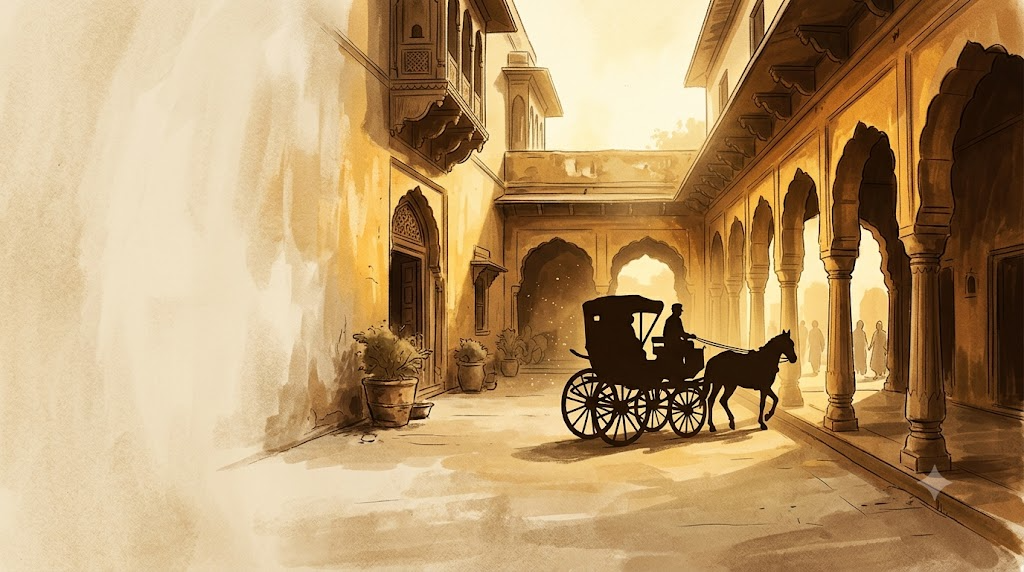
The Velakkara Regiment passed in grand fashion down Large Market Street. The soldiers bringing up the rear, I am sorry to say, were busy treating themselves to a great many ‘good deeds’ along the way. One sturdy fellow, for instance, barged cheerfully into a sweetmeat stall, hoisted a large basket piled high with plump, golden-brown adhirasams (sweet, deep-fried cakes of rice flour and jaggery), and began handing them out to his friends. Then, with great solemnity, he returned to the shop and crowned the aghast shopkeeper with the empty basket, thereby earning raucous appreciation from his mates and the watching passersby. Another soldier snatched a woven basket of flowers from an old woman walking by, and began pulling apart the blooms in earnest. “Look, look! It’s raining flowers!” he yelled, while children and idlers rushed about trying to catch the swirling petals. Yet another fellow halted a bullock cart right in the middle of the street, yanked the poor beasts out of their harness, and cracked a stick over their backs. The animals bucked and stomped madly through the crowd, while the soldiers romped about in high glee.
Vandhiyathevan watched these antics from the safety of the milling throngs by the edge of the road. Ah, these men aren’t so very different from the Pazhuvoor ruffians, he mused. They run amok through the crowd, making an absolute nuisance of themselves to the people. What a good thing that I am tucked away from their sharp eyes! Otherwise, there would have been a very pretty tussle, and my mission would lie in ruins. And yet, he had not failed to notice an important difference here as well: the local people gathered around did not really seem irritated by the Velakkara soldiers’ antics. If anything, they joined in the fun and romped around as well.
Vandhiyathevan opened his mouth, prepared to make a wry comment about this peculiar behaviour, but when he turned around, the pleasant young man who had been walking beside him had vanished. Basket, blooms, and all. The youngster had probably wanted to get on with his own work and had simply walked away.
Word had it that the great gates of the Thanjavur fortress closed for good once the Velakkara Regiment marched through in the evenings. They did not open again for anyone, except for members of the royal family, ministers, and the Thandanaayakkas (the high military commanders)—who alone, it seemed, held the privilege to enter and exit at any hour, day or night. The Pazhuvettarayar brothers, Vandhiyathevan soon learned, were also proud possessors of this concession.
To our young hero, this could mean only one thing: there was no point in trying to enter the fort tonight. The very last thing he wanted was to flash his newly acquired signet ring bearing the palm-tree insignia, only to find himself subjected to the hard scrutiny of the sentries at dusk. Or even to find out its unique gate-opening powers just yet. Far better, he thought, to stay the night out here in the outer town, take in the sights, and enter the fortress peacefully the next morning. Besides, even if he did somehow gain admission into the city tonight, he could hardly demand an audience with the Emperor right away and hand over his palm-leaf, could he?
His mind made up, Vandhiyathevan ambled slowly through the wide streets that skirted the great fort walls, happily drinking in the life of the bustling city. His poor horse had travelled many kaadhams that day, and the beast was exhausted beyond belief. He knew it could not be expected to carry him any further. He would have to find food and shelter for them both, or the poor animal would be completely useless to him in the morning.
And Thanjavur really was such an attractive city to linger in, besides! Being a newly established capital, it was beginning to expand very quickly, thriving and flourishing with business and people. Now, with twilight falling softly over the houses, hundreds of oil lamps lit by the roadside transformed the streets into a glittering fairyland.
The thoroughfares were practically bursting with life. Many of the folk had arrived from other towns and villages, bent on transacting business, and went about looking terribly important. Most, of course, were residents of Chozha Nadu, but Vandhiyathevan’s keen eyes spotted men who were obviously from the territories newly brought under Chozha dominions as well. Travellers had converged here from everywhere—from the banks of the River Porunai down south to the Paalaaru in the north; from the sun-washed east coast to the west. Why, some had even arrived from north of the Vindhya Mountains, or from mysterious lands beyond the seas.
Customers attached themselves like demented flies to stalls that sold soft, savoury aappams (bowl-shaped rice pancakes) and sweet adhirasams, buying them up by the dozen. Other shops displayed cheerful little mountains of bananas and a wonderful variety of fresh fruits. As for the flower stalls—well, the beauty of those fragrant corners was frankly beyond description. Snowy-white jasmine, delicate mullai, bright aathi, and golden shenbagam rose like sweet-smelling hillocks, and women buzzed around them like eager bees drawn to nectar.
Riding slowly past these scented stalls, Vandhiyathevan remembered the youngster and his baskets of blooms. Ah, an acquaintance with him would have proven very convenient indeed; our tired traveller desperately needed food and lodgings for the night. Even as the thought crossed his mind, he glimpsed the young man approaching in the distance, and jumped down from his horse at once.
“Why, Thambi—you don’t have your baskets with you,” he called out cheerfully. “What about the blooms? Sold them all?”
“Oh, those weren’t for sale,” the young man replied with a mild smile. “I was taking them to the temple nearby, for the evening’s worship. I’ve delivered the flowers, so I’m on my way home now.”
“And which is the fortunate shrine that benefits by your service?”
“Have you heard of the Thalikulathaar Temple?”
“Ah—would that be the Thanjavur Thalikulathaar? I’ve heard much about it, indeed. And is it a large shrine?”
“No, only a small one. But these days, it’s the Durgai Temple that receives all the honours. That’s the one where everyone celebrates all the festivals, offers Pongal (the sacred dish of newly harvested rice boiled with milk and jaggery) and other sacrifices, and generally worships. Even the royal family and the Pazhuvettarayars patronise it. Not so for the Thalikulathaar Temple. In fact, not many people even come there—”
“Ah, but you offer it flowers every day, don’t you? Surely you’re compensated in some form for your service?”
“My family received a grant for the purpose—it was offered to my grandfather during the reign of the saintly Emperor Kandaradhithar. These days, I and my mother serve the temple.”
“Is the Thalikulathaar Temple built of brick? Or stone?” asked Vandhiyathevan. All along the way, he had seen many formerly brick temples being freshly renovated with solid stone, and this divine work had prompted his query.
“Brick, of course, but I’ve heard that they’re going to rebuild it with stone. At least, they say that the revered elder queen, Sembiyan Madevi, residing in the old city of Pazhaiyarai, wishes to begin work right away, but—” The youngster hesitated, his voice trailing off.
“But—what?”
“What’s the use of discussing rumours? I’ve heard it said that one must look around before speaking in daylight, and not even speak at all at night. Besides, we’re surrounded by people, in the midst of a busy city—”
Vandhiyathevan chuckled. “I would’ve thought this the absolute best place to discuss secrets. With all the noise and hubbub, no one’s likely to hear a thing.”
“Oh?” The youngster glanced at Vandhiyathevan, suddenly looking uncertain. “What secrets are we supposed to discuss?”
Well, here’s an intelligent young man, mused Vandhiyathevan. This one might prove useful to ferret out information. All the more important that I don’t arouse the worst suspicions in him.
Aloud, he spoke in a reassuring voice. “What, indeed? Nothing at all. Be that as it may—Thambi, I’ve travelled far today and desperately need a quiet place to rest for the night. Would you help me please, by suggesting a good inn?”
“Thanjavur doesn’t lack for accommodation, Ayya (sir). There are a great many chathirams (rest-houses for travellers) about, not to mention grand royal lodgings for foreign visitors. But if you wish—”
“What’s your name, Thambi?” asked Vandhiyathevan abruptly.
“Amudhan. Senthan Amudhan.”
“What a beautiful name! As sweet as nectar, to be sure. But you were about to invite me to stay at your own home, weren’t you?”
Amudhan blinked in surprise. “Yes—but how did you guess?”
Vandhiyathevan tapped the side of his nose. “I’m a magician, Thambi; I’ve quite a few tricks up my sleeve. Where do you live?”
“Our garden is a shout away from the city; we live in a house within.”
“That does it; I’m spending the night at your home. I couldn’t get a wink of sleep in this noise and commotion, anyway. In any case, I also wish to make the acquaintance of the gracious lady who bore such a splendid son—your mother.”
A shadow crossed the young man’s face. “She’s certainly gracious—but also, unfortunate.”
“Why do you say so? Perhaps your father—”
“My father is no more, it’s true—but her misfortune dates from her birth. You’ll understand when you see her. Come, now.”
They walked together for half a naazhigai beyond the bustling city limits, until they arrived at a beautifully tended garden. The heady scent of night-flowers washed over them, delighting Vandhiyathevan’s tired senses and providing an unexpected comfort and a deep sense of well-being. The tumult and roar of the city had receded significantly, and the garden was shrouded in a soothing, leafy silence. In the middle stood a neat little tiled cottage. Two modest thatched huts flanked it, occupied by the families that assisted Amudhan in tending the garden. The young man kindly tasked a member of one to stable Vandhiyathevan’s weary horse and feed it.
They entered the house—and as soon as Vandhiyathevan set eyes on Amudhan’s mother, he realised the true extent of her misfortune: the gentle lady was deaf and mute. What she lacked in these senses, though, she more than made up for in others: her face fairly brimmed with compassion and gentleness, and her dark eyes gleamed with the light of intelligence. And is it not one of nature’s peculiar, kindly quirks that those who lack a faculty are often blessed more in others?
At Amudhan’s swift sign, she understood that their visitor had arrived from foreign parts, and her smiling face revealed a truly welcoming, hospitable spirit. In a few moments, a fresh dining leaf was duly set on the floor for the night meal. The first dish to arrive, steaming and befitting royalty, was a pile of fluffy white idiyappams (delicate string-hoppers made of pressed rice flour) served with sweetened coconut milk. Vandhiyathevan swore he had never, in his life, tasted anything so delightfully light and sweet. He cheerfully demolished ten or twelve of them, and half a measure of the rich milk, in short order. Next to make an appearance were a thick, savoury tamarind stew and hearty corn-flour cakes; Vandhiyathevan did very well by them as well. Still, his formidable appetite seemed unsated—it took a quarter measure of rice and half a measure of creamy, cooling curd to finally staunch the fire in his belly. Then, and only then, did he finally let out a sigh and rise from his leaf.
He did make good use of the time his meal afforded him, talking easily with Amudhan. In particular, he was keen on casually learning of those who dwelt within the Thanjavur fort at the moment, aside from the ailing Emperor, Sundara Chozhar, and his immediate retinue. The powerful Pazhuvettarayar brothers, for one, lived there in their various palaces, not to mention their own considerable entourage. The Royal Treasury and Granaries were also located within, which meant that an assorted number of officials and fussy accountants connected to these departments lived in the inner city.
In addition, the Chozha Minister Aniruddha Brahmaraayar, who also happened to be the Emperor’s confidant, had made his home within the fort, as well as the Thirumandhira Olai Naayakar. Then too, there were all the guards and soldiers under the direct command of Chinna Pazhuvettarayar, whose strict warrior duties made it imperative that they and their families reside within the fort. Silversmiths and goldsmiths, and wealthy merchants dealing in precious metals and gemstones, had been given quarters as well. Hundreds of clerks belonging to Periya Pazhuvettarayar’s vast tax department lived there. The famous Durgai Temple was situated in a corner of the fort; this meant that a whole community of priests, other menials belonging to the temple, and graceful courtesans resided in its vicinity.
“And the ministers?” asked Vandhiyathevan, once he had divined all the above information. “Are they all within the fort, as well?”
“No, how can that be?” said Amudhan. “They come and go as and when duty demands. Aniruddha Brahmaraayar, for example, hasn’t been in the city for quite some time. They say he has journeyed to the Chera country. Periya Pazhuvettarayar left the city four days ago as well—possibly north of the River Kollidam, into the Mid-Lands.”
“But perhaps he’s returned? Or don’t you know?”
“I did see the young Queen of Pazhuvoor’s palanquin arrive at the fortress gates this evening, with my very eyes. Not Lord Pazhuvettarayar, though. Perhaps he stayed somewhere along the way. He might return tomorrow.”
“Thambi—Prince Madhuranthakar resides within the fort too, doesn’t he?”
“Of course. Next to the Pazhuvettarayar’s palace, to tell the truth. He’s married to Chinna Pazhuvettarayar’s daughter, isn’t he?”
“Indeed? But this is news to me!”
“Not many people know of it,” Amudhan admitted softly. “The Emperor’s health being what it is, it was decided that grand wedding celebrations were unwarranted.”
“Excellent. In other words, Prince Madhuranthakar is within the fort?”
“He must be. I’m not sure, however, as no one is familiar with his whereabouts; he doesn’t venture out much. Word is that he spends much of his time in worship, meditating upon Lord Shiva and other attendant concerns.”
“And yet, he’s married at such a late date.”
“Surprising, but true. And they say the new groom has changed a great deal after his wedding! But, Ayya, these are royal affairs—it is far better that simple folk like us don’t discuss such things.”
The urge to keep picking Amudhan’s brain and learn more was almost overpowering, but Vandhiyathevan managed, with some effort, to tamp it down. There was no point in asking endless questions and arousing the boy’s worst suspicions. After all, one never knew—this naive youngster might prove to be of immense value some day. And this charming little cottage, so quietly situated near the city, was a great convenience as well. Why ruin such excellent arrangements?
Conspiracies and dark intrigues aside, the long day’s hard travel in the sun and the previous night’s adventures had finally taken their toll; Vandhiyathevan felt a heavy drowsiness creep up upon him. Amudhan noticed that his newfound friend was practically falling asleep where he sat, and swiftly laid out a comfortable bed for him on the floor.
Even as Vandhiyathevan dropped off to slumber, it was the radiant face of the younger Queen of Pazhuvoor, the beautiful Nandhini, that floated before him. Ah, such an exquisite creature—a dazzling form and face! He remembered the strange, helpless paralysis that had stolen over him at the sudden sight of that vision of beauty bursting upon him from her palanquin. Recalling the evening’s incident awoke a vague, long-lost memory from his boyhood. He had been walking alone along a dappled forest path once, when he had encountered a hooded, hissing cobra. Ah, the slender, terrible beauty of its form! The sinuous grace of its movements! The boy Vandhiyathevan had not been able to take his eyes off the beautiful creature, not even to blink. The snake wove about, dancing gracefully, and his own young body had begun to sway, mimicking its actions. It is impossible to guess what might have happened next, had a mongoose not leapt up from nowhere and sprung upon the cobra. The two animals began a furious battle to the death. The spell broken, Vandhiyathevan came out of his trance suddenly and took to his heels.
Chee, what a terrible comparison! he thought sleepily. How could he ever compare that ravishing beauty with a terrible cobra in a forest? Why, one look at her fair countenance, radiating such pure innocence, and you could forget hunger, thirst, and every other bodily instinct! Well, he consoled himself, he was about to meet her again tomorrow, wasn’t he? And ah, her voice—so silky and smooth all at once—he had certainly never heard anything quite like it.
But then, his tired mind drifted to that other majestic young woman he had come across on the banks of the River Arisilaaru, and again at the Kudandhai astrologer’s home. She had been exquisitely lovely as well, not to mention the unearthly, commanding beauty in her glowing face! Both of them were stunning, but ah, how completely different were their features?
Even as he lay there in the quiet cottage, dreamily ruminating upon these two remarkable women, a third lady intruded upon his thoughts, radiating quiet fury in every step. It was Nithra Devi, that ferocious, ancient Goddess who exerts complete and merciless control over the realm of sleep. And before he knew it, she had overwhelmed him swiftly, sweeping him away into the deep and dreamless night.

© 2026 Matribhasa Classics. Public Domain


Comments (0)
Log in to join the conversation.