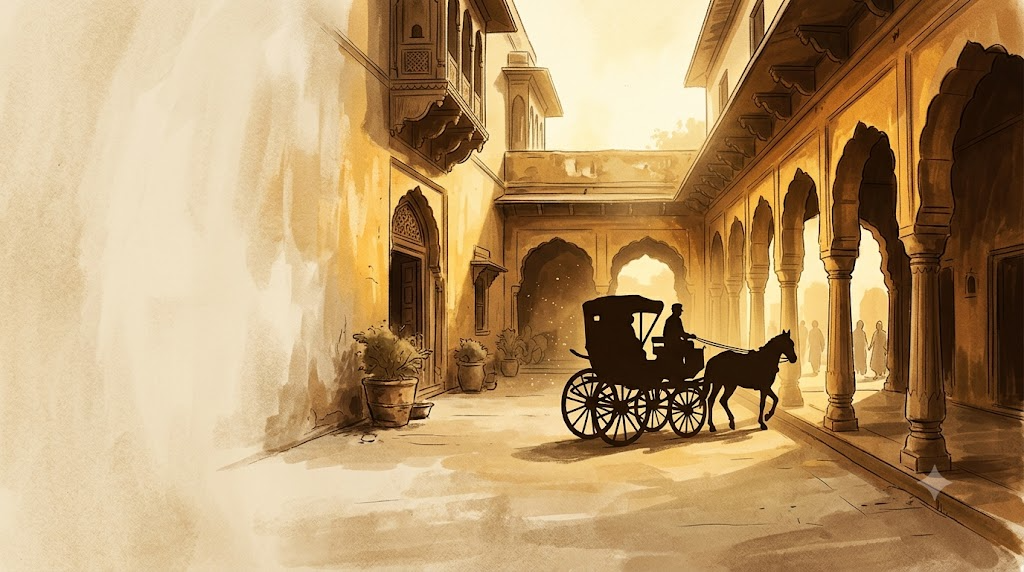
Old men, and Marriages

Along the shoreline of Maamallapuram, small boulders lay scattered in the sand, rather like a herd of sleeping cattle. When the tide came rushing in, the sea would pound against them, swallowing them up in a flurry of white foam. When the waters drew back, the stones were left out in the bright sun, given a quiet hour or two to dry. The master sculptors of this ancient port city had not let a single rock go to waste; each one, whether large as an elephant or small as a calf, had been coaxed into an exquisite work of art. Now, they decorated the long sweep of the beach, a permanent gallery of gods and beasts gazing out at the restless ocean.
The Chozha crown prince, Aditha Karikalar, and his two companions alighted from their chariot and made their way toward a pair of boulders that faced each other like old friends in conversation. Aditha Karikalar and the venerable Malayamaan took their seats on the rocks—which had been carved, appropriately enough, into thrones fit for kings—while the Pallava prince, Parthibendran, preferred to stand a little to the side. Every so often, a great surge of the sea would wash over their feet, rising cool and sudden to their calves. Sometimes, the crashing waves tossed fine sprays of salt water onto their faces, like a scattering of ocean pearls.
Out on the blue horizon, row upon row of small boats cleaved through the water. They were heavy with grain and goods, ferrying their loads to the massive merchant ships anchored further out at sea. You could just make out the great ships’ enormous sails, billowing wide to catch the wind.
Parthibendran stood watching the distant ships, a dark frown settling on his face. “When I see all the equipment and provisions we gathered with such painful effort for the Rettai Mandalam invasion being carted away wholesale to Eezham… well, I can hardly stand it. It makes my very blood boil!”
“And what else would you have them do, pray?” Aditha Karikalar asked sharply. “The finest of our Chozha warriors have been dispatched to that island. They are winning victory after victory on those battlefields, bringing us nothing but honour. Why, they have even managed to capture Anuradhapuram—the great pride of the Eezham rulers and their capital for a thousand years. It’s a prize that has always danced just out of our reach, yet our flag flies there now. Tell me, do you really want men of such mettle to sit there and starve?”
“No, of course not. When did I ever suggest such a thing?” retorted the Pallava prince. “Naturally they must be sent grain. But surely it should go from the Chozha port at Nagapattinam. Or perhaps from Sethukkarai, down in Pandiya Nadu. Why must we scrape together all our supplies from these dry, drought-ridden Thondai lands? Especially when we are on the very brink of marching upon Rettai Mandalam ourselves? That is my only grievance—that we are forced to kick our heels in the dust just to send them their daily rice.”
“Oh, I feel it too. I can hardly bear to sit still,” sighed Aditha Karikalar, his frustration plain. “And I cannot for the life of me understand what those dastardly Pazhuvettarayar brothers are hoping to achieve with all this! How long are we meant to endure this state of affairs?” He turned suddenly toward the elderly man seated opposite him. “Thatha,” he said, “do open your mouth and tell us what you think. Why this blessed silence?”
Old Malayamaan looked mildly at the young prince. “The waves crash ceaselessly on this shore, my child, thundering about all over the place. And your friend here adds his own voice to the tumult, screeching above the surf. How am I supposed to compete with all that noise? I am getting on in years, after all.”
Aditha Karikalar smiled. “Do be quiet for a little while, Parthibendran, and let Thatha give us his thoughts.”
“Consider my lips sealed this very instant,” Parthibendran replied, though he could not resist a theatrical sigh. “After all, poor grandfather has had a very trying time of it—having to ooze at a snail’s pace all the way from his rock-fort at his doddering age, just to meet us. My deepest sympathies for the effort; how dare I open my mouth in his venerable presence? As for this sea…” He shook his head at the rolling waves. “What a mannerless creature it is. Ranting and raving, throwing itself about however it pleases, right in front of him! And nobody here to take it down a peg or two. One would almost think the King of the Ocean has no fear of the great Lord of the Malayamaan hills!”
The old man remained perfectly calm, choosing to brush past the young man’s flippant speech. “And yet, Thambi,” he said gently, “there was a time when he did. There was a time when the kings and emperors of this land would tremble at the mere mention of my name. Men who ruled vast territories—the Chalukyas of Rettai Mandalam, the Vanagovarayars of Vallam, the Gangars and the Kongars—they would all slither back into their holes like frightened snakes at the first peal of thunder! Why, even Samudrarajan, the King of the Oceans himself, knew his place and stayed subdued. But now… now that this tired body of mine shows its years, they have seen fit to shed their fears. They show their true colours without a hint of shame.
“As for those wretched Pazhuvettarayars of the West, who would like nothing better than to root me out—not on their lives! You were saying just a moment ago, Aditha Karikalar, that you couldn’t fathom their true motives? Well, listen closely, young man, and I shall reveal it. Their only intention is to drive a wedge between you and your brother. It is a foul little plot to weaken you both, to make certain your hands never join. They want Arulmozhi Varmar to taste bitter defeat in the Eezham wars and return humiliated. They hope that you will then look upon him with contempt and learn to hate him. From there, it is a short step to the two of you wanting to rip each other’s throats out. And I suppose they think this old man would just sit by and watch in utter misery…”
“But that would never happen, Thatha!” Aditha Karikalar broke in, unable to wait for Malayamaan to finish. “I have no intention of ever quarrelling with Arulmozhi Varmar. Why, I would gladly give my own life for him if the need arose. In fact, thinking of him makes me wonder if I shouldn’t just board a ship and sail for Ilankai right now. Who knows what terrible straits my brother might be facing in those wretched lands? Meanwhile, I sit here in my pretty palace with nothing better to do than eat and sleep myself into a stupor. My sword and spear are rusting in their sheaths. Every passing minute feels like an aeon! I can barely sit still here. Tell me, Thatha, may I board one of those vessels sailing for Eezham? Now? This very instant?”
“What a marvellous suggestion, Your Highness!” cried Parthibendran, his eyes lighting up. “Now this is more like it! You have simply given form to my own intentions these past few days. There is not a moment to lose; let us leave at once. It’s no use asking Thatha; he is bound to counsel you to squat on your haunches and wait.” He adopted a mock-serious tone, mimicking the old man. “‘Do not decide anything on impulse.’ Let us leave tomorrow. We will round up half our Thondai Mandalam men, march to Ilankai, finish the war one way or the other, and then disembark right back at Nagapattinam.” The words bubbled out of him like mustard seeds sputtering in hot oil. “And then we will come down like a ton of bricks on those blasted Pazhuvettarayars and give them a hiding!”
Malayamaan sighed. “You hear what he says, Karikalar? Didn’t I warn you right at the start? Now you know why I swore I wouldn’t say a word unless this fellow kept his mouth shut, don’t you?”
Parthibendran scowled and clapped a hand over his mouth. “As you wish, Thatha. I am quiet. You are free to speak your mind. Whatever that may be.”
The old man turned his warm, weathered face back to the crown prince. “You, Aditha Karikalar, are a warrior among warriors. Even in these brave Tamil lands, renowned for their courageous sons, there have not been many of your ilk. I am an eighty-year-old man, a veteran of many, many great battles, and I tell you this, my boy: I have never seen anyone quite like you. You dared to plunge into the battlefield all by yourself, hacked your way through your enemies, and emerged triumphant. You were barely sixteen when you threw yourself into the battle of Sevur, and I have never seen the like, before or since. You waded through blood and gore, your sword swinging left and right, dismembering and decapitating until heads rolled everywhere like fallen fruit! I only have to close my eyes to see it still…”
He paused, letting the memory drift away on the sea breeze. “Your friend here is a fine warrior in his own right, too. And yet, the pair of you are far too quick to anger. Your impulsiveness—this rushing into things—is exactly why you fail at your tasks. You fail to think things through, and you end up doing the exact opposite of what will serve your purpose.”
“You have given us this particular piece of advice at least a thousand times, Thatha,” said Aditha Karikalar.
“And it has yielded absolutely no results. Is that what you wish to say? Or perhaps you would like me to pack up and leave for my home without another word?”
“No, not at all. Please, tell us what must be done next.”
“Send forth for Arulmozhi Varmar right away. Make absolutely certain that the two of you are never separated for an instant.”
Aditha Karikalar stared at him. “What on earth… what sort of advice is this? What becomes of the war in Eezham if my brother comes here?”
“The war, my boy, has now reached an impasse,” Malayamaan explained patiently. “Our troops have, at long last, captured Anuradhapuram, and just in time for the rains, I might add. It will pour for four months, during which time no invasion can move forward; they can only retain what has been captured. That is a task our commanders are more than capable of undertaking. It is absolutely vital that Arulmozhi Varmar be here with you at this very moment. I see no point in concealing the truth from you any longer: the Chozha Empire that Vijayalayar wrought into being with blood and sweat is under threat of collapse. It is imperative that you and your kin stand together at this dangerous time, and keep safe. We ought to do all in our power to gather our forces, for there is no telling what peril we might find ourselves in, at any time.”
“But Thatha, what is all this nonsensical talk?” asked Aditha Karikalar, waving a dismissive hand. “Why should I fear anything as long as I hold my trusty sword in my hand? What does it matter if we are in the very thick of danger? I can take care of myself. Surely there is no foe on this earth I cannot defeat, no peril I cannot face alone. I need no one’s support.”
“Spoken like a true warrior, Karikalar. And there is no need to remind me of your valour; haven’t I just told you that I know your worth, my boy? But there is no harm in casting our minds to the great poet Thiruvalluvar, and reflecting upon his wise words:
Anjuvathu anjaamai pethamai anjuvathu Anjal arivaar thozhil!
Cowardice may be despicable, lad, but there is something to be said for entertaining a healthy fear of that which is worthy of it. Quivering in your place during a war, facing an honest enemy, is contemptible. If I ever had the misfortune of being saddled with a boy of that kind in my own family, I would cleave him in two with my own sword, in my old, trembling hands, bereft of all their legendary strength, and without a moment’s regret!
“But of other things, my boy—such as treachery, and appalling plots hatched in the darkness of souls filled with hatred, and conspiracies that terrorise an empire—these, you must and should fear. And take steps to protect yourself from grievous harm. Royals, especially those in the direct line of succession who will one day rule the country, must be especially cautious about such threats. There is no room or place for indiscretion or carelessness. That would spell doom for the land as a whole.”
“Well, what are these inexplicable perils that you keep harping about?” Aditha Karikalar asked, leaning forward. “Only if you share them in detail, Thatha, will we be able to guard ourselves against them.”
“I certainly shall. I was just about to, anyway. A few days ago, the Sambuvaraiyars played host to a mysterious midnight meeting at the Kadambur palace. From what I can see, quite a few big names were there. Periya Pazhuvettarayar, for instance. And then Thennavan Mazhavaraiyar, Kundrathur Kizhaar, Vanangamudi Munaiyarayar, Anjaatha Singa Mutharayar, Rettai Kudai Rajaliyaar… those were the names I could gather. A good many others may have elected to be present as well.”
“Why, so they might have. What of it?” scoffed Aditha Karikalar. “Doubtless they watched song and dance far into their precious midnight meeting, ate until their stomachs burst, drank gallons of liquor, and stumbled off to their beds in a stupor. How does all this affect us? All these men you mentioned—grey-haired dotards with white beards trailing around their feeble waists—what on earth do you think they can accomplish with their whispering campaigns?”
Malayamaan gave a soft, dry chuckle. “Considering your confirmed opinion of old men and their feebleness, Karikalar, there does not seem to be anything more to be said. After all, I am getting on in years myself; far, far older than any of those I mentioned.”
“Pray don’t be offended, Thatha,” said the prince, looking a little abashed. “Would I ever dare to class you with those doddering idiots? Do tell us what happened next.”
“Ah, there you go again, implying that we cannot even fend for ourselves,” Malayamaan noted gently. “Do not forget, my prince, that the feeble old man who heads them did, after all, enter wedlock just some time ago. Do not forget, Karikalar, that there is nothing more dangerous than a young man who has married in his old age!”
At the very mention of the old lord and his new wedding, a strange, terrible expression flitted across Aditha Karikalar’s face. His eyes grew stark and bloodshot, like a ferocious village deity thirsty for a sacrifice. His lips trembled, and the low, hard sound of his teeth grinding together was almost audible above the wind. Malayamaan, intent upon his story, noticed none of this. But Parthibendran could, and did.
“Need we talk of all that now, Ayya?” Parthibendran intercepted quickly, hoping to steer the conversation to safer waters. “Why don’t you relate what happened next at the Sambuvaraiyar palace?”
“I was about to—but I am, as you so kindly pointed out, getting old… my mind wanders so much these days that I went on to something else,” said the old man. “Now listen, Karikalar; and you must too, Parthibendran. The meeting I mentioned was attended not just by old, doddering men, but by a few youngsters as well. One of them was Kandamaaran, Sambuvaraiyar’s son. And the other…”
Aditha Karikalar was quick to notice the pause, his dark mood breaking. “Well, who was it?” he prodded. “Who, Thatha?”
“The beloved son of your elder grandfather, Kandaradhithar. None other than your Chithappa (father’s younger brother), Madhuranthakar!”
Parthibendran and Aditha Karikalar stared at him for a moment. The next instant, they broke into merry, ringing peals of laughter.
“But—what is it that I have said?” Malayamaan asked querulously. “What do you find in this to amuse you? Or perhaps you are laughing at me again?”
“Not at all, Thatha, pray don’t take offence,” gurgled Aditha Karikalar, wiping a tear from his eye. “We just found it hilarious that you chose to refer to Madhuranthakar as a ‘youngster!’ Isn’t he, after all, even more elderly than all of you put together? The very symbol of pious old age, surely?”
“You have heard, I know, of youth returning to old men at times. It looks like the years have rolled back for your uncle, too,” Malayamaan replied wryly. “Until some time ago, he was touring the country, mumbling about renouncing the world and devoting himself to divine service and Lord Shiva. But now, I see he’s married wives one, two, and three at a steady rate.”
“Well, and so he may, with my goodwill,” Aditha Karikalar said breezily. “He can go on gathering wives into his harem for all I care. What of it?”
“But that is the problem, Thambi. You see, none of his marriages are affairs of the heart. They are political, all of them, arranged at the behest of those treacherous Pazhuvettarayars to further their conspiracies.”
“I see no need for beating about the bush anymore, nor for these mysterious tales of plots and betrayals, Thatha,” Aditha Karikalar said, his tone turning serious. “Do step right out into the open. What do those Pazhuvoor brothers wish? What on earth is behind their tours of the land, and these precious midnight conferences? What do they hope to accomplish with silly little Madhuranthakar?”
“Nothing much, I am afraid,” announced the old man, his voice taking on a heavy, stentorian ring. “Merely to place him upon the Chozha throne, and ensure that neither you nor your brother inherits this empire. It is to this exact effect that they have almost imprisoned your father, the Emperor Sundara Chozhar, within the Thanjavur fort—to secure his approbation for their heinous plan!”
© 2026 Matribhasa Classics. Public Domain


Comments (0)
Log in to join the conversation.