Maamallapuram

We must now take a little journey, dear reader, down to a seaside town you likely know well: Maamallapuram.
Three hundred years have slipped by since the Pallava kings, Mahendra and his illustrious son Narasimhar, touched this rather plain harbour and turned it into a dreamscape of lifelike stone. These days, sadly, the old port has lost much of its splendour, and the change tugs a little at the heart. Mansions and palaces stand crumbling; the grand stone buildings are weathering away. The streets and the harbour no longer hum with the vibrant crowds of yesteryear. The great warehouses are gone, and you will no longer find mountains of spices and silk sitting on the sands, waiting to be shipped across the oceans.
As we saw earlier, the sea once reached right inland, creating a deep, natural waterway where ships could sail in and drop anchor with ease. But time and tide have silted up the canal. Now, only small boats and fishing canoes can scrape through. The grand merchant ships must drop anchor far out in the open sea, and goods have to be ferried out to them on smaller skiffs.
Still, even in its quiet decline, Maamallapuram holds on to its magic. The shore temples, in particular, will steal your heart. Unlike the monuments that Mahendran and Maamallan carved directly from the living rock, these temples were built stone by stone. They sit right on the beach, sparkling in the salt air like jewelled crowns left behind for Samudhraraja (the Ocean King). Ah, adada! Words, really, are entirely inadequate when you try to capture the breathtaking beauty of these seaside shrines.
Tucked into the heart of the town is another wonder—a lovely little Vinnagara temple. Here, the Lord who watches over the three worlds reclines peacefully upon his serpent bed. This noble sanctuary, they say, was lovingly restored by Parameswara Pallavan, a king who held both Saivism and Vaishnavism as the twin halves of his soul, as precious to him as his own two eyes. It was to this very deity, Thalasayana Perumal, that the wandering saint Thirumangaiyazhwar came a century ago. Overcome by a great wave of devotion, he fell to his knees on the stone floor and poured his heart into song.
If you listen to his old hymns, you can catch a glimpse of the Pallava empire at the height of its wealth and glory:
Pulankoll nidhikkuvaiyodu Puzhaikkai ma kalitrinamum Nalankoll navamanikkuvaiyum Sumanthengum naanrosinthu Kalangal iyangum mallaik Kadal mallai thalasayanam Valangoll manathaaravarai Valangoll en madanenje!
A hundred summers have passed since the saint sang those verses. The Pallava empire is no more, and the sun has long set on its golden age. Kanchi, once celebrated as a peerless city of learning, has lost its crown. And Kadal Mallai—the old name for Maamallapuram, famous for its ships and bustling trade—has grown sleepy and dim.
Time changes most things, but here in Maamallapuram, it met its match. For all its restless marching, Time could not wear away the town’s beautiful stone carvings. The sculptures in the rock faces, the cave temples, and the magnificent vimanam-chariots (temples carved in the shape of processional cars) hewn from single boulders—all remain as perfect and crisp as the day the chisels left them three hundred years ago. Today, the people who wander these sandy paths are not merchants haggling over cargo, but pilgrims and travellers drawn by the sheer wonder of the stone.
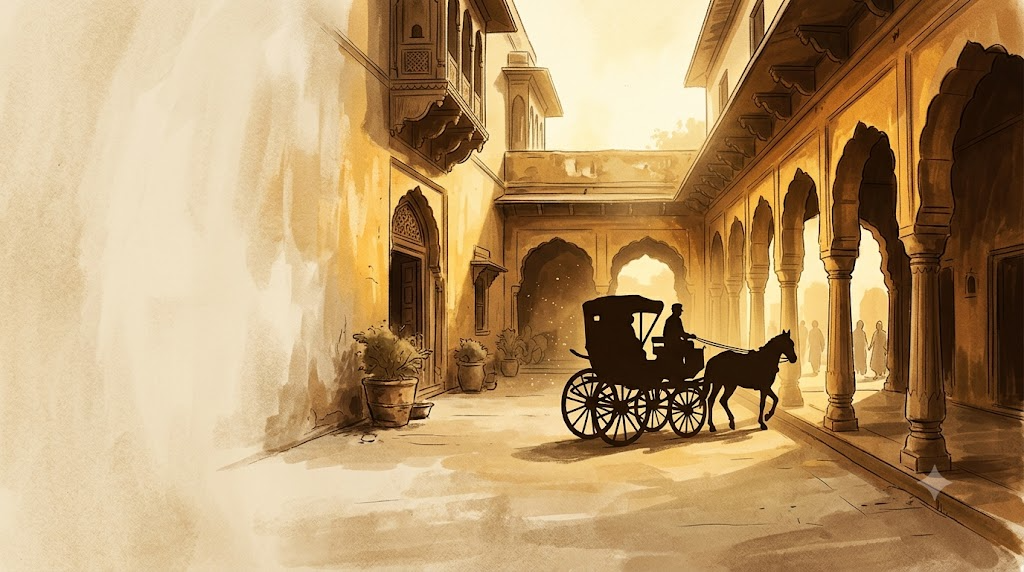
Along one of the town’s wide, sandy avenues, a beautiful chariot was rattling along in fine style. Designed to look just like a temple vimanam, it was drawn by a pair of magnificent blood-stallions. With the horses adorned in bells, the carriage intricately carved, and its gold-leafed roof flashing in the soft evening sun, you could tell at a glance that its three passengers were men of royal blood.
And so they were. One was none other than Aditha Karikalar, the eldest son of Emperor Sundara Chozhar. He was a warrior to his fingertips, a young man who had taken to the battlefield when he was barely out of boyhood. He had already made a name for himself as a seasoned fighter, most famously when he met Madurai’s Veera Pandiyan in battle and took his life—earning the fearsome and historic title: The Kopparakesari Who Beheaded Veera Pandiya. Soon after that great victory over their bitterest enemy, Sundara Chozhar had fallen terribly ill. Without waiting for matters to worsen, the ailing emperor had formally declared his eldest son the heir to the throne, performing the Yuvaraja Pattabishekam (the coronation ceremony for a crown prince). From that day, Aditha Karikalar had the authority to issue royal grants and carve his own name in stone as the Crown Prince.
Over the next few years, the restless young prince marched north. His praiseworthy goal was to drive out King Kannara Devan of the Rettai Mandalam, and pry the Thondai Nadu region from his grip. He fought like a lion in those northern lands, thoroughly beating his enemies and chasing them well past the northern banks of the Vada Pennai river. But war, as they say, is a hungry beast. It constantly needs fresh men, new weapons, and endless supplies. Aditha Karikalar often had to set up camp in Kanchi just to gather the resources for his campaigns. And that was when the Pazhuvettarayars—the powerful lords who controlled the treasury in Thanjavur—began placing stones in his path. They flatly refused to fund his northern wars until the ongoing battles down south in Ilankai were finished. Soon, darker whispers drifted into Kanchi: the Chozha army in Ilankai was faring badly, trapped and starving because the promised food supplies from the mainland had simply stopped coming. All this left Aditha Karikalar in a state of helpless, pacing fury, his warrior’s heart aching for his men.
We must remember that the three centuries surrounding our story were a golden age of heroes. Thamizh Annai (Mother Tamil) gave birth to men and women whose ideals and astonishing courage seemed to outshine even the legends of old. It was an era of warriors who rivalled the great epic heroes—men like Veeman and Archunan, Dhronar and Bheeshmar, Gadothgajan and Abhimanyu. Each impossible victory they won on the battlefield seemed to add another layer of muscle to their shoulders. Old men, their beards white as sea-foam, still possessed the sheer strength to shatter rocks with their bare hands; while young boys, barely old enough to shave, seemed capable of riding the storm-winds and plucking the very stars from the night sky.
Two such remarkable men sat beside Aditha Karikalar in the gilded chariot. One was Thirukkovilur Malayamaan, the lord of Malayamanadu—a name the locals had affectionately shortened to Maladu, which meant he was often called Miladudaiyar. As Emperor Sundara Chozhar’s second queen, Vana Maadevi, was his much-loved daughter, this grand old warrior was Aditha Karikalar’s grandfather. The passing years had only sharpened his wits without diminishing the iron in his arms, making him seem very much like Bheeshmar, the venerable patriarch of the Kauravas. Aditha Karikalar had a great deal of respect for the old man’s wisdom, though truth be told, the grandfather’s old-fashioned theories and winding, lengthy advice did occasionally test the fiery young prince’s patience.
The third man in the chariot was Parthibendran. A scion of an old branch of the Pallava clan, he was just a little older than the prince. Without a kingdom of his own to rule, his only burning ambition was to carve his name into history on the battlefield, which is why he had hitched his wagon, quite literally, to the crown prince. He had fought brilliantly as Aditha Karikalar’s right-hand man during the decisive clash with Veera Pandiyan. That loyalty had earned him the prince’s deep respect, and the two young men had been inseparable, fast friends ever since.
As the chariot clattered along the wide streets in state, the three men were engrossed in a fierce discussion. Their talk, naturally, revolved around the troubling news coming out of Thanjavur.
“I will not stand the Pazhuvettarayars’ high-handedness for another minute, I tell you!” Aditha Karikalar burst out, his voice thundering over the rattle of the wheels. “They cross the line a little more every day. How dared they—how dared they brand my personal messenger a spy? The sheer, unbelievable audacity of it! And to cry it through the streets of the city that there is a bounty of a thousand gold coins on his head? How am I supposed to sit here and swallow such an insult?” He glared at his companions. “My sword is practically shivering in its scabbard with the shame of it—and here you are, telling me to be patient!”
“I didn’t say that,” replied Parthibendran, his tone smooth and cool. “But I did warn you to think twice before sending Vandhiyathevan, of all people, on such a delicate errand. I knew that impulsive fool would make a mess of things. A royal mission needs a bit of quiet cunning and a sharp mind; it takes more than just a knack for swinging a sword and throwing a spear.”
To be fair, the Pallava prince had never been terribly fond of Vandhiyathevan, nor did he care for Aditha Karikalar’s obvious affection for the boy. He rarely missed a chance to point out the young man’s flaws, taking great pleasure in picking apart his every action.
“Didn’t take you long to start on him, did it?” groaned Aditha Karikalar. “You’ve never been able to sleep soundly until you’ve had a good rant about Vandhiyathevan. And as for his wits—who else would have been better for a job like this, tell me? How is he lacking in sense? I gave him strict orders to find a way to deliver my olai to the Emperor, and he did exactly that. That’s the real reason the Pazhuvettarayars are so furious. How is any of this Vandhiyathevan’s fault?”
“His fault lies in not following your instructions to the letter,” sniped Parthibendran. “I have no doubt he went completely off-leash, poked his nose into matters that were none of his business, and stirred up a hornet’s nest while he was at it.”
“Oh, do be quiet,” sighed Aditha Karikalar. He turned to the older man. “Thatha (Grandfather), why are you so profoundly silent? Tell me what you think, please. What if we gather every soldier we have, storm the gates of Thanjavur, and rescue the Emperor ourselves? Why not bring him here to Kanchi? How many more days am I supposed to sit idle, forced to watch those wretched Pazhuvettarayars cage my father like a prisoner?” The young prince was practically shaking with frustration. “Just who do they think they are? And how much longer must I pretend to be afraid of them?”
Thirukkovilur Malayamaan, a man who had seen the blood and dust of sixty-four battles, slowly cleared his throat to speak. But by this time, the sea had opened up before them, the salt wind catching their hair as white-tipped waves threw themselves against the sandy shore.
“Let us climb down from the chariot first,” the old warrior suggested mildly. “We can make ourselves comfortable at our usual spot on the beach and talk to our hearts’ content. For I am getting rather on in years, Thambi, and I find it terribly hard on the bones to shout over the rattle of a moving cart.”
© 2026 Matribhasa Classics. Public Domain
Comments (0)
Log in to join the conversation.