The Paranthakar Infirmary

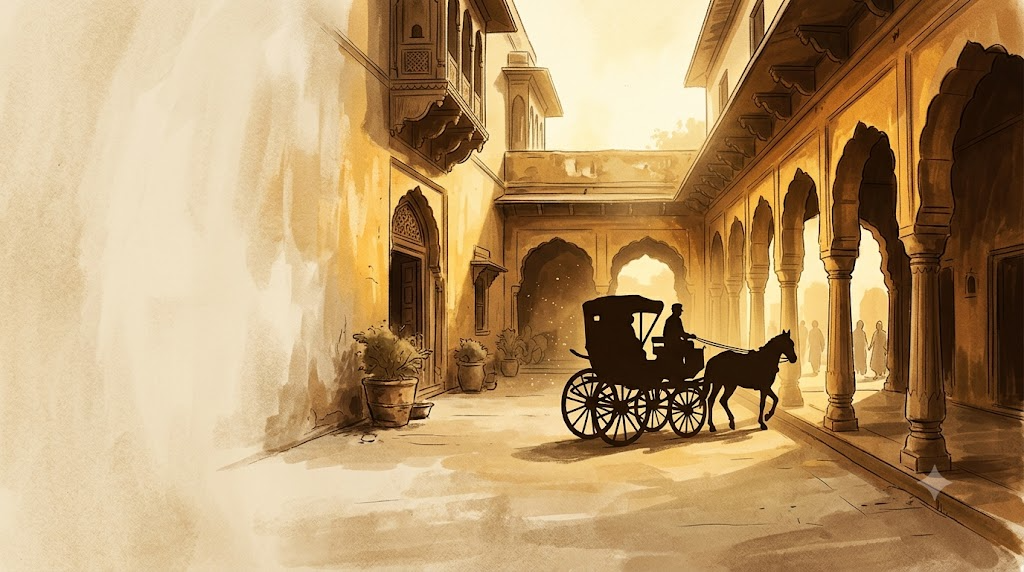
The sun’s rays bathed the wide streets of Pazhaiyarai (the historic capital city of the Chozhas) the next morning, flooding them with light. The golden domes atop the city’s splendid royal palaces dazzled with a bright, red-gold brilliance. A lavishly decorated elephant, resplendent with an ambaari (a covered wooden carriage or howdah) upon its broad back, made its ponderous, swaying way towards the front of Princess Kundhavai’s palace. The princesses walked out onto the special stone steps meant for mounting such great beasts, and settled themselves comfortably inside. The gentle animal then began to stalk towards the Paranthakar Infirmary, situated in the heart of the Padaiveedu, its heavy tread thundering softly through the streets with its precious burden.
The mahout walking by its side took matters in hand at once, murmuring to the elephant to soothe it, and the great beast moderated its pace. The cheerful, tinkling sound of the elephant’s bells heralding the arrival of the royals was enough to have the heavy wooden doors of homes thrown open, their residents hastening out into the street. Their faces beamed with genuine pleasure as they caught sight of the princesses, folding their hands in respectful greeting.
The broad avenues were swiftly crossed, and soon the elephant arrived at the soldiers’ settlements. It was a vastly different picture here from the quiet residential quarters. Plump, well-fed roosters crowed from every corner, strutting about as if seeking a worthy opponent for a quarrel. Sturdy rams, bearing their thick, curled horns proudly, seemed to swagger about the dusty lanes, as though sending out a silent challenge: Who amongst you is willing to lock horns with me? Ferocious hunting dogs, the sort that seemed quite capable of tearing a man’s throat out, were tied to the entrance-pillars of the homes with slender ropes or thick leather strips. Little boys pranced merrily through the streets, battling their friends with strong bamboo staffs. Sadasada, padapada! went their sticks as they slashed and parried, practicing Silambam (the ancient Tamil martial art of staff-fighting).
Many of the homes displayed vibrant paintings in kaavi (red ochre) upon the walls of their thinnai. For the most part, these murals depicted the many grand adventures of Muruga Peruman or the Chozha emperors themselves. War and battle, naturally, dominated the scene: the young god chopped away the countless heads of the demon king Soora Padmasuran in one panel, while the warrior goddess Durgai’s execution of the evil buffalo-demon Mahishasuran was illustrated in terrifying, glorious detail in another. Other walls glorified the many valorous exploits of Chozha warriors on the historic battlefields of Thellaaru, Thanjai, Kudamooku, Arisilaaru, Thiruppurambiyam, Velloor, Thakkolam, and Sevur.
The princesses’ majestic entry into the soldiers’ settlements was the signal for the streets to break into a happy pandemonium. Roosters flapped their wings in a great huff and flew up to the safety of the sloping tiled roofs. Children called out to one another and ran pell-mell into their homes, banging on doors to tell their families of the royal visitors.
“Long live Ilaiya Piratti Kundhavai!” the people cheered.
Women, children, and the elderly from practically every household lined the streets as the great elephant went past, showering the young women with joyous, heartfelt blessings.
“Long live Emperor Sundara Chozhar’s illustrious daughter!”
Some chose to follow the elephant, and soon this gregarious, happy crowd grew ever larger, echoing with cheerful chants. As we know, the residents of the cantonments numbered amongst them the mothers, wives, and children of the very soldiers presently fighting in the distant island of Eezham. Kundhavai had taken it upon herself to establish a hospital here—an adhurasalai (a place of healing)—for their benefit, using the funds from her own extensive lands and properties. The Chozha clan took great pride in extolling the names and deeds of their forebears, and the princess was no exception. Amongst her ancestors, one of the greatest was undoubtedly her great-grandfather, Emperor Paranthakar the First, and she had named the infirmary after him. It was her quiet, regular custom to visit often, and to enquire after the health and well-being of the soldiers’ families settled there.
The elephant stopped in the dusty yard near the infirmary. It bent its heavy forelegs first, then lowered its hind legs with a soft grunt. The princesses descended carefully to the earth.
The great beast’s departure was the signal for the general population—mostly women and children—to surround the royal ladies in an affectionate throng.
“The infirmary is of benefit to you, isn’t it?” asked the princess, a gentle smile on her face. “Do the physicians dispense medicines to those in need, every day?”
“Indeed, yes, Thaaye,” rose several voices at once. “They do!”
“I suffered from a terrible, racking cough for three months, Devi,” recounted one older woman. “The Vaidhyar’s (physician’s) medicine cured me in just a week.”
“My wilful little boy climbed a tall tree, fell down, and broke his leg, Amma,” said another woman, shaking her head. “Our physician splinted his limb and bade him take a special medicine for fifteen days. His leg is completely healed now. He runs and plays about with his usual high spirits. Why, he has even begun to climb trees again!” she finished with a relieved, exasperated laugh.
“My old mother’s vision had been poor for quite a while, Your Highness. She visited the infirmary every day for a whole month, and took her medicines,” related a young woman. “I am so happy to say that her sight is now as good as ever!”
“Do you hear that, Vaanathi?” murmured Kundhavai to her companion. “Ah, how wise and enlightened our ancestors were. I often wonder how they ever divined the precise, perfect herb that could cure a certain illness.”
“Undoubtedly, they must have had the benefit of a second sight,” was Vaanathi’s quiet response. “How else could they have learnt all they did?”
“It might well be true that they discovered medicines for almost every physical malady. But alas, they don’t seem to have found a single remedy for those such as you, dwindling away from afflictions of the mind!” mourned Kundhavai, her eyes twinkling. “Now, what do you believe can be done about that?”
“Pray, Akka—kindly cease talking about my mental illness! It’s no such thing. My friends tease me mercilessly as it is—”
“And that’s exactly as it should be, for you deserve every word of it. You’ve quite turned my own brother’s head, haven’t you? The poor boy used to enjoy the luxury of a carefree, wandering existence, and now he sends anxious messages enquiring after your health through every envoy from Ilankai!”
Abruptly, a shout reached them over the lively chatter: “Make way! Way for the Vaidhyar! Way!”
The royal guards cleaved a neat path through the surrounding crowds, and the most senior of the physicians presiding over the infirmary arrived, his face flushed, to welcome the princesses in state.
“You mentioned, I believe, certain wonderful, rare herbs to be found in the dense forests surrounding Kodikkarai, didn’t you, Vaidhyar?” asked Kundhavai. “I sent you a young warrior who might undertake a journey there and back. Did he arrive?”
“Indeed, yes, Thaaye. That quick-witted youngster came yesterday, under the escort of Eesana Siva Battar. I have formed the intention of sending my own son with him, too. My boy shall return from Kodikkarai with the herbs, while your soldier appears to wish to journey onward to Ilankai as well—”
“Do we really need to fetch herbs from as far away as that?” wondered Vaanathi.
“Certainly, my lady. You do know the old tale from the Ramayanam (the great epic), where the powerful monkey-god Lord Anumaar flew over the seas, bringing the Sanjeevi hills—a mythical mountain thick with healing herbs—all the way from the north to save Lakshmanar’s life. It is said that a few clods of earth fell from the mountain and onto the forests of Kodikkarai during his great flight, which is why we still harvest such wonderful, potent specimens from that region. Since the Sanjeevi hills were bound for Ilankai in the first place, it is only to be expected that the very best of herbs are still to be found there. Should I manage to find the ones I need, Devi, I swear that I shall cure all the Emperor’s ills myself, without a shadow of a doubt!”
“May it be so, by God’s grace,” said Kundhavai. “And so, where are these young men now?”
“Waiting within, Amma, in readiness for their journey, upon your word.”
The princesses entered the cool, shaded interior of the infirmary, escorted by the Chief Physician. They took in the sights of the people waiting patiently in the long corridors for their medicines, and those who had already had that felicity. Every one of them beamed at the sight of Kundhavai, vowing and declaring their deep gratitude for their princess’s kindness in setting up such a place for them.
Two young men awaited the ladies within the physician’s private room. One was Vandhiyathevan who, Kundhavai noted with a flicker of private amusement, had dressed himself in the latest of fashions with the utmost care. Even Vaanathi seemed to recognise him.
“Why, Akka,” she whispered into her companion’s ear. “It does seem to be that same young man from the astrologer’s home in Kudandhai, doesn’t it?”
“So it would seem,” Kundhavai’s tone was bland in the extreme. “What’s more, he is now visiting the Vaidhyar after barging into the home of an astrologer. Perhaps the poor fellow suffers from some hideous mental affliction, just like you?” She turned her gaze to Vandhiyathevan. “You, Ayya, are the warrior who is willing to undertake a journey to Ilankai for herbs to soothe the Emperor, I believe?”
Whatever incomprehensible language Vandhiyathevan’s dancing eyes and thick lashes may have chosen for silent communication, his lips took recourse to the spoken word.
“Indeed, yes, Your Highness. I’m on my way to Ilankai, it is true. And I may even have the great felicity of meeting the Prince. Is there a message you wish me to convey to him?”
“Why, so there is. Kindly inform His Royal Highness, should you ever meet him, that the Kodumbalur princess suffers grievous physical maladies. She swoons often, and stays unconscious for hours on end. Should the prince ever wish to see her in possession of her wits again, he ought not to pause for an instant in Eezham, but come home at once!”
“By all means, Ammani,” said Vandhiyathevan, and he turned his full attention to Vaanathi.
Kundhavai’s flippant words threw the gentle maiden into a morass of confused, blushing bashfulness. Her beautifully chiseled features glowed, their exquisite loveliness enhanced, if that were even possible. She blushed painfully, striving to master the sudden embarrassment that threatened to overwhelm her.
“K-Kindly do not convey any such message, Ayya! If you must, do tell him… do tell him that the Kodumbalur princess dines heartily four times a day, dresses in fine silks, and revels in the kind hospitality of Ilaiya Piratti Kundhavai, if you please.”
“By all means, Ammani,” promised Vandhiyathevan, a faint smile playing on his lips.
“Well, upon my word!” said Kundhavai. “You’ve heard both our messages, yet you assure us that you will deliver them faithfully. Surely only one of them can be true?”
“What of it, Ammani? My duty is to deliver the messages of both the plaintiff and the defendant. It is the prince’s responsibility, as the judge, to decide upon the veracity or otherwise of the statements,” finished Vandhiyathevan, with perfect aplomb.
“But don’t, I beg of you, confuse the messages with those who gave them!” put in Vaanathi hurriedly.
Kundhavai turned back to the Vaidhyar, apparently feeling that the lively conversation had gone on quite long enough.
“Have you received the palm-leaf scrolls to be given to these men, from the palace’s Thirumandhira Olai Official (the royal scribe)?”
“Of course, Thaaye. Two of them, to be accurate. One carries a general message: These envoys are engaged upon a royal mission to secure herbs for the wellbeing of the Emperor; government officials on their path are to render whatever assistance is necessary in accomplishing their task. The other is addressed specifically to the guardian of the lighthouse at Kodikkarai,” explained the Vaidhyar. “Both are safely in the possession of these youngsters.”
“Excellent. I see no reason for them to tarry, then,” said Kundhavai. “Surely they may leave at once?”
“Why, certainly,” assented Vandhiyathevan.
This, however, was easier said than done. The whole cavalcade exited the infirmary and moved out into the bright sun. The royal elephant, its ambaari at the ready, stood prepared to allow the princesses to mount. Two fine stallions, fleet-footed as the morning wind and fairly twitching for a good gallop, had been brought over from the palace stables for the messengers. And yet, it did not seem as though everyone concerned could begin their journeys at once. Vandhiyathevan, for instance, seemed to be beset with a veritable plethora of minor doubts that had to be assuaged that very instant. Kundhavai, for her part, seemed to be plagued by a thousand sudden perils that might endanger her messenger, and of which she thought it absolutely best to warn him. In particular, she instructed him at length about the dangers he might be expected to encounter upon the long road.
Eventually, the princesses ascended their royal mount. Vandhiyathevan and his young companion climbed nimbly onto their restless horses as well. The elephant cherished no desire, it seemed, to move. Kundhavai indicated, with a small, elegant sign of her hand, that it might be prudent for those who were to travel the longer distance to start first.
Left with no further pretext to dawdle in the dusty yard, Vandhiyathevan wheeled his horse—with a great deal of reluctance, it must be admitted. He craned his neck and gazed up at Kundhavai one last time, his eyes fairly brimming with an unspoken eagerness and yearning. Then, abruptly, he delivered a sharp slap to his stallion’s flank, as though suddenly furious with it. That well-bred animal sprang forward, quite unused to such cavalier treatment. It sped away down the lane, kicking up a fine cloud of golden dust; the Vaidhyar’s son had to gather all his considerable inexperience just to follow him.
Kundhavai fell into a quiet reverie as the great elephant made its ponderous, swaying way back to the palace. Strange indeed are the vagaries of the human mind, she mused. Why does my conscience, having rejected kings amongst kings, and the greatest of warriors with a mere flick of my finger, take such immense pains over a perfectly ordinary young man? Why does my heart worry so much about his fate, and hope upon hope that he will succeed in his perilous mission?
“Such deep reflections, Akka,” Vaanathi’s soft voice intruded upon her wandering thoughts. “What are they about, may I ask?”
“Nothing worth the mention, my dear. If you must know, I was wondering about that conceited young man, and why on earth I must needs choose him to send a message to my brother—”
“Indeed, Akka, you’re very right. A vastly troublesome fellow, I thought him to be. Even a master thief, if I might say so.”
“A thief, you say? But why?”
“Well, thieves make away with such useless things as silver and gold in the ordinary way, but this one seems a vast sight more dangerous. I fear, very much, that he wishes to steal Chozha Nadu’s most precious deity in his capable hands!” twinkled Vaanathi. “Surely you won’t let such a terrible eventuality come to pass?”
“Why, you insolent little brat,” exclaimed Kundhavai, without any real heat. “So you think me the same as you? Not on your life, my girl!”
As the elephant progressed along its dusty way, its occupants noticed, at one point, a great many women congregated together upon the street. Kundhavai halted their progress at once, and leant out over the side of the carriage.
“What is it?” she enquired gently. “Do you wish to apprise me of anything?”
“There has been no news until now of our men in the Eezham battlefield, Thaaye,” one of the older, gathered women took a hesitant step forward. “Is it true that the Thanjavur authorities have prevented rice and grain from being sent to them? But how will our boys survive without food in those harsh conditions, Amma?”
“There is no cause for concern, I assure you,” soothed Ilaiya Piratti. “No matter the schemes of those in Thanjavur, be aware that our soldiers receive their daily sustenance from the busy ports of Maamallapuram. Surely your beloved Prince wouldn’t let his valiant men starve, when they are distinguishing themselves so bravely for the sake of Chozha Nadu?”
At any other time, the princess would have stayed much longer in the street, in a bid to assuage their lacerated feelings—but she wished for solitude now, her heart battered and buffeted by strangely unsettling emotions. The great elephant marched on, leaving the women behind, walking slowly but steadily towards the quiet sanctuary of the palace.
© 2026 Matribhasa Classics. Public Domain


Comments (0)
Log in to join the conversation.