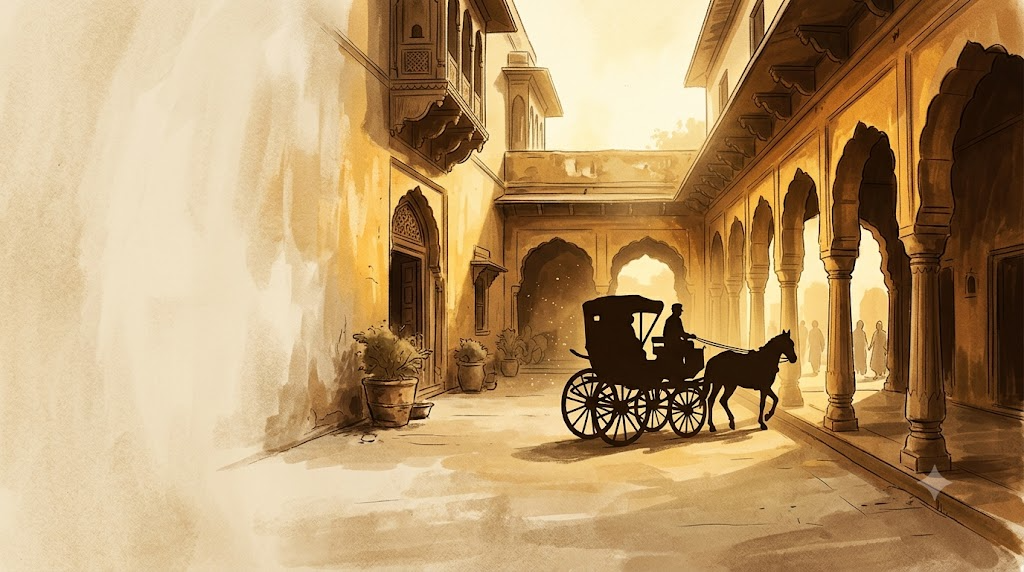
Wonder of wonders!

Kundhavai Piratti took the olai—the inscribed palm-leaf message—that Vandhiyathevan held out to her, and began to read. Until that moment, a frown had marred her lovely face, like a passing cloud, but as her eyes moved over the script, she began to relax. By the time she finished reading, her countenance was glowing with a warm, golden radiance.
“Well,” she said, glancing up at the young Vaanar warrior. “The olai is safely in my hands. What now?”
“My task is done, Your Highness,” he replied, a little wistfully. “I suppose all that is left for me is to return home.”
“Not at all. I should say, in fact, that your true mission has only just begun.”
“I am not sure I understand you, Devi.”
“My brother, the Crown Prince Aditha Karikalar, states here very clearly that I may entrust you with any confidential assignment. Surely you aren’t going to disregard his assurances?”
“I did, indeed, accept such a commission from him,” Vandhiyathevan said, sighing a little. “But I appeal to your kindness, Princess: pray, do not burden me with missions of the utmost secrecy or importance. I beg of you.”
“I’m afraid I am the one who doesn’t understand now. Is it common practice among Vaanar warriors to accept a commission, and then withdraw from carrying it out?”
“It is not in us to languish upon past laurels,” he replied, standing a little taller. “Neither is it the Vaanar practice to walk away from previously accepted assignments.”
“Well, what then?” A pretty, mischievous smile hovered about Ilaiya Piratti’s lips. “Perhaps you nourish a wholesome hatred for all womenfolk? Or is it just me you cordially dislike?”
Well, really. What sort of a question was this? Vandhiyathevan felt his mind spin. Would the great ocean ever nourish a hatred for the brilliant moon, hanging low and heavy in the night sky? And if it did, why on earth would it try so desperately to reach for it with a thousand frothing limbs, its restless waves? Who could ever claim that the blue sky loathed the beauteous Bhooma Devi, the Earth? Why else would it gaze down at her every night, hope and longing mingling in its thousand sparkling eyes, the stars upon the velvet dark? Could it ever be said that the dark monsoon clouds held the dazzling lightning in revulsion? Why else did they wish so desperately to clutch a power that cleft them in half, holding it in a close, thundering embrace? Did the honey-bee ever loathe the flower? If it did, why would it hover endlessly, drowsily, around the blooms? Would anyone ever believe it if the little vittil insect (the fluttering night-moth) was said to abhor the gentle, golden glow of a lamp? Why else would it dive into the light and sacrifice itself entirely?
What a question indeed, Devi. Dislike you? Why would your eyes, throwing those little sidelong glances in my direction, paralyse me into a state of sheer ecstasy, if I truly did? Why do you think that tantalising smile, playing at the edge of your lips, drives me to such a sweet, exquisite madness—a torture I can barely have enough of?
Such were the chaotic, tumbling thoughts that chased each other through the young warrior’s heart—thoughts that he could not, of course, give voice to in the waking world.
“You haven’t answered my question yet, Ayya,” the Princess prompted gently. “You believe, perhaps, that it is beneath the dignity of valiant Vaanar warriors to carry out a mere female’s commands? Didn’t the Crown Prince inform you of the contents of this palm-leaf when he gave it into your possession?”
“On the contrary, Devi—I was well aware of his express wishes and everything my mission entailed, right from the start. If anything, I am inclined to believe that I simply didn’t begin my journey at an auspicious hour. I have managed to make enemies all the way; I even had the supreme misfortune of seeing a bosom friend turn into a bitter foe. They pursue me even now, from all four directions. How may I safely carry out any task you might set me, under such troubling circumstances? That, in truth, is the only reason for my hesitation,” explained Vandhiyathevan earnestly. “I do not wish your commission to be jeopardised on my account, after all.”
“Foes in pursuit, you say?” enquired Kundhavai, a note of genuine worry seeping into her voice. “May I know who they are?”
“Well, the Pazhuvettarayars, for one thing. The powerful brothers have sent men into every corner, all making a great effort to apprehend me. My dearest friend Kandamaaran now believes me to have stabbed him in the back. Azhwarkkadiyaan Nambi, a certain fierce and rather argumentative Vaishnavite, dogs my steps day and night. Not to mention the fact that the Pazhuvoor Ilaiya Rani—Nandhini—has set a dangerous mandhiravadi (a dark magician) on my tracks. I have no idea when one or the other of these people will ensnare me, to tell the truth.”
The mere mention of the magician brought memories of their encounter flooding back to him. It had happened the night he escaped a watery grave in the floods. Vandhiyathevan had decided that continuing his journey in broad daylight was far too dangerous. He had spent the sunlit hours skulking in cool bamboo forests and shady plantain groves, choosing to walk steadily along the river banks only once the darkness had fallen.
Weariness had overtaken him sometime around the third jaamam, and he decided to take his ease in a ruined mandapam, an old stone pavilion. The moon was shining its pearly rays upon the earth, turning the night almost into day, and some of that pale radiance reached even a little inside the crumbling edifice. Vandhiyathevan moved beyond the light and lay down in the deep shadows. Sleep beckoned him warmly.
But even as he felt his eyes closing all by themselves, he was shaken awake, quite rudely, by a horrible screech very near him. An owl. Hadn’t he heard that very same screech during his conversation with the Pazhuvoor Ilaiya Rani, in her creeper-covered latha mandapam?
Vandhiyathevan rose hastily to his feet. Deep in the darkness, two tiny spots of light seemed to train themselves on him. He took two paces towards the entrance—when the soft sound of footsteps stopped him. Someone had just entered the pavilion.
Vandhiyathevan sidled behind a broken, ruined pillar and peered out. The moonlight fell directly on the newcomer’s face, and the Vaanar warrior realised with a jolt that it was none other than the mandhiravadi, Nandhini’s mysterious visitor. Much to his surprise, the magician seemed to make the pillar his target. Vandhiyathevan hoped the man was unaware of his concealment and would simply walk away into the night.
His hopes were dashed. The magician, tiptoeing like a stealthy cat until he reached the pillar, suddenly fell on Vandhiyathevan and clutched his neck with a loud, inhuman shriek.
“The signet ring!” the man howled. “Give me the palm-tree signet ring now—or I will strangle you this instant!”
Vandhiyathevan could barely breathe. His throat felt like it was being crushed in an iron vice; his eyes started out of his head as though they would pop out; he heaved and panted for air. And yet, somehow, he reined in his rising panic. He caught hold of the old stone pillar, gathered every ounce of his strength, and threw out his leg in a mighty, desperate kick.
The magician crumpled to the dusty ground with a scream. The old pillar, disturbed by the violence, chose that exact moment to crash down, and stones and rubble began to rain from the roof. A terrified bat flapped its way out of the pavilion, and so did Vandhiyathevan, running as fast as his legs could carry him. Only when he was absolutely sure there was no pursuit did he finally stop to catch his breath. His legs still shook and his body trembled even now, just recalling the terror of that night.
“Ayya?” Kundhavai’s melodious voice shook him out of his reverie and gently restored his equilibrium. “How long has it been, since you left Kanchi?”
“A week and a day, Devi.”
“Wonder of wonders, then, that you have managed to earn quite so many enemies within such a short space of time. Pray, how did you accomplish such a feat?”
“That would prove to be a very long story indeed, Your Highness.”
“You may recount it to me, nevertheless. My decision to entrust you with another mission depends, you see, upon knowing every single detail of your journey so far.” She turned to Eesana Siva Battar at that moment, calling the temple priest aside. “The boatman—what sort of a person is he?”
“Deaf as a post in both ears. He wouldn’t notice thunder if it tore his ear-drums, Thaaye,” the priest assured her.
“Excellent. Shall we embark on a boat ride, then? We would do well to row across the lake for a while; I wish to listen to his account in its entirety,” remarked the princess, walking swiftly and gracefully towards the shore.
A thrill of pure exhilaration coursed through Vandhiyathevan. On a boat—in the company of the illustrious Chozha dynasty’s exalted princess! What had he ever done to deserve this richness? He must have earned a great deal of virtue in at least seven past lives to be the recipient of such excellent fortune. Now that the Gods had seen fit to bestow such largesse upon him, he would ensure that this unlooked-for expedition lasted a very long time indeed. He would describe his adventures in such vivid terms, and with so many endless paragraphs, that it might never come to an end. Let it never be said that he ended a good story far too quickly. Such strokes of luck did not always find their way to a man—where was the need for any hurry?
Vandhiyathevan’s instincts may have been creditable indeed, but he had reckoned without Kundhavai’s own. The moment the little wooden boat began to glide over the rippling waters and he began his account of the midnight conference in Kadambur’s palace, the princess’s impatience rose with every passing moment.
“Well, what next?” she would ask. “And then?” “What happened later?” She shot the questions at him, barely able, it seemed, to sit still on the wooden planks.
To his credit, Vallavarayan did use the considerable powers in his repertoire, lengthening his tale as much as he could—but even the longest of stories has to come to an end at some point, mustn’t it? By the time he finally finished, the boat had completed its circuit upon the lake and returned to the quiet quay.
It was obvious, even as they climbed out and entered the fragrant shade of the royal gardens, that the Kuravai Koothu was still in full swing somewhere within the palace grounds. Stringed instruments played melodiously, accompanied by the rhythmic tinkling of thandai, the heavy silver anklets worn by the dancers.
A beautiful verse from the Silappathikaaram, set to an old, lilting tune, wafted towards them on the gentle breeze:
What eyes are those that do not marvel at the great Lord, the Maayavan; He who holds the whole world upon a beautiful lotus, borne of His navel, in a gentle clasp? What eyes are these that even blink, as they gaze upon His feet, eyes and dark, divine Form? What tongues are these that do not sing in praise of the Great One Who foiled the evil Kamsan’s devious plans; Who went as an envoy from the illustrious Pandavas to the hundred Kaurava brothers, To the glorious praise of thousands? What tongues are these, that do not chant the blessed name, Narayana, at every turn?
“Kamsan might have been devious in his revenge indeed, making deceitful, terrible plans to vanquish Kannan,” mused Vandhiyathevan, listening to the song. “But it cannot be denied that he performed a signal service for me.”
“Did he, now?” Ilaiya Piratti raised her delicate eyebrows. “What might that have been?”
“Assisting me in entering the city, of course,” he returned with a grin. Then, he went on to describe the exact, and rather comical, circumstances of this assistance.
Vallavarayan had guessed, quite accurately, that the Pazhuvettarayars’ men would be lying in wait for him even before he arrived at Pazhaiyarai, guarding every single point of entrance and exit. The least sign of suspicious behaviour, and he would be carted off to prison at once. How on earth was he to enter the stone gates under these troubling circumstances?
He had stood mulling over this complex problem on the dusty banks of the Arisilaaru river, some distance from the city’s principal entrance, when he caught sight of an approaching theatre troupe. They were complete with actors playing Kannan, Balaraman, and the wicked Kamsan in their full, colourful regalia. Of these, the last-mentioned was the only one to wear a curiously fashioned mask as part of his disguise. A fascinating, impish idea began to take shape in Vandhiyathevan’s fertile brain.
Sauntering over to the troupe, he engaged them in random, cheerful conversation. “Your precious actor, the one who is playing Kamsan—he’s not very talented, is he?”
Unsurprisingly, the actor playing Kamsan took instant exception to these flippant comments, and engaged Vandhiyathevan in a lively quarrel. And since when has our young warrior ever walked away from one? He snatched away Kamsan’s painted mask and wore it himself, in one audacious move.
“Here’s my challenge,” he crowed to the indignant actor. “I am a far better dancer than you—and I shall prove it!” he yelled, flinging himself about the riverbank with absolute abandon.
The rest of the troupe agreed, carried away with his sheer theatrics, even going so far as to say that Vandhiyathevan put on a much better show than their own member. This seemed to be the cue for the original Kamsan to tear off the rest of his disguise and stomp away down the dusty road, thoroughly disgusted and furious.
“Who cares about that idiot?” Vandhiyathevan had shrugged superbly. “I am here now—and I shall play Kamsan, if you wish.”
The theatre troupe did so wish, and bore him off promptly towards the gates, delirious with joy at having found a true actor. Once every song and dance at Pazhaiyarai’s street-corners had come to a jubilant end, Vandhiyathevan had slipped away, following Aditha Karikalar’s advice to the letter, and met Eesana Siva Battar at the Vada Metrali Temple. The good priest had bidden him wait in one of the old Samana (Jain) caves, before seeking Kundhavai Devi’s permission for a private audience. Once this was given, he had brought Vandhiyathevan safely to her, journeying upon the lake.
Ilaiya Piratti gazed at him, her exquisite eyes lovelier still, wide with astonishment.
“It appears to me that Kotravai, the Goddess of Victory, stands firmly by the Chozhas,” she murmured, a little awed by his tale. “Indeed, it is Her grace that has sent you to my assistance in these times of peril!”
“But—I haven’t been assigned a task yet, Your Highness,” protested Vandhiyathevan. “Nor a hazardous commission with which to prove my true worth.”
“Fear not. The mission I have in mind is one that will make your previous perils seem like nothing at all in comparison.”
Vandhiyathevan felt his heart swell, his body quiver with pride. Ah, wouldn’t he gladly cross the seven roaring seas in this lady’s service? Wouldn’t he engage in battle with a thousand lions and tear them apart without recourse to a single weapon? He would climb atop the insurmountable, mythical Mount Meru and pluck the very stars from heaven, at a single wave of her hand!
In the midst of the royal gardens stood a beautifully wrought vasantha mandapam, a cool, breezy pavilion meant for the spring, its marble pillars smooth to the touch. It was to this edifice that Kundhavai next made her way. The Battar and Vandhiyathevan followed quietly.
The princess reached into a tiny alcove, took out a fresh palm-leaf and a gold-handled quill, and began to inscribe a message:
Ponniyin Selva! Return home the instant you receive this message. More, you will know, through the bearer of this palm-leaf. You may trust him implicitly.
She signed this little effusion with a tiny etching of an aathi leaf—the traditional emblem of the Chozha dynasty, whose kings had worn its garlands for centuries—and handed it to the Vaanar warrior.
“You are required to leave without a moment’s pause for Eezha Nadu, the island kingdom across the sea. Convey this message safely into the hands of Prince Arulmozhi Varmar, and escort him home, personally.”
Vandhiyathevan’s life, it seemed to him in that moment, was beautifully complete. He stood perfectly still, buffeted by waves of sheer, unadulterated happiness, hardly daring to believe his luck. One of the two manoradhams—the greatest ambitions he had cherished all his life—had just come true: meeting the ancient Chozha clan’s magnificent princess, Ilaiya Piratti Kundhavai. And it seemed that his second would soon be achieved as well, by virtue of her command. He was about to have the supreme good fortune of meeting the beloved prince, Ponniyin Selvan, Arulmozhi Varmar himself.
“A task my heart craves above all, Devi,” he murmured, his voice soft with emotion. “I shall take your olai and set off at once.”
And he stretched out his right hand. The olai was duly given. As Kundhavai handed it over, her beautiful fingers, as graceful and slender as the delicate red and yellow kaanthal flowers that bloomed in the hills, brushed briefly against his own fortunate hand.
A sudden spark of energy burst through his body; his skin prickled with a hundred goosebumps, and his heart felt like it might simply explode with ecstasy. A hundred thousand butterflies seemed to fill his vision, dazzling him with their delicate, exquisitely fragile wings. A hundred thousand nightingales warbled a glorious, unending song of rapture in his ears. It felt as though fragrant blooms were descending upon him in veritable mounds, deluging him with sweet colour and perfume, scattering in all directions on the soft grass.
Vandhiyathevan slowly raised his head, and his eyes met Kundhavai’s for a long, quiet moment. A thousand words trembled upon his lips; his heart was utterly overrun with emotion. And yet—what power had mere, clumsy words to express his deepest feelings? No matter. His eyes, it seemed, were able to perform this office for him, more than adequately. What they communicated to the Princess at that moment—the splendid poems they recited in silence, the magnificent verses they extolled—ah, not even the great Kalidasa, nor the brilliant bards, nor the ancient composers of epics could have accomplished such a thing. What more needs to be said, then, of their beauty?
Salasalasala… dry leaves rustled suddenly, somewhere in the distance just outside the marble pavilion. Eesana Siva Battar politely cleared his throat.
And Vandhiyathevan came tumbling back to earth with a thud.
© 2026 Matribhasa Classics. Public Domain


Comments (0)
Log in to join the conversation.