Pazhaiyarai

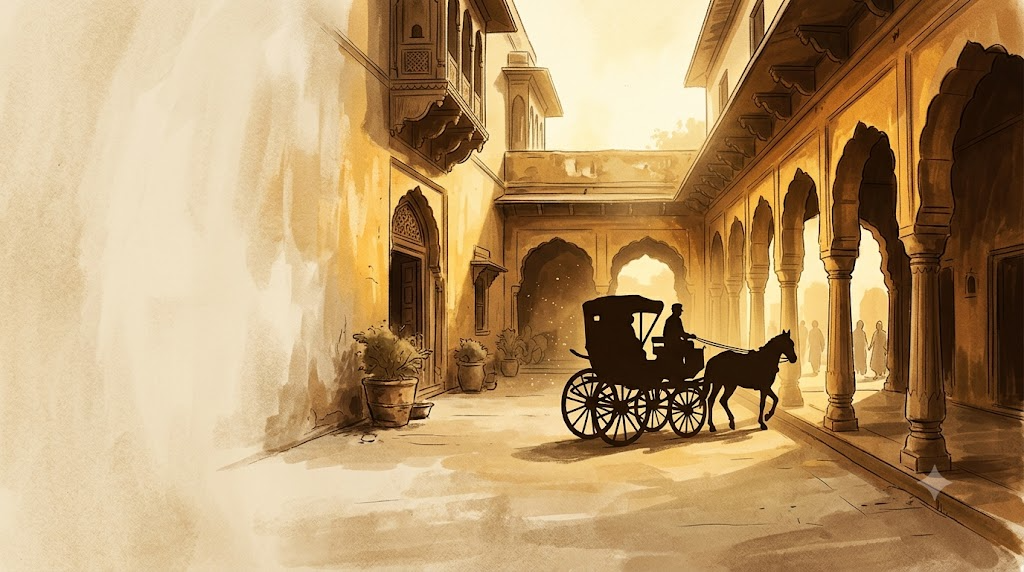
Our young friend Vandhiyathevan is fated to pass through many trials, tumbling into and out of half a dozen scrapes, before he can ever set foot in Pazhaiyarai. And so, dear reader, I ask that we might make our own entrance into this lovely old city a little ahead of him. Stand with me for a moment on the southern banks of the Arisilaaru River and just look at it. Surely this is more than a mere city? To my eyes, it is nothing less than a beautiful ornament resting on the forehead of the Tamil goddess herself. Is it not a dazzling netrichutti (a delicate piece of jewellery worn along the parting of the hair, resting lightly on the forehead), set with the brightest green emeralds, deep rubies, and glittering blue sapphires? The rivers, streams, ponds, and canals that embrace this gentle place are brimming with water, their surfaces carpeted with flowers of every hue. Tall coconut palms and shady punnai trees dot the landscape, offering a cool, quiet respite from the sun. The konrai trees are hung heavy with thick strings of golden blossoms. And there, rising softly from all this natural abundance, are grand mansions and palaces, their golden spires and temple gopurams reaching high into the bright blue sky. My goodness, it takes a whole handful of smaller towns to make up this one great metropolis! You have Nandhipura Vinnagaram, Thiruchathi Muttram, Patteechuram, and Arichandhrapuram—all of these, with their old stone temples, nestle together to form the greater capital of Pazhaiyarai. Four ancient shrines to Siva Peruman guard the city in the four directions: Vadathali, Keezthali, Metrali, and Thenthali. And dotting the outskirts are four veerapuris (martial settlements meant exclusively for the brave soldiers of the realm): Ariyappadai Veedu, Pudhuppadai Veedu, Manappadai Veedu, and Pambaippadai Veedu.
Right in the heart of all this stood the royal palace of the Chozhas, its many towers, breezy galleries, pavilions, and carved balconies climbing towards the clouds. But to call it just a single palace would not be quite right. Perhaps in the early days of Vijayalaya Chozhar it had been one building, but over the years, every Chozha prince, queen, and princess had seen fit to add a dwelling of their own. Now, well, you would need a thousand eyes just to take in the sheer wonder of all those new mansions clustering around the old one. Ten thousand poets, writing day and night, could hardly capture a fraction of its loveliness. Even the great poet Sekkizhar Peruman, writing his divine verses some two centuries later, marvelled at the place: “Therin meviya sezhumani veedhigal sirandhu, Paaril neediya perumai ser pathi Pazhaiyarai…” A city of magnificent chariot-lined streets, a city of enduring glory on this earth. Was there anywhere else quite like it? And if it moved poets so deeply much later, imagine how splendid it must have been in the golden reign of Sundara Chozhar!
And yet, our own arrival in this exquisite capital happens to miss that grandest period of festivity. We are a little late to see the metropolis as the bustling heart of the empire, when the Emperor himself sat upon the throne here. Ever since the old Chakravarthy, struck down by poor health, had shifted his court to Thanjavur, things had grown quiet. The endless stream of visiting royalty from foreign lands, the princes arriving to pay their respects, the busy ambassadors, ministers, and commanders—all had dwindled away to a trickle. Naturally, the great parivaarams (the sprawling, noisy retinues and entourages that always travelled with them) had vanished too. The four usually boisterous padaiveedu settlements (the military cantonments) were left looking rather bare. More than half the fighting men had sailed off to the war in Eezham, eager to show the world the mettle of Tamil soldiers. The rest were busy on the northern frontiers, or else showing off their skills down in Madurai. As a result, the cantonments were now mostly quiet places, home to the elderly, the women, and the children. Even the fiercely loyal Velakkara Regiment, who used to live in Mazhavarpadi, had packed up their families and followed the king to Thanjavur, leaving their old streets looking rather forlorn and empty. The ministers, the royal samanthakars (the vassal lords), and the many officials who actually ran the government day by day had all shifted to Thanjavur as well, taking their busy households with them.
Yet, despite this drifting away of the mighty and the powerful, Pazhaiyarai’s winding streets had not entirely lost their magic or their splendour. The wide avenues still seemed to burst at the seams with people going cheerfully about their day. There were temple sthapathis (the master architects and sculptors of stone), devoted followers of Shiva, and the gentle Odhuvaars (the temple singers whose lives were devoted to reciting the beautiful Thevaram hymns). There were temple servants, priests, and a happy assortment of pilgrims who had travelled from all corners of the country just to visit the shrines or join in the temple fairs.
Today, as it happened, was a particularly joyful day—a thiruvizha (an auspicious temple festival). Men, women, and little children were out parading in their brightest silks and finest silver ornaments. Crowds gathered at street corners, pressing in to watch small troupes of actors in bright costumes, singing and dancing in the dust. And what parts were they playing? Look closely—there is a boy painted blue, dressed as little Krishna, alongside his brother Balarama and the cowherd boys! Over there, a scene is unfolding where Krishna holds up a giant painted mountain to protect his people from the rain, while Indra, the king of the gods, bows humbly at his feet. And just down the lane, another actor wearing four papier-mâché heads to represent Lord Brahma is doing exactly the same thing. Ah, it all makes sense now. Today is Sri Jayanthi, the joyful birthday of the divine Kannan (Lord Krishna), and that is the reason for all this noise and laughter.
Not wanting to leave all the fun to the actors, young men were eagerly playing at uriyadi in the streets. Earthen pots were strung up high on bamboo poles, and blindfolded boys with sticks swung wildly, trying to break them, to the immense amusement of the crowd. Every time they missed, the uproarious onlookers would gleefully douse them with yellow turmeric-water.
All this merrymaking was happening right near the Nandhipura Vinnagara Temple. But wait a moment.
“Kanden! Kanden! Kanden! Kannukkiniyana Kanden!”
Who was singing with such rapture about gazing at the Lord? We know that booming voice, don’t we? And sure enough, there in the thick of the crowd stood our old friend Azhwarkkadiyaan Nambi, sporting all the unmistakable marks of a devout Vaishnavite. A small circle had already formed around him. A few good souls were listening earnestly, moved by his verses, while others had already begun a rather crude heckling. One couldn’t help but feel a little sorry for those naive onlookers, knowing how swiftly Azhwarkkadiyaan’s stout wooden staff usually dealt with thick skulls.
But before any arguments could break out, a stir rippled through the crowd near the massive wooden doors of the Vinnagara Temple. The waiting chariots and palanquins were hurriedly brought forward. A group of elegant ladies emerged from the cool shadows of the shrine, and it was quite clear they belonged to the royal family. These were the high-born queens and princesses who brought life to the many palaces of Pazhaiyarai.
Walking at the very front, leading them all, was Sembiyan Madevi. Across the Chozha Empire, she was revered simply as Periya Piratti. She was a daughter of the ancient Mazhavaraiyar clan and the widow of the deeply pious Emperor Kandaradhithar. Time had gently marked her face, and her sombre, plain white attire spoke of her widowhood, but heavens, how regal she looked! Her face carried a serene, radiant dignity that made you want to bow your head. Just behind her came Kalyani, the widow of Arinjaya Chozhar and a daughter of the Vaithumbarayar dynasty. You could still see the exquisite, chiselled loveliness of her face, and looking at her, you realised exactly where her son, the handsome Emperor Sundara Chozhar, got his famous good looks. And following quietly in her wake was yet another royal lady, a princess of the Chera clan, Paranthakan Devi.
Trailing behind these older queens came a flock of younger maidens, looking for all the world like celestial nymphs who had just fluttered down from the clouds. Among them were the brilliant Princess Kundhavai Piratti, the shy Vaanathi from Kodumbalur, and several other princesses from noble Tamil houses whom we have met before. Now, it is true that the Chozha kings had worshipped at the feet of Lord Shiva and Goddess Durgai right from the days of Vijayalayar. But this certainly did not mean they bore any ill will towards Thirumaal or the followers of any other faith in the land. Quite the opposite, in fact. That was why this royal procession had come in all its finery to the Vinnagara Temple—to happily celebrate the birthday of little Kannan.
Just as the Periya Piratti was about to step up into her palanquin, Azhwarkkadiyaan’s booming song caught her attention. One had to wonder if that was exactly why our clever Vaishnavite friend had been singing quite so loudly. If so, it worked beautifully. Sembiyan Madevi paused and quietly sent for him.
Azhwarkkadiyaan hurried over, bowing deeply and folding his hands with the utmost respect. “Well now, Thirumalai,” began the great queen gently. “I have not seen you for a while. Have you been away on a pilgrimage?” “Indeed I have, Thaaye,” he replied warmly. “I visited a great many holy shrines. Thirupathi, Kanchi, and Veera Narayanapuram, just to name a few. And what is more, I saw and heard a great many wondrous things on my travels.” “Come to the palace tomorrow, then, and you can sit and tell us all about your adventures.” “I am afraid I cannot do that, Amma,” he said, shaking his head apologetically. “I have to leave Pazhaiyarai this very night.” “In that case, you may come to see us this evening.” “Of course, Thaaye. Your wish is my command.”
With a creak of wood and the soft jingling of bells, the many palanquins and chariots began to trundle away towards the royal quarter. As they departed, Princess Kundhavai caught sight of the rather rotund Azhwarkkadiyaan. She pointed at him and whispered something to her friends, sending the young girls into a fit of merry, chiming laughter. Hearing the giggles, Azhwarkkadiyaan turned to see what was so amusing. For a fleeting second, the princess’s bright, intelligent eyes met his, silently exchanging a message in a language of glances that only the two of them seemed to understand. He gave a very small, barely perceptible bow—just enough to let her know he had caught her drift.
Sembiyan Madevi’s own grand palace sat comfortably at the very heart of the sprawling royal complex in Pazhaiyarai. Later that day, in the cool, airy space of her sabha mandapam, the gentle queen sat upon a golden throne set with the nine precious gems. But she did not look much like a queen on a golden throne. Choosing to walk the quiet, devout path of the great poet-saints like Karaikkal Ammaiyar and Thilakavathiyaar, she was the very picture of simplicity. She wore plain white silk. Her only adornments were the white smear of sacred ash on her forehead and strings of rough, brown rudraksha beads around her neck. Surrounded by the Ashta Aiswaryam (the eight magnificent forms of worldly wealth), she quietly proved to anyone who cared to look that it was perfectly possible to live the pure, detached life of an ascetic, wholly devoted to God, right in the middle of a palace. No heavy, jewelled crown weighed down her head, no heavy gold bangles clamped her wrists. And yet, looking at her radiant face and calm posture, you knew instantly that you were in the presence of true majesty. Here was a woman born to grace, who commanded deep, unshakeable respect without ever raising her voice.
It was easy to see why the entire Chozha family loved her so fiercely, turning to her for guidance and never once dreaming of going against her wishes.
Well, perhaps not entirely. Lately, something had occurred to trouble the deep peace that usually surrounded her. A shadow had fallen over her quiet life of prayer. Her own son, Madhuranthaka Thevar, a man who had always been such a devoted follower of Shiva, had gone entirely against her strictest instructions and married a girl from the powerful Pazhuvettarayar family. What was worse, troubling rumours had begun to drift through the palace corridors on the warm breeze—whispers that her son was suddenly hungering for the Chozha throne itself. It was only natural, then, that Sembiyan Madevi’s serene composure was, for the moment, a little ruffled.
Usually, the Periya Piratti’s courtyards and audience hall were full of life, echoing with the tapping chisels of enthusiastic sculptors and the sweet, steady singing of Thevaram hymns. Learned poets and devout pilgrims often trudged many long, dusty miles to recite for the queen, knowing they would be met with a kind smile and a generous gift. In the evenings, there was always a steady stream of temple priests bringing in fresh flowers and sacred offerings once their daily worship was complete.
On this particular afternoon, it was the turn of the builders and devotees from towns like Thirumudhukundram (Vridhaachalam), Then Kurangaduthurai, and Thirumazhapaadi. They had come all this way to petition the queen for funds to rebuild their old brick shrines in lasting stone. They stood about the hall holding scrolls of elaborate sketches and beautiful, intricate little wooden models to show the queen exactly how the new temple towers would look.
Having happily agreed to fund the thiruppani (the sacred building work) for the first two shrines, Sembiyan Madevi turned her gentle gaze to the last group. “Thirumazhapaadi?” she asked softly. “Now, which town is that?” “It is the very place where our beloved Lord Shiva called out to the great saint Sundaramurthy Nayanar, gracious lady,” explained an earnest man from the town. “It is there that the Lord holds court!” “Is that so? Pray, tell me the story,” said the Mazhavarayar princess, resting her chin on her hand, always eager to hear a tale of devotion. “Well, Amma,” the man began, his eyes shining, “Sundaramurthy Nayanar, as you know, spent his life walking from one holy shrine to another. On one such dusty journey, he came to a river that barred his path. Just as he was hitching up his robes to wade across, a voice suddenly rang out through the trees. ‘Sundaram! Have you forgotten me?’”
The man paused, making sure the queen was listening. “Sundaramurthy stopped dead in his tracks. He knew that voice. It was none other than Siva Peruman himself, the Lord who had long ago claimed his heart and soul. He turned to his disciples and asked, ‘Tell me, is there a temple for my Lord anywhere nearby?’ To which they pointed and said, ‘Yes, Swami. The temple of Mazhapaadi is concealed right behind that thicket of konrai trees.’”
“Sundaramurthy hurried over to the trees, which were heavy with fragrant yellow blossoms, and there, nestling quietly in the foliage, was a humble little Shiva shrine. He fell to his knees in worship. He marvelled at the sheer grace and compassion of a God who, having claimed him once before, would bother to call out to him again like a friend passing by. Weeping tears of joy, he cried, ‘Swami! What kind of question is that? How could I ever forget You? And if I ever did, who else is there in this whole world for me to worship?’ And right there on the riverbank, he poured his heart into these beautiful verses:
Ponnar Meniyane! Pulitholai Araikkasaithu Minnaar Senjadai Mel Milirkonrai aninthavane! Manne, Maamaniye, Mazhapaadiyul maanikkame! Anne unnaiyallal Ini yaarai ninaikkene?”
The man from Mazhapaadi clasped his hands together and looked up at the queen. “Great Mother, that same little shrine, the one that moved Sundaramurthy to such beautiful songs, still stands hidden among those konrai trees. It is small, made of crumbling brick, and quite insignificant to look at. That is the temple we are begging to rebuild in stone.”
Sembiyan Madevi smiled, a deep, satisfied warmth in her eyes. “So be it,” she assented simply.
While this quiet story was unfolding, Azhwarkkadiyaan had slipped into the back of the hall with a companion. The two of them stood quietly in the shadows near a stone pillar, a little distance away. Like watchful spectators, they observed everything, their senses on high alert.
© 2026 Matribhasa Classics. Public Domain


Comments (0)
Log in to join the conversation.