The Clash of Lions

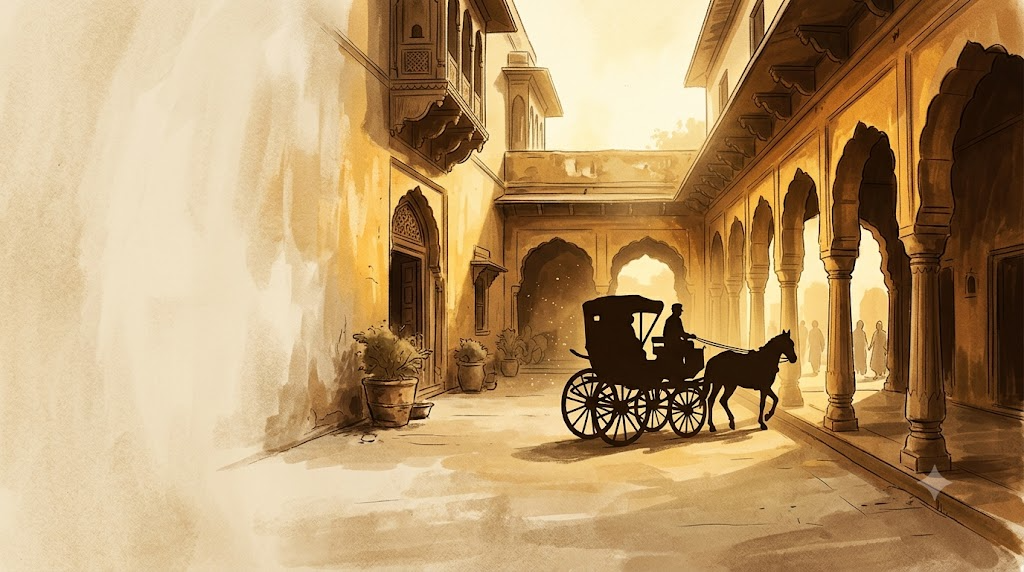
The good people of Thanjavur cherished a rather wholesome, if somewhat unique, fondness for the Pazhuvoor brothers. Hadn’t it been those great lords, after all, who had brought their old city its new lustre and a welcome sense of pride? It is only natural that a procession of elephants, horses, palanquins, and even the odd lumbering camel attracts a great deal of attention; people will always throng the streets to see such events, to gape at the opulence and drink in the festive air. Small matter, then, that Thanjavur’s residents accorded the very same degree of importance every time the elder brother, Periya Pazhuvettarayar, entered or exited the great stone fort. They ranged themselves along the sides of the dusty roads, raising chants of victory and shouting out fond blessings, showering the great man’s entourage with fragrant jasmine flowers and handfuls of puffed rice.
It was also the established custom for Chinna Pazhuvettarayar to arrive at the towering fortress gates to welcome his elder brother, whenever the latter returned home from a journey. Their embrace, once they set eyes on each other, was always a sight that inspired majesty and deep devotion. It was as though the very Nilagiri and Podhigai hills had uprooted themselves to clasp each other—such was the sheer physical stature and splendour of the two men. And as for the times both set off in grand procession through the wide, tree-lined avenues of the city, riding upon their respective elephants or fine horses—ah, a man would need ten thousand eyes to properly digest the magnificence of such a picture.
Some townspeople considered them equal to the mighty asura siblings of old, Hiranyan and Hiranyakshan; others were prone to call them the Sundhobha-Sundhars. There were those who swore that the affection existing between them was not unlike that of the epic heroes, Lord Rama and Bharata, while still others considered them warrior brothers on par with the Mahabharata’s Bhima and Arjuna.
Today, however, matters were vastly different. Neither Periya Pazhuvettarayar’s grand entrance, nor the suitably pompous performance delivered by his faithful entourage, served to stir up any real excitement. The streets remained entirely devoid of their usual delighted welcome; in truth, not many people were even present. But far more important than the missing crowds was the fact that Chinna Pazhuvettarayar was conspicuous by his complete absence.
Periya Pazhuvettarayar chose to disregard this rather glaring flouting of convention, proceeding straight to his younger brother’s sprawling mansion. He reasoned that Thanjavur’s Commander must have been unavoidably detained by something of grave importance. Perhaps the Chakravarthy’s health had taken a sudden turn for the worse. Or perhaps—just perhaps—a certain significant event that they had been anticipating had finally come to pass?
Plagued by these doubts and a few more besides, Periya Pazhuvettarayar’s impressive retinue reached the Commander’s palace much sooner than usual. The younger brother finally arrived at the entrance to welcome the elder, his face plainly shrouded with worry and dark anxiety. He bowed respectfully; the brothers embraced. Then, without a word to the guards, they entered the palace together, making straight for the mandhiralosanai.
Once they were safely in private, Periya Pazhuvettarayar came straight to the point.
“You do not seem to be your cheerful self, Thambi. Has something occurred? Is it the Emperor? He is well, is he not, Kalanthaka?”
Chinna Pazhuvettarayar—Kalanthaka, for that was his given name—nodded slowly. “As well as he ever is, I suppose. Neither terribly ill, nor completely well.”
“Why do you seem so ill at ease, then? I did not receive your customary welcome at the fort gates—and the city seems far less enthusiastic than usual.”
“Something has occurred, Anna—a very insignificant event, I must admit. But more of that later. What about your own affairs in the north?”
“A complete success, of course,” the elder brother boomed. “Every single one of the invited guests arrived at Kadambur. They all agreed, quite unanimously, that your son-in-law Madhuranthakar deserved to be the proper successor to the Chozha throne. They raised the very roof with victory chants, I must say! And if those in question will not listen to reason, our royal champions are very willing to raise their swords and fight for our cause. Witness the sight: even Kolli Mazhavan and Vanangamudi Munaiyaraiyar submitted completely to our decision. What more could we possibly need? As for Sambuvaraiyar, that man is eager to put his men, his fortress, his ramparts, and his entire wealth at our disposal, if it will aid our mission. His own son Kandamaaran is straining at the leash, frankly. Who cares about the mid-lands and Thirumunaippaadi, when we have all of Chozha Nadu firmly within our grasp? What else need we worry about, pray tell? The only objection, if any, might arrive from Pallavan Parthibendran, Thirukkovilur Malayamaan, and Kodumbalur Velaan. And of those three, the last is far away in Ilankai and poses no immediate threat. What could the other two possibly do on their own? Turn the whole world on its feet? All that is required now is to confront the Emperor soon and be done with it.”
“Excellent—as far as the local lords are concerned,” Chinna Pazhuvettarayar drew out his words thoughtfully. “What of the common people, though? If they should object—?”
“The people? Good God, what of them?” Periya Pazhuvettarayar scoffed. “Since when have royal affairs ever involved the ordinary subjects of the land? Should they ever be so presumptuous as to interfere in such things, it is our sacred duty to crush their impertinence. I do not, however, anticipate any sort of uprising. All that needs to be said is that the Emperor himself desires Madhuranthakar as his heir—and that will shut the people up fast enough. They might be stirred into noisy protests, I will admit, were Arulmozhi Varmar here, but fortunately, the boy is across the sea in Ilankai and highly unlikely to wreck our carefully laid plans. And our beloved people do not harbour the same amount of fond affection for Aditha Karikalar, as you well know. As for your son-in-law, it would be a very easy matter to gain him their lasting loyalty. He has already made a fine name for himself as a devout young man with plenty of pious character. And do we not all know that he is blessed with a countenance much fairer than both of Sundara Chozhar’s precious sons? Those learned idiots who are always shrieking that ‘the face is a reflection of the heart’ would be sure to sing his praises from the rooftops. I should be quite amazed, I will admit, if I did not hear ‘Long live Emperor Madhuranthakar!’ ringing from all quarters soon enough. No matter—surely there is nothing for you to fear as long as I am standing firmly by your side?”
“Yes—but what about the Velakkara Regiment? How do we counter the royal bodyguards?”
“Those warriors may have sworn a fearsome blood oath to protect Sundara Chozhar’s sacred person, but certainly not his sons, surely? And even if they should object, for some strange reason, your own fortress battalion can break them, can’t they? Drag the whole lot of them in a naazhigai and stuff them down the deepest dungeons, I say.”
“Pazhaiyarai is likely to pose the biggest threat by far, Anna. Who knows what sort of a terrible strategy that old hag and the young demon might hatch between them?” Chinna Pazhuvettarayar was referring, of course, to the dowager queen Sembiyan Madevi and the clever princess Kundhavai. “We must bend our energies to destroying those two, surely?”
“Thambi, you aren’t seriously insinuating, I hope, that I must exercise more caution over two weak, defenceless women than over seasoned, hardened warriors? What earthly havoc could they possibly wreck? And if they should happen to drum up some little plot, I possess more than enough trickery and magic to counter them, never you fear.”
“The Emperor has formally commanded both his sons to return to Thanjavur—”
“Aditha Karikalar certainly won’t come. Arulmozhi Varmar might give some credence to his father’s orders—in which case we must make very sure to stop him, using sheer force if necessary. Neither of them must be allowed to set foot in Thanjavur until we have firmly affirmed Madhuranthakar as the Crown Prince and set him on the Chozha throne, complete with every authority and power due to that high position. Only then, perhaps. However, you may leave all of these matters to my care. Now, to return to your earlier concerns—what was this insignificant issue that worried you so much today?”
“There was a certain young man who arrived from Kanchi, bringing palm-leaves for the Emperor and the Princess Kundhavai—”
“You have confiscated the leaves in question and thrown him in prison, I hope?”
“Er, no. He specifically mentioned meeting you in Kadambur—apparently, you commanded him to hand over the olai directly to the Emperor. Is that true?”
“Lies, all of it!” Periya Pazhuvettarayar thundered. “There was a young man lingering in the Kadambur palace, to be sure; a bold, uninvited guest who called himself Kandamaaran’s friend. But the dratted boy never mentioned an olai of any kind to me. I mistrusted him the very instant I set my eyes on his cunning face. Surely you did not fall prey to his scheming ways?”
“I am afraid I did, Anna—only because he mentioned your esteemed name.”
“Why, you absolute idiot! What dim-witted blunder did you commit now? You did not allow that young scoundrel to deliver his olai to the Emperor, did you? Without even taking a look at it?”
“I did read it, but it seemed to contain absolutely nothing of importance; only a bland message asking the Emperor to visit the newly built Golden Palace in Kanchi. That young man, though—once he had safely delivered the olai, he went on, saying something rather vague about ‘danger’…”
“All this, and you still did not imprison him?”
“No—although I did begin to suspect his true motives.”
“What on earth did you do with him, then?”
“He said he wished to sightsee around Thanjavur, and I sent him out with two escorts. But he gave them the slip in the bustling streets and vanished into thin air. I was utterly preoccupied with flushing him out, which was exactly why I could not even come to the gates to welcome you home. I have sent out a strict warning to the city guards, as well—”
“Chee!” (an exclamation of profound disgust). “What kind of a brainless idiot falls prey to a boy who is barely a man, a fellow without even a proper shadow of a moustache on his lip? Fool that I was, I proudly named you Kalanthaka Kandan, He Who Vanquishes Death! I strove to use every weapon in my vast armoury to make you the supreme Commander of the Thanjavur fort—and ah, how well you have repaid my lifelong efforts! How dare you stand in front of me and openly admit that you were made a fool of by a scheming little rascal of a boy? You ought to be thoroughly ashamed of yourself!”
“It was not just your name that he mentioned to get inside,” Chinna Pazhuvettarayar defended himself, stinging from the rebuke. “He showed me your own signet ring as well. Did you give it to him?”
“Not on my life! What sort of a bumbling nincompoop did you think I was? You?”
“That may be, but he most certainly did possess the Pazhuvoor signet ring, and so I will swear on all that is holy. What is more, he displayed it to the fortress guards as well, who naturally let him in. If he did not receive it directly from you—then there is only one other possible source he could have gotten it from.”
“And who might that be?” The older man’s voice dropped dangerously.
“Can you truly not guess? I mean the Ilaiya Rani, of course—”
“Careful, boy!” The elder brother roared, his face darkening like a monsoon sky. “Guard your tongue—else I will cut it out, myself!”
“Do, by all means; you have my full leave to chop off my head right now, if you so wish. But I have every intention of finally revealing what I have yearned to say, these many, many days. A vicious cobra may be a truly bewitching creature, and you may have considered it a thing of great and rare beauty when you first took it in—but remember that, sooner or later, it will sink its fangs into you. Some day, that beautiful snake will ruin us all! Do not lose yourself to her wily, hypnotic charms, Anna—throw her out of the palace now, and we may all be safe yet!”
“Kalanthaka Kanda—now that you have been so extremely good as to share your much-vaunted opinions; give me leave to return the favour.” Periya Pazhuvettarayar’s voice was a low, trembling snarl. “I have yearned to speak my mind as well, and here is what I wish to say. You have my full permission to deliver your advice, to share your deep concern; even to remonstrate with me, should you find any of my public actions questionable. You may do all of these things—save criticise the lovely lady who has done me the supreme honour of accepting my hand in marriage. Speak but one more word against her, and I shall strangle you with the very hands that raised you from childhood. The slightest accusation, and I shall stab you to death with the very hand that taught you how to wield a sword. Careful, now!”
Those two brothers, famed throughout the land for their deep and unwavering mutual affection, seemed like two enraged lions at that moment, ready to fling themselves at each other’s throats, entirely willing to rip each other’s eyes out. Their bitter war of words rang through the quiet chamber, echoing fiercely from every stone corner, very like the deafening roar of a ferocious jungle beast. They might have been supposedly engaging in a private, confidential conversation within the thick walls of the council chambers, but their growling threats permeated the heavy wooden doors, falling upon the startled ears of the guards waiting outside like the rumble of distant, terrifying thunder, the actual words mercifully muffled and indistinguishable.
Their grand entourage awaited their lords’ pleasure in the stone corridors, quivering with sudden dread. What sort of dark and terrible storm was about to break over their heads now?
© 2026 Matribhasa Classics. Public Domain


Comments (0)
Log in to join the conversation.