A Maid in a Tree!

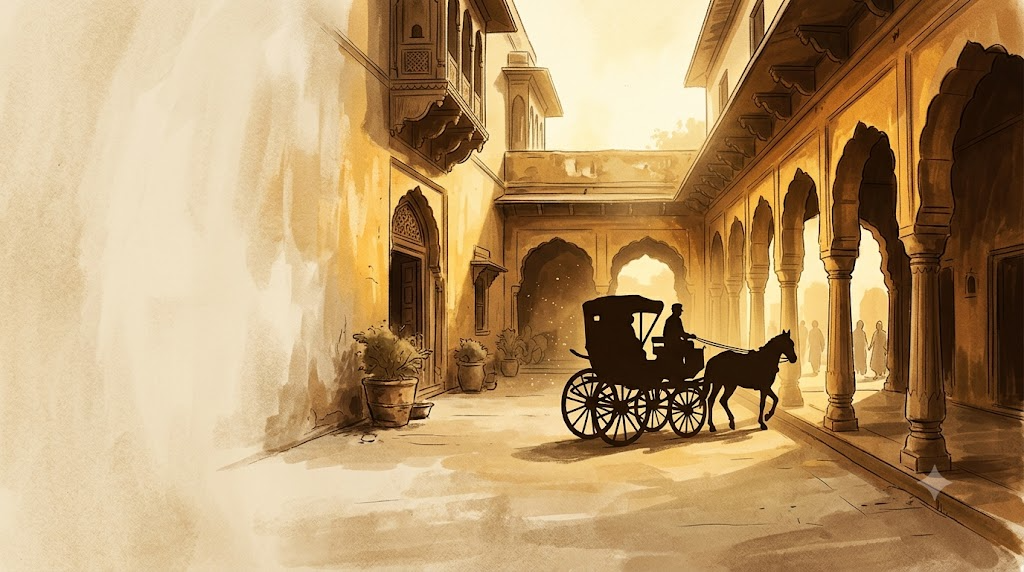
Flanked on either side by two burly guards in the service of Chinna Pazhuvettarayar, young Vandhiyathevan set off in rather grand state for a tour of the great city of Thanjavur. It was perfectly obvious, of course, that his escorts were there to ensure he didn’t run away. It was equally clear from the tight-lipped sentries at the fortress gates that strict orders had been passed down: no one was to be allowed out of the city that day.
Nevertheless, Vandhiyathevan had firmly made up his mind to slip away before midnight. He had to, really, if he wished to avoid the rather terrible fate of coming face to face with the elder brother, Periya Pazhuvettarayar. To linger any longer was to invite disaster; it would simply reduce his chances of getting out alive. As he wandered pleasantly down one street after another, pausing to gaze at the sights, his restless mind was busy hatching a dozen different strategies for escape. The first order of business was to slip out of the clutches of his two demon-like companions, and the second, to get out of the fort itself. But how on earth was he to manage it? Try as he might, he couldn’t quite piece together a plan that would answer both purposes. To tell the truth, it wouldn’t have been much trouble to overpower the guards; he was spry enough to flip them over his shoulder in an instant and slither away into the crowds. But where would he go?
Everyone knew that the Pazhuvettarayar brothers had fortified the Thanjavur stronghold beyond belief. The local folk were fond of saying that not even a breeze could wander through the gates without their express permission. Why, even the Emperor had remarked only that morning that Yama himself would quake with fear at the thought of breaching its borders. How was he, a solitary young man, to manage it? All he had to do was lay a single finger on his guards, and they would set up a terrific yell. He would be banished to the city’s dampest dungeons in an instant, or simply lose his head then and there. No, picking a fight with the sentries wasn’t the answer. He had to strategise his escape carefully—first from these men, and then from this wretched city.
Well now, no ancient fort worth its salt had ever been built without a secret passage somewhere, had it? In fact, the stronger the fortress, the greater the likelihood of a hidden tunnel. But how was he to find it? Who kept such secrets, and more importantly, if they did, would they ever dream of sharing them with him?
As he strolled along, turning over one hopeless scheme after another, his thoughts drifted to the young queen of Pazhuvoor. Ah, if there was anyone in this sprawling, stone-walled place who might throw him a lifeline, it was that gracious lady. It was a bit of a gamble, admittedly, but he could perhaps use his friend Azhwarkkadiyaan’s name to win her favour. Things ought to go rather smoothly after that. But first, he had to locate Periya Pazhuvettarayar’s grand palace without seeming to look for it along this winding route. And even if he found it, he still had to give the slip to these two heavy-footed fellows, who mustn’t suspect for a moment that he intended to visit the Ilaiya Rani. If they caught a whiff of his plan, they would march straight back to Chinna Pazhuvettarayar with the news, and that would truly be the end of it all. But oh, here was another rather chilling thought: what if Periya Pazhuvettarayar himself happened to return home just as Vandhiyathevan was creeping about his palace? That wouldn’t merely be walking into the lion’s den; it would be sticking his head right between the beast’s jaws.
Though he appeared completely lost in the colourful sights of the city, Vandhiyathevan kept his eyes sharp and his tongue busy. Questions tumbled out of him in a cheerful, unending stream. “What’s that?” “And this?” “Whose grand palace is that over there?” “What’s this tall building?” “Is that a temple gopuram?” “And what about this fine mansion?”
His ears pricked up after each question, hoping the guards would mutter, “This is Periya Pazhuvettarayar’s palace,” or “This is the Pazhuvoor Ilaiya Rani’s mansion.” His eyes roved in all directions, hungry for details. And amidst all his looking, one useful fact planted itself firmly in his mind: Thanjavur might boast wide, sunlit avenues crowded with bustling people and painted carts, but it also hid a great many narrow alleys, quiet nooks, little twisting crannies, and sprawling gardens thick with the shade of old trees.
It wouldn’t be too difficult, Vandhiyathevan mused, to dart into one of those shadowy little lanes, scramble up the rough bark of a tree, and drop down into some large leafy estate. A fellow could easily stay hidden for a day or two. But the trick lay in making his getaway without anyone noticing, and ensuring they didn’t tear the city apart looking for him. If Chinna Pazhuvettarayar unleashed his endless swarm of soldiers to conduct a proper search, escaping would be quite impossible.
Or Vandhiyathevan had one other option: to beg for asylum at someone’s home. And who else but the beautiful Ilaiya Rani would take pity on him in this vast city? He’d simply have to draw upon all the powers of his rather vivid imagination and spin a tale so fantastic that she’d have no choice but to believe him. And the very first step towards accomplishing any of this would be to escape the clutches of his guards.
Ah, what’s this commotion? Who’s shouting? Who are these people, and why are they surging down the street in such a great, dusty throng? Thank the heavens—there was no doubt that the gods were smiling on him at this very instant! For here, right before his eyes, was the perfect diversion, the very ruse he needed to make his escape.
Vandhiyathevan had reached a crossroads where several narrow lanes spilled out onto a wide avenue, and he found himself face to face with a massive, noisy crowd. They were marching past, chanting full-throated songs of victory that seemed to pierce the evening sky, clashing brass cymbals and beating vigorously on drums. It was easy enough to guess that this was the famed Velakkara Regiment, on their way out of the fort after an audience with the king. What if he simply blended in with them? Surely there couldn’t be a finer way to vanish.
He knew perfectly well that his sour-faced guards wouldn’t let him walk away easily; they would plunge right into the chaotic regiment after him. And slipping through the massive fort gates wouldn’t be a simple matter either. The gatekeepers weren’t quite so thick-headed as to let a stranger stroll out unhindered. They would stop him. But really, what other choice did he have? He would be a fool to let such a godsent opportunity pass him by.
Playing his part, he turned to his escorts with wide, innocent eyes and asked who these marching men were and what they were doing here. When they gruffly informed him that it was the Velakkara Regiment, Vandhiyathevan began to chatter away with breathless excitement. He wanted nothing more, he prattled, than to join this brave band of soldiers. He simply had to approach them, to see them at close quarters! And with that, he began inching his way into the thick of the noisy clan. A moment later, he threw his hands up and declared airily that he desperately wished to see the men playing the thaarai and thappattai (long curved trumpets and flat frame drums) at the front of the procession. Before his guards could object, he plunged into the churning crowd.
As the regiment surged forward, Vandhiyathevan moved with them. He danced forwards and backwards, bobbing this way and that, raising his voice in enthusiastic victory chants that threatened to drown out even the hardened soldiers. A few of the men gave him strange looks, wondering who this lively fellow was. Some decided he was the village idiot, overly excited by a parade; others just smiled in amusement, assuming he had partaken a little too generously of the local palm wine. No one, however, tried to stop him or push him away.
His escorts, meanwhile, hovered nervously on the sidelines. They weren’t at all keen on tangling with the boisterous, unpredictable Velakkara men. They consoled themselves with the thought that the young fool was bound to step out of the crowd somewhere further down the road, and so they kept a safe distance, peering anxiously through the dust from time to time.
Just at that moment, a young woman balancing a basket of sweet-smelling curds on her head paused at the mouth of a little alley to let the regiment pass. One of the soldiers, feeling rather cheerful, swaggered up to her. “I am terribly thirsty, little mother,” he grinned. “May I have some of your curd?”
“Not curds,” the young woman snapped back, her eyes flashing, completely unfazed. “But I can certainly deliver two sound slaps to your cheek!”
“Will you, now?” laughed the soldier, stepping closer. “Then you may as well give me those!”
As he reached out, the young woman shied away like a startled deer, dropping her basket, and took to her heels. The soldier let out a whoop and set off in pursuit. Seeing the fun, two more men broke rank and sprinted after their mate. Soon, all the runners were shouting and yelling, darting blindly down the narrow lane. The rest of the crowd had no idea what the commotion was about, only that some good entertainment was afoot.
Vandhiyathevan, observing this little drama unfold, made a split-second decision. As we know quite well by now, for our young man, to think was to act. The word ‘hesitation’ had no place in his adventurous life. And once his mind was made up, pausing to reflect was entirely against his nature. So, he threw himself into the fray.
“Run! Run!” he shouted at the top of his voice, breaking away from the procession and racing after the soldiers who were chasing the curd-seller. “Catch her! Get her!”
The nimble lass sprinted for a little distance before ducking into a remarkably narrow alleyway. When her panting pursuers finally bundled into the lane after her, they could see nothing of her. She had vanished into thin air! The soldiers, leaning against the walls to catch their breath, decided they had had enough sport for the evening. They laughed off their defeat, abandoned the chase, and ambled back to their own.
Vandhiyathevan, however, did nothing of the sort. He kept running. He hurried down the curd-seller’s lane, scurried around two or three more sharp corners, and ducked under low-hanging branches. Only when the shouts of the regiment had faded entirely did he finally slacken his pace and drop into a quiet walk.
We know, don’t we, that the Velakkara Regiment usually marched out of the fort just as the sun was setting? In these narrow, twisting lanes, the day ended much earlier, and the shadows were already thick and dark. Sometimes Vandhiyathevan found himself striding down alleys flanked by high madhils; at other times, he brushed past simple thorny fences intertwined with creepers. It didn’t matter. He didn’t pause for a single moment, nor did he care much about which direction he was taking. Even the most confusing maze of little lanes had to meet the outer fort walls eventually. He would decide what to do next once he reached his destination. After all, he had the whole long night ahead of him to dream up a dozen clever tricks.
Night fell softly over the city, and true to his guess, Vandhiyathevan’s path eventually came to an abrupt end against a solid wall. In fact, it was so dark that he only realised he had reached a dead end when he bumped his nose gently against the cold stone. Standing there in the pitch black, he couldn’t quite tell how high or wide the wall was. For all he knew, it might be the great outer wall of the fort itself. In which case, there was nothing better to do but sit down at its base and wait. The moon would be up soon, and its pearly light would show him the way.
It was quiet here, smelling of dry earth and old leaves. He felt sure there was no better hiding place in all of Thanjavur. His clumsy escorts must have trotted back to Chinna Pazhuvettarayar by now with the sorry news. The angry Commander would have dispatched search parties immediately. He might even suspect that Vandhiyathevan had slipped out through the gates with the Velakkara Regiment. It was a comforting thought to picture those gruff soldiers tramping up and down the thoroughfares, searching for him endlessly inside the city and out.
Let them tear their collective hair out in frustration, he thought with a quiet chuckle. Let them search until their legs ached and they had to embrace defeat. I shall fool them all and slip out of this mighty fort right under their very noses, or my name isn’t Vandhiyathevan—nor am I a true son of the famed Vaanar clan!
The rising moon, of course, would bring its own set of problems. The soft light would be just as useful to Pazhuvettarayar’s soldiers as it would be to him. They might even track him down to this very spot—but let them try! Much good it would do them. They wouldn’t find a whisper of young Vandhiyathevan if he chose to melt into the shadows of these dense groves.
He leaned back against the cool, rough stone and slid down until he was sitting comfortably on the ground. Between the strenuous exercise of running around all day and the natural tiredness of youth, his eyelids soon began to droop. A gentle west wind stirred the branches of the trees nearby. The leaves rustled and rubbed against one another, whispering a soft, shushing lullaby that quietened his racing thoughts. Within minutes, Vandhiyathevan was fast asleep.
When he finally awoke, the moon had climbed over the horizon and was making its steady way up the eastern sky. Pale, silvery light dappled the ground, filtering through the tree branches, and Vandhiyathevan was able to make out a little of his surroundings. He rubbed his eyes, remembered the chaotic events of the day, and was frankly amazed that he had managed to sleep so soundly under the circumstances.
But what was even more surprising was the reason he had woken up at all. What exactly had roused him? Had it been a voice? Was it a human, or perhaps some restless animal? A night-bird calling to its mate? He could have sworn he had heard a voice.
Craning his neck, Vandhiyathevan peered up into the patchy moonlight, trying to gauge the height of the wall towering over him. It didn’t look quite tall enough to be the main fort madhil; those were usually massive, looming things. Was there, perhaps, a smaller wall within a larger one? Or was this just the boundary of some wealthy nobleman’s garden?
Still looking up, Vandhiyathevan got to his feet—and his heart gave a sudden, violent thump. His stomach seemed to tie itself in a knot and lodge firmly in his throat. For a brief, terrible moment, he couldn’t breathe.
There, sitting on a branch just above the wall—what on earth was it? Every terrifying childhood tale of vedhaalams (tree-dwelling spirits and ghouls) came rushing back to him in a cold wave. But—did ghosts speak in human voices? And a young woman’s voice, at that? If this was a spirit, it was a remarkably chatty one. Vandhiyathevan decided to listen carefully before coming to any unjust conclusions.
“Well, Ayya?” came the voice, crisp and clear. “Did you fall asleep against the wall? How many more times am I supposed to call out to you?”
Ah—definitely not a wandering tree-spirit. This was a flesh-and-blood young woman, sitting calmly on a branch. Was all this a fantastic dream? Surely such things didn’t happen in real life!
“Of all the ridiculous—!” the girl huffed from the shadows. “You still look half-asleep. Here, I’m sending down a ladder. Climb up carefully, will you? I don’t want you slipping and breaking your neck.”
And with a soft scraping sound, she pulled a slender bamboo contraption from beside her and lowered it over the wall, letting it rest gently against the stones.
None of this made the slightest bit of sense to Vandhiyathevan, of course. But when had he ever turned his back on a godsent opportunity, a rare chance that practically dropped into his lap? What must happen would happen, and he was quite prepared to meet whatever fate tossed his way. Climbing the ladder was the priority now. As to what came after—he would confront it when he reached the top of the wall.
He was about three-quarters of the way up when the young woman spoke again, a touch of impatience in her voice. “I’ve never known anyone to be quite so late. There’s the Ilaiya Rani waiting endlessly for you, and here you are, snoring against the palace wall!”
Vandhiyathevan almost fell off the ladder in sheer shock. Luckily, his fingers scrambled for purchase and clamped around a jutting stone just in the nick of time. The Ilaiya Rani! Surely it couldn’t mean—and yet, whose grand palace could this be, if not the younger Queen of Pazhuvoor’s? But how in heaven’s name could she have possibly known that he, Vandhiyathevan, was squatting at the bottom of her garden wall? Truly, she must possess some dark, wonderful magic to see such things! She certainly did seem intensely interested in meeting him, didn’t she? Or—and this was a sobering thought—had he just climbed a ladder meant for someone else?
It didn’t matter. Vandhiyathevan had stepped forward, and there was no going back. He would see this strange business through to the end, which wouldn’t be very far away now. As he reached the crest of the wall, the young woman reached out a small, firm hand and pulled him up.
The bright moonlight fell fully across her face. But by this time, Vandhiyathevan had quite simply run out of the capacity for surprise. How else could he have kept his balance on the wall, even after realising that the girl sitting in the tree was none other than the pretty little curd-seller who had been chased so fiercely by the Velakkara guards just a few hours ago? To tell the truth, after a day like this, nothing—no matter how peculiar or impossible—could amaze him anymore.
“Come now,” she whispered sharply. “Are you going to squat on that wall and gape forever? Pull the ladder in and climb down, quick!”
And with the swiftness of a squirrel, the young woman slipped down the trunk of the tree on the other side. Vandhiyathevan dutifully obeyed. He found his feet resting on soft grass. He had landed, it seemed, in a sprawling, elaborate garden. In the distance, rising above the trees, were the elegant gopurams, curved gables, and high towers of a magnificent palace, shimmering in the pearly moonlight like something out of a fairyland.
He cleared his throat, intending to politely ask whose estate this was, but he was instantly silenced by a fierce “Hush!” from the young woman. She pressed a finger to her lips, threw him a warning glare, and turned to walk softly into the shadows.
Vandhiyathevan sighed, smiled to himself, and quietly followed her.

© 2026 Matribhasa Classics. Public Domain


Comments (0)
Log in to join the conversation.