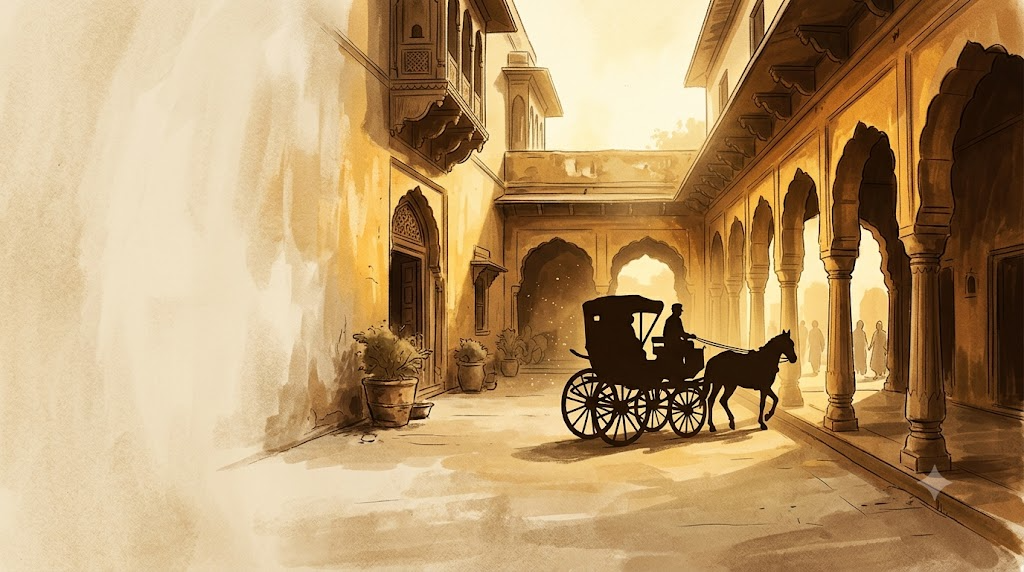
“Thieves! Thieves!”

Vandhiyathevan stood for a long time before the portraits of the Chozha Emperors, gazing up at the gallery that stretched from the victorious Vijayalayar all the way to Paranthakar, whom everyone now affectionately called Sundara Chozhar. It gave him a great deal of quiet pleasure to study those painted faces. It was hard not to be moved by the sheer courage and valour of these men. What marvellous deeds they had accomplished in their time! They had fought their wars and battles from the very front, standing tall in the thick of it without a single thought for their own lives. Why, he had not heard such tales of grand daring even in the numerous old epics that grandmothers told across the country. Chozha Nadu was fortunate indeed, to be guided by a dynasty such as this. And fortunate, too, were the many other lands presently resting under their great umbrella of power.
He might have been fairly dazzled by these emperors and their greatness, but for all that, Vandhiyathevan possessed a sharp eye. He hadn’t failed to notice a rather important, recurring detail in almost every portrait. Beside every single Chozha emperor stood a man of the Pazhuvoor clan. They were always there, providing extraordinary assistance, lending their shoulders in battle, serving to the very limits of their abilities and often well beyond.
It was a Pazhuvettarayar who had been the first to lay siege and set foot into the Thanjai fort when it was still held by the Mutharaiyars. When the great Vijayalayar floundered in the fierce battle of Thiruppurambiyam, having lost the use of both his legs, a Pazhuvoor king had hurried to his aid, hoisting the crippled emperor onto his own capable shoulders so that his liege-lord might continue to perform valorous deeds. A Pazhuvoor scion had held the crown and placed it upon Aditha Chozhar’s head at his coronation. And when that same emperor leapt boldly from his elephant to send Aparajitha Varman to his death, it was a Pazhuvettarayar who had bent down in the dust, offering his own back as a stepping stone. These sturdy, hardy men had been at the forefront of Paranthaka Chakravarthy’s battles as well, holding aloft the Chozha standard and the tiger flag with a proud, unyielding mien. Even when Prince Rajadithyar lay mortally wounded on the battlefield, it was a Pazhuvettarayar who gathered the bleeding prince gently into his lap to deliver the one piece of welcome news: “The Rashtrakutas are in retreat!” The same staunch, unflinching service had been given freely to the emperors Arinjayar and Sundara Chozhar.
Vandhiyathevan noted all this blatant evidence of the Pazhuvoor clan’s royal service, and found himself immersed in a sort of speechless amazement. There was reason enough, it seemed, for the two Pazhuvettarayar brothers to exert their sweeping authority over all of Chozha Nadu. Nor could anyone wonder why Sundara Chozhar refused to make a single decision without their expert advice.
But while this was all very admirable, what was far more obvious was that he, Vallavarayan Vandhiyathevan, was presently in very deep water. There was no doubt at all that Chinna Pazhuvettarayar, the younger brother, entertained the gravest of suspicions about him. It was only a matter of time before those suspicions were proven right. The truth about the palm-tree signet ring would surely come out—and then the fat would truly be in the fire! Vallavarayan had heard a great many harrowing tales about Thanjavur’s gloomy, subterranean dungeons, kept under the direct supervision of the Commander himself. If Vandhiyathevan found himself clapped into one of those dark holes, he might as well bid a long farewell to any hope of seeing the sun again. It was common knowledge that even if a man managed to get out alive, he emerged only as a blubbering, brainless idiot, all skin and bones and wholly devoid of sense.
Ah, how was he to wriggle out of such a predicament? One thing was certain: he had to come up with some clever ruse and leave this heavily guarded city before Periya Pazhuvettarayar, the elder brother, returned. Even the overwhelming desire to catch a glimpse of the famously beautiful young queen of Pazhuvoor had entirely deserted our young hero. All he wanted at that very moment, with every fibre of his being, was to flee this city and its terrible dungeons with his life and limbs intact. He might not have the olai anymore, but he could still deliver his message to Kundhavai Piratti in person. And frankly, who cared whether the princess believed him or didn’t? The main thing was getting out. But how, how on earth was he going to make his way out of this wretched fortress of a city?
Abruptly, he remembered something. What in heaven’s name had become of his old clothes? It hit him with sudden clarity. There could only be one reason why his hospitable new hosts had confiscated those travel-stained garments, dressed him in rich, dazzling silks, and wined and dined him with such enthusiasm. They wanted to check his pockets! Of course, it was all perfectly obvious now. The olai meant for Kundhavai must have fallen into the Commander’s hands. There was no doubt about it. Now he knew exactly why Chinna Pazhuvettarayar had grabbed his hand so hard earlier, effectively preventing the young man from slipping away with the wandering poets. The reason for his three-man strong ‘escort’ was suddenly crystal clear. What he needed now was a ruse—any ruse, really, to get away from this terrible toil. He had to do something, anything, before the elder Pazhuvettarayar returned. Think, think… ah, yes! Here was a plan. There was no time to waste; to think was to act. He would give it all he had. On guard, then! Vetrivel! Veeravel! (the ancient war-cry invoking the victorious and heroic spear).
Vandhiyathevan peeped out of the decorated window of the chithira mandapam. Chinna Pazhuvettarayar was approaching resplendently on his horse, surrounded by a heavy entourage. Ah, now was the perfect time to set his little drama in motion. Not a moment to pause.
The trio of guards, who had been sitting up front passing the time with a game of chokkattaan, put a stop to their playing and rose to their feet. Obviously, they had heard the clatter of their master’s impending arrival.
Vandhiyathevan walked right up to them, his face dark with sudden, manufactured fury.
“Beloved brothers, where are my old clothes? Do you know?”
“What on earth do you want with those filthy garments?” queried one of the menials, looking him up and down. “We’ve obeyed our master’s instructions and dressed you in new, expensive silks, haven’t we?”
“I don’t need these silks. Do return my old clothes to me soon, and I shall be content.”
“We’ve sent them out to be washed. They’ll be returned to you when they’re done.”
“Absolutely not! I need my old garments at once. Thieves, the lot of you! I had stashed some money in them, and you’ve obviously been trying to steal it. Return my things at once, or else—!”
“Or else what, Thambi?” said the guard, a sneer playing on his lips. “You’ll chop off our heads and pack them off to Thanjavur, will you? But we are already in Thanjai now, you know. You’d do well to remember that.”
“Adei! Will you return my clothes at once, or not?”
“Only if they exist, Thambi. You see, we dropped the whole smelly bundle in the river Vettaru. They’d be crocodile feed by now—and whoever heard of getting anything back from a reptile’s stomach?”
“Thieving bastards!” roared Vandhiyathevan. “So you’re mocking me, are you? Just wait till I report you to your master!”
Vandhiyathevan made a great show of marching toward the threshold. One of the men approached at a rapid pace to bar his path. The Vaanar warrior didn’t hesitate; he delivered a resounding punch to the man’s face. The guard fell flat on his back, gasping aloud as bright red blood gushed from his nose.
Another came rushing at Vandhiyathevan, hands outstretched, clearly intending to wrestle the troublesome guest to the ground. Our young man promptly grabbed one of the reaching hands, thrust his own leg neatly between his opponent’s limbs, and gave a sharp twist. The soldier shrieked a pain-filled “Ammaadi!” (a sharp cry to the mother, usually yelped in pain) and sat down on the floor with an abrupt, heavy thump.
By this time, the third guard was almost on top of him. Vandhiyathevan pivoted lightly on his feet and aimed a neat, well-placed kick at the soldier’s midriff. The man felt the full force of the blow and crashed to the ground with a terrible scream.
The three fallen men recovered their wits within moments. They scrambled up and began to circle Vandhiyathevan for another attack—though very warily this time, it must be said, keeping a respectful distance from his fists and feet.
By now, the loud sounds of horses clattering right up to the entrance of the palace could be heard. Vandhiyathevan saw his chance. He set up a piercing yell of “Thieves! Thieves!” and flung himself at his would-be assailants.
The guards tried desperately to restrain him, but in vain, while Vandhiyathevan kept up his terrible, ear-splitting screeches. “Thieving scoundrels!” he bellowed, for good measure.
This, it seemed, was the perfect cue for Chinna Pazhuvettarayar to enter the scene.
“What is the commotion here?” the Commander demanded, his voice cutting through the noise like a heavy iron blade.
© 2026 Matribhasa Classics. Public Domain


Comments (0)
Log in to join the conversation.