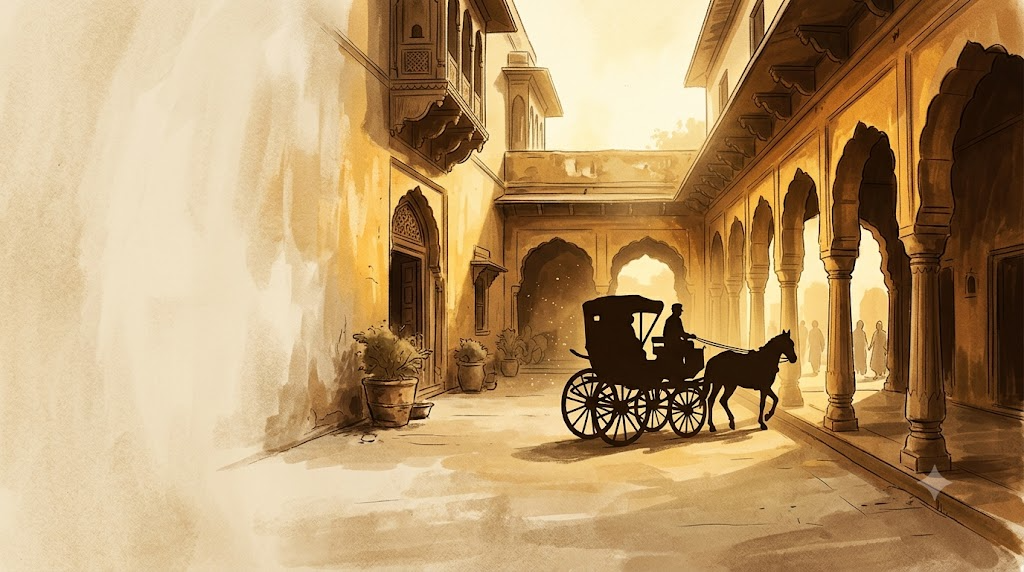
The Chithira Mandapam

Chinna Pazhuvettarayar kept a firm, almost proprietary grip on Vandhiyathevan as they made their way back to the aasthaana mandapam. The young man’s breathless, wide-eyed tale of impending danger had not sat entirely well with the Commander. Had it been a mistake, he found himself wondering, to let the boy have a private audience with the Emperor? But really, what choice had he been given? As a warrior in the service of Aditha Karikalar, the boy deserved every ounce of suspicion that could be mustered against him. And yet, as a messenger bearing a letter from the Commander’s own elder brother, he was virtually beyond reproach. After all, who would presume to dictate caution to the elder Pazhuvettarayar, a man who knew everything there was to know about the shadow-play of politics?
Still, the Commander’s mind chewed over the details. He remembered the moment he had strode into the Chakravarthy’s chambers, only to see the boy hesitating before the Emperor, looking terribly nervous, his eyes wide and bright. “Abaayam! Abaayam!” the boy’s voice seemed to ring out in his memory, clear as a temple bell. If he had indeed been crying out about “Abayam” (seeking asylum or protection), surely the Commander’s ears could not have mistaken it for “Abaayam” (danger)?
In any case, the older man decided it would be best to keep this spirited youngster close by for a few days, at least until he could make proper enquiries of his brother. Truth be told, a fine, strapping warrior like this one would make a marvellous addition to his own personal entourage. He would be of great use. And why not secure a portion of the boy’s lost ancestral lands for him while he was at it? Young men like this, when made the recipients of such grand, magnanimous gestures, tended to prostrate themselves at your feet in eternal loyalty. And if, by some unhappy chance, the boy turned out to be an enemy spy, well, there were always quiet, effective ways to handle such eventualities. Whatever the outcome, I would do well to wait until my brother returns, the Commander mused as they walked. And then—we shall see.
The moment they stepped into the aasthaana mandapam, Vandhiyathevan’s eyes began to dart about with eager desperation. He stared hard at the polished stone floor, right at the spot where he had first handed over the olai to the Commander. He was wondering, with a sinking heart, if perhaps the second, equally important palm-leaf had fallen somewhere nearby. Ah, if it was truly lost, then the world surely possessed no greater fool than him! Gone, forever, would be his golden opportunity to meet the Chozha dynasty’s most beautiful, world-renowned princess—and he would have failed miserably in carrying out the second half of Aditha Karikalar’s commission.
Chinna Pazhuvettarayar glanced around the great hall, his sharp eyes settling on one of the sentries. “You, there. Escort this young man to our palace. Find a comfortable room for him in our guest quarters and make sure his every need is met. And you are to stay there, on guard, until I return.”
The moment Vandhiyathevan departed with his escort, another soldier approached the Commander. Deference limned every pore of the man’s body as he bowed low and held out a small palm-leaf.
“My lord, this olai was found on the floor, on the path leading to the Emperor’s audience chamber,” the soldier murmured. “Perhaps it fell from the waist of the young man who just left?”
The Commander took it eagerly, unrolled the leaf, and ran his eyes over the etched script. Instantly, his heavy brows drew together, rising in a threatening frown that swallowed half his forehead, and a truly terrifying expression flitted across his harsh, weathered face.
Ah, an olai to the Ilaiya Piratti, Princess Kundhavai, from her devoted brother Aditha Karikalar, he read silently. “Hadn’t you asked me for a reliable person to carry out certain tasks on your personal account—a warrior who wouldn’t flinch at performing the direst duty? I am sending such a one. You may entrust any mission to him without compunction, for his loyalty and courage are beyond question.”
Written by the Crown Prince’s own hand, no less! There is a deep mystery afoot here, mumbled the Commander to himself. I wonder if my brother knows anything of all this? I must exercise the greatest, most absolute caution over this young man! He immediately called over the soldier who had scrounged about for the dropped message and murmured a few sharp, quiet instructions into his ear, sending the man scurrying away at once.
Meanwhile, Vandhiyathevan was being shown every honour and luxury worthy of a highly eminent guest in Chinna Pazhuvettarayar’s grand palace. He was drawn a steaming, fragrant bath to wash away the dust of the road, and presented with rich, new clothes. All his life, our young hero had entertained a quiet passion for dressing well, and he made sure to thoroughly enjoy the silken splendour he now found himself swathed in. Looking every bit the fashionable young lord, he was next led to the dining hall and offered the proverbial arusuvaiundi—a magnificent feast comprising all six tastes: sweet, sour, salty, bitter, pungent, and astringent. It was a meal fit for a king, and the famished young man made excellent, enthusiastic use of the opportunity, temporarily forgetting even his gnawing worry over the missing olai.
When he had finally eaten his fill, Chinna Pazhuvettarayar’s men escorted him to the palace’s private art gallery, the chithira mandapam.
“Do take your time and look at the paintings that adorn these walls until the Commander returns,” his guards told him cheerfully. Leaving him to wander, three of the men retired to the breezy front porch of the mandapam. They sprawled out on the cool floor with complete abandon, trading the day’s gossip and settling in for a lively game of chokkattaan (a traditional Indian board game played with dice).
In those days, Thanjavur had not only gained fame as the Chozha Empire’s brand-new, bustling capital city, but had also acquired renown far and wide as a magnificent centre for arts and sculpture, much in the same way that nearby Thiruvaiyaaru had built a staunch reputation for classical dance and music. The chithira mandapam in Chinna Pazhuvettarayar’s palace was a place of particular note. Vandhiyathevan stepped into the long, cool hall and gazed about in absolute stupefaction. The walls were alive with great, sweeping paintings, rich with earthy ochres, deep lapis, and bright gold. He lost himself entirely in the brilliant colours and the masterful execution of the brushstrokes. So deep was his admiration that he forgot himself, the passage of time, and even the vital, dangerous mission he was engaged in.
He was especially fascinated by a series of vibrant murals that illustrated the history of the ancient Chozha kings, depicting various momentous events in their personal and martial lives. Many of the paintings in the hall were dedicated to the Chozha dynasty’s famed rulers from the past century—and it was to these that our young hero found himself most powerfully drawn.
It is here, at this quiet, reflective juncture, that we would like to gently take our readers by the hand and wander back through a hundred or so years of Chozha history, as its illustrious kings ruled from Pazhaiyarai and Thanjavur. A little knowledge of these old ghosts and their triumphs will prove extremely useful in understanding and appreciating all that is to come in our story.
We have mentioned, in passing before this, the great Vijayalaya Chozhar, who sported no less than ninety-six battle scars, wearing them as the greatest, most precious of ornaments upon his noble, war-torn body. The Chozha monarchs traditionally took the royal titles of Parakesari and Rajakesari by alternating turns. Once Parakesari Vijayalaya Chozhar’s reign came to a peaceful end, his son and heir, Rajakesari Aditha Chozhar, ascended to the throne, proving himself a more than worthy successor to his illustrious father.
One of Aditha Chozhar’s first great accomplishments was to join forces with the Pallavas to defeat the Pandiyas, winning back a good deal of the Chozhas’ lost footing in the shifting political landscape. But he did not stop there. He soon declared war on the Pallava king himself. The region of Thondai Nadu swiftly fell under the sway of the valiant Aditha Chozhar after a decisive, bloody battle, during which he leapt upon the hapless King Aparajitha Varman as he rode his richly decorated royal elephant, sending him swiftly to his death. Kongu Nadu, too, was soon gathered into the folds of his expanding territories. Yet, for all his martial prowess, Aditha Chozhar was a man of deep faith, a great devotee of Lord Shiva. To him goes the lasting credit of having built a great many beautiful stone Shiva temples all along the winding banks of the sacred river Kaveri, from the place where she springs to life in the cool Sahya Hills, all the way down to where she tumbles joyfully into the ocean.
After Aditha Chozhar came Parakesari Paranthakar, who ruled for forty-six long, glorious years. Next to the legendary ancient Emperor Karikala Peruvalathan—who had marched north and proudly planted his tiger-flag atop the snowy peaks of the Himalayas—Paranthakar was easily the greatest king to walk in his footsteps. His glory was attested to by a litany of magnificent titles given to him by his people: Veera Narayanan, Panditha Vathsalan, Kunjara Mallan, and Soora Sigamani. In addition, he bore the grand name of Maduraiyum Eezhamum Kondavan—He Who Conquered Madurai and Eezham. By his time, the great Chozha Empire stretched vast and green from Kanya Kumari in the deep south, all the way to the River Krishna in the north. The golden Tiger-flag even fluttered with glorious abandon in the island of Lanka for a time. It is to this devout Emperor, too, that we owe the praise for sheathing the roof of the great Thillai Chitrambalam temple in Chidambaram with tiles of pure, gleaming gold.
Towards the twilight of his rule, however, the Empire met with some of its gravest dangers. The Rashtrakuta kings, who had been acquiring a fierce notoriety in the north, grew steadily in strength and began making violent inroads into Chozha territories. What was most worrisome was that they had begun to taste a bitter, steady success in their endeavours.
Paranthakar the First had three sons. The eldest, Rajadithyar, was a warrior among warriors. He spent a great deal of his youth in Thirumunaippaadi on the northern front, camped in the dust and heat, in daily anticipation of an invasion. It was this thoughtful prince who brought the magnificent, sprawling Veera Narayana Lake into existence, naming it in honour of his beloved father. At Thakkolam, a dusty plain near present-day Arakkonam, a truly terrible and bloody battle was fought as the Chozha and Rashtrakuta armies finally clashed. It was here that Rajadithyar demonstrated his incredible, fiery valour, cutting through his enemies in one fell swoop before embracing a true warrior’s death. Because he gave up his life while fighting atop a war elephant—much like the old Pallava King Aparajitha Varman—he was forever graced in the stone inscriptions and copper-plates that followed with the melancholy, poetic title, Yaanai Mel Thunjiya Thevar—He Who Embraced Death on an Elephant.
By all rights of justice, had Rajadithyar survived the brutal war, it would have been he who succeeded Paranthaka Chakravarthy on the Chozha throne, and his own descendants who would have followed him. But fate is a fickle breeze. Prince Rajadithyar died, and he died without issue. This complicated matters greatly, leaving his younger brother, Kandaradhithar, to accede to his aging father’s request and ascend the throne.
Like his father and grandfather before him, Kandaradhithar’s heart overflowed with a fervent devotion to God, coupled with a deep, unflagging love for the Tamil language. Unlike them, however, he lacked the fiery passion to rule. He much preferred the quiet scent of incense and old parchment, spending the vast majority of his time in the worship of the deity and the composition of verse. So deeply did he immerse himself in these peaceful pursuits that he composed beautiful hymns in praise of Lord Shiva, very much in the manner of the ancient, wandering Naayanmar saints. His songs were collectively known as the Thiruvisaippaa. Here is one lovely verse that marks the end of his work, wherein he refers to his own quiet self:
Seeranmalgu Thillaichembon Ambalathaadithannaik Kaaraarsolaik KozhiVendhan Thanjaiyarkonkalandha Aaraavinsork Kandaradhithan Arunthamizhmaalaivallaar Peraulagir perumaiyodum Perinbameythuvare!
Though Vijayalaya Chozhar’s successors had ruled largely from Thanjavur and Pazhaiyarai, none of them had ever forgotten their roots, nor the fact that they hailed originally from the ancient city of Uraiyur. This old city went by another name, “Kozhi,” which explains why the kings took such fierce pride in calling themselves Kozhi Vendhar, or the Kings of Kozhi.
Now, Kandaradhithar might have sat on the throne and ruled in name, but there was no doubt in anyone’s mind that it was his younger brother, Arinjayar, who took the heavy reins of the Chozha Empire in his capable hands and administered it in full. As a young prince, Arinjayar had accompanied Rajadithyar in the military camps at Thirunaavalur; he had been a vital part of the ferocious campaign against the Rashtrakutas, and had somehow managed to salvage the terrible battle of Thakkolam, turning what had seemed certain defeat into a lasting victory for the Chozhas. It was Arinjayar, too, who held the line, ensuring that the Rashtrakutas did not venture a single step further south than the banks of the river Then Pennai.
All these immense contributions weighed heavily on Kandaradhithar’s mind, leading the gentle king to make a very important political decision: he officially declared his younger brother, Arinjayar, as the Crown Prince, adding the clear caveat that Arinjayar would succeed him on the throne when his own time came to an end. There was another, quieter reason for his conclusion. Kandaradhithar had been married in his youth, but his beloved wife had passed away long before he was crowned Emperor, and the thought of re-marriage had not entered his grieving heart for many years. His brother Arinjayar, however, had a fine young son who excelled not just in his studies and the martial arts, but was blessed with striking good looks. Named Paranthakar after his grandfather, the boy was so handsome that the people lovingly bestowed upon him the title Sundaran (the Beautiful).
It seemed only natural, and beautifully just, to Kandaradhithar that such an excellent young man should eventually succeed Arinjayar. He resolved that this would be the case, and made sure that the royal court officials, the military commanders, and the representatives of the public were all made aware of, and assented to, his decision. Once the formalities were fulfilled, the matter was made known to the kingdom at large.
And yet, once these momentous plans were set in stone, fate decided to play a little trick. A rather strange, lovely event occurred late in Kandaradhithar’s life. He chanced to meet a young, radiant princess of the Mazhavarayar clan. Her beauty, her innate grace, her quiet virtue, and her deep, matching devotion to Lord Shiva so impressed the aging king that, despite his advanced years, he married her. In due course, a son was born to them, and the happy, doting couple named the boy Madhuranthakar, showering him with a wealth of love and affection.
However, neither the Emperor nor his young consort had any mind to change the succession arrangements that had already been promised to the realm. Both of them were deeply immersed in their devotion to God and had no desire for a life of earthly power; they wished only to raise their son in the exact same manner. Firm in the belief that an ascension to Kailasam—Lord Shiva’s eternal, celestial, snow-capped abode—was of far greater merit than inheriting a puny, earthly kingdom, they strove to ensure that little Madhuranthakar would be deserving of a place in heaven, rather than a hollow seat on a worldly throne. Kandaradhithar thus took great, deliberate pains to assure everyone around him, once again, that the Chozha Empire would pass to Arinjayar and his son after his time, and to absolutely no one else.
And so it was that the Chozha crown bypassed the heroic Rajadithyar, who was meant to have worn it; sat lightly upon Kandaradhithar, who had no real desire for it; and passed on to Arinjayar and his descendants, who, it seemed, were simply destined by the stars to inherit an empire.
As it happened, Parakesari Arinjayar did not rule the country for very long. Not long after Kandaradhithar passed on to Shiva’s celestial abode, his younger brother followed his footsteps into the next world. In strict accordance with the late kings’ wishes, the lords, officials, and people of Chozha Nadu decided unanimously to crown Arinjayar’s son.
And so it was done. Rajakesari Sundara Chozhar ascended the throne, appearing properly, humbly cognizant of the great honour and incredible fortune that had been placed upon his shoulders. He ruled exceedingly well, with a firm, just, and gentle hand. He ensured that the lost territories of Thondai Nadu and Pandiya Nadu were successfully annexed and made a part of the Chozha dominions once more, and he finally drove the lingering Rashtrakuta forces away from the shores of the Then Pennai river, once and for all.
His two sons, Aditha Karikalar and Arulmozhi Varmar, grew into phenomenal warriors in their own right, and soon seemed poised to overtake even their own father in popularity and the goodwill of the people. They were swift to assist the Emperor wherever necessary. Even at a very young age, they rode out to war, took daring initiative, and fought bravely at the very forefront of the Chozha armies.
And Jayalakshmi, the golden Goddess of Victory, stood firmly by the Chozhas, granting them triumphant success at every single step of the way.
© 2026 Matribhasa Classics. Public Domain

Comments (0)
Log in to join the conversation.