Inside the Fort

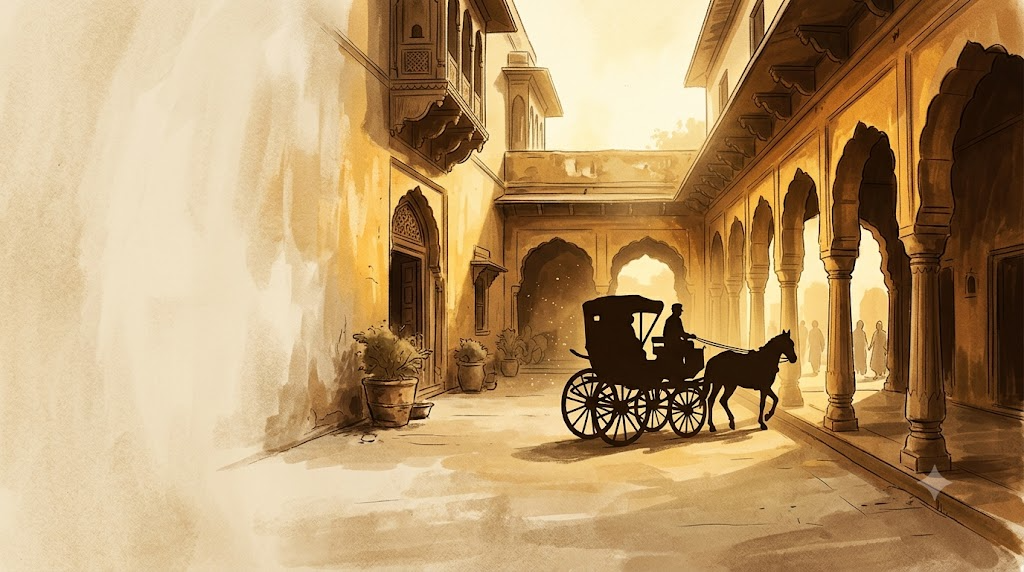
The palm-tree insignia, Vandhiyathevan soon discovered, was every bit as powerful as the magical rings he had heard about in the fairy tales of his childhood. It was early morning, and a great crowd had gathered at the fort’s gates, jostling good-naturedly for a chance to get in. There were milk and curd vendors, sellers of fresh flowers, fruits, and vegetables, alongside artisans, craftsmen, and various clerks. The sentries at the gates were fully aware of their own importance, and they made sure everyone else felt it too, squeezing the crowd through a small, narrow entrance cut into the massive main doors. But the moment Vandhiyathevan held up the insignia, the guards bowed deeply from the waist. They treated him with the utmost deference and went so far as to swing open one of the great wooden gates just for him. And so, Vandhiyathevan entered Thanjavur in grand style.
Ah, the things that happened once he set foot in that ancient, venerable city! One has to wonder about the alignment of the stars and planets at that precise moment. What made this day so different from any other? Events were to follow one upon the other in such quick, breathless succession—and with such profound impact—that his quiet morning entrance would eventually become a turning point in the very history of the Chozha empire. As for our young hero, he simply stood awestruck for a while after stepping inside the fort. Kanchi, the ancient capital city of the Pallava dynasty, had suffered a great many invasions over the years. Its buildings and old residences wore a tired, dilapidated look, crumbling a little more each day and often layered with soft green mildew. Beautifully carved structures, once the pride of the city, were now practically in ruins. Aditha Karikalar had done his best to renovate a few of them upon his arrival, but even those repaired mansions stood out like fresh blossoms pinned to a withered tree, only making the surrounding desolation seem more pronounced.
Thanjavur, on the other hand, was an entirely different world. Ah, everything here—every mandapam and grand mansion—felt wonderfully new, gleaming with a fresh, vibrant energy. Large houses jostled cheerfully alongside each other. Some glowed a pristine white in the morning sun, while others were built of warm, burnt-red brick, looking for all the world like rubies set amongst dazzling pearls and diamonds. Because of the rich, fertile earth, many of these homes boasted luxuriant gardens. Grand old trees spread their shady branches everywhere—sweet-smelling Punnai and Asokam, the sacred Arasu, tall Thennai (coconut palms), sprawling Aal (banyan trees), along with sturdy jackfruit and neem. Their emerald leaves caught the light, shifting through a hundred different shades of green, soothing both the eye and the spirit. It truly felt like a celestial city, as though it had been dreamt up and built by Mayan, the architect of the gods himself. The place possessed such beauty and quiet presence that merely walking down its streets filled you with a sudden burst of happiness, and a strange, unexplained, but entirely pleasant sort of pride.
Because there had been so many guards at the gates and so many strict rules for getting in, Vandhiyathevan had somehow formed the impression that the city inside would be largely empty and quiet. He could not have been more mistaken. The streets were practically bursting with life and surging crowds. Horses and elegant horse-drawn chariots clattered briskly along the wide avenues. Every now and then, the earth would tremble beneath the thundering footsteps of temple elephants, swaying majestically through the thoroughfares like moving black hillocks, the heavy brass bells around their necks sending a deep, rhythmic clanking in every direction. The high-pitched cries of the milk, curd, flower, and vegetable sellers nearly deafened him. Above it all rose the golden, resonant peals of the alatchi bell (the great time-keeping gong) announcing the hour, blending seamlessly with the deep thrum of large perigai drums (ceremonial drums). From unexpected corners came the bright notes of musical instruments, mingling with the sweet, melodious singing of young women. There was a festive atmosphere in the air; a sense of enthusiasm and simple delight seemed to fill every open space.
Now this, he thought, was the very epitome of a city! And perhaps it was only natural that the capital of an empire—one that was rapidly expanding its borders across the world—should look exactly like this, brimming with a spirit and energy that infected everyone who walked its streets.
The last thing Vandhiyathevan wanted to do was to reveal just how lost he was in a city of this size. If he stopped to ask for directions to the palace, people would surely look him up and down with amusement. “So, you’re new here, are you?” they would think. They might even decide he was just a simple country bumpkin! No, he would find his own way. Surely it couldn’t be that difficult.
Sada-sada! Pada-pada! Brightly patterned flags, pretty cloth buntings, and makara thoranams (auspicious festoons decorated with mythical sea-creatures) fluttered gaily from the balconies of large mansions, whipping and snapping against the brisk westerly wind. Emblems of the roaring tiger and the stately palm tree were everywhere. But rising high above them all, taller and far more imposing than any other banner in the city, flew one enormous tiger flag.
That, Vandhiyathevan guessed, must mark the Emperor’s palace. Keeping his eyes on it, he began to walk in its general direction, turning over his next steps in his mind. He had to deliver the palm-leaf scroll, of course, but it was just as crucial to pass on Aditha Karikalar’s secret verbal message. He knew he couldn’t do any of this without the express permission of the younger lord, Chinna Pazhuvettarayar. But how on earth was he to get that? The gods had been kind enough to get him past the fort gates, but a man couldn’t expect divine intervention for every little chore. He would have to invent some clever ruse to get an audience with the Emperor. But what could it be?
The blood of generations of Vaanars (his proud, ancient clan) ran hot and quick in his veins, and they were never short on resourcefulness. Ah, my ever-fertile brain, he told himself, you must help me hit upon the perfect plan. Come now, bring out that old creativity! After all, it isn’t just poets and writers who need imagination to survive. Men like me, wading through the deep, murky waters of royal politics, need a clever head just as much.
Well, what brilliant scheme would he come up with?
Actually, one of the very first things he had done upon slipping into the fort was to quietly confirm that a certain fearsome old warrior lord was, indeed, absent.
“Tell me, my good man,” he had casually asked one of the sentries near the outer wall, “do you know if Pazhuvettarayar has returned to the city?”
“Which one do you mean, thambi?” the guard asked. “The younger lord is here in the city.”
“Oh, I know that! I was asking about Periya Pazhuvettarayar, the elder lord. He was recently travelling through the mid-lands, wasn’t he?”
“Is that where he went? That’s news to me,” the guard confided, leaning on his spear. “I do know that the young queen’s covered palanquin was brought back last evening. But the lord of Pazhuvoor hasn’t returned yet. Word has it he will arrive tonight.”
That was very good news indeed. It meant the window was still open. All he needed to do now was secure an audience with the Emperor, somehow, and place the palm-leaf in his hands. But how was he to manage it?
And then, in the very next instant, a bright idea blossomed in his head. His worries melted away like morning mist. The old enthusiastic smile returned to his face, and his eyes began to dance with their usual spirit of mischief.
As things turned out, he didn’t have to wander aimlessly in search of the royal residence. By simply keeping his eye on the great Tiger flag and following the winding roads, he found himself led straight to the palace gates.
And what a palace it was! The columns were grand and imposing, and the richly decorated pillars holding up the front mandapam were so magnificent that one doubted if even Indra, the King of the Gods, possessed such a fine home, or the legendary King Vikramaditya of Ujjaini for that matter. The stone horses carved into the tall pillars were so lifelike, so detailed in their ornaments and rearing postures, that they looked as though they might leap right off the stone and pounce on him at any moment.
A number of broad pathways ran through the city, all eventually converging on the great courtyard before the palace. Every single approach was guarded by a pair of men on horseback, along with a firm sprinkling of foot soldiers. Vandhiyathevan noticed that most ordinary passersby didn’t even bother approaching the guards. A few brave souls might casually stroll up, but after a long, intimidated look at the palace entrance and the fluttering Tiger flag, they would usually decide on a strategic retreat.
Whenever it looked as though a crowd might be gathering, the soldiers would wave their spears and quickly disperse them. Even those who did manage to stand around for a moment made sure never to raise their voices. They spoke in hushed, careful murmurs, their words meant only for each other’s ears.
Vandhiyathevan, naturally, didn’t hesitate for a second. Where others faltered and turned away, he walked briskly and with the utmost confidence straight down the palace path.
The instant he reached the entrance, however, two men on horseback blocked his way, their large steeds leaning in so close they nearly nuzzled him. A cluster of heavy spears swung towards him with a sharp metallic clang, their polished iron tips catching the bright sun—the weapons of the cavalry joining those of the infantrymen.
But the magical signet ring worked its quiet charm once again. The moment he held his hand up, the soldiers seemed to deflate. Their gruff, thinly-veiled arrogance simply vanished. Three different guards leaned in to inspect the ring, one after the other.
“Very well,” muttered a senior guard. “Let him pass.”
The crossed spears parted instantly, and Vandhiyathevan swept right through with a regal air.
Still, once inside the courtyard, he had to wonder—what good was this, really? How many more checkpoints and stern inspections would he have to face? How much more scrutiny? How on earth was he supposed to locate Chinna Pazhuvettarayar in this sprawling maze? Who could he ask for directions without raising suspicion? There was no way he could see the Emperor without the younger lord’s explicit permission. And even if he could, where would they keep a bedridden, invalid Emperor in an enormous, winding palace complex like this? How was he ever going to find out?
Just then, Vandhiyathevan heard the shuffle and chatter of a group of men walking up behind him. He paused and looked back. A small gathering had halted by the outer guards, waiting to be let in. They were dressed extraordinarily well, draped in fine, expensive silks, sporting neat pearl necklaces, and wearing heavy golden kundalams (large, ornate earrings) in their ears. Some had broad stripes of sacred white ash smeared across their foreheads, while others wore bright kungumam and sandalwood paste mixed with javvadhu (a fragrant, earthy perfume).
From the look of their attire and their confident, dramatic bearing, they seemed to be poets.
And indeed they were.
“The royal bards have arrived! Let them through, please!” called out one of the guards—likely their captain. He turned to a younger soldier and added, “Lord Chinna Pazhuvettarayar is holding court in the central mandapam. Escort them there at once.”
“Respected lords,” teased another guard with a grin, “if you happen to receive any gifts today, please do take this exact same path on your way out. If you get nothing, you needn’t bother!”
A ripple of easy laughter went through the group.
The ripe fruit falls right into the bowl of milk, thought Vandhiyathevan with quiet satisfaction as he listened to this exchange. All he had to do to find the younger lord was simply fall in step behind this merry band of poets. There would be no need to wander the vast corridors, stuttering and asking suspicious questions in vain. As for what he would do once he actually came face-to-face with the man—well, he had a good head on his shoulders, didn’t he? His old friend, his imagination, would surely find a way out. And a little luck wouldn’t hurt, either.
Without missing a beat, Vandhiyathevan quietly attached himself to the tail end of the departing poets, and strolled along with them into the heart of the palace.
© 2026 Matribhasa Classics. Public Domain


Comments (0)
Log in to join the conversation.