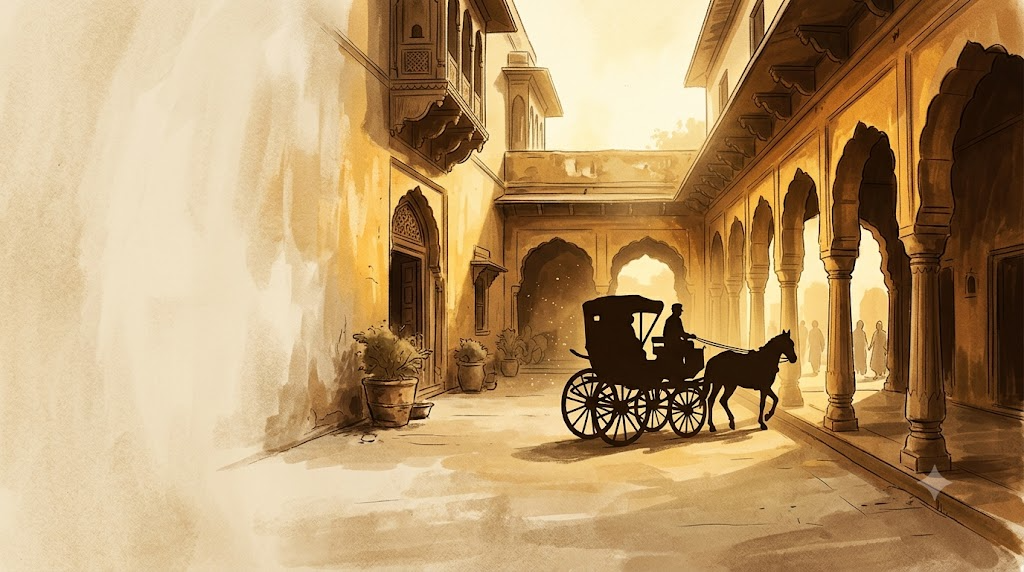
Crows and Nightingales

Vandhiyathevan slept like a log all night, and when he finally woke, the sun was well up in the sky. Even at that late hour he lay in bed, feeling pleasantly lazy, reluctant to stir. The west wind was blowing briskly around the little cottage; leaves and branches rustled together in a low, continuous murmur that sounded very much like rain. And then, as if in tune with the music of the trees, a sweet voice drifted on the air. Someone was singing one of saint Sundaramurthy’s Thevaram hymns (the ancient Tamil devotional songs in praise of Lord Shiva), set to a clear, lilting melody: “Ponnaarmeniyane, pulith tholai araikasaithu, minnaar senjadaimel—milir konrai anindhavane!”
Listening to this lovely praise of the ‘golden-hued one who wears a tiger’s skin at his waist, and lustrous konrai flowers in his tresses’, Vandhiyathevan decided it was time to open his eyes. When he looked out, sturdy konrai trees met his sight just outside the cottage, their yellow blooms hanging down in long, brilliant strands. Senthan Amudhan stood beneath them, a flower basket in one hand and a long hook in the other, singing happily as he plucked the blossoms one by one. The young man had clearly bathed in the cool early hours; his forehead and chest were liberally smeared with viboothi, and he could have passed for a living incarnation of Markandeyan (the mythological youth who conquered death to remain forever sixteen). What a pity, thought Vandhiyathevan, that the boy’s poor mother was fated never to know what a beautiful voice her son possessed. As he got up, Vandhiyathevan felt a sudden, unexpected yearning for the quiet simplicity of such a life—a life spent gathering flowers and offering them to the deities in peaceful temples. Why couldn’t he do just the same?
After all, what was the point in wandering the country with a sword and spear, always looking for someone to hunt down, or worrying about being hunted in return? But then, as he stood there, his feelings shifted slightly. Not everyone in the world was quite as gentle and decent as Senthan Amudhan. The world was full of thieves, murderers, bullies, and cheats. You needed a government to put them in their place. You needed kings and wise ministers to form that government; Velakkara Regiments to ensure their safety; and, he supposed, you needed young men like himself, if only to ride about carrying important messages on palm-leaves. Ah, yes—that reminded him. He would certainly have to seek an audience with Chakravarthy Sundara Chozhar today. If he put it off any longer, Periya Pazhuvettarayar would soon return to the capital, and then he might as well abandon all hope of ever setting foot inside the palace.
Vandhiyathevan took himself off to bathe in the cool lotus pond near the garden, returned feeling thoroughly refreshed, and dressed in his best clothes and ornaments. After all, he was going to see the Emperor himself, wasn’t he? If this wasn’t the perfect occasion to put on his finest garments, he really didn’t know what was. At least, that was the principal reason he gave himself. If he harboured another motive for wanting to look his absolute best—such as the hope of crossing paths with the Pazhuvoor Ilaiya Rani later that day—well, he kept that quietly to himself.
Once they had finished a simple morning meal, Senthan Amudhan gathered his baskets of flowers to depart for the afternoon’s temple worship, and Vandhiyathevan prepared for his royal visit. They set off together on foot. Vandhiyathevan had decided it was best to leave his horse behind at the cottage. There was no point in risking a commotion by riding a strange horse into the fort. Besides, his good steed needed the rest; he might have need of it very soon—who knew? It was safer resting where it was.
As they strolled together towards the fort, Vandhiyathevan drew Amudhan into some light-hearted banter, hoping to glean a little more information from his new friend.
“Tell me, do you have any relations besides your mother?” he asked casually.
“Yes—my mother had an elder sister, and she has a brother,” said Amudhan. “Her sister is no more, sadly, but her brother lives down in Kodikkarai. He delivers flowers to the Kuzhagar Temple there, and he tends to the lighthouse as well. He has a son and a daughter. She—” Amudhan began, and then stopped abruptly.
“What of her?”
“Oh, nothing at all. You see, nature has chosen to bless our family with some strange quirks. Some of us are mute, but others are given beautiful voices. They sing extraordinarily well…”
“Your cousin isn’t mute, is she?” put in Vandhiyathevan with a smile.
“Good heavens, no.”
“In other words, she sings very well. Better than you, perhaps?”
“Why, what a question!” Amudhan laughed. “You might as well ask if a nightingale’s voice is sweeter than a crow’s! When Poonguzhali begins to sing, the very king of the ocean bids his waves fall silent to listen to her song. The cows, the goats, even the wild animals of the forest stand perfectly still, quite spellbound.”
“She is called Poonguzhali, then? The very essence of a flower’s fragrance! A beautiful name.”
“That’s not the only thing that’s beautiful.”
“She must be lovely, indeed—or you wouldn’t go into such ecstasies, would you?”
“Deer and peacocks are supposed to be the very image of beauty,” said Amudhan earnestly, “but even they couldn’t hope to rival hers—no, not even if they were to beg and plead for it! And as for Rathi and Indrani (the celestial queens of love and the heavens), those divine women would have to do penance for several lifetimes in a vain attempt to match her loveliness.”
Senthan Amudhan’s heart was not entirely lost at Siva Peruman’s divine feet, Vandhiyathevan noticed with quiet amusement.
“The perfect bride for you, in fact!” he enthused warmly. “And since she is your muraippenn (a man’s cross-cousin, and by tradition his rightful bride), your cousinly claim to her possesses even more merit. So, when is the wedding to be?”
“I would never dare to call myself her equal,” murmured Amudhan, looking down. “It is I who am not in any way worthy of her. If they still held swayamvarams (the ancient custom where a princess chooses a husband from assembled suitors) for girls like Poonguzhali, just as they did in the old days, I am certain kings from all the fifty-six kingdoms would fall over themselves in a vain bid for her hand! Even the devas might descend from their celestial abode, perhaps, just as they did long ago for Princess Damayanthi (a legendary beauty whose radiance drew the very gods from heaven). But then, this is the Kali Yugam (the present age of darkness and decline), and such marvellous things mightn’t happen anymore.”
“Well! It almost looks as if you wouldn’t want to marry her even if she did.”
“Now, that would be going too far. If Siva Peruman were to appear before me this very instant and ask, ‘Do you wish to ascend to Holy Kailasam with your mortal body intact, like Sundaramurthy Naayanar (the revered poet-saint who journeyed bodily to heaven)—or wed Poonguzhali and live on earth?’ I would certainly wish the latter. But what’s the purpose in just my yearning for it?”
“Why ever not? You wish it—and isn’t that more than enough for a wedding? How many men, do you think, actually ask for the girl’s consent? Take old Pazhuvettarayar, for instance, who is married at the advanced age of fifty-five and more; do you suppose he made a petition for and received the assent of that young queen before making her his wife?”
“Anna (an affectionate term for an elder brother),” Amudhan cautioned softly, “these are royal affairs. Why must we discuss them at all? If you won’t take offence, I should like to warn you: you are about to enter the fort. It would be best if you didn’t speak of the Pazhuvettarayars at all. That’s just asking for danger.”
“You quite terrify me, thambi.”
“I am merely stating the truth. It is the Pazhuvoor brothers who rule the Chozha Empire right now. There is nothing and no one to gainsay them.”
“What—not even the Emperor?”
“He is ill and abed. If the Pazhuvettarayars drew a line all around him, they say he wouldn’t even dare step across it. He never utters a word against them, nor does he countermand their commands. Why, he doesn’t even listen to his own sons!”
“Indeed. They must be extraordinarily influential, then. Surely they didn’t command quite so much power even two years ago?”
“No; all this has come about only after the Emperor took up residence in Thanjavur. Now, their authority knows no boundaries, and there is no one to raise a voice against them. It is said that that was why Aniruddha Brahmaraayar departed for Pandiya Nadu—disgusted with their power-plays.”
“Why did the Emperor move from Pazhaiyarai to Thanjavur in the first place? Do you know?”
“Bits and pieces of news have been floating about for a while—I will tell you what I know. Three years ago, Veera Pandiyan lost his life in battle. The word is that the Chozha forces wreaked havoc in the Pandiya lands during those times. Such is war, isn’t it? And so Madurai came under Chozha rule, but there were certain of the Pandiya king’s aides who swore revenge. They have taken an oath to destroy their foes—and this is why the Pazhuvettarayars insisted on bringing the Emperor here. The Thanjavur fort is far more secure, and there are more warriors to protect his noble self. Also, the royal physicians say that the air of this city is far more conducive to His Majesty’s health than Pazhaiyarai.”
“And that’s another thing: everyone talks a great deal about Sundara Chozhar’s health, but no one seems to know exactly what ails him.”
“But they do. Both his legs have been struck by paralysis; they are entirely useless now.”
“Ah—then he can’t walk? At all?”
“No. Neither can he climb an elephant or ride a horse. He is bedridden, for what it’s worth—even travelling by palanquin causes him great pain, although it could be attempted if need be. That is why he never ventures outside the palace. And lately, there have been dark whispers that his mind is… well, not quite himself.”
“What a terrible pity!”
“I am not sure you can even voice such sentiments out loud, anna—for fear of being tried for treason by the Pazhuvettarayars.”
Pazhuvettarayar—Pazhuvettarayar! Wherever he went, whatever he did, they seemed to loom large, casting their long shadow over everyone and everything. It was not to be borne, thought Vandhiyathevan, no matter their great valour in the past. Sundara Chozhar should certainly never have allowed them such complete and unquestioning authority over the treasury, the granaries, the Thanjavur fort, and indeed, the security of the entire land. All this power and authority had undoubtedly gone to their collective heads—would they even dare think of conspiring against him, otherwise? And now, the poisonous tendrils of their treachery were spreading further and further. How far would they go? What destruction would they wreak upon this beautiful land? It was up to him to do whatever he could to halt their progress. And, if fortune favoured him, to seize the opportunity to warn the Emperor as well!
The imposing fortress gates of Thanjavur came into view, rising tall and solid against the sky. Senthan Amudhan took leave of his new friend and went his gentle way towards the Thalikulathaar Temple. Vandhiyathevan, in the meantime, approached the fort—with a great many castles in the air of his own.
© 2026 Matribhasa Classics. Public Domain


Comments (0)
Log in to join the conversation.