The Velakkara Regiment

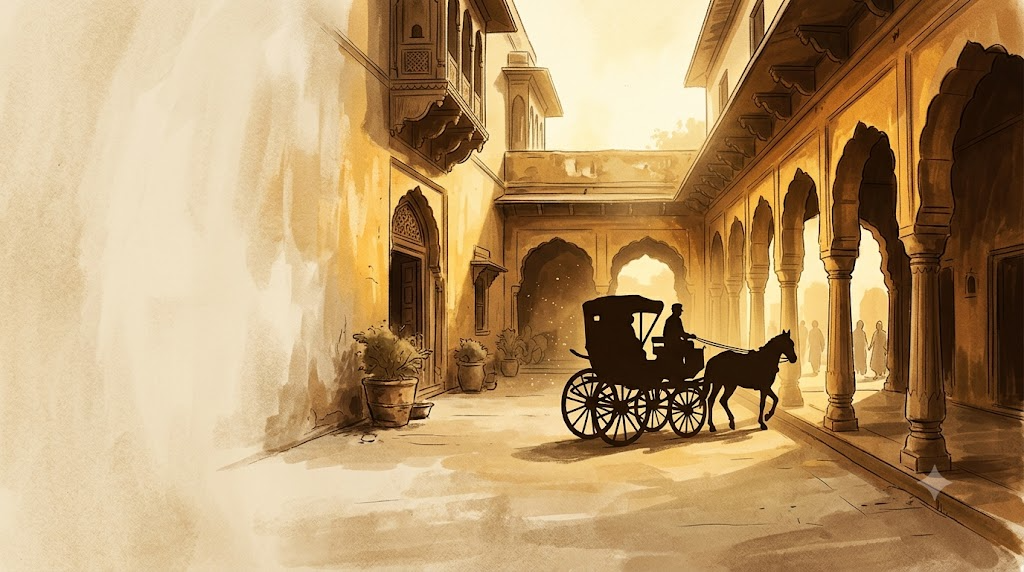
The first to move was the heavy outer curtain, bearing the embroidered palm tree, the proud emblem of the Pazhuvettarayars (the powerful lords who controlled the treasury). Then came a soft rustle from the silken drapes within. And there, right before Vandhiyathevan’s fascinated eyes, a golden hand crept out into the fading daylight—just as he had seen once before, on the dusty road.
He decided, quite sensibly, that it wouldn’t be proper to remain seated on his horse while addressing royalty. He leapt down at once and practically ran towards the palanquin. “Your Highness! My Prince! Your palanquin-bearers—!” he cried out, looking up at the window.
He stared at the face looking down at him. He blinked, rubbed his eyes, and stared again. The vision that met his startled gaze almost blinded him with its sheer, luminous radiance.
“No, no… I—” Vandhiyathevan’s tongue felt thick and useless; his throat had suddenly gone quite dry. “I mean… no, it’s… you’re the Pazhuvoor Queen… er, the Pazhuvoor Prince. Your… er, your bearers’ horses knocked into my palanquin!” he blurted out, finishing his sentence in a magnificent display of utter confusion.
All of this, naturally, happened in a matter of moments. The Pazhuvoor guards closed in, surrounding Vandhiyathevan almost at once. In that instinctive way which becomes second nature to anyone who lives by the sword, our young man sensed the soldiers pressing close. His hand crept towards the hilt at his waist, almost of its own accord. And yet, for the life of him, he simply could not tear his eyes away from the golden, radiant face of the young woman peering at him from the shadows of the palanquin.
For it wasn’t a prince sitting there, as he had so confidently expected, but a woman. And what a woman she was. In all his young life, Vandhiyathevan had never imagined that such beauty could truly exist—the kind of beauty that, on a warm evening, might easily drive a man out of his senses.
Fortunately, some small, sensible corner of his brain was still working. A sudden, bold impulse stole over him, and he decided to trust it. Gathering every ounce of courage he possessed, he made a monumental effort to force his tongue to form the right words.
“I beg your pardon,” he said, bowing slightly, “but I am in the gracious presence of Pazhuvoor’s Ilaiya Rani, am I not? It was in the hope of an audience with your highness that I travelled all this way!”
The young queen of Pazhuvoor fixed her dark, lovely eyes on him. Her golden face blossomed into a quiet little smile. It was as though a lotus bud had opened its delicate petals to the morning sun, revealing a row of glittering white pearls. The sheer loveliness of it dazzled Vandhiyathevan back into speechlessness. The guards surrounding the palanquin hesitated, shifting on their feet as they waited for their queen’s command. She gave a slight, regal wave of her hand, and they fell back to a discreet distance.
Two soldiers stepped forward to rein in Vandhiyathevan’s horse, which was still fretting and knocking against the side of the palanquin. The young woman turned her gaze back to the Vaanar warrior (a young man of the noble Vaanar clan), and Vandhiyathevan felt as though two sharp little spears had pierced his heart.
“I am the Pazhuvoor Ilaiya Rani,” she said softly. And oh, what was it that made her voice so wonderfully exquisite? What was this sweet, intoxicating quality that made his head spin like a top? “Didn’t you complain about something, just now?” she continued, her tone light and amused. “Something about my palanquin-bearers?”
The velvety softness of the famed silks from Kasi (the holy city of Benares), the warm dizziness of strong wine, the sweet thickness of wild forest honey, the sudden brilliance of lightning against a dark monsoon sky—could a young woman’s voice truly hold all these marvellous things at once?
“What was it that you said?” she asked. “Something about my bearers knocking the palanquin into your horse?”
A faint, mocking smile touched her coral lips. She was clearly enjoying the absurdity of the whole situation.
Vandhiyathevan felt his natural good cheer returning at her playful reaction. “Indeed, yes, my queen,” he said, gesturing dramatically. “That is exactly what they did. You can see for yourself how terrified my poor steed is!”
“It isn’t just the horse that looks terrified, I think,” she teased. “You had better go and ask the village priest at Goddess Durga’s temple to sweep away the evil eye with a handful of neem leaves (the bitter foliage traditionally used to ward off ill-fortune).”
By now, Vandhiyathevan had recovered his wits completely. He even let himself chuckle a little at her words. But this easy laughter, it seemed, was the wrong thing to do. The Pazhuvoor Queen’s mood changed in a flash. Her radiant smile vanished, and her face darkened with sudden anger. It was as though a golden moon had slipped behind a bank of heavy storm-clouds.
“Keep your little jokes for later,” she said coldly. “And answer me this: why did you let your horse run into my palanquin? Tell me the truth now, or else…!”
Fortunately for our young friend, he had already thought up an excuse. Glancing around the dusty road to make quite sure no one was close enough to eavesdrop, he leaned in and lowered his voice, as though sharing the deepest of secrets.
“Devi (a respectful title for a lady),” he began. “Nandhini Devi? It was Azhwarkkadiyaan Nambi—I mean, Thirumalai—who trusted me with a message for you. He asked me to meet you, and that is why I had to think up this clumsy little ruse. Once again, I do beg your pardon!”
Vandhiyathevan watched her face keenly, eager to see how she would take this unexpected bit of news. He knew it was a bit like throwing a stone up into the branches of a fruit-laden mango tree. What would he get for his trouble? A sweet, ripe fruit? A sour, unripe one? Perhaps the stone itself, bouncing back to hit him on the head, or some other severe punishment?
The young queen’s dark, elegant eyebrows shot up. Her beautiful eyes widened, brimming with a sudden mixture of surprise and suspicion. But in the very next moment, she seemed to make up her mind.
“Very well,” she said briskly. “But the middle of a dusty road is hardly the place for this sort of conversation. Our palace in Thanjavur, tomorrow evening. You may ask for an audience, and we shall speak more of this.”
Vandhiyathevan’s heart gave a little skip of delight. It looked as though his wild gamble had been a complete success! He had leapt three-quarters of the way across the well, as the old village saying went; all that remained now was to clear the final quarter without falling in.
“But, Devi,” he said, putting on a helpless expression, eager to get past this last little hurdle. “The guards are hardly likely to let me into the fort, let alone the palace. How am I ever to see you?”
The Ilaiya Rani turned smoothly to a small silken pouch resting by her side. She opened it and drew out a carved ivory ring. “Show them this,” she said, holding it out to him. “You will be allowed in at once—both at the fort gates and at our palace doors.”
Vandhiyathevan took it from her with a deep, respectful bow. He stole a quick glance at it as it dropped into his palm; the smooth ivory was etched with the proud emblem of a palm tree. By the time he looked up to thank her, the heavy silk curtains of the palanquin had already been pulled shut.
Ah, what a pity, he thought to himself. Even Rahu (the great celestial snake of the myths) takes his time when swallowing the moon during an eclipse, letting us enjoy the fading light. But these wretched curtains had snapped shut over her golden face in the blink of an eye!
“Take care now,” came her low, musical voice from behind the silk. “And do not follow us from here. It is far too dangerous for you. Wait a little while on the road, and enter the fort later.”
The bearers lifted the poles, and the palanquin moved on, the soldiers marching smartly around it. Vandhiyathevan stood by the edge of the road, holding his horse’s reins lightly in his hands, watching the procession pass. Even as he marvelled at his own good luck, he couldn’t help noticing that one of the Pazhuvoor guards—the very man who had shouted at him earlier—kept casting dark, backward glances at him as they marched away.
For the most part, however, his mind was completely filled with the exquisite loveliness of Nandhini, the Pazhuvoor Ilaiya Rani, journeying onwards to Thanjavur in her swaying palanquin. Had he really just stood there and spoken with her? Had that brief, dazzling meeting truly happened? And, more to the point, was it really possible for a living, breathing human being to possess such astounding beauty?
He had heard the old temple tales, of course, about celestial dancers like Rambhai, Urvasi, and Menakai (the divine maidens), who lived in the heavenly courts of the Devas. The storytellers loved to describe how their divine grace could drive even the most disciplined hermits—men who had renounced the world to live on roots and berries—entirely out of their minds.
Here on earth, too, there was a great deal of quiet, mocking gossip about Periya Pazhuvettarayar and his blind infatuation with his much younger wife. But standing there on the road, Vandhiyathevan realised there was nothing surprising about it at all. Even the old man’s dearest friends couldn’t pretend that the battle-scarred, rugged treasurer of the Chozhas was a handsome fellow. Yet his young bride was a vision of absolute perfection. Who could blame the old warrior if he was ready to give up heaven and earth just to coax a single smile from her lips?
After spending a good half-hour idling by the roadside, lost in his own pleasant daydreams, Vandhiyathevan finally swung himself back into the saddle and set his horse trotting slowly towards the great fort of Thanjavur. The evening sun was dipping low in the west, casting long, golden shadows across the plains by the time he reached the main gates.
The original heart of Thanjavur might have lain safely within the high stone walls of the fort, but over the years, the city had spilled out and grown. The straggling fingers of trade and everyday life had stretched far beyond the moat. Street upon street now clustered around the outer walls. The air was rich with the smell of woodsmoke and mouth-watering sweetmeats frying in hot ghee. The steady clink-clank of hammers came from busy smithies and workshops where men laboured in the fading light. The wide thoroughfares were thronged with people—buying, selling, arguing over prices, or hurrying home on urgent business. The roads were almost choked with slow-moving bullock-carts, jingling horse-drawn chariots, and stray dogs wandering between the wheels.
Looking at all this lively bustle, Vandhiyathevan felt a sudden, boyish urge to tie up his horse, plunge into the crowded bazaars, and spend the evening watching how the people of this sprawling new Chozha capital lived their lives. But, with a small sigh of regret, he decided it would have to wait. He had important work to do first. The simple amusements of the town could come later.
Full of this very sensible and grown-up resolve, he rode up to the imposing main gates of the fort—only to find them firmly shut. The guards on duty were walking up and down, pushing the townsfolk back to the edges of the road. And, rather surprisingly, the usually noisy crowd was obeying without a murmur. Instead of hurrying about their business, the people—men with baskets, tired women, leaning oldsters, and wide-eyed children—were waiting patiently by the roadside, craning their necks as though expecting a grand procession.
The wide, dusty square directly in front of the timbered gates was completely empty, save for the pacing sentries. Vandhiyathevan was burning with curiosity to know what all the fuss was about, but he had no intention of riding up to the guards and demanding an explanation. Not when everyone else was standing so quietly out of the way. Poking his nose in now would only lead to pointless arguments and ruffled tempers, and he wanted to avoid trouble at all costs. Getting his message to the Emperor was his only priority. This was no time for picking fights with grumpy soldiers.
So, slipping down from his high perch, Vandhiyathevan quietly merged into the crowd gathered by the roadside, taking care to find a good spot where he could still see the gates.
Just then, the sweet, heavy scent of jasmine and marigolds drifted past his nose. He turned his head and saw a pleasant-looking young man carrying two large bamboo baskets overflowing with fresh flowers. His forehead and arms were thickly smeared with viboothi, and he wore several strings of brown, knobbly rudraksha beads (the dried seeds sacred to the deity) around his neck. He looked the very picture of a pious, gentle Saivite.
“Thambi,” Vandhiyathevan asked, tapping him lightly on the shoulder. “Why is everyone standing about the road at this hour? Are we expecting a procession of some kind?”
“Are you new to these parts, Ayya?” the young flower-seller asked, looking up.
“I am,” Vandhiyathevan smiled. “I’ve travelled down from Thondai Mandalam (the northern province of the Tamil lands).”
“Ah, that explains why you’re asking,” the young man nodded. “If I might make a suggestion, brother, it would be best if you got down from your horse entirely.”
Vandhiyathevan had already dismounted to hide in the crowd, but the boy’s earnest warning puzzled him. It was certainly easier to chat with the young fellow while standing on the dusty road beside him.
“Why do you say that, Thambi? Why shouldn’t a man sit on his own horse?”
“The Velakkara regiment (the elite royal bodyguards sworn to protect the king) are inside right now, paying their respects to the Emperor,” the flower-seller explained in a hushed voice. “Any minute now, they will come pouring out of the fort. That is what everyone is waiting for.”
“To watch them march past, I suppose?”
“Yes.”
“Well, I can watch them just as well from the saddle, can’t I?”
“You could,” the young man said slowly. “But if one of the Velakkara soldiers spots you sitting up there, looking down at them… well, things might get rather difficult for you.”
“Difficult how?” Vandhiyathevan chuckled. “Do you mean they’ll try to steal my horse?”
“They might take the horse—and thrash the rider, too, just for the fun of it. You never know with them. They are a law unto themselves, those men.”
“Is that so?” Vandhiyathevan frowned. “And the good people of Thanjavur just put up with this nonsense?”
The young man shrugged, shifting his heavy baskets. “What choice do we have? The Velakkara regiment does exactly as it pleases these days. Their word is law on these streets. Even the powerful Pazhuvettarayars wouldn’t dream of interfering with them.”
Just at that moment, a tremendous commotion erupted from behind the high stone walls of the fort. Brass trumpets flared and white conch shells blew with wild abandon. The deep, rumbling boom of nagara and parai (traditional leather-bound drums) began to beat out a frantic rhythm, while hundreds of rough voices roared out praises that seemed to shake the very evening sky.
Vandhiyathevan had heard many campfire tales about these fierce men. Their fame had spread far and wide across Chozha Nadu. Officially, they were the king’s bodyguards, but there was a very real difference between an ordinary palace guard and a Velakkara warrior. These men had taken a terrible, binding blood-oath to protect the Emperor with their own lives. If any harm whatsoever came to the royal family because of some lapse or carelessness on the regiment’s part, these soldiers were bound by honour to march into the temple of Goddess Durga, kneel before the dark stone idol, and strike off their own heads with their swords.
When a man has taken such a terrifying vow, it is only natural, Vandhiyathevan supposed, that he is allowed a few small privileges that ordinary townsfolk are denied—like swaggering about the streets and knocking people off their horses.
Padaar! Padaar!
With a heavy, groaning crash, the massive iron-studded gates of the fortress swung open.
Two soldiers rode out first on stamping horses, each holding a long flag aloft in his right hand. It was a peculiar, rather unsettling emblem they flew. Against a field of blood-red silk, there was a golden tiger, and just beneath it, a royal crown. Below the crown was a balipeedam, upon which rested a decapitated human head and a broad, curved sword. All in all, it painted a decidedly gruesome picture fluttering in the breeze.
Right behind the horsemen came a magnificent, humped bull, carrying two enormous perigai (enormous drums) strapped to its sides. Two strong men walked beside it, beating out a deep, thundering rhythm that vibrated in the chest. Behind the bull marched some fifty men, wildly striking smaller drums—the siruparai, the perumparai, and the flat, ringing thambattam (smaller traditional drums)—announcing the regiment’s arrival to the whole city. Another fifty men came close on their heels, chests puffed out as they blew into huge, curved brass horns that bellowed out, Baam! Baam! Ba-baam!
Then came the regiment itself. A thousand men marched in perfect time, their heavy boots raising clouds of golden dust. Most of them were shouting out lusty praises, their voices merging into a great roar that made the evening air crackle with raw, wild energy.
“Long live the illustrious Paranthaka Chakravarthy, Lord of the World!” cried the leaders.
“Vaazhga! Vaazhga! (Long may he live!)” the thousand voices roared back.
“Long live King Sundara Chozhar!”
“Vaazhga! Vaazhga!”
“Long life to the Kozhi Vendars (the ancient Lords of Uraiyur, the old Chozha capital)!”
“Vaazhga! Vaazhga!”
“Long live the Lords of Thanjavur!”
“Vaazhga! Vaazhga!”
“Long live the Lord Who Brought Veera Pandiya to his Knees!”
“Vaazhga! Vaazhga!”
“Long live the Rajakesari (the Lion Among Kings, a Chozha royal title) Who Conquered Madurai, Eezham, and Thondai Mandalam!”
“Vaazhga! Vaazhga!”
“Long live Karikala Chozhar’s illustrious descendants!”
“Vaazhga! Vaazhga!”
“May Goddess Durga, Maakaali (the dark, fierce Mother), and Paraathpari Paraasakthi (the Supreme Divine Energy) be Victorious!”
“Velga! Velga! (May they conquer!)”
“May the tiger flag fly proud all over the world!”
“Velga! Velga!”
“Vetrivel! (The Victorious Spear!)”
“Veeravel! (The Heroic Spear!)”
Anyone who heard those blood-stirring chants tearing from a thousand throats could not help but feel their skin prickle with sudden emotion. The soldiers’ rousing shouts were picked up by the crowds pressing against the edges of the road. Old men, young boys, and simple townsfolk raised their voices to join in the roaring chorus. And so, carried on a great, swelling tide of devotion and energy, the Velakkara Regiment marched proudly out of the fort gates, down the dusty streets of outer Thanjavur, and slowly disappeared into the gathering dusk.
(A gentle note for the curious reader, much as Kalki Krishnamurthy himself might have added in 1950: It is said that the Velakkara Regiment took its name from Lord Murugan, the handsome god of war, one of whose titles is ‘Velakkaran’—He Who Holds the Spear and Swears to Protect His Devotees. In describing the bewitching beauty of Nandhini earlier in this chapter, Kalki loved to use grand, old Sanskrit-rooted words like Mohanangi, Sukumari, Bhuvana Mohini, and Sundharangi. Today, those rolling musical names belong strictly to a bygone age, a quiet reminder of how beautifully our stories and our language have travelled through time.)
© 2026 Matribhasa Classics. Public Domain


Comments (0)
Log in to join the conversation.