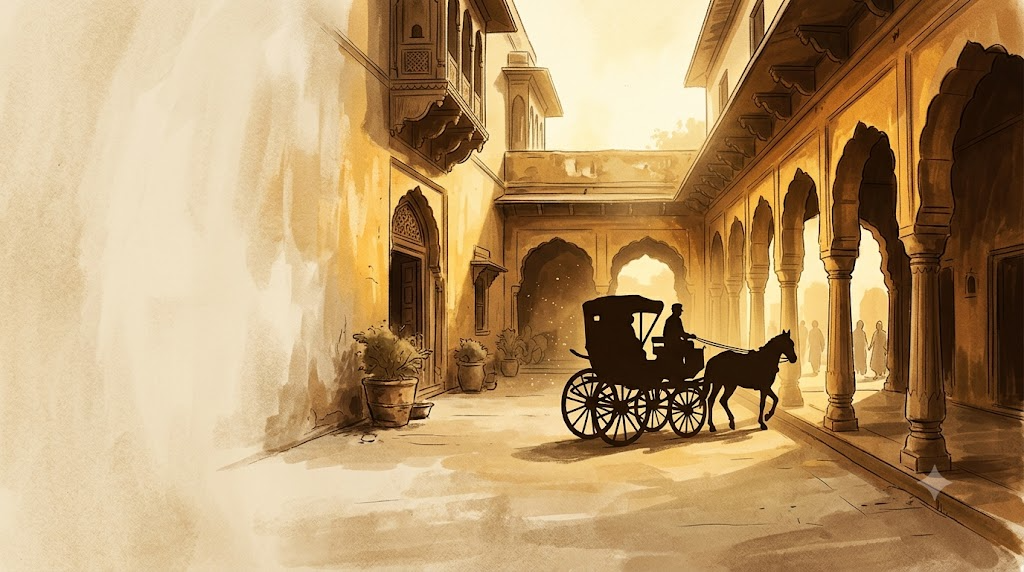
The Rustling Curtain

Could a man be of two minds at the very same time? To Vandhiyathevan, riding slowly under the dappled shade of the roadside trees, it certainly seemed so. He was making his way through some of the most flourishing, green landscapes of Chozha Nadu. It was that wonderful time of the year when the rivers brimmed over their banks. Every little canal, stream, and brook bubbled and gushed with fresh, cool water, spilling joyfully into the paddy fields until it seemed the whole earth was drowned in a shimmering sheet of silver. Ah, it was no wonder they called this country Vala Nadu (the bountiful land)—for it was simply bursting with nature’s quiet generosity. And how fitting it was, too, that the king of such a realm was affectionately known as Valavan (the bountiful ruler).
But thinking of the land and its kings brought his mind right back to the shadows. He couldn’t help but dwell on the many quiet perils that seemed to be gathering around the royal family, threatening this peaceful country and its emperor. He wondered, not for the first time, about his own small part in it all and its consequences. What was he really supposed to do now? Deliver Crown Prince Aditha Karikalar’s olai (an inscribed palm-leaf message) to Emperor Sundara Chozhar, and then wash his hands of the whole messy business? Why should he go poking his nose into this royal quagmire of ambitious cousins, contested thrones, and whispered conspiracies? What did it matter to him who succeeded Sundara Chozhar, after all? Weren’t the Chozhas, if one looked back far enough, the sworn enemies of his own clan? After all, it was an old coalition of the Chozhas and their allies, the Gangas and Vaithumbars, that had brought down his own proud Vaanar dynasty. Aditha Karikalar might consider him a friend today, but did that mean he, Vandhiyathevan, had to simply forget every old injustice the Chozhas had ever perpetrated in the past? Ah, no, no—this was getting ridiculous.
To sit on a horse and call wars and invasions ‘unfair’ was, in itself, rather unfair. Which king, when you got down to it, hadn’t tried his level best to conquer his neighbour? Every ruler in the long, dusty pages of history had tried to subjugate someone else; victory and defeat were just a natural part of their lives. And it was perfectly natural, too, for the vanquished to nurse a deep, quiet hatred towards their conquerors—even if such hatred was rather pointless. Good heavens, hadn’t Vandhiyathevan’s own ancestors committed every atrocity known to them during their own quest for greatness? Weren’t they guilty of the same unjust practices in their time? He tried to recall that old war-song that used to be so celebrated once in his family. Ah, there it was:
“Senaithazhaiyakki senguruthineer thekki Aanaimithithaarunchetril—Manaparan Paavendharthamvendhan Vaananparithunattaan moovendharthangalmudi!”
His own people had once engaged in fierce, terrible battles. They had destroyed men and beasts alike, roaring in approval as they gleefully decapitated their enemies and planted those skulls in the bloody morass of battlefields, churned up by heavy war-elephants. The truth was, dishonour was always the fate of those vanquished in battle. You couldn’t expect every king to be as endlessly gracious and compassionate as Sri Rama or as stubbornly righteous as Yudhishtra of the Pandavas, surely? And if one were really honest with himself, wasn’t it their very compassion that had caused their terrible sufferings in the lonely jungles? What had those mighty warriors lacked, after all, when it came to soldiers, kingdoms, or riches? Their benevolence had yielded nothing but penury and anguish. No, there was simply no room for pity in royal affairs.
In fact, the Chozhas were, as conquerors go, rather inclined towards lenience. They much preferred diplomacy and tact to deadly war with their enemies. Witness their many alliances forged through marriage with various, supposedly enemy clans? Emperor Sundara Chozhar’s own father, Arinjaya Chozhar, had wedded the ravishing Kalyani, a princess of the Vaithumbar dynasty—which perfectly explained the striking, almost luminous beautiful features and good looks of Sundara Chozhar and his children.
And speaking of exquisite beauty… his thoughts drifted, as lightly as a falling leaf, to the young woman from Kudandhai whom he had seen again on the gentle banks of the river Arisilaaru. Well, no, that wasn’t entirely honest. He hadn’t just thought of her—the memory of her face had been smouldering quietly deep within him all this while. Thus far, he had been gazing open-mouthed at Chozha Nadu’s natural beauty and musing over the many dangers that seemed to surround their royal family—but underneath it all had been constant thoughts of the bewitching young lady who had captured his imagination so completely.
Now, he gave up all pretence of plodding over conspiracy theories and engaged himself in the far more appealing task of thinking of her. Suddenly, everything in Chozha Nadu seemed to remind him of her beautiful features. The smooth, pale green bamboo shoots put him in mind of her slender shoulders; the dark kuvalai (blue water-lilies) flowering in profusion in the many village ponds he passed recalled to him her large, limpid eyes. He found himself wondering, quite seriously, if the soft pink and white lotuses he spotted waving in the breeze were any match at all for her golden countenance. And the drowsy, musical buzz of the honey-bees in the trees he rode under—could they possibly rival her sweet voice? Poets, of course, did their best to compare nature with women, but truth be told, such comparisons were ridiculous. How could a handful of flowers, a buzzing bee, or a bit of bamboo possibly equal her unbelievable soundharyam (stately beauty and physical perfection)? Ah, the sudden thrill in his veins when he had first set eyes on her charming face! How his heart fluttered even now, just at the memory of her. No lotus bud or wandering bee could ever inspire such a thrill in him, could it?
But really, this was madness in the extreme. His elders had warned him, time and again, about the distracting wiles of women. It took a man of great resolve, they said, to escape their cunning lures. All the more reason why he should steer clear of them, if he ever hoped to make something of his life. Why, he didn’t have to look far for a cautionary tale. There was poor Kovalan from the ancient epic Silappathikaaram, whose life had been thoroughly destroyed because of women. Or wait, why take him as an example, anyway? He only had to look at Periya Pazhuvettarayar—a warrior among warriors, the powerful Treasurer of the Empire—who was now the quiet laughing-stock of his people, all because he had tumbled headlong into love recently. Ah, but the people were silly and ignorant; they little knew who the old man really squired around in his closed, silk pallakku (palanquin). If they but guessed…
And why must Prince Madhuranthakar demean himself this way? Chee!—a little sound of sheer disgust escaped him. Was this how a grown man behaved—shutting himself up in a stuffy palanquin and travelling around the country in the guise of Pazhuvettarayar’s young wife? Did he really cherish ambitions to ascend the great Chozha throne using such humiliating tactics? If so, how could he ever hope to rule this empire? Anything he did would have to be under the aegis of Pazhuvettarayar and his lordly cohorts. But then again, why blame only Madhuranthakar? If anything, it was Sundara Chozhar who had committed a grievous blunder by allowing them such power and authority—especially when he had two excellent sons who were more than capable of ruling the country. Not to mention a lovely daughter, famed far and wide for her intelligence and good sense…
Ah, that majestic young lady. The one he had marvelled at both on the river’s banks and at the astrologer’s home. Her face had seemed strangely, naggingly familiar, somehow. Why—could it possibly be… no; that was a silly thought, it couldn’t be. But heavens, what if it were? If his sudden, horrifying suspicions were true—ah, then Vandhiyathevan was certainly a fool to beat all fools, and quite possibly the most unfortunate among men, too. For he had just met the young lady whose fame was spread everywhere, from the hoary Vindhya mountains down to the sandy tip of Ilankai—and he had behaved like the most ill-mannered village lout. Good heavens, he certainly hoped she wasn’t who he suspected she was. How could he ever dare to even look at her, when he tried to deliver her brother’s olai?
Pondering over everything from sky to earth, Vandhiyathevan let his horse trot along the shady, winding road edging the Kaveri, until at last he reached Thiruvaiyaaru. Ah! Truly, it had no equal when it came to quiet prosperity and leafy beauty. He confirmed with a few smiling passersby that this was indeed the famous temple-town, and discovered that in this case, rumour had done a grave injustice to its charm and loveliness. Why, the boy-saint Gnana Sambandhar’s description of it in the divine Thevaram stayed true even now—three hundred years had made no difference whatsoever. Witness the glorious, heavy foliage along the banks of the river; the luscious, sweet-smelling jackfruits that hung heavily from their trees! Such richness was a rare sight indeed up north in Thondai Nadu. And everywhere there were monkeys, chattering and eager to sample nature’s delights. How they ever caught the scent of fruits, one never knew, but he felt he could never grow tired of their playful antics.
Now, what was it that Sambandhar had sung? Ah, yes, he remembered it now: he had sung that in Thiruvaiyaaru, graceful young dancers performed on appropriately placed platforms at street corners, while deep-throated drums beat out a glorious rhythm to match their song and dance. And the monkeys, playing among the trees, would mistake the muffled roar of the drums for thunder. They would clamber up the very highest branches, craning their little necks in vain, searching the bright sky for dark clouds heavy with the promise of rain! Ah, those words were true even now. Monkeys still scampered along the trees, and that was not all; faint, sweet musical strains floated out from within the town as well. If he listened closely, he could hear the instruments playing on the breeze: the strumming of the yaazh (an ancient lute), the sweet wail of the kuzhal (flute), the deep thud of the muzhavu, and the crisp tap of the thannumai (traditional percussion drums)—all weaving gracefully around the gentle tinkling of dancers’ anklets.
Obviously, these dancers weren’t the wild, possessed performers of the frantic Kuravai Koothu he had seen back in Kadambur. Their song was far more melodious, and their Bharathanatyam (the classical temple dance) aspired to far better standards. Why, he could even hear their teachers, who beat a steady rhythm with their little wooden batons:
“Kolodakkolvalaiyaarkuthaadak Kuvimugaiyaarmugathininru Selodachchilaiyaadaseyizhaiyaar nadamaadumthiruvaiyaare!”
Ah, Saint Sambandhar was undoubtedly a great Saivite—but even more importantly, he understood and appreciated beauty in all its earthly forms. The Thiruvaiyaaru he had described stayed true to his description even today. Vandhiyathevan decided that he would stay a day here, and spend it looking at the lovely sights to his fill. He would also take the time to visit the renowned temple and worship at the feet of Aiyaarappar (the Lord of the Five Rivers, after whom the town took its name), and His divine consort, Aram Valartha Nayaki (the Goddess who nurtured righteousness).
Ah, the very sight of so many Siva devotees praying along the banks of the Kaveri, their bodies covered in sacred white ash, was calming indeed. Why, sometimes, their deep, heartfelt chorus of chants, “Namachivaaya!” (the sacred five-syllable mantra of Shiva) rose on the air and gently drowned out the songs from the town itself. Somewhere nearby, a voice rose in a melodious rendering of one of Sambandhar’s Thevaram songs. Truly, this sweet town was blessed by Siva Peruman (Lord Shiva) himself to be the lasting abode of culture and piety.
Yes, he certainly would stay here a day and take in the sights! After all, where was the guarantee that he could even enter the fort of Thanjavur? And even if, by some hook or crook he did, how on earth would a country boy ever gain an audience with Emperor Sundara Chozhar? Wasn’t the poor man well nigh imprisoned by the Pazhuvettarayar brothers, after all—a tired bird in a very large, golden cage? Well, well, his way was clear: he would find a boat, cross over to the Kaveri’s north banks, and—
Just as Vandhiyathevan arrived at this comfortable part of his ruminations, something occurred to distract him. Coming down from the west arrived a palanquin along the dusty path edging the Kaveri, moving at a brisk trot with an escort of stern-looking soldiers, front and back. A prickle of suspicion touched Vandhiyathevan’s mind; he pulled his horse into the shade and waited until it came closer. It was just as he had thought: the thick, heavy silk curtains that covered the sides of the palanquin bore the bold emblem of a palm-tree. It probably came from Kadambur. He had arrived here taking the route from Kudandhai, while they had probably chosen another path. But where was Periya Pazhuvettarayar? Perhaps the old lord had opted to stay somewhere along the way?
As he watched, the palanquin turned south, taking the direct road towards Thanjavur—and Vandhiyathevan changed his mind in an instant. Thiruvaiyaaru and its music could wait; he would follow this palanquin. As to why he made that split-second, reckless decision, he did not quite know. All he was sure of, at that moment, was that the curtained box bore Prince Madhuranthakar—and his scorn for that man grew all over again.
Still, that was not important now. Perhaps he would gain an opportunity to meet the prince later on. The palanquin-bearers may set it down for a rest at some point; Madhuranthakar may just step out for a breath of air. He, Vandhiyathevan, might get a God-given chance to ‘accidentally’ make his acquaintance with the prince—which might serve some purpose later. Why, it might even gain him his much-needed entrance into Thanjavur and an audience with the Emperor! He knew he might have to resort to subterfuge to make it work—but then, a little mischief and such clever stratagems were highly necessary to gain his own ends. After all, he was on a royal mission, wasn’t he? To think was to act. Vandhiyathevan let the palanquin go forward a fair distance, kicking up a little cloud of white dust, before nudging his horse into a quiet walk to follow them.
He was doomed to disappointment, however; absolutely none of the convenient circumstances he had anticipated presented themselves. Four more rivers on the long stretch between the Kaveri and Thanjavur came and went, but so far, the pallakku had shown no signs of a halt. The bearers seemed bent on going ahead without a single pause for breath, in fact, and—there, the dark, imposing turrets and massive fort-walls of Thanjavur could be glimpsed, towering above the tree line in the hazy afternoon light. Vandhiyathevan could even see the great iron-studded gates at one point. If the palanquin entered the fort, he might as well give up all hopes of acting upon his grand ruse! He’d have to gather his courage and hit upon some clever ploy to accomplish his aim, and do it quickly.
After all, what could he possibly lose? His head? Well, a man only had one, but what of it? Where was the purpose in returning home without accomplishing his mission? And then, he was still quietly furious with Madhuranthakar as well. His hands fairly itched to ride up, throw open the palanquin’s heavy silk screen, and expose this imposter to the sunlight. His heart raced with the sudden, reckless, desperate need to tell the world that the person hiding within was not a dainty woman, but a fully grown man.
Even as he was rolling these wild ideas around in his head, finding a way to do all the above, one of the soldiers—part of the vanguard of the palanquin—slowed his pace, fell back, and subjected Vandhiyathevan to a very keen, unwelcoming scrutiny.
“Who might you be, my man? Why do you follow us?” came the sharp query.
“I’m not,” answered Vandhiyathevan cheerfully. “I’m travelling to Thanjavur myself—this is the main road to the city, isn’t it?”
“Yes, but it may be used only by dignitaries and other such personages,” shot back the soldier, his tone stern. “There is another dirt path over there for commoners.”
“Indeed? Well, I happen to be a very important personage indeed.”
“Are you, now?” the soldier smiled a little, his eyes narrowing. “What is your purpose in Thanjavur?”
“I’ve received news that my uncle is very ill,” Vandhiyathevan gabbled smoothly. “I wish to visit him and sit by his bedside.”
“Indeed? And what is he? A high-ranking employee in the royal palace, perhaps?”
“Not at all. He’s a caretaker in an inn.”
“Oh? But in that case, why lag behind us? If you’re in such a hurry, you could have gone forward, couldn’t you?”
“My horse is tired, Ayya,” Vandhiyathevan said, patting the animal’s neck. “Do you really think I like staring at your backs?”
Vandhiyathevan had been trotting his horse steadily forward even as this conversation took place—and now, the perfect piece of mischief he had been searching for in vain burst in upon him in all its glory. Instantly, he pressed his heels into his steed, reined it in hard to make it rear up, and then let it loose directly upon the palanquin-bearers in the back row.
They stumbled and stared at him, startled. At once, Vandhiyathevan threw up his arms and set up a blood-curdling yell.
“Ayyo! Maharaja—my king! O Great King!” he hollered at the top of his voice. “Your palanquin-bearers are attacking my poor horse! Ayyo, ayyo, help!”
Inside the palanquin, the heavy silk curtains gave a sudden, startled rustle.
© 2026 Matribhasa Classics. Public Domain

Comments (0)
Log in to join the conversation.