The Waxing Moon

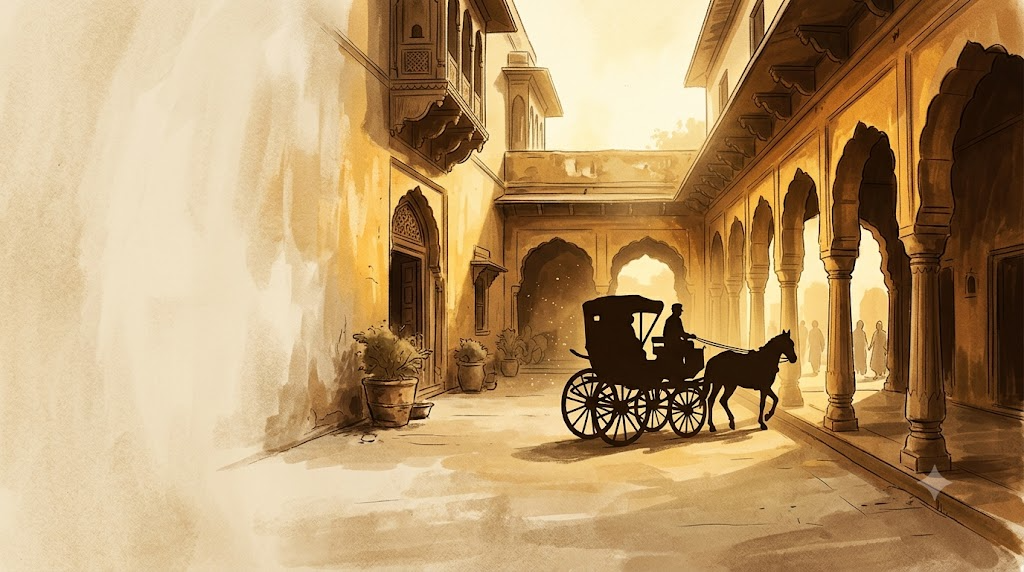
Once the princesses had vanished in their chariot, leaving nothing but a swirl of sunlit dust behind them, the astrologer ushered Vandhiyathevan inside his quiet home. He took his own seat and gently bade the young man—who was staring around the shadowy room with wide-eyed curiosity—to find a place to sit as well. Then, the older man leaned forward, subjecting his new visitor to a long, keen scrutiny.
“Well, Thambi?” he asked at last. “And who might you be?”
Vandhiyathevan couldn’t help but chuckle, a bright sound in the dim room. The astrologer frowned, his bushy eyebrows knitting together. “What amuses you so?”
“You are supposed to be famed for your skills, aren’t you?” the young man replied. “Why must you ask me anything at all? Surely you can consult the stars to predict my name and the purpose of my visit?”
“Ah,” the older man sighed, a faint smile touching his lips. “It would be no hard task to divine everything about you; such a thing is certainly well within my means. But if I do all the work for myself, what becomes of my dakshinai (the customary fee or offering given for a reading)? Making a humble living is my only real concern, you see.”
Vandhiyathevan smiled a little at the man’s frankness. “Tell me, Jothidar,” he asked, leaning closer. “Who were your previous visitors?”
“Ah, you ask about the people who just left, do you? The ones who were sitting right here when you came in? The ones who climbed into their covered chariot and drove away in a great cloud of dust? You are enquiring about them, aren’t you?” The astrologer spun his words out in as roundabout a fashion as he possibly could, testing the young man’s patience.
“Yes, indeed. They are the very ones I am talking about.”
“Ask away, by all means. You have every right to be curious. And I shall tell you, of course. The people who just left were two young women.”
“Wonderful,” sighed Vandhiyathevan. “I saw that much for myself. I do have eyes, after all, and I make a habit of using them frequently. I am quite capable of distinguishing men from women. I fancy I can even tell if a man is cleverly masquerading as a woman.”
“What is it you wish to know, then?”
“I meant, who are they? What is their station in life, their lineage, or perhaps their caste—”
“Ah, as to that, you must know that women can be classified into several distinct types, don’t you? Padmini, Sidhini, Gandharvi, and Vidhyaadhari are the four traditional kinds in our ancient poetry. You strike me as a young fellow who might be acquainted with the Saamudhrika (the ancient Indian treatise on reading character through physical features), Thambi. Well, judging by those old laws, one of those young ladies is a lovely Padmini, while the other is most certainly a Gandharvi—”
“Good God!” exclaimed Vandhiyathevan in sheer exasperation.
“Yes, my man?” the astrologer replied mildly.
“Why do you answer when I am clearly calling out to God?”
“And what if I did? You have heard, I hope, that the Almighty is omnipresent? You do not seem to have been fortunate enough to benefit from the gentle wisdom of your elders. You see, my boy, God resides perfectly well within me, and in you as well. He dwells even within my poor young disciple, whom you so roughly dragged into my home just a few moments ago—”
“Oh, enough, please. Stop,” begged the young warrior.
“It is God who has been speaking to you all this while,” the astrologer declared with a twinkle in his eye. “And it is God who now wishes me to stop!”
“Jothidar, all I truly wanted to know were the names, the clan, and the whereabouts of the two women who just left. Do please stop beating around the bush, and kindly provide me with those simple details. And if you will do me this favour—”
“What would you offer me in return, exactly?”
“Vandhanam (my heartfelt greetings and respect); my eternal gratitude, of course.”
“You may keep your gratitude. I find I much prefer pon-dhanam (a solid gift of gold).”
“Fair enough,” Vandhiyathevan laughed. “Would my gold be enough to overcome your professional scruples?”
“That would depend entirely on my own discretion. Listen to me, Thambi. An astrologer sees many visitors in his day; it is a point of honour that we must not divulge information about one client to another. I should never, for instance, reveal anything at all about the women who just left to a stranger like you. But by the same token, neither will I ever betray information about you to anyone else who might come asking!”
“Ah, it seems Azhwarkkadiyaan Nambi was quite right about you!”
“And who might that be?”
“Don’t you know him? He spoke of you just earlier today, as though you were a dear, long-lost friend. And here you are, claiming you don’t even seem to have heard of the man.”
“Perhaps I do know the fellow, but the name has slipped my mind. Be a good lad and describe him to me, if you please.”
“Well, he is short and rather squat, with a neat little top-knot upon his head. He has got quite a noticeable paunch, and he wears his veshti (a traditional length of unstitched cotton worn around the waist) tied tight around it. He bears the prominent, striped markings of a devout Vaishnavite (a worshipper of the god Vishnu) all over his body, and he makes it a point to quarrel with Saivites (devotees of Lord Shiva) at every single opportunity he gets. As for the poor Advaitha philosophers (those who believe in the non-dualistic nature of the soul and the divine)—he simply beats them with his trusty wooden stick. Why, just a few moments ago you declared that God resided within both you and me, didn’t you? Well, had Azhwarkkadiyaan heard such a thing, he would have yelled, ‘God now attacks God!’ and he would have gone at you with a will!”
“Judging by the lively picture you have painted so far, this fellow would seem to be Thirumalai.”
“Does he go by more than one name, then?”
“That staunch Vaishnavite has a different name for every town he visits.”
“And a fresh disguise to suit every person he meets too, I suppose?”
“And to suit every situation, as well.”
“And I suppose his words are a very clever mixture of truth and lies, aren’t they?”
“Three-fourths, and three-and-a-half veesam (an old fractional measure) of what he says might very well be lies and wild fantasies, but that last, tiny half-veesam would hold the solid truth.”
“A thorough rogue, you say?”
“Not at all. He is a man who returns kindness with equal kindness, and repays villainy in exactly the same coin.”
“But you can’t really trust him, can you?”
“That would depend entirely on the nature of his speech at any given moment.”
“He told me, for example, that you would deliver an incredibly accurate prediction about my future.”
“I did just mention that there would always be a half-veesam’s truth in his words, didn’t I? Well, there you are.”
“In that case, do please predict something for me. Time is running out, Ayya—I really must be taking my leave soon.”
“And where would you be going in such a terrible hurry?”
“Couldn’t you divine that as well? After all, that was precisely what I wished to ask you about—the nature of my journey, my destination, and whether I shall find any success in my mission.”
“We need just a little more information to work with, even for such straightforward predictions, Thambi. A properly cast horoscope, for example. If not that, then your date of birth and your guiding star—or, failing all of that, I should at least need your name and your hometown.”
“My name is Vandhiyathevan.”
“Ah!” The astrologer’s eyes widened with sudden interest. “A descendant of the great Vaanar clan?”
“Yes.”
“You are Vallavarayan Vandhiyathevan?”
“Indeed I am.”
“Excellent! Now, why couldn’t you have just mentioned this earlier? I may have to rummage through my old palm-leaf collection for a bit—but I do believe I actually have your horoscope tucked away somewhere.”
“You do? But how come?”
“Humble astrologers such as myself survive by keeping such things as our stock-in-trade, Thambi. We make it a point to collect the birth-charts of the descendants of great clans and ancient tribes to study them closely—”
“But I am hardly a prince or a great chieftain, am I?” Vandhiyathevan protested mildly.
“Good God, my man. What is this that you are saying? Your dynasty is amongst the very greatest that have ever ruled these lands. Why, so many fine poets have sung the praises of your noble ancestors in such glowing, musical terms as to put all other kings to shame! But perhaps you have not had the fortune to hear any of them.”
“Why don’t you recite one for me, then?”
The astrologer cleared his throat and began at once, his voice rising in dramatic cadence:
“Vaanan pugazh uraiya vaayundo, Maagadharkon Vaanan peyar ezhudhaa maarbundo, vaanan Kodi thaangi nillaatha kombundo, undo Adi thaangi nillaa arasu!”
(“There is no mouth that does not sing of the Vaanar clan’s great glory,” he translated warmly. “There is no warrior’s chest that does not bear the inscription of their valiant name; no sturdy staff that does not hold the Vaanar flag flying proud in the wind; and truly, there is no ruling dynasty, no arasu, that has not bowed to their greatness!”)
Judging by his rather rough performance, the astrologer was certainly no trained singer—but whatever he lacked in melody, he more than made up for with sheer, fiery spirit and a thoroughly dramatic execution.
“Well?” he asked, breathless, when he had finished his recitation.
“It does sound very grand, I must admit,” Vandhiyathevan smiled ruefully. “But to tell you the plain truth, Ayya, there is no staff left in this world that will carry my ancestor’s flag unless I tie it onto a bamboo pole myself. And there is certainly no kingdom, no great arasu, that bears our rule anymore—the only arasu I can ever hope to conquer is if I climb up into its branches! And honestly, knowing my luck, even that might collapse under my weight and fling me straight into the dust.”
“That might be the sad case today, my young friend—but who knows what wonderful things might happen tomorrow?”
“Why, I thought you would know,” put in Vandhiyathevan with a teasing grin.
“How could I know everything, Thambi? This old astrologer is but an ordinary, stumbling mortal, much like everyone else. The vast stars and the silent planets chart the true course of our lives and futures; all I can do is sit here and use my meagre, earthbound skills to divine their ancient paths, and pass that comfort on to those who seek such knowledge.”
“And what do those silent stars say about me?”
“They say that you grow in stature with each passing day.”
“Good grief,” sighed Vandhiyathevan. “My height is quite enough of a hindrance already—I had to duck my head just to enter your low doorway. What on earth am I to do with more size? Do let us not be so pleasantly vague. Please be a little more specific.”
“I can be specific only if your query is precise, as well.”
“Fair enough. Then tell me this—will my mission to Thanjavur succeed?”
“If the matter rests on your own account, then yes—for your stars are most certainly on the rise, my boy. But if the mission is on behalf of someone else, then I am afraid I shall have to study their horoscopes too, before I can tell you how it will fare.”
“Good God, Ayya.” Vandhiyathevan shook his head slowly and touched a finger to his nose in an expression of pure astonishment. “I have never, in all my born days, met a man quite as clever as you.”
“Flattery will get you nowhere, Thambi,” the astrologer said placidly.
“Be that as it may—I shall try to make myself clearer. I wish to seek an audience with the Emperor himself in Thanjavur. Will I succeed?”
“For that, my young friend, you may have to consult two far greater astrologers in Thanjavur than I.”
“And who, pray, might they be?”
“One is Periya Pazhuvettarayar. The other is Chinna Pazhuvettarayar.”
“I have heard it whispered that the Emperor’s health is failing fast. Is it true?”
“Idle gossip is untrustworthy at the very best of times, Thambi. Who cares a fig for what anyone says? Do not believe everything you happen to hear. And, more importantly, do not go repeating it, either.”
“And what of the succession to the throne? Who do you think will be the great Chakravarthy’s (the emperor’s) chosen heir?”
“Considering it is most unlikely to be either you or me—why on earth must we trouble ourselves over such weighty things?”
“Why indeed,” sighed Vandhiyathevan. “We are certainly well spared that particular burden.”
“True. It is no easy thing to be the heir to a vast empire, Thambi. Far too dangerous a position, in fact.”
“Jothidar, you will recall, I am sure, that Prince Aditha Karikalar is away in Kanchi at the moment.”
“I do indeed. And you are here in his service, are you not?”
“Finally!” Vandhiyathevan laughed. “You have certainly taken your sweet time guessing at the plain truth. Now, what can you tell me about his future?”
“I am afraid I simply do not have his horoscope to hand. Any prediction I might make can only be done with a proper copy before me.”
“Well then, what about Prince Madhuranthakar’s fortunes?”
“A strange horoscope, that one, Thambi,” the astrologer said thoughtfully. “Almost feminine in its peculiar characteristics. His is a life that will always, always be lived under the influence of others.”
“Isn’t that exactly how things stand these days? Everyone vows and declares that the empire is now ruled by a woman—that we have all knuckled under to a veritable Alli Rajyam?”
“Do they, now? Where do they say such things?”
“North of the Kollidam.”
“Then perhaps they are speaking of the domineering young queen of Periya Pazhuvettarayar.”
“Not to my knowledge.”
“Oh? Who else, then?”
“Supposedly, it is the Chakravarthy’s own daughter, Princess Kundhavai, who rules the land with an iron hand.”
The astrologer subjected Vandhiyathevan to a careful, sidelong scrutiny. Did the young man know, perhaps, that it had been Princess Kundhavai herself who had just left his home? Were all these probing questions the result of that knowledge, and a sly desire to dig a little deeper? But Vandhiyathevan’s face remained as open and guileless as a child’s.
“That is perfectly ridiculous, Thambi. The Emperor resides in Thanjai, whereas Kundhavai Devi has made her home far away in Pazhaiyarai. Moreover—”
“Well? Moreover what? What were you about to say?”
“One should always look carefully around oneself when speaking of such things in broad daylight—and one should never even dream of uttering them at night. However, you seem trustworthy enough to me. These days, the Emperor holds no real power, does he? Are the Pazhuvettarayars not the ones truly holding the empire’s reins tight in their hands?” And the astrologer stared hard at Vandhiyathevan once again.
“Never fear—I am not their spy. You needn’t entertain any suspicions on that score. You spoke, a little while ago, of the fragility of kingdoms and dynasties, of how very vulnerable they can be. You even quoted my own Vaanar dynasty as a sorry example. I ask you now, in all earnestness—please tell me what the future truly holds for the great Chozha Empire.”
“Very well. Listen carefully, then, and I shall tell you this without the slightest shadow of a doubt. By the end of the month of Aani (mid-June to mid-July, just before the floods), the Kaveri and her sister rivers will swell and overflow, very nearly breaking their banks with fresh floods. People who know Ponni well will understand at once that these are new waters, and that they will only rise higher as the days pass. And so it shall be all through the months of Aavani and Purattasi (September–October). Then, from Kaarthigai to Margazhi (November to January), the floods will slowly begin to subside—and people will understand, just as surely, that such is the gentle way of nature. That, Thambi, is the Chozha Empire as it stands now. It grows and grows, like the new floods of the Ponni, and it will go on expanding for the next several hundred years. At this moment, the Chozha Empire is like a waxing moon. It swells ever larger. But there are many days yet before it becomes a radiant full moon. And so, in time, it shall.”
“Thank you. I am glad, at any rate, that you have told me this much in all this time. Just one thing more: I have longed to go on a sea voyage for quite a while now…”
“And so you shall. You possess, you see, the sakadayogam (the destiny of restless travel)—you are fated to roam the wide world as though your very feet were fitted with wheels. You will walk, you will ride horses and elephants—and yes, you will even travel aboard a great ship. Oh, I most certainly predict a sea-voyage in your future.”
“Ayya, the Senapathi of the Southern Chozha Forces, Prince Arulmozhi Varmar, who wages war in distant Eezham at this very moment—what can you tell me of him? How do the stars and the planets chart his future?”
“Thambi, you have heard, I suppose, that sailors use a compass to find their direction out in the open sea? Lighthouses are of great assistance to them as well. But do you know what the greatest and most precious aid is to any sailor caught in choppy, treacherous waters? It is the pole star, the Dhruva Natchathiram (the fixed northern star), that glows steady in the northern sky. All the other stars and planets may shift and wander in their courses; even the Seven Sages of the heavens change their paths. But the Dhruva star never moves; it shines on steadily, always holding its appointed place. That, Thambi, is exactly how I would describe Emperor Sundara Chozhar’s youngest son, Prince Arulmozhi Varmar. Nothing on this earth can shake his courage or his iron determination; he is as valiant as he is gentle and compassionate, and as trustworthy as the dawn. His knowledge of the world runs as deep and thorough as his fine education. Those who merely look upon his innocent, radiant face will feel their sorrows and hardships melt clean away, and a great contentment fill their hearts in their place. He is, in truth, the very cherished son of good fortune. Young men like you, who wish to make something worthy of their lives, would do well to take him as their guiding idol—just as the lonely sailor steers his ship safely home by the light of the Dhruva star.”
“Good God—how warmly you do paint our Arulmozhi Varmar! Why, you speak of him as a young woman might describe her own beloved!”
“Anyone at all who claims the lush lands of Ponni as his home, Thambi, will tell you exactly the same thing.”
“Thank you, Ayya. If ever I have the chance, I shall certainly put your wise words to good use.”
“Your own stars are on the ascendant as well, Thambi—that is the very reason I have predicted for you as I did.”
“Then I shall take my leave of you. And along with my deep thanks, I give you what little gold I can honestly afford. Do please accept it.” And Vandhiyathevan set down five gold kazhanjus (an old coin of weighed gold) upon the floor as his fee.
“The Vaanar dynasty’s noble reputation for philanthropy remains quite untarnished, I see!” The astrologer duly gathered up the coins with a satisfied smile.

© 2026 Matribhasa Classics. Public Domain


Comments (0)
Log in to join the conversation.