The Astrologer of Kudandhai

Beautiful River Ponni claimed the Kodagu mountains as her birthplace, spending her infancy trickling playfully through its rocky fastnesses. But time passed, and she grew to womanhood. The time soon came for her to join her beloved, the Ocean. She gurgled over smooth river stones, flowed deep into dark forests, tumbled off hillsides, and gushed into sweeping green vales. With every passing mile, her eagerness to reach her destination seemed to grow. As she poured out over the open plains, she realised she was closer than ever to her loved one. Her heart trembled, and she swelled with sheer, irrepressible delight. Going further, two great limbs branched out from her, eager to embrace him. She leapt forward, hands stretched wide—but two hands simply seemed not enough. How could they be, when such love overflowed in her heart? So her hands grew from two to ten, twenty, a hundred; she extended them all in a joyful bid to touch Samudra Rajan (the Ocean King). Ah, how the mothers of Chozha Nadu delighted in decking out their daughter, the river-bride, in nature’s finest clothes! They laid out lush, green saris of paddy to wrap around her; they threw fragrant blossoms from every flowering tree they could find, and scattered breathtaking incense on the breeze to welcome her arrival. The sight of the Punnai and Kadamba (flowering trees of the south) lining her banks, showering the river nymph with their floral pearls and rubies—was there anything in this world to equal it? Not even the divine blossoms of the Devas (celestial beings) could compare. Oh, Ponni! No maiden could fail to be captivated by your charms; no woman would fail to lose her heart, dazzled by your bridal finery. And it is only natural, after all, that they surround you with laughter and delight when they set eyes upon your magnificent beauty.
One of the slender, golden limbs that Ponni reached out to embrace her consort was the river Arisilaaru. Tucked away to the south of the vast main river, she flowed in silence, concealed by a lush, continuous avenue of shady trees. Indeed, a traveller approaching from afar would rarely know of her existence unless someone had specifically told him where to look. Hers was a sweet, shy presence, much like a young princess leading a sheltered life in her anthappuram from birth, never meant to appear before the eyes of strangers. There is nothing on this earth that can quite compare to the exquisite, untouched loveliness of such a maiden.
May I ask my readers to kindly tear themselves away from the hidden lures of the anthappuram, and follow me through the dense, sun-dappled trees on the banks, towards the Arisilaaru. Ah, what is this sight that greets us—sweeter than nectar, and adding its own charm to the river’s divine beauty? Who are these young women sitting on a richly carved wooden boat, shaped like a graceful swan? And who is the lady seated in the very midst of them? Ah, she is like a golden moon amidst a smattering of twinkling stars, possessing the presence of one born to rule not just this quiet land, but all the seven worlds. And who might be the tranquil young woman seated beside her, cradling a veenai (a traditional stringed instrument) in her slender arms? Each of these girls, it seems, possesses some feature that adds to her loveliness. One is a meenalochani (a beauty with bewitching, fish-shaped eyes); another is a neelalochani, her eyes an appealing, deep blue-black. A third girl’s face glows softly like a morning lotus in full bloom; a fourth has eyes of such a graceful shape that they would put the petals of that very same lotus to blush. As for the quiet one who plays the veenai—one could happily spend days just watching her fingers, as delicate as the bright red kaanthal flower, dance upon the strings. And what, indeed, of their charming songs! The river itself seems to flow more softly, pausing to listen to their merry voices; even the green parrots and nightingales nestling in the leafy branches have fallen silent in deference. It is no surprise, therefore, that human beings, who are so much more capable of appreciating fine music, should lose themselves in sheer ecstasy. But what are they singing? Ah, listen, here it is:
Marunguvandusirandhuaarppa, Manippuaadaiathuporthu Karungayarkkanvizhithuolgi Nadanthaivaazhi Kaveri
Karungayarkkanvizhithuolgi Nadanthaellaamninkanavan Thirunthusengolvalayamai Arinthenvaazhi Kaveri
Poovarsolaimayilaadap Purindhukuyilkalisaipaada Kaamarmaalaiarugasaiya Nadanthaivaazhi Kaveri
Kaamarmaalaiarugasaiya Nadanthaellaamninkanavan Naamavelinthiramkande Arinthenvaazhi Kaveri!
Now, where have we heard these charming words before? Indeed, yes—they are sweet verses from the Silappathikaaram (one of the great ancient epics of the Tamil people), praising the divine river Kaveri and her peerless beauty. And yet, sung by these young women, the old words possess a fresh allure that holds listeners in thrall. They must surely be Ponni’s beloved handmaidens; no one else could sing about her with such heartfelt fervour. Oh, the melody, the expression, and the emotion that flow from their voices! But no, it is nonsense to try and analyse it. No one could possibly pick these songs apart and examine them for exactly what makes them beautiful—it is sheer magic, a kind of gentle sorcery that bewitches both the singers and those who listen.
The wooden boat floats along the quiet river, gradually sidles towards a gap in the dark trees, and bumps gently against a landing. Two women step out onto the bank. One is the majestic young lady we saw earlier, who possesses the unmistakable aura of an empress; the other is the quiet girl who played the veenai with such delicate fingers. Both of them were beautiful, but in their own distinct ways, with fine, classic features. One’s face resembled a lotus in full bloom; the other had a countenance more akin to a gentle kumudha (the pale water lily that opens to the moon). One had the confident radiance of a full moon; the other, the shy, translucent beauty of the crescent moon at dawn. One looked stately, like a magnificent peacock on a palace lawn; the other was a mild, sweet-voiced nightingale. One was like Lord Indra’s divine consort, Indrani; the other possessed the fragile, delicate beauty of Rathi, the beloved of Manmadhan, the god of love. One was the royal river Ganga, a vegavahini (a swift and majestic torrent) in her grace and power; the other, the gentler, bashful Kaveri.
I shall not test my reader’s patience any longer, but will simply reveal their identities. The regal young woman was King Sundara Chozhar’s daughter, Princess Kundhavai; she was the beloved elder sister of Arulmozhi Varmar, who would later gain immense fame as the great Raja Raja Chozhan. Her titles included that of Ilaiya Piratti. She was to become a pillar of strength upon which the vast Chozha Empire would one day lean. It was she who would also raise her brother’s son, Crown Prince Rajendra Chozhan, guiding him into the warrior and great emperor he was destined to be. The other girl was Vaanathi, a princess of the Kodumbalur clan, who were faithful vassals of the Chozha Empire. She resided with Princess Kundhavai, as was the custom for young women of her noble station. Fate was eventually to bless her with a destiny far beyond her wildest dreams—but that lay in the hazy future. At this moment, she was simply a demure, gentle young woman, quite unaware of the grand part she would be called upon to play.
When they had stepped out of the boat, Kundhavai turned to look at the other girls still seated inside. “Stay where you are,” she told them. “We shall return in a naazhigai.” All the young women in the boat belonged to one royal clan or another in the empire. They resided with Princess Kundhavai in the ancient Chozha capital of Pazhaiyarai, as was the custom; all of them hoped for her patronage, being princesses of various vassal kingdoms. To see her now stroll casually away with just one girl chosen from their group was rather galling. Disappointment and a prickle of jealousy warred in their narrowed eyes.
On the shady bank stood a chariot at the ready, the horses already harnessed and waiting. Kundhavai glanced at the young woman beside her. “Vaanathi, get in.” When she obeyed, the Ilaiya Piratti followed her up. The chariot set off at a spanking pace down the dusty path.
“Akka (elder sister),” asked Vaanathi, “may I know where we’re off to?”
“Indeed you may,” answered Kundhavai cheerfully. “We’re about to visit the Kudandhai astrologer, of course.”
“But—why? What do you wish to ask him?”
“What else but about you, my dear? You’ve been looking pale and dispirited for months now—not to mention thinner than ever. I’d like to consult him about your health, and find out when you’ll be feeling better.”
“Akka, if you please—there’s nothing the matter with me. If this is all you wish to ask him, may we turn back? Please?”
“No, my girl, we certainly won’t. I promise that I shan’t utter a single word about you. Shall we say, instead, that I wish to consult him about my own future?”
“You? But—why would you need to consult an astrologer about yourself?”
“Why would a young woman ever want to consult one? I wish to ask him about my marriage, of course. Will I ever wed anyone? Or is it my fate to spend my days as a lonely virgin?”
“Akka, wouldn’t you rather ask that of your own heart? All you have to do is nod—princes from all fifty-six kingdoms, from Imayam in the north down to Kumari (Cape Comorin) in the south, would be ready to fling themselves at your feet! I daresay they’d arrive in droves from even beyond the seas. I wonder which prince will be fortunate enough to claim your hand? But that decision is entirely yours, isn’t it?”
“Let’s say, for the sake of argument, that you’re right—but I see obstacles there as well. Should I ever marry a royal, I shall have to make my home with him, far away in his kingdom. Vaanathi, I’d hate to leave Chozha Nadu, made lush and beautiful by the river Ponni. You see, I’ve made a quiet pledge to myself never to depart these lands—”
“I confess I don’t see the problem. The man who marries you is bound to fall at your feet, a willing slave to your every whim and fancy. Simply order him to make his home here, and he’ll be happy to do so.”
“Ah, talk about bundling a live rat in your waistcloth! Do you truly wish me to confine a prince of another kingdom here? Are you aware of the serious political consequences that might have, my girl?”
“But—every woman must marry sometime, mustn’t she?”
“And which old scripture lays down such a strict rule, I ask you? Take the great poet Auvaiyaar, for instance. Wasn’t she a virgin unto her death? Didn’t she live a long, full life, unattached to any man, and yet reap such wonderful fame? A kaveeswari (a queen among poets), in fact?”
“Auvaiyaar was blessed by God, Akka—she received the strange boon of growing old in her youth. You haven’t a single wrinkle on your face.”
“Have it as you please, then. But I shall marry only a poor, honest soldier in this very Chozha Nadu—such a one will have no kingdom to rule, no people to govern. He wouldn’t pose conditions about taking me away, either. He would make his home right here, in this empire, quite happily…”
“Then—you wouldn’t leave Chozha Nadu, Akka? Ever?”
“Never. Not even if they promised to make me the Queen of Heaven.”
“Now, I’m truly happy.”
“You are? Why?”
“If you leave, you see, I shall have to accompany you—for I can’t even imagine living anywhere in your absence. But I don’t wish to leave Chozha Nadu either—”
“But you’ll have to, wouldn’t you? Once you yourself are married?”
“I’m never going to get married, Akka.”
“Good heavens, girl—what of all the reams of advice you’ve just been giving me about women and matrimony?”
“Our positions are hardly the same, are they?”
“Why, you little imp! Did you really think to fool me with your quiet ways, my girl? I know for a fact that you don’t care the slightest about these lands; the Chozha Nadu you truly desire is currently far away in Eezham, fighting with swords and spears. Vaanathi, you didn’t really believe me to be so blind, did you?”
“Akka—do you truly think me so silly? How can I… how can an insignificant little dewdrop trembling on the grass ever aspire to the sun? How would such a thing ever come to pass?”
“Indeed; there’s no comparing them, after all. But the tiny dewdrop does manage to capture the vast, seething ball of fire within itself, doesn’t it?”
“Truly, Akka? Do you really believe that it might claim the sun?” Vaanathi asked, suddenly full of eagerness and delight.
But then, just as abruptly, her depression returned. “The dewdrop does cherish desires; it succeeds in capturing the sun, too. But what’s the use? The dewdrop receives the punishment it so richly deserves for such outrageous daring—it simply melts within moments in the scorching sunlight!”
“You are wrong, Vaanathi. The sun does return the dewdrop’s affections—he loves her in the only way possible; he draws her up to himself and never lets her return to the earth again. You see, he doesn’t really want other men to cast their lustful eyes on her, for she belongs only to him. And when night falls, he releases her—don’t we see fresh dewdrops resting on the grass each morning?”
“These are merely pretty words to pacify me, Akka.”
“Aha! So you do admit that something troubles your heart—while insisting all these days that it was nothing of the sort! Now you know exactly why I wish to consult the astrologer.”
“And even if I am troubled,” Vaanathi murmured, staring out at the passing trees, and heaving a great sigh. “What would be the point of asking him about it?”
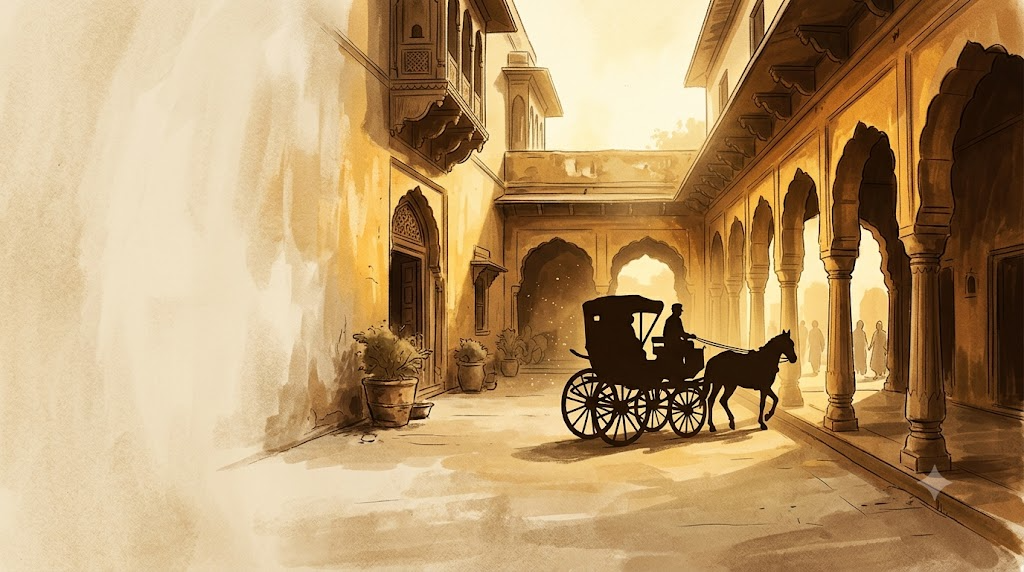
The astrologer had chosen to live in the quiet vicinity of a Kali temple in a leafy corner of Kudandhai. It was well away from the bustle of the markets; in fact, it was possible to arrive at his small home without entering the main city at all. The chariot followed a well-worn, sandy path. From the ease with which the charioteer negotiated the winding route, it seemed fairly obvious that he had driven this way many times before, and knew the track like the back of his hand. Their arrival appeared to be expected, too; the astrologer and his young disciple stood in readiness by the entrance of his home.
The moment the two princesses alighted, he hurried forward and bade them welcome, deference oozing from every pore of his body. “Perumaatti (noble lady), Your Gracious Highness! This humble abode of mine is deeply honoured to welcome you, the very embodiment of Kalaimagal (the goddess of learning) and Thirumagal (the goddess of wealth). That you should grace this poor hut once again with your noble presence is truly a privilege!”
“Ayya,” asked Kundhavai, “may we be quite sure that no one else will try to visit you for the duration of our consultation?”
“Certainly, my lady. Nobody seeks my services these days. And why should they? Your father, the illustrious King Sundara Chozhar, rules with such benign grace that there is no want, no need, no hunger or disease. His subjects lead a happy and fulfilling life. Why on earth would they need to consult astrologers?”
“In other words, I am doing so only because I am in difficulties.”
“Never, Thaaye (Mother)! Who in this land would ever dare to imply that the Pazhaiyarai lord’s noble daughter, blessed as she is with the navanidhis (the nine kinds of divine wealth), is plagued by trouble? Doubtless, it is to succour me that the Goddess Ambigai herself has decided to visit this pitiful dwelling—for, with every citizen of Chozha Nadu living a satisfying life, it is I who am now entirely deprived of an income and am therefore in great difficulties.” The astrologer recovered his footing with considerable aplomb. “May I request the princesses to kindly step inside? It is an insult to your noble selves to stand at my dusty entrance for so long!”
Kundhavai turned to the charioteer. “Make sure the radham (chariot) stands in the shade of the banyan tree by the temple.”
She and Vaanathi gathered their skirts and entered the residence. The astrologer paused for a moment to murmur to his disciple. “My boy, guard the door with your life. Make sure that not a single soul trespasses until our royal visitors leave.”
The house itself might have been of rather humble dimensions, but it was obvious that the astrologer had taken great pains to arrange it in a manner suitable for his guests. A charming little painting of the Goddess was placed in an alcove in one wall; two wooden seats were placed on the cool floor, in readiness. A tall brass kuthuvilakku cast its warm, golden light around the hall, and artistic kolams (auspicious patterns drawn with rice flour) decorated the walls and the floor. In addition, bundles of dried palm-leaves bearing intricate scratchings of astrological signs were strewn about everywhere, giving the place an air of great learning.
The astrologer took his own seat on a mat, once the princesses had settled themselves.
“My lady must graciously apprise me of the reason for her visit,” he said.
“Wouldn’t you be able to glean that simply by looking at your palm-leaves?”
“Very well.” The astrologer dutifully closed his eyes. His lips mumbled away at something, as though he were chanting ancient mantras.
“You are here, Thaaye, to consult me about this maiden’s horoscope,” he said a little while later, opening his eyes wide. “Goddess Parasakthi’s divine grace informs me so. Is this true?”
“Wonderful! Words fail me, Ayya, when I try to praise your powers. Indeed, yes—my purpose in visiting you today was to seek a consultation about this young woman. She came to the Pazhaiyarai palace a year ago, and you would have been hard put to find a more carefree, happier girl—she sang and danced all day long. For the first few months, she was the most cheerful among my handmaidens; full of bright spirit and enthusiasm. But then something changed. She hasn’t been the same for the past four months. She tires easily and sits as though in a trance for hours on end. There’s never a smile to be seen on her face, but when I ask if something is wrong, she insists she is perfectly fine. I daren’t face her family if they visit us and make enquiries about her health!”
“My lady, this young woman is the beloved daughter of the illustrious Kodumbalur Velir the younger, is she not? And is her name Vaanathi?”
“Why, you seem to know everything about her!”
“I have her horoscope too, somewhere about. I remember collecting it, amongst others. Just a moment, Ammani (madam), while I find it.”
The astrologer opened a battered old wooden box nearby and began rootling about inside it. Soon enough, he picked up a few dry palm-leaves from within, held them up to the warm light of the lamp, and read their contents carefully.
© 2026 Matribhasa Classics. Public Domain


Comments (0)
Log in to join the conversation.