Of Mirth— and Consequences

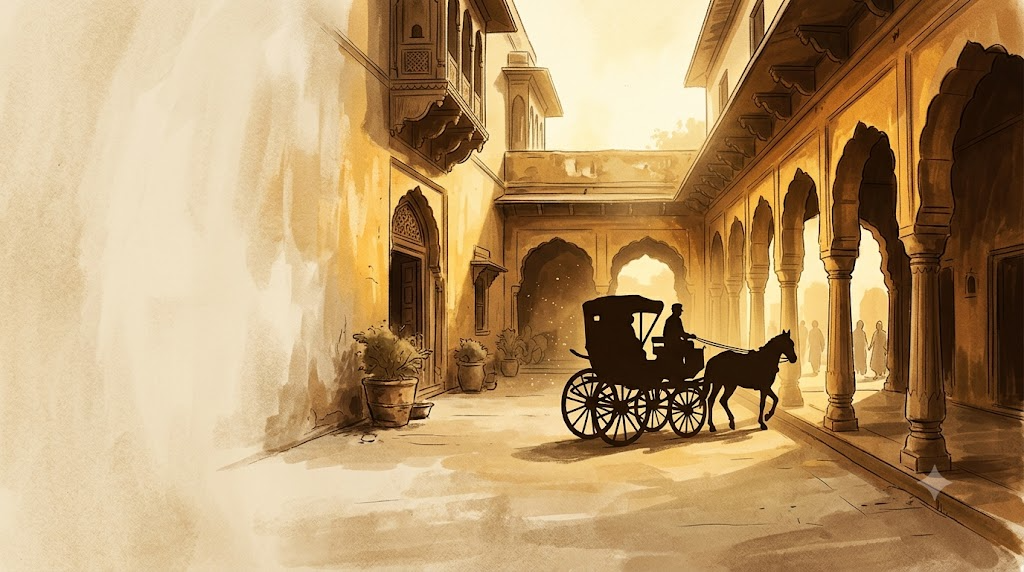
As soon as the words “succession to the throne” drifted up to him in the quiet night air, Vandhiyathevan made up his mind. He was going to listen to every single word. What on earth were these men planning? And what right did they have to discuss the crown in the dark of night? His duty, he felt, was perfectly clear: he would have to do a little eavesdropping of his own, and really, there was no better vantage point than this secluded balcony. That strange fellow Azhwarkkadiyaan could go hang himself; Vandhiyathevan had no time to worry about him now. Something significant was brewing in the courtyard below, something shadowy and unsettling enough to turn the whole empire upside down.
For a while now, a niggling suspicion had troubled him. The Kadambur Palace felt less like a welcoming home and more like the nerve-centre of some dark conspiracy. Azhwarkkadiyaan’s odd, riddling speeches on the road; the heavy-handedness of the palace guards; the belligerent, almost hostile welcome from their host, Sambuvaraiyar; the frenzied, wild-eyed cries of the Devaralan (the temple oracle) demanding a royal sacrifice… all of it had left a cold knot of discomfort in his stomach. Now, the gods had handed him the perfect opportunity to cast aside his guesses and learn the truth. Why on earth would he let it slip by? Even his dear friend Kandamaaran hadn’t found it in his heart to confide in him about this clandestine midnight gathering. Instead, he had conveniently persuaded Vandhiyathevan to sleep out here on an isolated balcony! Well, he would certainly give his friend a piece of his mind in the morning. By now, the great treasurer, Periya Pazhuvettarayar, had begun to speak, his deep voice carrying on the wind. The young Vaanar warrior leaned close, hanging on to every syllable.
“My purpose in journeying here tonight is to bring you news of great import,” the elder Pazhuvettarayar began. “It is also the reason Sambuvaraiyar has gathered us all together under this roof. The state of our Emperor Sundara Chozhar’s health is extremely precarious. I have made my own quiet enquiries among the royal physicians, and they are all of a single mind. There is little hope left—his days in this world are numbered.”
Pazhuvettarayar paused, letting the heavy words settle over the assembly. “It falls to us, then, to decide on our future course of action.”
“What do the astrologers say?” called out a voice from the shadows.
“Why bother consulting them about this?” put in another. “Haven’t we all seen the comet blazing in the midnight sky these past few weeks?”
“The astrologers’ prognosis is merely to postpone the inevitable by a few weeks,” Pazhuvettarayar replied smoothly. “Whatever the outcome may be, it is upon us to decide the heir to the Chozha throne—”
“What would be the use of contemplating such a thing now?” interrupted a hoarse voice. “Prince Aditha Karikalar was announced as the Crown Prince more than two years ago, was he not?”
“True enough,” Pazhuvettarayar conceded, his tone hardening. “But I should very much like to know which of us—if any of us at all—were consulted before such an arrogant and peremptory decision was made. Every man sitting here has pledged body and soul to the Chozha dynasty for well over a hundred years. Our clans go back centuries. We have been in loyal service to the empire for more than four generations. My own great-grandfather laid down his life in the historic battle of Thiruppurambiyam; my grandfather fell in the conflict at Velur; my father breathed his last on the bloody field of Thakkolam. Everyone here has lost a valued brother, a father, or even a son, guarding this very empire. Even today, the war raging across the sea in Eezham has our youngsters standing shoulder to shoulder, destroying our foes. And yet—not one of us was asked for our opinion when it came to choosing the successor to the throne.
“You will recall the old epics. Even King Dasarathar, in the great days of yore, called for a council to choose the Crown Prince for Ayodhya. He sent for his ministers, his commanders, his trusted aides, generals, and feudal lords. He convened a proper mandhiralosanai (a royal council of ministers) and made sure their voices were heard. Our Emperor Sundara Chozhar, on the other hand…”
“…may not have asked our advice, it is true,” came a faintly mocking voice from the back. “But our illustrious Treasurer is not quite correct to presume that no one at all was consulted. After all, Sembiyan Madevi, the noble elder queen we revere as Periya Piratti, and the honourable Princess Kundhavai, our Ilaiya Piratti, were both taken into his deepest confidence, were they not? Can the Lord of Pazhuvoor honestly claim, then, that Sundara Chozhar made an arbitrary decision about his heir?”
A soft, rippling wave of mirth flowed over the audience, a quiet chuckle at the great man’s expense.
“Ah, you laugh!” roared Pazhuvettarayar. “How you can find it in yourselves to be amused at this pathetic state of affairs, I shall never quite understand. My heart burns within me. My blood boils! I am moved to wonder what purpose my pitiful existence on this earth serves anymore. Just hours ago, the Devaralan demanded the sacrifice of a royal from a dynasty that has flourished for a thousand years. Well, do me a favour, all of you, and offer me up to the Goddess Durga instead! My clan has made Chozha Nadu its home for more than ten centuries. You may all draw your swords and cleave my head from my body right now. The Goddess is bound to be pleased with my blood, and at least my poor soul will finally find some measure of peace!”
The great man came to a sudden halt, his broad chest heaving, his voice shaking with as much wild, frenzied emotion as the possessed oracle had shown earlier that evening.
A heavy silence fell over the courtyard. The west wind whirred through the stone corridors, cool and indifferent. Outside the high fort walls, the old trees swung wildly in the stiff night breeze, their leaves rustling and whispering against the ancient stones.
“The Lord of Pazhuvoor must pardon our thoughtless speeches and our foolish laughter,” Sambuvaraiyar called out, his voice thick with humble supplication. “Ridicule was very far from our minds, I assure you; such was never our intention. You are our peerless leader, and each one of us here is willing to deem your smallest wish as our utmost command. Yours is the absolute right to lead us, and yours is the path we seek to follow. Pray, accept our heartfelt apologies, my lord.”
“I beg your pardon as well, for having lost my temper,” Pazhuvettarayar replied, somewhat mollified. “But I ask you to listen to me. Exactly a hundred years ago, Vijayalaya Chozhar reduced the Mutharayar dynasty to dust and captured Thanjavur. He ranged himself on the side of the Pallava kings and destroyed the mighty Pandiyan armies in the Thiruppurambiyam battle. Ever since that day, the Chozha Empire has grown by leaps and bounds. I highly doubt it possessed even half the territories it does today back in the glorious times of the great Emperor Karikalar, who raised the high banks of the Kaveri river. Today, our magnificent samrajyam (empire) stretches all the way from the southern tip of Kumari to the northern banks of the rivers Thungabhadhra and Krishna. We have the Pandiya lands, Naanjil Nadu, Thondai Mandalam, Paagi Nadu, Gangapadi, Nulambampadi, Vaithumbar Nadu, Seetpuli Nadu, Perumpaanappadi, and even Kudagu (the mountainous region where the Kaveri is born), all paying regular tributes as our vassals. Even the Chera country, which has a proud history of never submitting to anyone, now acknowledges our suzerainty. Our glorious tiger flag flutters proudly in all these countries, proclaiming our undeniable superiority. By rights, the rest of Ilankai in the south, and Vengi and Rettai Mandalam in the north, ought to have fallen to their knees before our onslaught long ago. As to why they have not—surely my wise friends here are aware of the reasons?”
“Indeed. There are only two reasons,” answered a chieftain named Mazhavarayar. “One is Prince Aditha Karikalar, the supreme commander of our Northern Forces. The other is his younger brother, the commander of our Southern Armies, Prince Arulmozhi Varmar—”
“Mazhavarayar speaks the absolute truth,” Pazhuvettarayar cut in. “All the great kings I have known favoured time-honoured methods when it came to choosing their generals and commanders. Warriors who had excelled in bloody wars, men who sported their scars with pride, veterans with years of hard-won experience at their backs—these were the men usually deemed most suitable to lead our armies. Such has been the steady custom in our empire for the last hundred years. But now? Now, we have the Crown Prince, quartered with vast, restless armies in the north. He is supposed to be reaping glorious victories against Vengi and Rettai Mandalam. And what does he do instead? He squats comfortably on his hind-quarters in the city of Kanchi, building himself a palace of gold. I ask you, respected members of this gathering, scions of the oldest and most valiant families of Thamizhagam—which of the rulers of this earth has ever built himself a golden palace? Not even Paranthaka Chakravarthy, who vanquished Madurai and Lanka and now resides in resplendent glory in the heavenly abode of Lord Shiva, ever wished for such an extravagant residence. What he did accomplish, beautifully and piously, was to present the great temple at Chidambaram with a roof of pure gold. But witness, if you please, the lofty, self-serving aims of our revered Crown Prince! Apparently, the hoary, ancient palaces of the Pallava emperors are simply not suited to the delicate status of our heir to the throne. So he builds a palace of gold, and embeds diamonds and precious stones into its very walls! Not a single, measly copper coin of the great treasures he carried away from his campaigns in Nulambampadi, Gangapadi, or Kudagu has made its way back to the royal treasury—”
“The Golden Palace is fully complete, then?” someone asked in astonishment.
“I have reliable information from my spies that the work is, indeed, at an end,” Pazhuvettarayar said grimly. “Emperor Sundara Chozhar has received quite a few missives from the Prince as well. Apparently, his beloved and dutiful firstborn wishes his ailing father to travel north and reside in his obscenely opulent edifice for a while.”
“Is the Maharaja truly to stay in Kanchi?” asked a worried voice from the crowd.
“Never fear. My trusted brother and I, together, shall make quite sure that such an eventuality never comes to pass. As you know, none can enter the Thanjavur fort without our express approval. No one may seek an audience with the Emperor or present any kind of palm-leaf message to him without it passing our hands first. I have, in fact, made quite sure that two or three such missives from the Prince have been successfully intercepted and put away.”
“Ah! Long live Pazhuvettarayar!” rose several voices in a cheerful shout. “Praise be to his clever strategies!” “May his valour rise to ever greater heights! Truly, you are a Chanakya among us!”
“There is more, my friends,” Pazhuvettarayar continued, holding up a hand. “If you thought the Crown Prince had lost his royal mind, just wait until you hear of the antics of our younger prince, Arulmozhi Varmar, who was sent to fight in Ilankai. Reflect, if you please, on the traditional methods of waging war. Think of our own experiences thus far, and on the military traditions that have been solidly in place for a hundred years. Should we ever march into an enemy’s lands, our armies naturally seize whatever food they can find from the surrounding areas. Our hard-earned rewards are the loot plundered straight from their treasuries—and let us not forget, this is the chief source of payment for our own exhausted soldiers. The surplus, of course, must be transferred safely back to the royal treasury in the capital. But listen to Prince Arulmozhi Varmar’s high-flown, sentimental nonsense, if you please! He believes that plundering a conquered land is a despicable act. He actually wishes for food and supplies to be sent all the way from our own lands in Thamizhagam! The good God above knows that I have already had to send more than ten massive shipments of grains and pulses across the sea—”
“What complete idiocy is this!” “Such foolishness!” rose the outraged voices, buzzing like angry bees. “Such things have never been heard of in the history of war!” “Why on earth must we put up with this injustice?”
“Do but listen to Arulmozhi Varmar’s very odd explanation for his outlandish conduct,” Pazhuvettarayar said with a bitter laugh. “He flatly refuses to seize local resources, claiming that it would only lead to discontent and misery among the island’s populace. Our battle, he believes, is solely with the rulers of Eezham; the common people should not be made to suffer for his sake. Once he has vanquished the kings and their armies, he says, he would much prefer to secure the approval and happiness of the citizens before he establishes his rule over them!”
“I have seen and heard many unnatural things on the battlefield,” mumbled one grizzled chieftain, disbelief dripping from his voice. “But to try and acquire the goodwill of the very people you are about to invade… What does he wish us to do? Fall at their feet and beg for permission?”
“Witness the grand result of these hare-brained tactics,” Pazhuvettarayar declared. “Both our fine princes have successfully ensured that the empire’s treasury and its granaries are almost completely empty. And I am placed in the highly uncomfortable position of having to heap fresh taxes upon all of you, just to make good the deficit! Such is my duty, after all. If it were not for the fact that the fate of this empire weighs so heavily upon my conscience, I would have resigned from this revolting post years ago!”
“Never—never!” Sambuvaraiyar called out earnestly. “The Lord of Pazhuvoor is the only reason this empire has not crumbled into dust by now. Your iron will and your strong conscience ensure our continued protection. But tell us, have you not sought an audience with the Emperor regarding these pressing concerns?”
“A thousand times have I tried,” Pazhuvettarayar sighed heavily. “Only to be categorically repulsed. Should I ever require His Majesty’s advice on these matters, I am expected, if you please, to bow down to the superior guidance of Sembiyan Madevi or Kundhavai! I tell you, the Emperor has lost either the will or the ability to think for himself. At no moment does he seek our learned opinions in matters of state. His beloved Sembiyan Madevi stands in the role of his chief mentor; her words are as holy as the Vedas to him. If not her, then he wishes us to seek the opinion of his beloved daughter. He truly believes Kundhavai’s understanding to be entirely superior, capable of addressing all our military and financial concerns! I! I, and the other veteran ministers who have grown grey in the service of this kingdom, are expected to stand at attention in front of this chit of a girl—a sheltered young woman whose dainty feet have scarcely stepped beyond the Kollidam river in the north and the Kudamurutti in the south—and beg for her precious indulgence! Have you ever, in all your lives, heard of women being allowed such free rein in matters of state in any kingdom? How long do you expect me to bear such an insult to my name and my life’s work? But there is a simple way out. You could all come to a unanimous decision tonight and demand my resignation. I should be very glad indeed to wash my hands of these stupid affairs, and consign myself to a quiet life at home—”
“Never! The Lord of Pazhuvoor must not even think to utter such terrible words,” Sambuvaraiyar protested loudly. “The Chozha Empire stands today on the broad shoulders of thousands of warriors. It is strengthened by the spilled blood of four generations of our men. Nothing will ever induce us to sit back and see it ground into dust in our own lifetime!”
“My friends and compatriots—I rest my case,” Pazhuvettarayar finished, his voice dropping to a low, commanding timbre. “Our great empire is now effectively governed by females. We have a veritable Alli Rajyam (a fabled kingdom ruled entirely by women, where men are but playthings) on our hands. Tell me, how do we rectify this terrible state of affairs?” He paused, looking slowly around the sea of shadowed, listening faces in the courtyard. “What do we do?”
© 2026 Matribhasa Classics. Public Domain


Comments (0)
Log in to join the conversation.