The Kuravai Koothu

The two friends had only just strolled out of the anthappuram when a high, feminine voice reached them.
“Kandamaaran! Oh, Kandamaaran!”
“That’s my mother calling,” Kandamaaran said. “Wait here a little while, will you?” And with that, he vanished back into the women’s quarters.
Left to cool his heels against the old stone of the corridor, Vandhiyathevan could not help but listen to the muffled, cheerful commotion within. He heard the barrage of questions the women were throwing at his friend, and Kandamaaran stammering and stuttering his way through the answers. A sudden burst of tinkling laughter spilled out into the hall. Vandhiyathevan felt a prickle of annoyance. Perhaps they were laughing at him? He felt his face grow hot with a mixture of shame and irritation. But there was no time to dwell on wounded pride; Kandamaaran reappeared almost instantly.
“Come on,” he said, grabbing his friend’s hand and pulling him along. “There’s a great deal I must show you!”
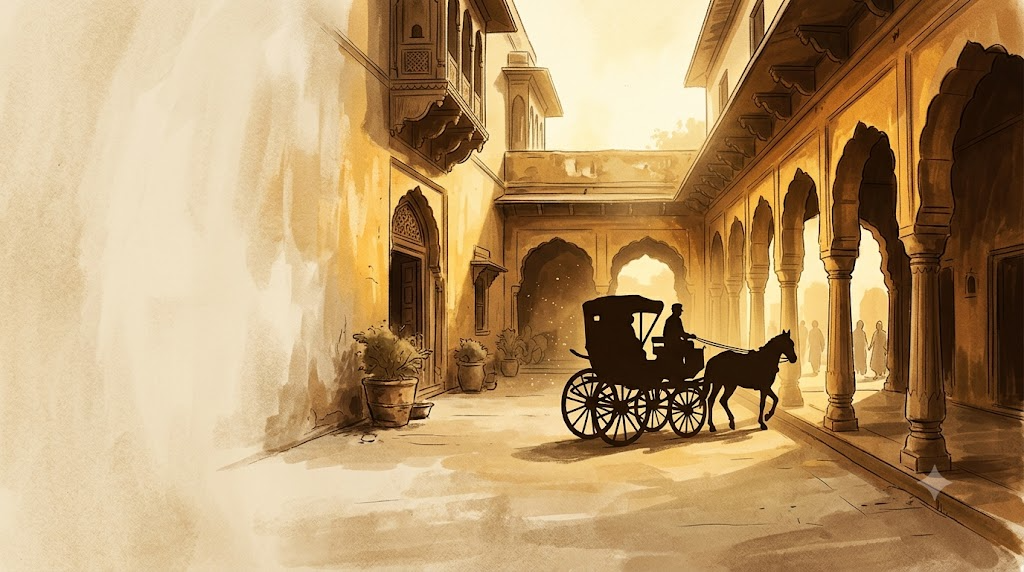
They embarked on a thoroughly unhurried inspection of the Kadambur Palace. They wandered through broad, moonlit courtyards, quiet dance and music halls, and past deep granaries. They admired smooth marble terraces, beautifully carved stone alcoves, airy balconies, and soaring towers. After walking past commemorative plaques and the polished brass of temple kalasams (the sacred finials crowning the spires), they finally reached the royal stables, which smelled pleasantly of warm horses and sweet hay. It was here that Vandhiyathevan put forth his question, trying to sound as nonchalant as a passing breeze.
“The ladies seemed to be in very high spirits when you left me in the corridor,” he remarked. “Were they really so overjoyed at my arrival?”
“Oh, they were certainly happy to see you. My mother and the rest liked you very much. But you weren’t the cause of their laughter, I’m afraid.”
“No? Who was, then?”
“Well, you know, don’t you, that the great Lord Pazhuvettarayar has taken a young wife after all these years, at his rather advanced age? He’s brought her here with him in a tightly closed palanquin. But listen to this: he refuses to send her to the women’s quarters! Instead, he chooses to keep her locked safely away in his own private apartment. One of our maids happened to catch a glimpse of her, peeping into their rooms through the palagani (a latticed wooden window), and she described the lady in such glowing terms that no one quite knows what to make of it. Now they’re all gossiping, speculating about her birth and her identity. Perhaps she’s from Ilankai, across the sea? Or Kalingam, or perhaps even the Chera kingdom! You are aware, I suppose, that the Pazhuvettarayars originally hail from those western parts?”
“Of course,” Vandhiyathevan waved a careless hand. “You told me so yourself. Be that as it may—how long has it been since the old man married this mysterious beauty from who-knows-where?”
“Not more than two years, I should think. Rumour has it that he never leaves her alone for a single moment. He takes his beloved lady with him in a closed palanquin wherever he goes. People have been trading stories about his marital escapades for quite a while now. What else can you expect when a man of his great age and high standing gives in to temptation, and stoops to spending all hours of the day with a young girl?”
“That’s hardly a reason for such widespread talk about old men and their fondness for young women,” Vandhiyathevan said smoothly. “Shall I tell you the real reason for all this gossip? Women, my dear Kandamaaran, are jealous creatures by nature. I’m not casting aspersions on your family—merely commenting on the way of the world. Kadambur’s royal ladies are classic, dark-complexioned beauties; Pazhuvettarayar’s young wife, on the other hand, is a golden nymph, with skin like a delicately tinted lotus! It’s hardly surprising, is it, that they should speak of her in such terms?”
Kandamaaran stopped walking. “Golden? But how on earth would you know? Have you seen her, then? Where? And when? If Pazhuvettarayar ever caught wind of it, my friend, you’d be dead in moments.”
“You know me, Kandamaaran—I’m hardly the sort of man to be terrified by such threats. In any case, it wasn’t at all what you’re imagining. I was standing in the crowd at Veera Narayanapuram, watching the Pazhuvettarayar cavalcade pass by. By the way, I did hear that the grand elephants, the fine horses, the palanquins, the parivattams (the ceremonial silk turbans of honour) and everything else were all part of your family’s welcoming committee.”
“True enough,” Kandamaaran agreed. “What of it?”
“What of it, indeed? I was merely comparing his magnificent, royal entry to my own rather dusty arrival.”
Kandamaaran chuckled appreciatively. “We gave Pazhuvettarayar the welcome due to the Treasurer of the Chozha Empire. While you, as a staunch and true warrior, deserved something a little more… spontaneous, shall we say? If, by Lord Muruga’s grace, you should ever happen to become something more—such as the son-in-law of the Kadambur royal family, for instance—you’ll find your welcome changes entirely!” He paused, his curiosity returning. “But you were about to explain something else. How did you know Pazhuvettarayar’s beautiful wife was a golden nymph?”
“Ah, yes. Well, there I was, gaping at Pazhuvettarayar as he passed me by. He was majestically seated on his elephant—though truth be told, Kandamaaran, with his fierce glare he seemed rather more like Yamadharman, the Lord of Death, riding his terrifying black bull. Anyway, I was lost in daydreams about how, one day, I should like to ascend to such heights myself. A closed palanquin followed close behind him. I was just wondering about its occupant when a slender hand crept out and pushed the silk screen aside just a fraction, allowing me the briefest glimpse of a golden face. And that was all I saw. From what you’ve told me tonight, she would seem to be his young wife.”
“You’re a lucky man, my friend,” Kandamaaran said softly. “Word is that no man has ever managed to catch even the smallest glimpse of her. But you saw her arm and her face. What country did she seem to be from, would you say?”
“I confess I didn’t really bend my mind to it at the time. From the little I saw, though, I wonder if she might be from Kashmir? Or perhaps one of those distant lands beyond the seas, like Saavakam, Kadaaram, Misiram—or even Greece? Perhaps she’s from the Arab lands? I’ve heard old tales that they cover their women from head to toe the moment they’re born.”
From somewhere far away in the palace grounds, the sudden, rhythmic sound of instrumental music drifted on the night air. The sharp beats and droning notes of the salli, the karadi, the parai, the small hourglass udukku, and a solitary flute all blended together as they reached the two young men.
“What’s happening?” asked Vandhiyathevan.
“It sounds like the Kuravai Koothu is about to begin. They’re playing the prelude now, I think. What’s your pleasure? Would you like to go and watch? Or would you prefer to have your meal and make an early night of it?”
Azhwarkkadiyaan Nambi’s enthusiastic words about the grand celebrations at Kadambur that night echoed warmly in Vandhiyathevan’s ears. His mind was made up in an instant.
“I’ve never actually seen a Kuravai Koothu, Kandamaaran. I should very much like to see one now.”
The friends turned a corner in the long stone corridor, and found the glory of a stage completely set up for the performance right before them. They were just in time; the spectators had only begun to arrive and settle themselves.
The stage for the dance was laid out in the midst of a vast, open courtyard strewn with soft white river sand. It was enclosed by the palace on one side and the thick, sturdy walls of the fort on the other. Delightful drawings of roosters, peacocks, and swans were arranged on the stage at careful intervals. Colourful, rustic decorations were scattered liberally everywhere: handfuls of puffed rice made from roasted red grains, glossy red and black kunrimani forest seeds, fragrant flowers, and thin yellow trails of turmeric-smeared thinai (a sweet foxtail millet).
Large kuthuvilakkus (tall, slender brass lamps) and thick oil-torches burned brightly, pushing back the encroaching darkness of the night. But the heavy smoke belching from the torches, combined with the fog-like density of burning akhil (fragrant eaglewood incense), dimmed the harsh light and produced a deeply dramatic, mysterious atmosphere. The musicians had seated themselves at the front and along the sides of the stage, playing their instruments with tremendous alacrity. The thunderous drumbeats, the heavy scent of crushed flowers, and the aromatic incense smoke wended their way into Vandhiyathevan’s brain. For a moment, the world seemed to spin pleasantly around him.
Once the chief guests arrived and took their seats, the performance began.
Nine women gathered on the stage. In accordance with the ancient traditions of the dance, they wore simple garments moulded closely to their figures, and traditional jewellery that set off their rustic charms to perfection. Hollow silver silambu anklets clinked musically on their bare feet. Their dark, oiled tresses fairly glowed with forest flowers—kanni, kadamba, kaandhal, kurinji, and sevvalari—all bright blooms set there to gladden the heart of Lord Muruga. In addition to wearing the blossoms in their hair, they had woven them into a tremendously long garland, intertwining themselves into it as they stood in a line. Some of the women held graceful wooden parrots in their hands, carved from sandalwood and painted in a riot of bright colours. They paid their deep respects to the gathered audience, and the Koothu began in earnest.
The women sang soaring songs in praise of Muruga, singing of his courage, and the valour that led him to confront terrible demons such as Soorapadman and Gajamugan. They sang the stirring tales of his fierce battles against them; of the enormity of his divine power that vaporised entire seas and oceans; and his complete, unyielding annihilation of evil forces. They spoke of his peerless beauty and his many attractive charms. They sang of his deep compassion, and of the celestial women who, though the very epitome of beauty themselves, yearned hopelessly for the love of such a warrior. They told of Muruga’s magnanimity in refusing the hands of such high-born damsels, choosing instead to journey to the wild, mist-wreathed mountains of the south, where he wooed and won the heart of a simple tribal girl who spent her days shooing birds away from the millet fields.
The stories they told, the songs they sang, and their beautifully coordinated dancing, driven by the steady, pounding beats of the parai and the melodious trill of the flute, set the audience’s pulses racing. Nerves jangled in sweet anticipation. Finally, the women finished their dance with the age-old, traditional blessing:
“Woe to Famine, Disease and War! Welcome, welcome, to Rains, Wealth and Fortune!”
Their quiet departure from the stage was the sign for the next, and far more important, part of the evening to commence: the Velanattam, the furious dance of Velan.
The principal players, the Devaralan and the Devaratti—the male and female shaman-dancers of the ritual—arrived on stage. True to the fierce roles they were about to embody, both were dressed in blood-red garments, with gloriously red garlands of sevvalari flowers twined thickly around their necks. Their foreheads were smeared heavily with bright red kungumam (vermilion powder), and their mouths glistened crimson with the juice of chewed betel leaves and areca-nuts. When they cast their eyes around the audience, they seemed to glow a terrifying, bloodthirsty red in the lamplight.
The dance began, to tell the truth, in a somewhat subdued fashion. The man and woman danced slowly across the stage—sometimes drifting apart by themselves, sometimes moving in perfect tandem with their hands interwoven. But as the minutes ticked by, the crashing beats of the instruments picked up a frantic pace, and their dance turned turbulent, reverberating with raw, untamed emotion.
The Devaratti danced over to a corner of the stage and picked up a long spear. The Devaralan pranced toward her and did his absolute best to wrest the weapon from her grip. The Devaratti protested, pushing and fending him off. After a prolonged struggle, the Devaralan finally grew tired of her stubborn refusal and delivered a mighty, soaring leap that set the wooden stage quaking beneath his feet. He grabbed the spear from his mate. Upon losing the weapon, the Devaratti crept away to the edge of the stage, trembling and shrinking as though terrified by the sight of him.
Now gripping the spear, the Devaralan began to dance alone. It was a dance that grew in frenzy and mad, crackling energy by the second. A dance of annihilation, of total destruction, representing the razing down of the pride and arrogance of the demon Soorapadman and his evil cohorts. Velan hacked away each of the demon’s monstrous heads—but, lo and behold, they simply grew back! And the more they grew, the more Velan’s divine wrath boiled over. His fury reached enormous, terrifying proportions. His eyes seemed to spit actual sparks of fire into the smoky air. Finally, the invisible demon lay dead at his feet.
The spear dropped from the Devaralan’s suddenly nerveless fingers.
Abruptly, every instrument stopped its agitated performance. A heavy silence fell over the courtyard, broken only by the rapid, rattling rhythm of the udukku, played by the head priest. The Devaralan stood quaking and shivering on the stage. Every pore in his sweating body seemed to jangle with a sparking energy that fired up the nerve-endings in his brain.
“Sannadham!” whispered the audience in awe, recognising his state—the divine, shuddering trance of possession. He was filled with other-worldly power and the sudden ability to foretell the future. “It is time!”
And indeed it seemed so, for the priest began to rattle his little drum with more frantic energy than ever. He focused all his attention on the quivering Devaralan.
“Velan! Muruga! Commander of the Divine Armies!” the priest entreated into the night. “Kandha! Destroyer of the Demon Soora! Grant us your pearls of wisdom! Give us knowledge of what is to happen!”
“What do you wish to know?” growled the Devaralan. His voice was thick and unearthly, shaking in the deep grip of the trance. “Tell me!”
“Will the rains come on time? Will our lands never lack for wealth and water?” asked the priest. “Shall the empire flourish? Will all our desires be fulfilled?”
“The rains shall come! The land shall flourish! All your desires shall be fulfilled!” shrieked the Devaralan, caught utterly in the grip of the divine power. “But you—you have all failed! Failed to satisfy my Mother! Failed to worship Her! You have not given Her Heart’s desire!”
“What does she ask for?” cried the priest.
“She asks for blood! My Mother, the fearsome Goddess Durga, Mother Kali wishes for a sacrifice! She Who Guards the World, the Supreme Goddess Chandikeswari, who vanquished Mahishasuran, wants a sacrifice!”
“What kind of sacrifice?” asked the priest, his voice echoing in the quiet courtyard. “Are you prepared to offer what She wishes?”
The Devaralan shook and quivered in absolute frenzy. “Will you give what Her Heart craves?”
“We will; we will!” yelled the priest.
“Blood! The blood of kings!” The Devaralan screamed, a terrible sense of catastrophe colouring his rough voice. “My Mother craves the blood of a royal dynasty that spans a thousand years!”
The flickering firelight of the torches cast strange, vaguely terrifying shadows on the faces of Periya Pazhuvettarayar, Mazhavarayar, Sambuvaraiyar, and the other great dignitaries seated directly across the stage. Upon hearing the Devaralan’s startling words, they exchanged quick, furtive glances. Their eyes, already bloodshot and swimming with the mad, intoxicating fervour of the evening’s events, met in the smoky gloom. Lord Sambuvaraiyar directed a single, sharp look at the priest and gave a barely perceptible nod.
The rattling of the udukku stopped. Instantly.
The Devaralan, still shaking on the wooden planks of the stage, dropped like a felled tree. The Devaratti ran up from the shadows, managed to scoop his limp form into her arms, and made a hasty exit into the night.
The shaken audience began to disperse in silence, stepping softly over the white sand.
Somewhere, far away in the dark woods beyond the fort, jackals began to howl into the night. Vandhiyathevan, whose own nerves were almost as jittery as anyone else’s—what with the intoxicating excitement of the Koothu and its strange, violent emotions—pricked his ears at the animals’ inhuman cries. Almost involuntarily, his eyes strayed toward the high fortress walls.
Azhwarkkadiyaan Nambi’s head rested there, on top of the stone wall.
Vandhiyathevan almost jumped out of his skin, completely horrified. A cold sweat broke out over him, and the short hairs on the back of his neck rose, prickling in pure terror. In the dim light, it looked exactly as though someone had severed Nambi’s head and stuck it up on the ramparts as a bloody warning!
He blinked, rubbing his eyes, and stared at the fortress wall again. It was completely empty.
Vandhiyathevan shook his head, feeling utterly ashamed of his own morbid fancy. But as he followed his friend into the palace, nameless fears and dark conjectures continued to fill his heart, and try as he might, he could not find it in himself to shake them off.
© 2026 Matribhasa Classics. Public Domain
Comments (0)
Log in to join the conversation.