Chapter One

The Temple
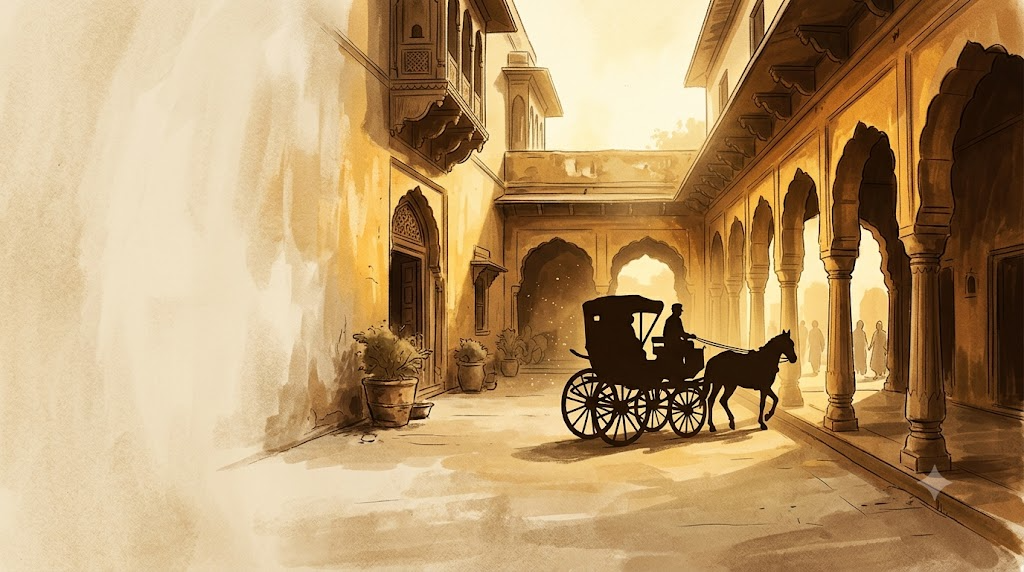
It was towards the close of summer, in the nine hundred and ninety-seventh year of the Bengali era, that a solitary horseman made his way along the road from Bishnupur to Mandaran. Perceiving that the sun was hastening towards his setting, the rider urged his horse to a swifter pace — for before him stretched a vast and open plain, and he feared lest, as was the habit of the season, a violent storm and downpour should overtake him ere he had crossed it, leaving him shelterless and in great distress upon that naked expanse. He had not yet gained the farther side when the sun went down; and presently the night-sky became mantled with dark masses of cloud rolling up from every quarter. So impenetrable a darkness descended at the very commencement of the night that the management of his horse grew exceeding difficult, and the traveller could advance only by such light as the lightning vouchsafed him, groping his way flash by flash along the unseen road.
Within a little while the summer storm broke upon him with a mighty roar, and with it came a torrent of rain. The horseman could no longer discern his road at all. He slackened the rein, and the horse went forward as chance directed. They had proceeded thus some distance when the animal's hoof struck against some hard substance and the beast stumbled. At that instant a flash of lightning revealed to the traveller, for one brief moment, a great whitish mass looming before him. Judging this white bulk to be some edifice, the horseman sprang from the saddle to the ground. The moment he alighted, he perceived that his horse had stumbled upon a flight of stone steps — whence he concluded that some place of refuge lay close at hand. He therefore let the horse go free and, himself advancing carefully up the steps through the darkness, learned presently by the light of another bolt that the building before him was a temple of the gods. By dexterous management he gained the small door of the sanctuary, and found it shut; feeling with his hand, he satisfied himself that the door had not been fastened from without. In this deserted temple upon the open plain, he marvelled somewhat that any person should have barred the door from within, and his curiosity was strongly aroused. The rain beat upon his head with great violence; and as whoever might be within the sanctuary was of no consequence beside that extremity, the traveller knocked upon the door again and again with vigorous and insistent blows — yet none came to open it. He was half minded to burst the door with his foot, but forbore out of reverence for the house of God; nevertheless the heavy strokes of his fist were more than the wooden panel could long endure, and in a little time the bolt gave way. The instant the young man stepped within the temple, a half-stifled cry reached his ears; and at the same moment, the gust that entered through the opened door extinguished the faint lamp that had been burning there. What manner of persons were within, what form the deity wore — the newcomer could see nothing whatsoever. Finding himself in this predicament, the fearless young man merely smiled to himself, and first made obeisance with devotion towards the unseen image of the god. Then rising, he called out into the darkness: "Who is there within this temple?" No answer came; but the soft jingle of ornaments fell upon his ear. Deeming further speech needless, the traveller drew the door shut against the wind and rain, and, in default of the broken bolt, set his own body against it; then called once more: "Whosoever may be within this temple, give ear. I am here — armed — sitting at the threshold. Disturb not my rest. If thou art a man, thou shalt have cause to repent it. If thou art a woman, sleep without fear; while a Rajput's sword and shield are here, not so much as a blade of kusa grass shall wound thy feet."
From within the temple, in a woman's voice, came the question: "Who art thou?" The traveller answered in some surprise: "By thy voice I judge that it is some fair lady who asks. What concern have you with my particulars?"
The reply came from within: "We are greatly frightened."
The young man then said: "Whoever I may be, it is not our custom to give account of ourselves. But be assured that while I am here, no harm of any kind shall befall a woman."
The lady answered: "Hearing thy words, I take courage — until now we had been wellnigh dead with terror. Even yet my companion is but half recovered from her swoon. We came hither at evening-tide to worship the god Shaileshwar, and when the storm arose, our bearers and servants abandoned us and fled — whither, I cannot tell."
The young man said: "Be not troubled. Rest now, and at dawn to-morrow I will myself conduct you home." The lady replied: "May Shaileshwar grant thee every blessing."
When, towards the middle of the night, storm and rain at last subsided, the young man said: "Do you remain here yet a little longer and take heart. I go to a neighbouring village to procure a lamp."
The lady who had been speaking replied: "Sir, you need not go so far as the village. The keeper of this temple dwells very near at hand; the moon has now come out, and from the door of the temple his cottage will be visible. That man lives alone upon the plain, and therefore he keeps in his house at all times the materials for making fire."
The young man followed this counsel. Coming out of the temple, he descried by the moonlight the dwelling of the temple-keeper, went to its door, and roused the man from his slumber. The keeper, fearing to open to a stranger in the night, first peered out from concealment to take the measure of his visitor. Careful inspection revealed no mark of a robber about the traveller, and moreover the temptation of the money offered him was not easily withstood. After much hesitation the temple-keeper opened his door and lit a lamp.
The traveller brought the lamp within, and by its light beheld a white marble image of Shiva enshrined in the temple. Behind that image crouched two women — and only two. The younger, the moment the light appeared, drew her veil close about her and sat with face bowed down. Yet the bare wrist he could see bore bracelets set with diamonds, and her garments were of rich and intricate workmanship, while the array of jewels that adorned her was such as to leave the traveller in no doubt that this young woman was of no mean birth. From the comparatively inferior worth of the second woman's apparel he inferred that she was the younger lady's companion and attendant — yet more handsomely provided for than servants ordinarily are. Her age appeared to be about five-and-thirty. The young man readily surmised that it was with this elder that he had been conversing. He observed with some wonder that neither woman wore the dress customary to the women of this province; both were habited after the fashion of ladies from the western parts — that is, of Hindustani women. Having placed the lamp in a suitable position within the temple, the young man stood before them. As the lamplight fell full upon him, the women saw that the traveller appeared to be somewhat above five-and-twenty years of age; his stature was such that in another man so great a height might have seemed ungainly, but the breadth of his chest and the full and noble proportions of every limb made that lofty stature a cause of extraordinary comeliness. His complexion was as fresh as young grass born of the rains, or yet more winning than that; and above this bright complexion he wore the accoutrements and raiment of the Rajput race — coat of mail and cuirass, a sword at his hip in a jewelled scabbard, a long lance in his long hand; upon his head a turban with a diamond upon it; in his ears pearl ear-rings; about his neck a necklace of gems.
Both parties, now that they could see each other, were keenly desirous to know who the other was; yet neither could readily bring themselves to be the first to ask, lest such inquiry seem unmannerly.

© 2026 Matribhasa Classics. Public Domain


Comments (0)
Log in to join the conversation.