7

Another two days passed. They advanced deeper and deeper into the jungle. The path was never level, a constant series of ascents and descents, interspersed with forests of coarse, long tusak grass. Water was almost unobtainable; though a spring or two might be seen, Alvarez wouldn’t let them even touch the water. Divine, crystal-clear water tumbled from the spring, cool and tempting; for a thirsty man, resisting such a temptation was exceedingly difficult—but Alvarez would make them drink cold tea instead; he still wouldn’t allow them to drink the water. Cold tea does not quench a thirst for water, and to Shankar, the agony of thirst seemed the greatest agony of all.
In one place, the tusak grass grew extremely dense. On top of that, a deep fog had enveloped them on all sides that day. Suddenly, as the day broke, the fog below dispersed—and looking ahead, it seemed to Shankar that a great ascent stood barring their way, its height impossible to gauge, for its upper reaches were completely shrouded in dense fog or cloud. Alvarez said, “The main range of the Richterveld.”
Shankar asked, “Do we need to cross this?”
Alvarez said, “It’s necessary because the last time, Jim and I came from the south to the foot of this mountain range, but we didn’t cross the main range. The river where the yellow diamond was found flows from east to west. This time, we’re travelling from north to south. So unless we cross the mountains to the other side, how can we pinpoint that river’s location?”
Shankar said, “Seeing how foggy it is today, why don’t we wait a bit? Let the day get a little brighter.”
They pitched the tent and finished their meal. Even as the day wore on, the fog did not really lift. Shankar fell asleep inside the tent. When he awoke, the day was gone. Rubbing his eyes, he came out of the tent to find Alvarez sitting with a worried expression, a map spread open before him. Seeing Shankar, he said, “Shankar, we still have much to endure. Look ahead.”
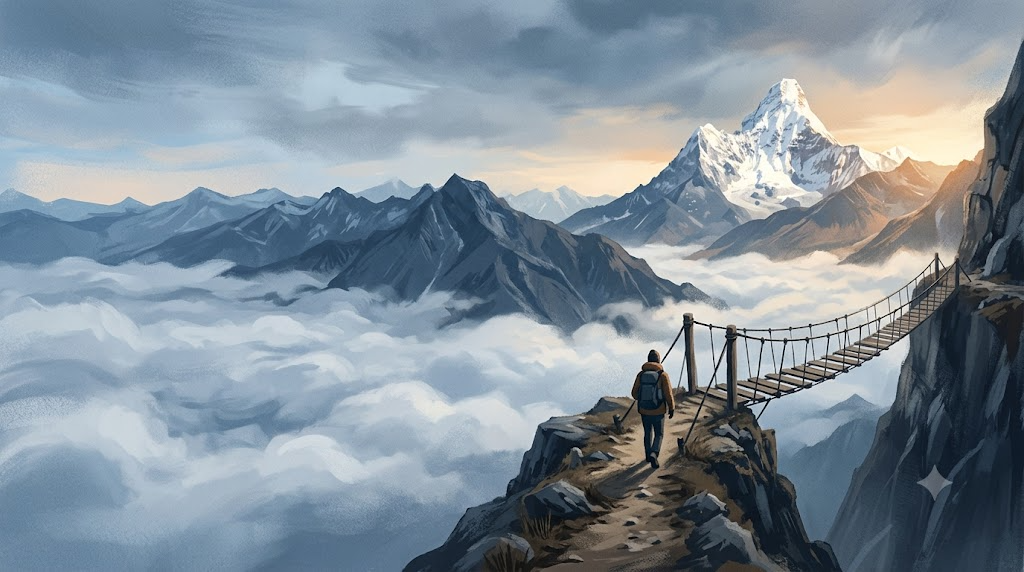
At Alvarez’s words, Shankar looked forward and a solemn vista met his eyes. The fog had cleared at some point, and before him, the main massif of the immense Richterveld mountains rose step by step, seeming to touch the very sky. The mountain’s flanks were shrouded in dense, lightning-filled thunderheads, but its highest peaks, in the ruddy light of the setting sun, stood with their heads raised high in the distant blue void, like the golden temples of a celestial city.
But the section of the mountain before them was completely impassable—nothing but sheer, towering peaks—with no slope to be found anywhere. Alvarez said, “It’s not possible to climb the mountain from here, Shankar. You can surely see that. We’ll follow the foot of the mountain westward. Wherever we find a low, sloping pass, we’ll have to cross the mountain there. But in a mountain range a hundred and fifty miles long, just finding such a place looks like it will take over a month.”
But after five or six days of heading west, they found a place where the mountain’s face was quite sloped, from which an ascent could be made.
The next day, the climb began very early in the morning. By Shankar’s watch, it was half past six. Before it was even half past eight, Shankar could go no further. In the section they were climbing, the mountain rose six thousand feet within four miles, so even though the path was sloped, one can easily imagine how terribly arduous it was. Besides, the higher they went, the denser the forest became, with deep darkness all around; the day had broken, the sun was up, and yet no sunlight penetrated the jungle—the sky itself was not visible, let alone the sun.
There was no such thing as a path. Before their eyes, there were only tree trunks, seeming to rise step by step towards the sky. Water dripped from some unknown source, making the stone underfoot damp and slippery; nearly everywhere, the rocks were covered in moss. A slip of the foot meant tumbling a long way down, to be injured on the sharp rocks below.
Neither Shankar nor Alvarez spoke a word. Both were exhausted by the hardship of this towering ascent, both were breathing heavily. Shankar’s suffering was even greater; born and raised on the flat plains of Bengal, he had never had any practice in climbing mountains.
Shankar wondered when Alvarez would call for a rest. He could climb no more, but even if he were to die, he would never tell Alvarez that he couldn’t go on. Perhaps Alvarez would then think that these people from the East Indies were utterly useless. In this immensely difficult mountain and forest, he was India’s representative—he could do nothing that would bring shame to his motherland.
It was a marvellous forest, like a fairy kingdom; now and then, small waterfalls cascaded from high above down through the trees. Parakeets of many colours flitted from branch to branch, dazzling the eye. White flowers topped the tall grasses, and orchids hung from the branches and trunks of the trees.
Suddenly, Shankar’s eyes fell upon some figures perched on a branch—who were they, looking like the long-bearded, miniature balkhilya sages of myth! They were all sitting in silence, filled with a sage-like gravity. What was this?
Alvarez said they were female Colobus monkeys. “The male Colobus has no beard or moustache; it’s the female that grows a beard and moustache a foot long. And they are very solemn, as you can see.”
Shankar nearly died laughing at their antics.
Beneath their feet there was neither soil nor stone—only a mass of rotting leaves and dry tree trunks. For century after century in these forests, leaves have fallen and rotted, thick moss has grown over them, mushrooms have sprouted, and on top of that, a new layer of fallen leaves, and then more branches and trunks. In places, this pile of leaf-mould was sixty to seventy feet deep.
Alvarez taught him that one must tread very carefully in these places. There were spots where a man, while walking, could suddenly sink into this mass of fallen leaves and be submerged, just as one might unexpectedly fall into an old well. In such cases, if rescue is not possible, death by suffocation is inevitable.
Shankar said, “We can’t climb any further without cutting through the vegetation, it’s getting too dense.”
A forest of elephant grass, its broad leaves sharp as razors—like the double-edged swords of the Roman era. As they made their way through it, neither of them felt safe; when you cannot see what is two arm’s lengths away, every kind of danger is a possibility. There could be a tiger, there could be a lion, there could be a venomous snake.
Shankar noticed a sound from time to time, like the beating of a dugdugi or a dhol. Were some local tribesmen beating a drum? he asked Alvarez.
Alvarez replied, “Not a drum. A large baboon or an ape makes that sound by beating its chest. Where would men come from here?”
Shankar said, “But you told me there were no gorillas in this forest?”
“Gorillas probably aren’t here. Apart from the Belgian Congo’s Kivu region, the Ruwenzori Alps, or the forests of the Virunga volcanoes, gorillas aren’t known to exist anywhere else in Africa. But other types of apes besides gorillas can make that sound by beating their chests.”
They had climbed above four and a half thousand feet. They pitched their tent there to rest for the night. The nocturnal sounds of a vast, true tropical forest were so varied and so terrifying that Shankar could not close his eyes all night. It was not just fear, but a sense of wonder mixed with fear.
So many kinds of sounds—the laughter of hyenas, the harsh cries of Colobus monkeys, the chest-beating of apes, the roar of a tiger—in this vast, private menagerie of nature, no one slept at night.
The entire forest seemed to have gone mad in the dead of night. He was reminded of a time, a few years ago, when a large circus troupe had pitched its tent on the field next to his school boarding house, and the boarding students couldn’t sleep at night for the cries of the animals. But more than all this, in the middle of the night, Shankar heard the trumpeting of a herd of wild elephants extremely close to the tent and was so frightened that he quickly woke Alvarez. Alvarez said, “There’s a fire burning outside the tent. Don’t worry, they won’t come near.”
In the morning, they started climbing again. Up, up they went—through mile after mile of wild bamboo forest, with wild ginger growing beneath it. Within a hundred yards of their path, a huge herd of elephants passed through the bamboo forest to their left, snapping off tender young bamboo shoots with a great crunching sound.
At five thousand feet, what a festival of wild blossoms—brilliant red Erythrina bloomed in enormous trees. The flowers of the blooming Ipomoea vine looked just like the bonkolomi flowers of Bengal, though the colour was not as deep a purple. White Veronica freighted the air with its thick fragrance. Wild coffee flowers, colourful begonias. A forest of flowers in a kingdom of clouds; now and then, cloud-puffs like white balloons would get caught in the treetops—or descend even lower to drift through the Veronica forest, leaving it drenched.
Above seven and a half thousand feet, the character of the forest changed completely. It had taken them another two days to reach this height. The hardship was unbearable; their backs were breaking. Here, the forest’s aspect was very strange; the trunk and branches of every tree were covered in thick moss, and moss hung from every bough—in some places so long that it nearly touched the ground—swaying in the wind. And enveloping it all was an unearthly silence—there was no sound of the wind blowing, no birdsong in that forest—no human voice, no animal cry. It was as if they had stumbled into some dark hell, into a congress of long-bearded ghosts.
That afternoon, when Alvarez gave the order to pitch the tent and rest, Shankar sat outside with a cup of coffee and felt that this was a forest from the dawn of creation, from a time before the planet’s plant life had taken any definite shape or form, an age when giant reptiles roamed the deep darkness of a world-spanning jungle—and by some magic spell, he had been transported back to that primeval past—
Just after evening, the entire forest was cloaked in dense darkness. They had built a fire outside the tent—nothing was visible beyond its circle of light. The astonishing silence of this forest amazed Shankar. Why were the varied sounds of the forest night silent here? Alvarez was looking at the map with a worried face. “Listen, Shankar,” he said, “I’m thinking about something. We’ve climbed eight thousand feet, but we still haven’t found the pass that will let us cross the range to the other side. How much higher can we go? What if, say, there is no saddle in this section?”
It was not as if this same doubt had not occurred to Shankar. Just today, during the climb, he had tried several times to look upwards with the field glasses, but his efforts had been futile, as the upper reaches were always shrouded in thick cloud or fog. It was true, how much higher could they climb? What if no level pass was found? They would have to go down again, and climb up again from another spot. They’d be done for.
He asked, “What does the map say?”
From Alvarez’s face, it seemed he had lost faith in the map. He said, “This map isn’t made with that much detail. Who has ever climbed this mountain to make a proper map? This one you see—it’s a map made by Sir Filippo de Filippi, who became famous for ascending the Fernando Po peak in Portuguese West Africa, and who was also part of the famous mountaineer the Duke of the Abruzzi’s expedition a few years ago. But he never climbed the Richterveld. The contours drawn on this map don’t seem very accurate. I can’t quite figure it out.”
Suddenly Shankar cried out, “What was that?”
First, a faint sound from outside the tent, and an instant later, the sound of a painful cough—as if a tuberculosis patient were coughing in great, wretched difficulty. Once… twice… and then the sound stopped. But it was not the sound of a human throat; the thought struck Shankar the moment he heard it.
Grabbing his rifle, he was about to hurry out of the tent, but Alvarez quickly got up, took him by the arm, and sat him down.
Astonished, Shankar asked, “Why? What was that sound?”
As he spoke and looked at Alvarez, he noticed with amazement that Alvarez’s face had gone pale. Just from hearing that sound!
At the same moment, in the deep darkness beyond the circle of the campfire, they could distinctly hear a heavy yet light-footed creature moving through the undergrowth.
Both were silent for a while. Then Alvarez said, “Throw more wood on the fire. And check if the rifles are loaded.” Seeing the look on his face, Shankar did not dare ask him any more questions.
The night passed.
The next morning, Shankar was the first to wake. Coming out of the tent to light a fire for coffee, he went a short distance away to break some wood. Suddenly, his eyes fell on a footprint on the wet ground—a print no less than eleven inches long, but with only three toes. The marks of all three toes were quite distinct. He followed the track—there were many more prints, all of them with the same three toes.
Shankar remembered the story of Jim Carter’s death, which he had heard from Alvarez in the station house in Uganda. The three-toed tracks of that unknown, savage beast in the sand at the mouth of the cave. The story told by the chief of the Kaffir village.
He also remembered Alvarez’s pale face from the night before. There had been one other day when Alvarez had been just as frightened: the day they first pitched their tent at the foot of the mountains.
The Bunyip! The same Bunyip from the Kaffir chief’s story! The terror of the Richterveld mountains and forest, which was feared so deeply that not only tribal men, but no other wild animal would venture into this forest above eight thousand feet. Now it was clear to Shankar why no animal sounds had been heard last night. Even Alvarez had turned pale with fear at the sound of its voice. Alvarez must have been familiar with that sound from before.
Alvarez was a little late in waking that day. But as soon as he had swallowed some hot coffee and food, he was once again the same fearless and formidable Alvarez who feared neither man nor devil. Shankar deliberately did not show Alvarez the tracks of the unknown beast. Who knew, what if Alvarez were to say—we still haven’t found the mountain saddle, so let’s go back down.
That morning it was very cloudy, and the rain came down in torrents. The rainwater was rolling down the mountain slopes like the streams of a thousand waterfalls. This forest and these mountains played tricks on the eyes; they had climbed so high, but from every thousand feet up, looking down at the treetops of the forest below created the illusion that it was a forest on a plain—and so, at first, one would think, how far have we really climbed? Just that little bit.
The rain did not stop that day—but after waiting until ten in the morning, Alvarez gave the order to start climbing. Shankar had not expected this. Here, Shankar observed a particular aspect of the industrious white man’s character. He had been thinking: Why go out uselessly in this rain? What difference would one day make? What was the gain in walking through a downpour?
That whole day, they climbed through the dense forest in the incessant rain. Climbing, climbing, ever climbing—Shankar could go on no longer. Clothes, belongings, the tent, everything was soaked through; there wasn’t a dry handkerchief to be found anywhere—a kind of exhaustion had come over Shankar’s body and mind—and towards evening, as the whole mountain and forest merged into a formidable and solemn gloom of cloud and dusk, it occurred to him—where was he going, in this unknown country, on this unknown mountain, through this forest teeming with terrifying beasts, on this rain-swept evening, towards an uncertain diamond mine or an even more unknown death!
Who was Alvarez to him? Why had he come here on his advice? He had no need for a diamond mine. The thatched-roof houses of Bengal, the shade-filled, peaceful village paths, the little rivers, the songs of familiar birds—all these seemed like things from some distant, unreal dream-kingdom, and no diamond mine in Africa was more precious than they.
But this mood of his passed late that night, when the moon rose in a cloudless sky. That unearthly, moonlit night is beyond description. Shankar was no longer on Earth; there was no country called Bengal. It had all become a dream—he no longer wanted to return anywhere, he didn’t want diamonds—he was now an inhabitant of some celestial realm high above the surface of the Earth, luminous with moonlight; the beauty that surrounded him, no human eye had ever seen before. That profound silence, no human being had ever felt before. The uninhabited, immense Richterveld mountain and forest, seated in the realm of the clouds in the deep of night, was self-contained, lost in meditation—the good fortune of a human from Earth to gain entry there was a rare occurrence indeed.
That night, he was startled from his sleep by Alvarez’s call. Alvarez was shouting, “Shankar, Shankar, get up, grab your gun—”
“What—what is it—”
Then he listened carefully—something was circling the tent; its heavy breathing was clearly audible from inside. The moon had begun to set; outside the tent, it was mostly dark, the moonlight having retreated to the treetops. Nothing was visible. A little fire still burned at the tent’s entrance—but its circle of light was as small as its glow was faint, offering no help in seeing.
There was a crashing sound—as if a heavy animal had suddenly broken through the trees and fled. It was as if the creature outside had realised that everyone in the tent was now awake, and the advantage of a surprise attack was lost.
Whatever the animal was, it seemed to have intelligence, the power of reason, a brain.
Rifle in hand, Alvarez went outside, shining a torch. Shankar followed behind him. In the torchlight, they could see that a patch of saplings and undergrowth at the northeast corner of the tent looked as if a heavy steamroller had passed over it. Alvarez raised the barrel of his gun in that direction and fired twice.
No sound came from any direction.
As they were returning to the tent, a footprint right at the entrance, very near the fire-pit, caught the eye of them both. The print of just three toes was distinct upon the damp earth.
This was proof that the creature was not afraid of fire. It occurred to Shankar that if they had not woken up, that unknown horror would not have hesitated for a moment to enter the tent—and what might have happened next was best not imagined. Alvarez said, “Shankar, you go on and get your sleep. I’ll stay awake.”
“No, Alvarez, you sleep,” Shankar said.
Alvarez gave a faint smile. “You madman,” he said. “There’s nothing you could do if you were awake, Shankar. Go on, get some sleep. Look, lightning is flashing in the distance. Another storm is coming, the night is almost over. Sleep now. I’ll have a bit of coffee instead.”
With the break of dawn came a torrential downpour, accompanied by the same lightning, the same thunder. It rained relentlessly all day long, without pause, without respite. It seemed to Shankar that a cataclysmic rain had begun to fall upon the earth, that the god of the apocalypse had perhaps begun his work of washing away all creation. Even Alvarez, daunted by the sheer force of the downpour, forgot to so much as mention striking the tent.
The rain stopped at five in the afternoon. Perhaps it would have been better if it hadn’t stopped, for Alvarez immediately gave the order to start moving. The Bengali boy in him naturally thought, Why leave at such an ungodly hour? Are we in that much of a hurry? But to Alvarez, day and night, rain and sun, moonlight and darkness were all one. That night, as they made their way through the rain-drenched forest land, in the light of a moon breaking through the clouds, the two of them were climbing, ever climbing—when suddenly Alvarez called out from behind, “Shankar, stop! Look over there—”
Alvarez was looking through his field glasses at the mountain peak to their left, bathed in the brilliant moonlight. Shankar took the glasses from his hand and fixed his gaze in the same direction. Yes, he had found the level notch! It wasn’t too far, either—within two miles, hugging the left side.
Alvarez said with a smile, “See the saddle? No need to stop. Let’s push on tonight and pitch our tent right on the saddle itself.” But Shankar truly could not go on. What a wretched ordeal he had put himself through, coming in search of diamonds with this indomitable Portuguese! Shankar knew that according to the rules of an expedition, one could not question the leader’s command. Here, Alvarez was the leader; his order could not be disobeyed. Though it was not written down in any law, this was a rule that all the great expeditions in the history of the world had followed. He would follow it too.
After walking without rest, they finally reached the saddle at sunrise—by which time Shankar no longer had the strength to take another step.
The saddle itself was no less than three miles wide. At times it rose a sheer two hundred feet, at others it dropped four or five hundred feet within a mile, making it quite a formidable climb. The level stretches were nothing but a jungle of great forest giants—erythrina, poinciana, soapnut, bamboo, wild ginger. Flowers of every conceivable colour of orchid bloomed on every branch. Baboons and colobus monkeys were everywhere.
After descending continuously for another two days, they set foot in the valley on the other side of the main Richtersveld range. It seemed to Shankar that the jungle here was even more impenetrable, more diverse. Sea-vapour rising from the Atlantic Ocean was partly blocked by the Cameroon mountains of West Africa, and the rest was trapped by the southern slopes of the massive Richtersveld—and so the rainfall here was torrential, and the vegetation grew with a corresponding vigour.
For fifteen days the two of them searched every corner of that vast, forest-clad valley, but could find no sign of the mountain river Alvarez had described. A few small streams did flow through the valley, but Alvarez would only shake his head and say, “Not these.”
Shankar would say, “Why don’t you look at your map properly?” But by now it was clear that Alvarez’s map was far from certain. Alvarez would reply, “What good is a map? The image of that river and that valley is etched deeply in my mind—the moment I see it, I’ll recognise it. This isn’t the place at all. This isn’t the valley.”
Helpless. All they could do was search on.
A month went by. In early March, the rains came to West Africa. And what terrible rains they were! Shankar had already had a taste of them while crossing the Richtersveld. The valley was flooded by the waters of great mountain torrents cascading down from the hills. There was no place to pitch a tent. One night, a sudden, violent downpour caused a meek, slender stream in front of their tent to assume a terrifying form, nearly sweeping them away, tent and all. They were saved from disaster that time only by Alvarez’s ever-watchful sleep.
But if the days passed, the moments themselves seemed to crawl. One day, Shankar found himself in grave danger deep inside the jungle. And it was a danger of a most peculiar kind. That day, Alvarez had been cleaning his rifle, with the understanding that he would cook once he was finished. Shankar, rifle in hand, had set out into the woods in search of game.
Alvarez had warned him to move with extreme caution in this forest, and to always keep the rifle’s magazine loaded with cartridges. He had given him another valuable piece of advice: whenever walking in the forest, always wear a compass on your wrist, and leave some kind of mark on the trees along your path, so that you can follow those same marks to find your way back. Otherwise, disaster was inevitable.
On this day, Shankar had gone deep into the forest in search of springbok. He had set out in the morning, and now, weary from wandering, he sat down to rest for a while beneath a large tree.
The place was a convocation of immense forest giants, and up the trunks and branches of every tree, a kind of large creeper had climbed, enmeshing the trees so tightly with its small leaves that their true bark was not visible. Nearby, by a small marsh, clumps of mariposa lilies were in bloom.
After sitting there for a little while, Shankar felt a certain unease. He could not understand what kind of unease it was, yet he felt no desire to get up and leave the spot—he was tired, and the place itself was quite pleasant.
But what was happening to him? Where had this exhaustion come from, pervading his entire body? Was he coming down with a malarial fever? To shake off the languor, he fumbled in his pocket, took out a cigar, and lit it. A sweet fragrance on the air was quite pleasing to Shankar’s senses. A moment later, as he bent to pick up the matchstick from the ground and put it in his pocket, it felt as though his hand was not his own—as if it were someone else’s hand, which did not move according to his will.
Gradually, his entire body seemed to surrender to a pleasant, comfortable lethargy. What was the use of this futile wandering, this pointless chase after a will-o’-the-wisp? What greater happiness could there be than to spend one’s life in idle dreams, in a secluded bower of creepers in the dense shade of a forest like this? The thought did cross his mind that he should get up and head back to the tent now, or else some disaster might befall him. He even tried to stand up once, but in the next instant, the exhaustion that had taken over his body and mind won out. It was not exhaustion, but a kind of bliss, a gentle, sweet intoxication. The entire world seemed trivial to him. And that intoxication was gradually making his whole body numb.
Shankar laid his head on a tree root and lay down properly. The lines of light and shadow on the branches and boughs of the great cottonwood trees were hazy and indistinct. The call of a wild owl had been audible from somewhere nearby for a long time; now it seemed to grow fainter and fainter. After that, Shankar knew nothing more.
By the time Alvarez, after a long search, discovered his unconscious body in the shade of the cottonwood jungle, there was not much daylight left. At first, Alvarez thought it must be a snakebite—but upon examining the body, he found no sign of one. Suddenly, his gaze fell upon the branches overhead and the surrounding vegetation, and the experienced traveller understood everything. The area was a veritable forest of the deadly poison ivy, in whose sap the primitive peoples of Africa dip their arrowheads. Its presence fills the air with a pleasant fragrance, but if inhaled in large quantities, it can cause paralysis; even death would not be surprising.
Back at the tent, Shankar remained bedridden for two or three days. His entire body was swollen like a drum. His head felt as if it would split open, and his throat was constantly parched with thirst. Alvarez said, “If you had been forced to stay there all night, it would have been difficult to save you in the morning.”
One day, on the sandy bank of a stream, Shankar saw something yellow. Alvarez, the seasoned prospector, came and washed the sand, revealing grains of gold, but he was not particularly enthused by it. The quantity of gold was so small that it wouldn’t be worth the labour—washing a ton of sand might yield three ounces of gold, perhaps.
Shankar said, “What’s the point of just sitting around? Whatever gold we can get is something. The price of three ounces of gold is nothing to scoff at.”
But what seemed to Shankar an extraordinary find was nothing to the experienced prospector Alvarez. Besides, Shankar’s idea of a fair wage did not align with Alvarez’s. In the end, Shankar had to give up on the idea.
In the meantime, they wandered through various parts of the jungle for another month. They would pitch their tent here for two days, then move on to another place, and after a few days of meticulously scouring the surroundings there, they would move on again. One day, they had just arrived at a new spot in the forest and set up camp. Shankar had shot a couple of birds and returned to the tent in the evening to find Alvarez sitting and smoking a cigar, his face looking worried and pensive.
Shankar said, “I say, Alvarez, since even you couldn’t find it, let’s just turn back.”
Alvarez replied, “The river hasn’t flown away. It must be in some region of this forest and these mountains.”
“Then why can’t we find it?”
“Our search isn’t being done correctly.”
“What are you saying, Alvarez? We’ve been combing this jungle for six months! What else do you call searching?”
With a grave face, Alvarez said, “But do you know where the real trouble lies, Shankar? I haven’t told you yet. If you hear it, you might lose heart or get scared. Well, let me show you something. Come with me.”
With eager anticipation and curiosity, Shankar followed him. What could it be?
Walking a little distance, Alvarez stopped beneath a large tree and said, “Shankar, we just pitched our tent here today, right?”
Shankar, surprised, replied, “What do you mean by that? Of course we arrived today. When else would we have come?”
“Alright, come closer to the trunk of this tree and have a look.”
Shankar went forward and saw that someone had carved ‘DA’ into the soft bark with a knife—but the inscription was not fresh; it was at least a month old.
Shankar could not make any sense of it. He stared at Alvarez’s face. Alvarez said, “Don’t you understand? It was I who carved the initials of my name on this tree a month ago. I had a slight suspicion. You can’t tell, to you all parts of the forest look the same. Do you understand what this means now? We are walking in circles inside this forest. When this happens in a place like this, it’s terribly difficult to get out.”
Only now did Shankar understand the situation. He said, “You mean to say we were here a month ago?”
“Exactly. This danger occurs in great forests or deserts. It’s called a death circle. About a month ago, I first suspected that we might have fallen into a death circle. It was to test this that I carved those letters into the tree’s bark. Today, while walking through the forest, I suddenly spotted it.”
Shankar said, “What happened to our compass? How are we losing our direction every day when we have a compass?”
Alvarez replied, “I think the compass has gone bad. During that terrible storm and lightning when we were crossing the Richtersveld, its magnetic properties must have been destroyed somehow.”
“So our compass is useless now?”
“That is my belief.”
Shankar saw that their situation was not merely bad. The map was wrong, the compass was useless, and on top of that, they had fallen into a dreadful mortal vortex in the middle of a vast, impenetrable jungle. There were no people, no food, and one could say no water either, as the water from just any place was not fit to drink. All that remained was the terrifying fear of an unknown death. Jim Carter had come to this accursed forest in his lust for treasure and had given his life for it; it did not seem likely that any good would come to anyone here.
But Alvarez was not one to be disheartened. Day after day, he walked on through the jungle. Shankar could find neither rhyme nor reason to the forest; whatever sense of direction he had before was completely lost ever since he heard they were moving in a vortex.
Three days later, they arrived at a place where a spur of the Richtersveld ran northwards, perpendicular to the main range. It was at least four thousand feet high. Further to the west, a very high mountain peak played hide-and-seek behind dense clouds. The valley between the two mountains must have been three miles wide, and this valley was filled with a very dense jungle.
The vegetation in the forest seemed to have three or four layers. The topmost layer was nothing but parasitic plants and moss; the middle layer was a crowd of large and small forest giants; and the bottom layer was thickets and small shrubs. Sunlight had no business inside this forest.
Alvarez suggested they pitch the tent at the edge of the forest rather than entering it. In the evening, while drinking coffee, they began to discuss what was to be done now. Their food had run out completely. There had been no sugar for a long time, and now it seemed that in a day or two, the coffee would be finished as well. A small amount of flour still remained—but nothing else. The flour was there only because they used it on rare occasions. Their main reliance was on the meat of wild animals, but since they didn’t have a munitions factory with them, how long could they really depend on hunting?
As they talked, Shankar was occasionally glancing at the distant mountain peak that was playing hide-and-seek behind the clouds. Just then, for a brief moment, the clouds cleared completely. The peak had a strange shape, as if someone had taken a single bite out of the tip of an ice-cream cone.
Alvarez said, “From here, Bulawayo or Salisbury to the south-east is between four and five hundred miles. In between, there are a couple hundred miles of desert. The coast to the west is within three hundred miles, it’s true, but Portuguese West Africa is full of terribly impenetrable jungle, so forget about that direction. Our option now is, either you or I go to Salisbury or Bulawayo and buy ammunition and food. We need a compass too.”
Shankar had heard these words from Alvarez’s lips at a most auspicious moment. Does a man always understand the great role that fate plays in his life? By a stroke of destiny, the names of two cities, ‘Bulawayo’ and ‘Salisbury’, their direction, and their approximate distance from this place entered Shankar’s ears. How many times after this would he thank Alvarez in his heart for having mentioned those two names. The conversation did not proceed much further that day. Both were exhausted and retired to their beds early.
© 2026 Matribhasa Classics. Public Domain

Comments (0)
Log in to join the conversation.