13

When the midday sun set the horizon ablaze, he took shelter behind a small rocky knoll. A temperature of 135 degrees had registered on the thermometer; for a man of flesh and blood, it was impossible to walk on in such heat. If he could somehow escape the clutches of this dreadful desert, he might yet reach human habitation alive. He feared only this desert. He knew the Kalahari to be the domain of great lions, but he had a rifle; even alone in the dead of night, he was not afraid to face any number of them. His fear was for the thirst-demon. From her clutches, there was no escape. Twice that afternoon, he saw a mirage. In all his time travelling the desert, he had never before witnessed this strange natural spectacle; he had only ever read of them in books. Once to the north-east, and once to the south-east, but both mirages were nearly identical: a great domed mosque or church, surrounded by a grove of date palms, with a vast expanse of water in front. The one to the north-east was the more distinct.
Towards evening, a mountain range appeared on the far horizon, like a bank of clouds. Shankar could not believe his own eyes. To the east, only one great mountain range could possibly be visible from here: the Chimanimani Mountains on the border of Southern Rhodesia. Could it mean that he had crossed the immense Kalahari on foot, and was nearing its end? Or was this, too, a mirage?
But even after walking until ten at night, in the moonlight he could still see the distant mountain’s outline just as clearly. Thank you, God, a thousand times over. It was not a mirage, then. No one had ever seen a mirage by the light of the moon.
Did this mean there was hope for his life? Today, he was the owner of the world’s largest diamond mine. He had earned the rights to it through his own labour and audacity. If only he could return alive to his motherland, to the heart of impoverished Bengal.
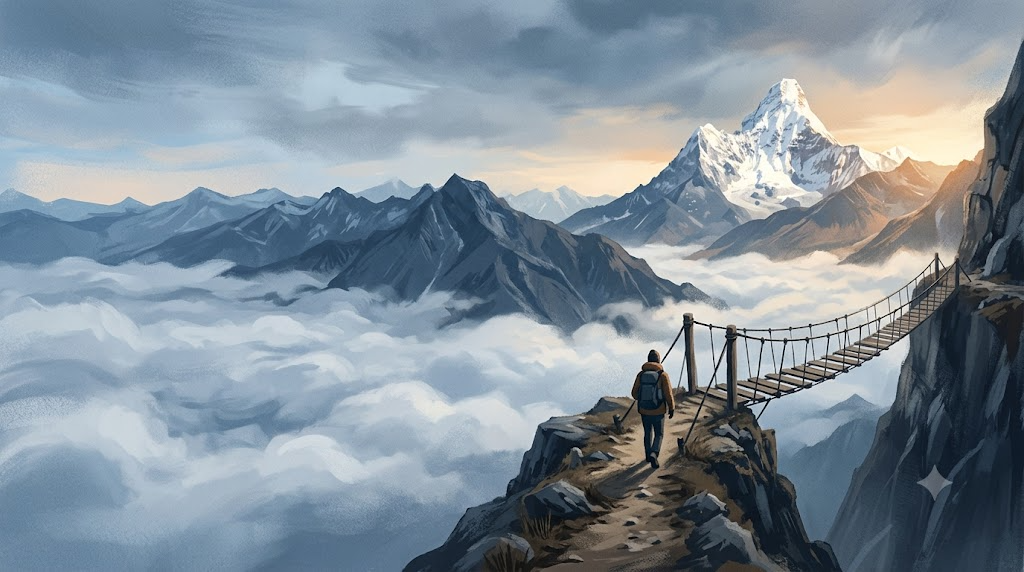
On the afternoon of the second day, he reached the foot of the mountains. He saw then that there was no easy way to the other side except by crossing them. The alternative was a twenty-five-mile trek through the desert to go around the southern end of the range. He was not prepared to enter the desert again for any reason. He would cross the mountains.
Here, he made a colossal mistake. He forgot that scaling a twelve-and-a-half-thousand-foot mountain range was no simple matter. It was as difficult as crossing the Richtersveld. More difficult, even, for there he had had Alvarez; here he was alone.
Shankar failed to grasp the gravity of the undertaking. As a result, in attempting to cross the Chimanimani range, he came to the brink of death; not even while crossing the fiercely blazing Kalahari had he faced such certain doom.
The jungle on the Chimanimani Mountains was not especially dense. Shankar climbed a good distance on the first day—and then came to a place from which there was no way forward. He could no longer find the path by which he had ascended—it seemed to him that he had drifted thirty degrees south of his starting point on the plain below. He could not for the life of him figure out why this had happened. He had no idea how he had got here; sometimes he was climbing, sometimes descending, using the sun to fix his position, but why was it taking him so long to traverse seven or eight miles of mountains?
On the third day, a new calamity struck. The day before, a loose rock had rolled down and injured his leg. It hadn’t seemed like much then, but the next morning he could not rise from his bed. His knee was swollen, and the pain was intense. In this condition, ascending and descending the treacherous paths was impossible. He had collected some water from a mountain spring on his way up; he was now rationing it, sipping a little at a time. He would have to wait here until the pain in his leg subsided. He couldn’t go far. He would have to move about a little, in search of food and water; luckily, this part of the mountain was somewhat like a plateau, which was a saving grace.
In these circumstances, on this uninhabited mountain, danger lay at every step. Any European explorer attempting to scale this peak alone might have met with the very same misfortune.
Shankar could go no further. Something was wrong with his heart; with the slightest exertion, it would begin to pound against his ribs. The inhuman strain of the journey, the constant anxiety, subsisting on inedible and foul things, at times on nothing at all—there was nothing left of his body.
On the evening of the fourth day, his body exhausted, he took shelter under a tree. He had had no food since yesterday. He had his rifle with him, but there wasn’t a single wild animal in sight. In the afternoon, the sight of a grazing deer had filled him with hope, but his rifle had been leaning against a tree fifty yards away; by the time he went to get it, the deer had fled. There was very little water left in his leather bottle. In his condition, how was he to go down to the spring to fetch water? His knee had swollen further. The pain was so great that the slightest movement sent a searing agony all the way up to the veins in his head.
Under the clear sky, the dry air allowed for a sharp view over a great distance. The horizon was ringed with the hazy blue of distant mountain ranges. To the south-west lay the vast expanse of the Kalahari. To the south, the Wahkuhku Mountains, and far beyond them, the Paul Kruger range, visible like a bank of clouds. Nothing could be seen in the direction of Salisbury; a higher peak of the Chimanimani range blocked the view.
Since noon today, a flock of vultures had been circling over his head. In all his tribulations until now, nothing had affected Shankar as much as this. But today, seeing the vultures circling overhead, he felt a genuine fear. Did they somehow know that their next meal would not be long in coming?
Sometime after evening fell, he heard a sound and looked up. Behind an adjacent boulder was a grey wolf—its long, pointed ears were pricked up, its red tongue lolling far out over its white teeth. The moment their eyes met, it darted away from the rock and fled into the distance.
Did the wolf also understand? It is said that animals can sense many things in advance.
The cold that descended with the night was bone-breaking. He gathered some twigs and lit a fire. Beyond the small circle illuminated by the fire lay a dense darkness.
Some animal came and settled itself in the darkness a short distance from the fire, its body melting into the shadows. A coyote, a creature of the wild dog family. Soon, another came, then two more, then three. As the night deepened, ten or fifteen of them had gathered. They surrounded him in the darkness, silently, with infinite patience, as if awaiting something.
What ominous sights these were!
His blood ran cold with fear. Had his death, too, truly drawn near at last?
So it had come, after all this time! He, too, had failed to escape with the diamonds from the Richtersveld!
Oh, what a fortune he possessed today! Putting the diamond mine aside, the six diamonds he had with him were surely worth at least two or three hundred thousand rupees. If only he could have returned with this money to his poor village, to his poor parents’ home… he could have wiped the tears from so many impoverished eyes, provided dowries for so many poor village girls so they could marry well, made the last days of so many helpless old men and women free from care…
But what was the use of thinking of things that were not to be? Better, then, that Shankar, like the young Italian, Gatti, should feast his eyes before death on the beauty of this extraordinary, star-lit sky, on the silent, solemn aspect of this vast mountain and desert. They were all strung together on the same invisible thread of destiny—Attilio Gatti and his companions, Jim Carter, Alvarez, he himself…
The night grew deep. The cold was terrible! He glanced over once and saw that the coyotes had, at some point, crept even closer. In the darkness, the firelight made their eyes gleam. Shankar threw a burning log at them, and they all retreated—but how silent their movements were, and how infinite their patience! It seemed to Shankar that they knew their prey was in their grasp, that there was no chance of escape.
Meanwhile, the grey wolf from the evening had also come twice, sitting in the darkness behind the coyotes to observe before leaving.
He did not dare to sleep for even a moment. Who knew, perhaps the pack of coyotes and the wolf would tear him apart alive, mistaking him for dead. In his exhausted, weary state, he had to remain sitting, awake. Even if his eyes drooped with sleep, there was no choice. From time to time, the coyotes would advance and sit, and he would throw a burning log, forcing them to retreat… A hyena or two also came and joined their ranks… How fiercely the hyenas’ eyes glowed in the dark.
What a dreadful situation he was in! On a deserted mountain in a desolate, savage land, three and a half thousand feet up, he sat, unable to move… It was deep night, pitch dark… a small fire was burning… Above his head, in the moistureless, still atmosphere, the countless stars of the sky blazed as if they were electric lights… Below, encircling him in the darkness, was a silent pack of flesh-hungry coyotes and hyenas.
But at the same time, it occurred to him that he was not dying in a Bengali village, wasting away from malaria. This was a hero’s death. He had crossed the Kalahari Desert on foot—alone. If he died, he would leave his name carved on the rocks of the Chimanimani Mountains. He was a distinguished explorer and discoverer. Hadn’t he been the one to find that great diamond mine? After Alvarez’s death, wasn’t he the one who had made his way out of the labyrinth of that vast forest and mountain range, all alone, to come this far? Now he was helpless, ill, unable to move. Yet he was still fighting; he had not given in to fear, had not lost his courage. He was no coward, no craven. Life and death are but a game of fate. If he did not survive, how was it his fault?
The long night passed, and the eastern sky began to lighten. At once, the pack of wild beasts vanished. As the day brightened, the merciless sun once again began to burn and scorch everything in every direction. At the same time, the flock of vultures appeared from nowhere. Some circled overhead, others perched on distant tree branches or rocks. They were waiting, very patiently. It was as if they were saying, “Where will you go, little one? Prance about for as many days as you have left. We’ll just sit here; we’re in no great hurry.”
Shankar had no appetite. He had no desire to eat. Nevertheless, he shot and killed a vulture. The sun had grown ferocious. One could not set foot on the fire-hot rocks. This mountain, too, was a desert; there was no food to be found here, nor water. He took the dead vulture, lit a fire, and began to roast it. He had eaten vulture meat before, in the desert. For now, they were his only means of staying alive. Today, he was eating them; tomorrow, they would eat him. The vultures had gathered overhead again.
His own shadow fell on the rock face. In that desolate place, to Shankar’s unhinged mind, the shadow seemed like another companion. Perhaps his mind was beginning to fail… for in his delirium, he found himself talking to his own shadow time and again… and time and again, in a subsequent moment of lucidity, he would realize his error and pull himself together.
Was he going mad? Or did he have a fever?… Everything in his head was becoming a jumble. Alvarez… the diamond mine… mountains, mountains, a sea of sand… Attilio Gatti… he hadn’t slept last night… night was coming again, he would try to get some sleep.
A sound tore him from his drowsiness. A strange kind of sound was coming from somewhere. It wasn’t like any familiar sound. What was it? It was impossible to tell which direction it was coming from. But it was getting progressively closer.
Suddenly, Shankar’s eyes fell upon the sky, and he stared in astonishment… right over his head, something was flying through the sky, making a tremendous noise. Was that an aeroplane? He had seen pictures of them in books.
When the aeroplane was directly overhead, Shankar screamed, waved his cloth, broke off a tree branch and waved it, but he could not attract the pilot’s attention. Before his eyes, the aeroplane disappeared over the distant, violet-hued Paul Kruger mountain range.
Perhaps more aeroplanes would pass this way. What an amazing thing an aeroplane was to see. He had not seen a single one while in India.
Shankar thought he would light a fire and add green branches and leaves to make a lot of smoke. If another one passed this way, the pilot’s attention would be drawn by the smoke. One good thing had come of it: the deafening noise of the aeroplane had scared the flock of vultures away.
The day passed. As day turned to night, Shankar’s ordeal began anew. It was a repeat of the previous night. The same pack of coyotes returned. They once again surrounded him and his fire. The wolf came for a look from a distance before dusk had even fully set. It came again, once more, in the dead of night.
How could he escape their clutches? He dared not make a sound—he had only two bullets left. If he ran out of bullets, he would die of starvation. He was going to die anyway, but it might be two days sooner or later; as long as there is breath, there is hope.
But he was forced to make a sound. Deep in the night, the hyenas arrived and emboldened the coyotes. They drew even closer, encircling him from all sides. They were no longer afraid when he threw burning logs.
Once, he felt a wave of drowsiness come over him—he had dozed off while sitting. Waking with a start the next moment, he saw that the wolf had crept out of the darkness, tip-toeing extremely close to him. He was terrified; it might pounce on his neck. In a fit of fear, he fired a shot. The same thing happened again, towards the end of the night. The coyotes’ patience was infinite; they merely sat quietly, saying nothing. But the wolf was looking for an opening.
As the sky brightened, the coyotes, hyenas, and the wolf vanished like a bad dream. At the same time, Shankar, lying by the fire, fell asleep.
A sound woke Shankar from his slumber.
A moment ago, there had been a very loud noise of some kind. The echo of it still lingered in his ears.
Had someone fired a gun? But that was impossible. What person would come to these impassable mountains?
He had only one bullet left. Relying on fate, he spent it to make a sound. Whatever would be, would be; he was as good as dead anyway. In reply, there were two gunshots.
In his joy and excitement, Shankar forgot that his leg was lame, forgot that he could not walk far without stopping. He had no more bullets—he could not fire his gun again—but he began to scream with all his might, breaking off tree branches and waving them, his eyes searching frantically all around for kindling to light a fire.
A team surveying the Kruger National Park had pitched their tents at the foot of the Chimanimani Mountains, in the north-eastern corner of the Kalahari Desert, on their way from Kimberley to Cape Town. They had with them seven motor vehicles fitted with double-tyred caterpillar wheels. Apart from the Negro porters and servants, there were nine Europeans in their party. Four of them had climbed up to the first and lowest tier of the Chimanimani range to hunt deer.
Suddenly, in this desolate, wild region, they were astonished to hear the sound of a modern rifle. But when their own answering shots received no reply, they set out to search the area and saw, on a relatively higher peak ahead, a gaunt, skeletal, hollow-eyed spectre, waving its arms and legs like a madman, trying to explain something to them. It was dressed in tattered and filthy European clothes.
They ran towards him. Shankar babbled something incoherently, which they could not properly understand. They carefully brought him down the mountain to their camp below. His belongings were also brought down. He was then put to bed.
But Shankar had to suffer greatly from this shock. From constant starvation, hardship, anxiety, and the consumption of inedible and foul food, his body had been severely damaged—that very night, he came down with a raging fever.
He fell into a deep, feverish unconsciousness—Shankar had no memory of when the motor vehicles left that place, or when they reached Salisbury. He spent fifteen days in that state in a hospital in Salisbury. Then, gradually recovering, he was discharged one morning about a month later and stood on the public road outside.
© 2026 Matribhasa Classics. Public Domain

Comments (0)
Log in to join the conversation.