Chapter Two

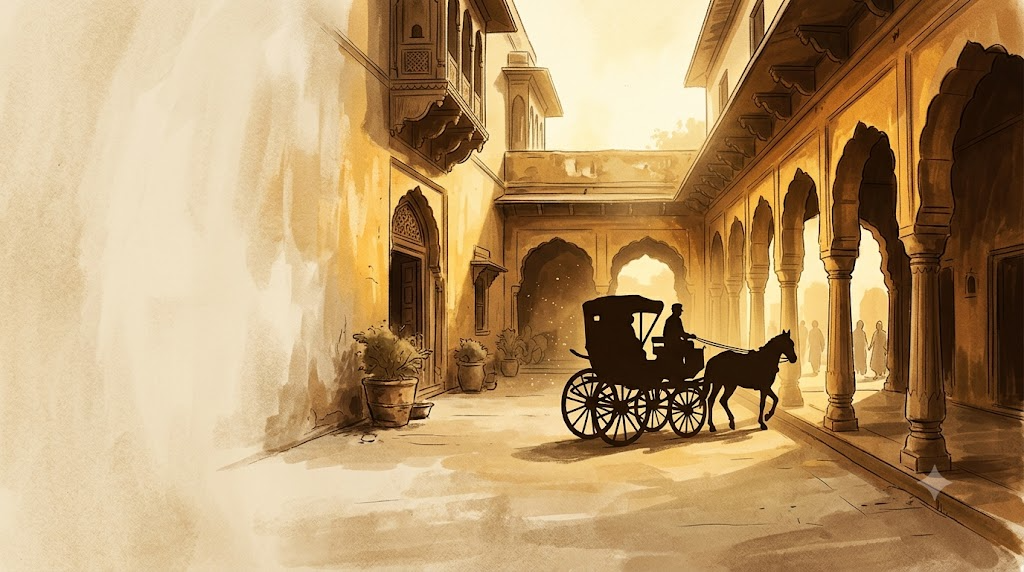
In the year eleven hundred and seventy-six, on a certain day in the season of summer, the heat of the sun lay heavy upon the village of Padachihna. The village was full of houses, yet no living soul was to be seen. In the bazaar stood rows upon rows of shops, in the market-place rows upon rows of stalls; in hamlet after hamlet, hundreds upon hundreds of mud-built dwellings, and here and there great mansions, high and low. To-day all was silent. In the bazaar the shops were shut, and of the shopkeepers there was no trace — whither they had fled, no man could say.
To-day was market-day, yet no market was held. It was the day of alms-giving, yet no beggar had come forth. The weaver had stopped his loom and lay weeping in a corner of his house; the alms-givers had withheld their alms, the pundits had closed their schools; it seemed that even the little children had lost the courage to cry. Upon the highway no man was to be seen; in the bathing-tanks no bather; only in the burning-ghat the jackal and the dog. One great mansion — its tall pillars with their carven crowns visible from afar — rose in the midst of that cavernous wilderness like the peak of some lonely mountain.
Yet what was its grandeur now? Its doors were barred, its halls bereft of human company; even to the soundless entry of the wind there was hindrance. Within its inner chamber, in the very midnoon, was darkness; and within that darkness, like a pair of night-blooming flowers, sat a husband and his wife, sunk in thought. Before them lay famine.
In the year eleven hundred and seventy-four the harvest had not been good, and consequently in eleven hundred and seventy-five rice had risen somewhat in price. The people suffered, yet the King levied his revenue to the last cowrie. Having yielded up that revenue to the last cowrie, the poor took but one meal in the day. In eleven hundred and seventy-five the rains came down well in the season of the monsoon. The folk thought, surely the gods have shown mercy. In their gladness the cowherds sang again upon the meadow, and the peasant's wife began once more to plague her husband for a silver ornament wrought in the shape of an owl.
Of a sudden, in the month of Aswin, the gods turned away their faces. Through Aswin and Kartik not so much as a drop of rain fell, the standing paddy in the fields withered into mere straw, and what little ripened — a measure or two — the King's officers bought up to keep for the sepoys. The people had no more to eat. First they fasted one meal of the day; then they began to eat half a belly at one meal; then they began to fast two meals together. What little of the spring crop was reaped sufficed no man's mouth.
But Muhammad Reza Khan, who had the gathering of the revenue, bethought himself: "Now is the time when I shall make my own greatness." On a sudden he raised the revenue by ten rupees in the hundred.
A great wailing rose throughout Bengal.
First the people began to beg; but who was there to give alms? Then they began to fast. After that they began to fall sick. They sold their cattle, they sold their plough and yoke, they devoured the seed-grain, they sold their houses and homesteads. They sold their holdings and tenures. Then they began to sell their daughters. Then they began to sell their sons. Then they began to sell their wives. After that — daughter, son, wife — who was there to buy? There were no purchasers; every man would sell.
For want of food they began to eat the leaves of the trees; they began to eat grass, they began to eat the wild herbs. The low castes and the forest folk began to eat dog and rat and cat. Many fled away; and they that fled died of hunger in foreign lands. They that fled not, they ate what was unfit to eat, or ate not at all, and falling sick gave up the ghost.
Disease had its hour: fever, cholera, consumption, the pox. The pox above all spread mightily abroad. In house after house the people fell to the pox and died. Who was there to give water unto another, who to touch another? None tended any; none came to look upon any; when they died, none was there to bear them away. Many a comely body rotted of itself within the very mansions. Into whatsoever house the pox once entered, thence the dwellers fled in terror, leaving the sick behind.
Mahendra Sinha was a man of great wealth in Padachihna village; but to-day rich and poor were of one measure. In this time of sorrow his kinsfolk and all his men-servants and maid-servants had fallen sick and were gone — some had died, some had fled. Of that great household there remained now but his wife, himself, and one infant daughter. Of these we were speaking.
His wife Kalyani, putting away her thoughts, went herself to the cow-shed and milked the cow with her own hands. Thereafter she warmed the milk, fed it to her child, and went forth to give grass and water to the cow. When she returned, she said: "How many days can we go on thus?"
Kalyani said: "Not for very many days. So long as we can; I shall keep us going as long as I am able, and after that thou shouldst take the little one and go to the city."
Mahendra: If we are to go to the city, why should I let thee suffer thus? Come, let us go even now.
Then between the two ensued much debate and arguing.
K. If we go to the city, shall any great good come of it?
M. That place too may, for aught we know, be as empty of men, as bare of all means of saving life.
K. Going to Murshidabad, to Cossimbazar, or to Calcutta, our lives may yet be preserved. To leave this place is by every reckoning our duty.
Mahendra said: "This house is filled with wealth gathered from generation to generation through long ages; all that the thieves will plunder away."
K. If they come to plunder, shall we two be able to save it? If life itself be not preserved, who shall enjoy the wealth? Come, even now let us close the doors and depart. If we live, we shall return and enjoy it.
Mahendra asked: "Wilt thou be able to walk so long a road? The palki-bearers are all dead; if there be a bullock, there is no driver; if there be a driver, there is no bullock."
K. I shall walk the road; have thou no care for that.
In her heart Kalyani determined: "Be it so — though I fall dead upon the road, these two shall yet be saved."
On the morrow at dawn the two of them, taking some little money about their persons, locking fast the doors of the house, loosing the cattle, and taking the little daughter in her arms, set forth toward the capital. As they set out, Mahendra said: "The way is exceeding perilous. At every step robbers and plunderers roam the road; we ought not to go forth empty-handed." So saying, Mahendra returned to the house and brought out a musket, with ball and powder.
Seeing this, Kalyani said: "If thou hast bethought thyself of arms, then take thou Sukumari a while into thy arms. I too shall bring a weapon." So saying, Kalyani placed the child in Mahendra's arms and went within the house.
Mahendra said: "What weapon now wilt thou be taking?"
Kalyani came out, hiding a small phial of poison within the folds of her garment. Thinking that in days of trouble there was no telling what fate might bring, Kalyani had aforetime laid by this poison.
The month was Jaishtha; the sun was fierce; the earth was as a flame; the air itself scattered fire; the sky was as a canopy of heated copper; the dust of the road was as scattered sparks. Kalyani sweated grievously; now sitting in the shade of a babla tree, now in the shade of a date-palm, now drinking the muddy water of some dried-up pool, with sore travail she fared on the road. The little one lay in Mahendra's arms; ever and anon Mahendra fanned the child. Once they sat down to rest beneath the shade of a great tree, mantled with fragrant blossoms and clasped about with creepers and verdant foliage.
Mahendra marvelled to behold how greatly Kalyani had borne the toil of the way. Wetting his cloth, Mahendra fetched water from a neighbouring pool and sprinkled it upon Kalyani's face and his own, upon their hands and feet and brows.
Kalyani was somewhat refreshed thereby; but the two of them were sore stricken with hunger. That they might have borne — but the hunger and thirst of the little one they could not bear. Therefore they took the road again. Breasting that wave of fire, they came before evening to a wayside chati. Mahendra had hoped within himself that, reaching the chati, he would be able to set cool water to the lips of wife and child, and to give them some morsel that might preserve life. But what then?
In the chati was no human soul! Great rooms stood vacant; all the folk had fled. Mahendra cast his eye about him and said to his wife Kalyani: "Take thou courage a little, and remain here alone. If there yet be a cow in the country — Sri Krishna grant his mercy — I shall fetch milk." So saying, Mahendra took up an earthen pitcher and set forth.
Pitchers there lay in abundance.

© 2026 Matribhasa Classics. Public Domain

Comments (0)
Log in to join the conversation.