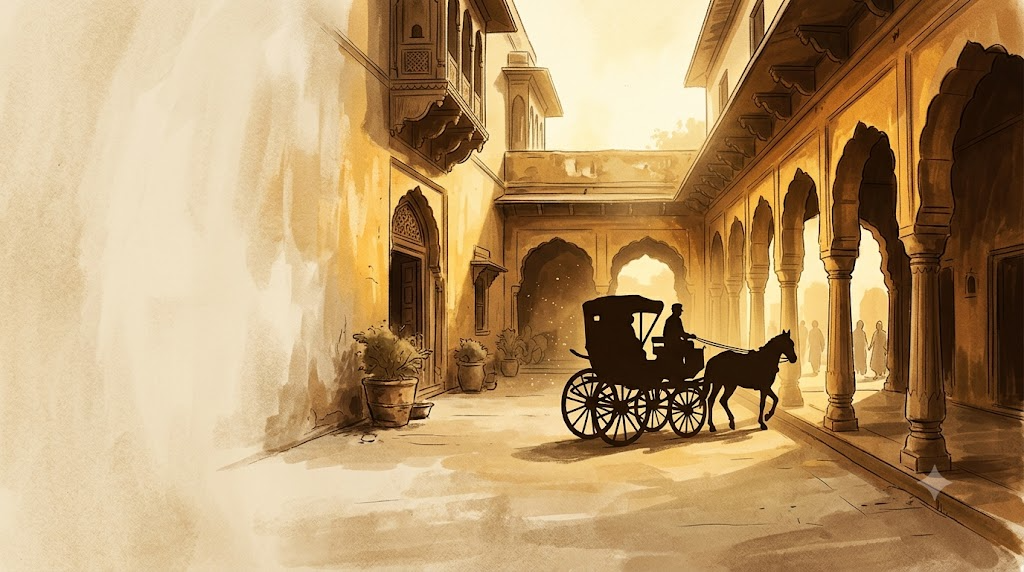
Chapter Forty Three

Northern Bengal had slipped out of the Mussulman's grasp. No Mussulman would acknowledge it — they blinded their own eyes with their own hands, and said: a few brigands were running riot, and they were being chastised. How long matters might have continued in such fashion none can say; but at this hour, by the appointment of Providence, Warren Hastings became Governor-General at Calcutta. Warren Hastings was not a man to blind his own eyes — had he been so, where today would the British dominion in India have stood? Without delay, a second commander by the name of Major Edwards was despatched with fresh troops to chastise the Children.
Edwards perceived that this was no European war. The enemy had no army, no city, no capital, no fortress, and yet all things lay under their sway. Wherever the British camp stood on a given day, that place for that day was subject to British arms — but on the morrow, when the British troops had marched on, straightway from every quarter the song of "Bande Mataram" arose.
The sahib could not discover whence these creatures issued forth like ants in the night, burning every village that had submitted to the English, or, when a small body of British soldiery fell into their hands, putting them to the sword on the instant. Pursuing his enquiries, the sahib learnt that they had built themselves a fortress at Padachihna, and there preserved their armoury and their treasury. He resolved therefore that this fortress must be reduced.
Through his spies he set about ascertaining how many of the Children were stationed at Padachihna. From the intelligence he received, he did not think it prudent to assault the fortress out of hand. Within his mind he devised a singular stratagem.
The full moon of Magh was at hand. On the bank of the river, no great way from his camp, there was to be a fair. This year the fair was to be held with extraordinary pomp. In ordinary times a lakh of people would gather at it; but this year a kingdom of the Vaishnavas had arisen, and the Vaishnavas had resolved to flock to the fair in great show. There was every likelihood, therefore, that on the day of the full moon the entire body of the Children would foregather at the fair. Major Edwards reckoned that even the wardens of Padachihna would in all probability come down to the fair. That very moment, he thought, he would fall upon Padachihna and possess himself of the fortress.
With this design, the Major caused it to be noised abroad that he meant to attack the fair. Catching all the Vaishnavas in one place, he would in one day make an end of his enemies. He would suffer no Vaishnava fair to be held.
This rumour ran from village to village. Whoever belonged to the brotherhood of the Children straightway took up arms and hastened to the defence of the fair. Every Child came down to the river bank, and on the day of the Magh full moon they were all assembled. What the Major Sahib had imagined came to pass exactly so. By the good fortune of the English, Mahendra also walked into the snare; Mahendra left but a small garrison at the fortress of Padachihna and marched out with the bulk of his troops for the fair.
Before any of this came to pass, Jibananda and Shanti had already taken their leave of Padachihna. At that hour no word of battle had yet been spoken, nor had their minds been set upon battle. Their design was rather this: that upon the full moon of Magh, that holy day, at an auspicious hour, they would yield up their lives in the sacred waters, and so make atonement for the great sin of broken vows. But as they journeyed on the road, they heard tell that a great battle was to be fought between the assembled Children at the fair and the English soldiery. Thereupon Jibananda said, "Then in battle shall we die — let us hasten!"
They pressed on apace. The road at one point ran across a hillock. Mounting upon it, the heroic pair beheld below them, at no great distance, the English camp. Shanti said, "Let our dying wait — utter thou now, 'Bande Mataram!'"
Mahendra said, "Was the venerable Bhabananda a man of faith?"
Nabinananda rolled his eyes and said, "Would Kalyani have laid hand upon Bhabananda and unfastened his tiger-skin?" Even as she spoke, Shanti seized Kalyani's hand and held it fast, suffering her not to unfasten the tiger-skin.
M. What of that?
N. Distrust me, an it please thee — but on what grounds dost thou distrust Kalyani?
At this Mahendra was sorely abashed. He said, "Why, when have I shown distrust?"
N. Else wherefore didst thou come after me into the inner chamber?
M. I had some word to say to Kalyani; for that did I come.
N. Then go thou now. I too have some word to say to Kalyani. Withdraw thee aside, and let me speak first. Thy hearth and home are thine own; thou mayest come at any hour, whereas I am scarce able to come even once, and that with much labour.
Mahendra stood like one stupefied. He could comprehend nothing of all this. These were not the words of a guilty creature. Kalyani's bearing also was passing strange. She had not fled like a faithless woman, nor was she afraid, nor abashed — nothing of the kind; rather she was smiling softly. And Kalyani — she who beneath that tree had drunk poison without a tremor — could such a one be guilty? While Mahendra was musing thus, the hapless Shanti, seeing his distress, smiled a little and cast a sidelong glance at Kalyani.
On the instant the darkness lifted from Mahendra's mind — he perceived that this was the glance of a woman. Plucking up courage, he caught hold of Nabinananda's beard and gave a sharp tug — the beard was counterfeit — beard and moustache came away in his hand. Seizing the moment, Kalyani undid the knot of the tiger-skin, and the tiger-skin too slipped off. Discovered, Shanti stood with her head bowed.
It was now noon. Thither came Jibananda and Shanti and showed themselves. Kalyani said to Shanti, "We are sold to thee for no price. Tell us tidings of our little daughter, and complete the good office thou hast done us."
Shanti looked Jibananda in the face and said, "I shall sleep. I have not so much as sat down these eight watches, nor slept these two nights — I go, my lord and master!"
Kalyani smiled faintly. Jibananda, looking towards Mahendra, said, "That charge shall rest upon me. Do thou go to Padachihna — there shalt thou find thy child."
Jibananda went to Bhairuipur to fetch the child from Nimai — the business proved no easy one.
First Nimai swallowed hard, and looked this way and that. Then her lip and her nose quivered. Then she burst into tears. Then she said, "I will not give up the child!"
Wiping her eyes with the back of her plump little hand, turning it about this way and that, Nimai listened while Jibananda said, "Why, sister, why dost thou weep? They live no such distance away — if thou wilt, thou mayest go to their house, and look in upon her now and again."
Pouting, Nimai said, "Then why dost thou not take thine own daughter thyself? What is she to me?" So saying, Nimai brought Sukumari and in vexation flung her down hard before Jibananda, then stretched out her feet and sat down to weep. Jibananda, perforce, said no more upon the matter, but went on prating of this and that. Yet Nimai's anger would not abate. Up rose Nimai and one by one came thumping down with Sukumari's bundle of clothes, her box of trinkets, her hair-string, her playthings, and cast them down before Jibananda. Sukumari herself set to gathering them up. She kept asking Nimai, "Say, mother — whither shall I go, mother?" Nimai could endure it no longer. Then, taking little Suku in her lap, she went away weeping.

© 2026 Matribhasa Classics. Public Domain

Comments (0)
Log in to join the conversation.