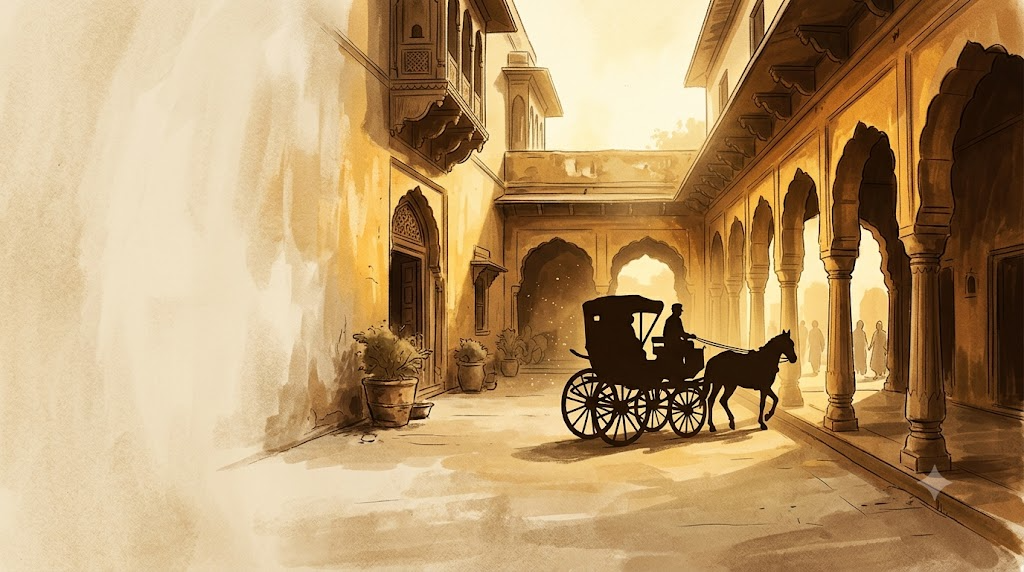
Chapter Thirty Six

"Boom, boom, boom!" Roared the English cannon.
That sound shook the great forest and echoed back, "Boom, boom, boom!" Turning from bend to bend of the river, that sound was flung back from the far rim of the sky, "Boom, boom, boom!" Entering far across the river into the interior of distant forests, that sound called yet again, "Boom, boom, boom!" Satyananda commanded, "See ye what cannon these may be." Forthwith a few of the Children mounted their steeds and galloped forth to see; but no sooner had they passed out of the forest and gone some little way, than down came a shower of balls upon them like the rain of the month of Shravan, and horse and rider, all wounded, gave up the ghost.
From afar Satyananda beheld it. He said, "Climb up a high tree and see." Even before he had spoken, Jibananda had climbed up into a tree and was looking out in the morning light; from the topmost branch he called down and said, "The cannon are the English." Satyananda asked, "Horsemen, or footmen?"
Jibananda. There are both.
Satyananda. How many?
Jibananda. I cannot reckon them; they are still coming forth from behind the forest.
Satyananda. Are there white men? Or only sepoys?
Jibananda. There are white men.
Then said Satyananda to Jibananda, "Come down from the tree."
Jibananda came down from the tree.
Satyananda said, "Ten thousand of the Children are here at hand; see what thou canst do. Thou art the captain this day." Jibananda armed himself and at a single bound leapt into the saddle.
Once he looked towards Nabinananda Goswami and with a glance of the eye said somewhat — what, none could understand. What Nabinananda answered with the like glance, that also none could comprehend; only the two of them knew within their hearts that this, perchance, was their farewell in this birth. Then Nabinananda lifted up the right arm and said unto all, "Brothers! At this hour sing 'Glory to the Lord of the Universe, O Hari!'" Then those ten thousand Children, with one voice making the river, the forest, and the sky to ring again, drowning the very voice of the cannon, with thousands upon thousands of arms uplifted, sang:
"Glory to thee, O Lord of the Universe, O Hari, For the destruction of the host of mlecchas thou dost wield thy sword!"
At this moment the rain of the English balls came down upon the host of the Children within the forest. Some, even while they sang, fell to the earth with heads riven and arms riven and hearts torn through; yet none ceased from his song, all sang on, "Glory to the Lord of the Universe, O Hari!" When the song was done, all of a sudden every voice was hushed. That dense forest, that sandy river-shore, that boundless solitude, was sunk in a deep and solemn stillness; only that most terrible thunder of cannon, and from afar the clash of the white soldiery's gathered arms and the tramp of their marching feet.
Then Satyananda, in the midst of that profound silence, said in a voice exceeding loud, "The Lord Hari of the Universe shall have mercy upon you — how far off are the cannon?"
From above one made answer, "Hard by this forest, only the breadth of a small field between!"
Satyananda said, "Who art thou?"
From above the answer came, "I am Nabinananda."
Then Satyananda said, "Ye are ten thousand Children; this day shall ye have the victory — seize ye the cannon!" Then Jibananda, the leading horseman, said, "Come!"
Those ten thousand Children — horse and foot — followed Jibananda with the utmost speed. The footmen bore their muskets upon their shoulders, swords at their girdles, spears in their hands. No sooner had they issued forth from the forest than the ceaseless rain of the balls fell and rent them in pieces. Many of the Children gave up their lives without battle and lay stretched upon the ground. One said unto Jibananda, "Jibananda, what need of so vain a slaughter of life?"
Jibananda turned and looked, and behold, it was Bhabananda. Jibananda answered, "What wouldst thou have me do?"
Bhabananda. Let us remain within the wood and from the shelter of the trees preserve our lives — in the mouth of the cannon, upon the open field, without cannon of our own, this host of the Children shall not stand the space of one danda; but lurking in the thicket, we may yet fight a long while.
Jibananda. Thou speakest truly, but the Master hath given command, the cannon must be seized; therefore must we go to seize the cannon.
Bhabananda. Who hath the power to seize cannon? Yet if we needs must go, do thou hold back, I shall go.
Jibananda. That may not be — Bhabananda! This day is my day to die.
Bhabananda. This day is my day to die.
Jibananda. I have a penance to perform.
Bhabananda. Thy body is sinless — for thee there is no penance. My heart is stained — I am the one that must die — abide thou here, I shall go.
Jibananda. Bhabananda! What thy sin may be, I know not. But if thou abide, the work of the Children shall be accomplished. I shall go.
Bhabananda was silent for a space; at last he said, "If it be needful to die, this very day shall I die; on whatever day it be needful to die, on that day shall I die; for death, what is there of season or unseason?"
Jibananda. Then come.
After this speech Bhabananda set himself at the head of all. Then in bands and in swarms the balls came pouring down, hewing the host of the Children in pieces, rending and tearing them, overthrowing them headlong; and over and above this, the musketeer-sepoys of the foe with unerring aim laid the ranks of the Children low upon the ground. At this hour Bhabananda said, "Into this wave must the Children plunge today — who can do it, brothers? At this moment sing 'Bande Mataram!'" Then with a high cry, in the strain of the Meghamallar raga, that thousand-throated host of the Children, keeping time with the cannon, sang, "Bande Mataram!"
© 2026 Matribhasa Classics. Public Domain

Comments (0)
Log in to join the conversation.