Chapter Thirty One

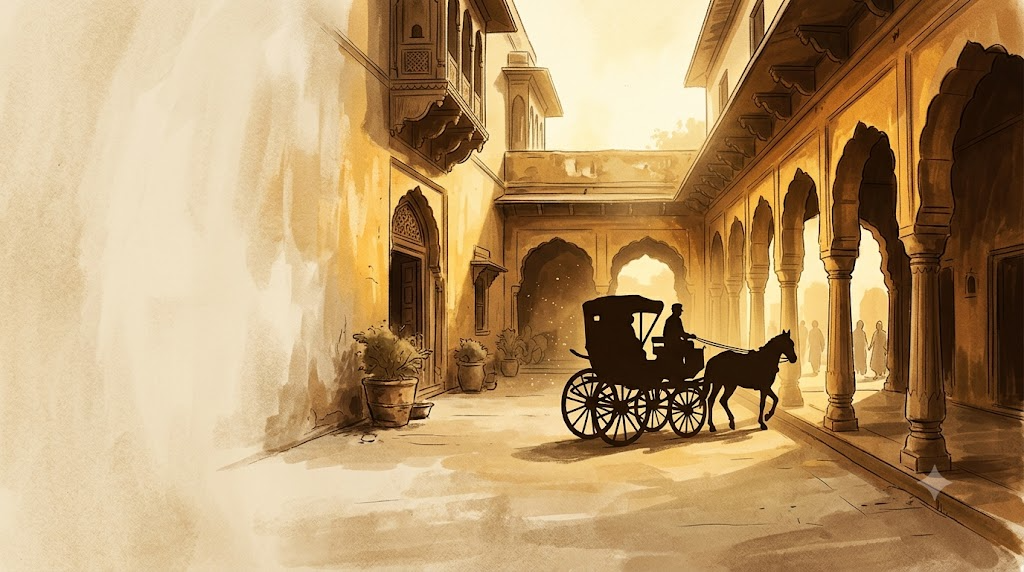
Bhabananda Goswami one day repaired into the city. Quitting the broad highway, he entered into a dark and narrow lane. On either side of the lane stood ranks of lofty mansions; the noonday sun did but peer for a moment into the alley, and thereafter darkness alone held sovereignty. Into a two-storied house upon the side of this lane Bhabananda Thakur entered. In a chamber upon the lower floor, where a woman of middle years was busied at her cookery, there did the holy Bhabananda present himself.
The woman was of middle age, stout and well-fleshed, dark of complexion, clad in a knotted cloth, her brow marked with the tattoo, and her braid of hair gathered into a coronet upon the parting of her crown. The rice-stirring stick clattered against the rim of the pot; her unruly tresses fluttered and tossed; the wench muttered and grumbled to herself; and the manifold tilts and totters of the topknot upon her head answered the workings of her countenance. At such a moment did Bhabananda the Master enter the chamber and say, "Sister Thakurun, my morning salutation to thee!"
Sister Thakurun, beholding Bhabananda, fell straightway into a flurry of confusion, putting her garments in order. Fain would she have undone the alluring topknot upon her head, but the thing might not be; for her hands were unclean from the cooking. That smooth, unguent-shining mass of hair—alas! a heron-flower had fallen upon it at the hour of worship!—this she sought to cover with the border of her sari; but the border was not equal to the task, for the dame had put on but a five-cubit cloth.
That five-cubit cloth, having first compassed the broad-girt region of her belly, was well-nigh exhausted; thereafter it had likewise to preserve some screen of modesty about the heavy-laden orb of her bosom. By the time it gained her shoulder, the border gave up its office. Mounting as far as her ear, it declared, "Further I cannot go." Whereupon the most bashful Lady Gauri held the said border close against her ear with her own hand.
And, having sworn a firm vow in her secret heart that henceforward she would purchase an eight-cubit cloth, she said, "Who is it? The Goswami Thakur? Come, come! And wherefore, dear, dost thou give me a morning salutation?"
Bhabananda: "Thou art mine elder sister, art thou not?"
Gauri: "Thou sayest it by way of fondness. Ye are Goswamis, ye are gods! Yet that thou hast said it, said it is; long live thou. And in truth thou mightest say so, for after all I am the elder in years."
Now in fact the lady Gauri Devi was some five-and-twenty years older than Bhabananda; yet the cunning Bhabananda made answer, "What sayest thou, elder sister! Beholding so winsome a soul, I call thee elder sister; else, when reckoning was made, didst thou not come out six years younger than I? Thou knowest there is every sort among us Vaishnavas. It is my secret wish to bid the abbot Brahmachari give thee in wedlock to me. To say that very word am I come."
Gauri: "What words! Fie! Are such things to be spoken? I am a widow."
Bhabananda: "Then shall there be no nuptials?"
Gauri: "Well, brother, do as thou knowest. Ye are pundits, we but women—what understand we? Tell me, when shall it be?"
With great pains restraining his laughter, Bhabananda replied, "It needs only that I once meet with that Brahmachari. And—how doth she fare?"
Gauri grew downcast. She suspected in her secret mind that the talk of the wedding had been but jest. She said, "How should she fare? As she ever fares."
Bhabananda: "Go thou and look upon her once and see how she doth, and bring me word; tell her I am come and would meet with her."
Then Gauri Devi, letting fall her stirring-stick and washing her hands, mounted by the high-stepped stairs and ascended to the upper floor. In a chamber, upon a tattered mat, sat a wondrous beauty. But over that beauty lay a heavy shadow. As at noontide upon the bosom of a brimming river, full of glad waters and great singing of waves, the shadow of a thick cloud doth lie—even such a shadow was upon her. The waves toss upon the river's heart, the blossomed trees lean upon her banks in the breeze, bow under their weight of flowers, ranks of mansions adorn her shores, fleets of boats move and stir her waters.
The noon is dark, yet under that cloud-thick blackness all her glories are cast into gloom. Even so was it with her. There were the same charming, glossy, restless, thick locks as of old; the same wide, moist, lustrous, large black eyes, yet not so full of glances, not so full of play, somewhat subdued. Upon her lips the same hue of passion, her bosom heaving the same to her breath in its ripeness, her arms holding the same softness past the reach of forest-vines. But to-day there was not that brilliance, not that brightness, not that keenness, not that sportiveness, not that savour.
Nay—if truth be told—it seemed her youth itself was no more. There remained only that beauty and that sweetness. New had come patience and gravity. Beholding her formerly, one had thought her a beauty without peer in the world of men; beholding her now, one thought her a goddess of the celestial sphere stricken with a curse. About her, two or three palm-leaf manuscripts lay open. Upon the wall hung a rosary of the holy Name, and amid these were spread bright pictures of Jagannath, Balaram and Subhadra, of the Subduing of Kaliya, of the Krishna among the Nine Maidens, of the Stealing of the Garments, of the Lifting of Govardhana, and such other sports of Braj.
Beneath the pictures was written, "A picture, or no picture?" Into this chamber Bhabananda entered.
Bhabananda enquired, "How farest thou, Kalyani? Is thy bodily health well?"
Kalyani: "Wilt thou never have done with this question? What profit canst thou take in my bodily welfare, and what profit therein for me?"
Bhabananda: "He that planteth a tree watereth it daily. He hath joy when it groweth. I planted life in thy dead body—shall I not ask whether it groweth or no?"
Kalyani: "Hath a tree of poison any decay?"
Bhabananda: "Is life then poison?"
Kalyani: "Else why did I pour out nectar to destroy it?"
Bhabananda: "Long have I had it in mind to ask, yet have I not had the courage. Who was it that made thy life poison?"
Kalyani answered steadfastly: "No one made my life poison. Life itself is poison. My life is poison, thy life is poison, the life of all men is poison."
Bhabananda: "True, Kalyani, my life is poison. From the day when—is thy grammar finished?"
Kalyani: "No."
Bhabananda: "Thy lexicon?"
Kalyani: "It pleaseth me not."
Bhabananda: "I had marked in thee some zeal for the gaining of learning. Whence now this indifference?"
Kalyani: "When even a pundit such as thou art is a great sinner, then it is well not to read and write at all. What news of my husband, my lord?"
Bhabananda: "Wherefore askest thou after that news again and again? For thee he is as one dead."
Kalyani: "I am as dead unto him; he is not so unto me."
Bhabananda: "Because thou wouldst be as one dead unto him, didst thou not die? Wherefore again and again that talk, Kalyani?"
Kalyani: "When one dies, doth kinship die also? How fareth he?"
Bhabananda: "He is well."
Kalyani: "Where is he? At Padachinha?"
Bhabananda: "There is he."
Kalyani: "What work doth he do?"
Bhabananda: "What he was doing. The fashioning of forts, the fashioning of arms. With the arms of his making thousands upon thousands of the Children are arrayed. By his good office we lack now neither cannon nor musket, neither ball nor bullet nor powder. Among the Children he is foremost. He doeth us a mighty service. He is our right arm."
Kalyani: "Had I not yielded up my life, would so much have been? Can he upon whose breast is bound a jar full of clay swim across the ocean of being? Can he run whose feet are in iron fetters? Wherefore, ascetic, didst thou keep this paltry life of mine?"
Bhabananda: "A wife is the partner of duty, the help of righteousness."
Kalyani: "In small duties. In great duties she is a thorn. By the thorn of poison I had drawn forth from him the thorn of unrighteousness. Fie! O wicked, base Brahmachari! Wherefore didst thou give back this life?"
Bhabananda: "Well, what I have given, let that be mine still. Kalyani! The life that I have given thee, canst thou give it unto me?"
Kalyani: "Hast thou any tidings of how my Sukumari doth?"
Bhabananda: "These many days I have had no news of her. Jibananda hath not gone that way for a long while."
Kalyani: "Canst thou cause those tidings to be brought to me? My husband must I forsake; but, since I yet live, wherefore shall I forsake my daughter? Even now, were Sukumari but brought to me, some happiness might be possible in this life. But wherefore wilt thou do so much for me?"
Bhabananda: "I will do it, Kalyani. I will bring thy daughter to thee. But after that?"
Kalyani: "After that, what, my lord?"
Bhabananda: "Thy husband?"
Kalyani: "Of mine own will have I forsaken him."
Bhabananda: "If his vow shall be accomplished?"
Kalyani: "Then his will I be. Doth he know that I am yet alive?"
Bhabananda: "No."
Kalyani: "Dost thou not meet with him?"
Bhabananda: "Yea, I do."
Kalyani: "And speakest naught of me?"
Bhabananda: "Nay; what kinship hath a husband with a wife who is dead?"
Kalyani: "What sayest thou?"
Bhabananda: "Thou mayest wed again; thou hast been born anew."
Kalyani: "Bring me my daughter."
Bhabananda: "I will. Thou mayest wed again."
Kalyani: "With thee, belike?"
Bhabananda: "And if it be even so?"
Kalyani: "And where then shall be the Children's vow?"
Bhabananda: "In the unfathomable waters."
Kalyani: "And the world to come?"
Bhabananda: "In the unfathomable waters."
Kalyani: "And this great vow? And this name of Bhabananda?"
Bhabananda: "In the unfathomable waters."
Kalyani: "For whose sake wilt thou drown all these in the unfathomable deep?"
Bhabananda: "For thine. Behold, be one a man, be he sage, be he siddha, be he very god, his heart is not its own master. The Children's vow is my very life; but to-day for the first time I say it—thou art dearer than life unto me. From the day I gave thee back thy life, from that day am I sold at thy feet. I knew not that such loveliness was in the world. Had I known I should ever behold such loveliness with these eyes, never would I have taken upon me the Children's vow. That vow is burnt to ashes in this fire. The vow is consumed, but life remaineth. Four years now is the life also burning, and it endureth no longer! O fire! Kalyani, the fire! the burning! But the fuel that should burn is no more. My life departeth. Four years have I endured, and now I can no more. Wilt thou be mine?"
Kalyani: "From thine own mouth have I heard that of the Children's vow this is a rule: whoso falleth into bondage of the senses, his expiation is death. Is that word true?"
Bhabananda: "That word is true."
Kalyani: "Then is thy expiation death?"
Bhabananda: "My one expiation is death."
Kalyani: "If I should fulfil thy heart's desire, wouldst thou die?"
Bhabananda: "Most surely will I die."
Kalyani: "And if I fulfil not thy heart's desire?"
Bhabananda: "Even so is death my expiation; for my heart hath become the bondsman of my senses."
Kalyani: "I will not fulfil thy heart's desire. When wilt thou die?"
Bhabananda: "In the next battle."
Kalyani: "Then take thy leave. Wilt thou send me my daughter?"
With tears in his eyes Bhabananda said, "I will send her. When I am dead, wilt thou remember me?"
Kalyani said, "I will remember thee. I will remember thee as one fallen from his vow, an unrighteous man."
Bhabananda took his leave, and Kalyani sat down to her manuscripts.

© 2026 Matribhasa Classics. Public Domain


Comments (0)
Log in to join the conversation.