Chapter Nine

Having received the Brahmachari's command, Bhabananda set forth, softly chanting the name of Hari, towards the wayside inn where Mahendra had been seated. There, he reasoned, lay the surest hope of finding Mahendra.
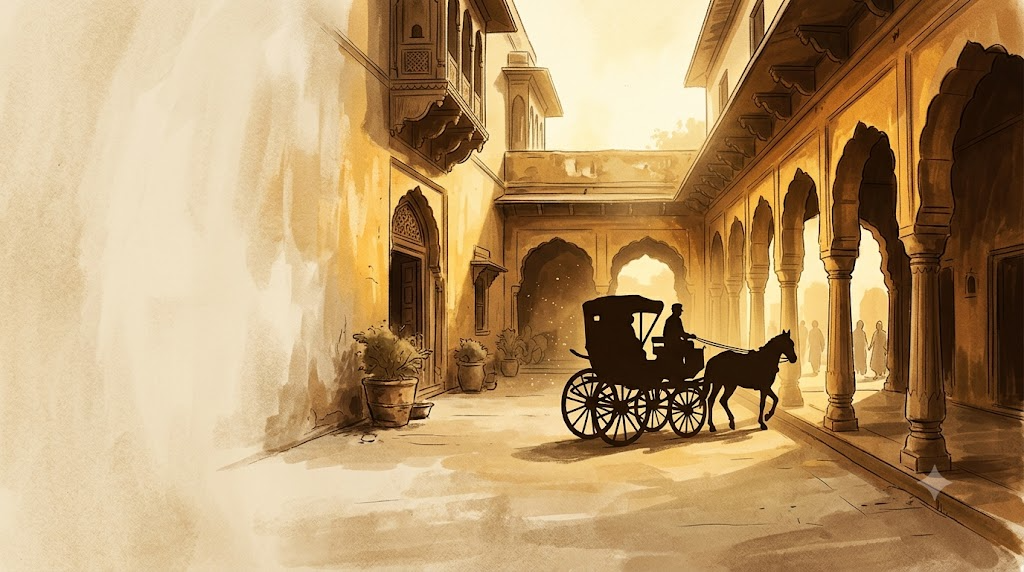
In those days the modern highways constructed by the English had not yet been laid. To come to Calcutta from the towns one was obliged to travel by those wondrous roads built by the Mussulman emperors. Mahendra also, in journeying from Padachinha to the city, had been proceeding from south to north; and it was for this reason that he had fallen in with the sepoys upon the road. Bhabananda likewise, advancing from Talpahar towards the inn, took the same southerly to northerly course.
As he went, therefore, he ere long came upon the sepoys who guarded the treasure. Like Mahendra before him, he too gave the sepoys the wayside salute. Now these soldiers were already well persuaded that the dacoits would beyond doubt attempt to plunder the consignment; and they had moreover already taken one dacoit upon the road. No sooner, then, did they behold Bhabananda also passing by at that hour of the night, than they were assured he must be another of the same brotherhood.
Forthwith the sepoys laid hold of him.
Bhabananda, with a faint smile, said, "Wherefore, my friends?"
A sepoy answered, "Thou rascal, thou art a dacoit!"
"Look upon me," said Bhabananda. "I am but a Brahmachari clad in ochre robes. Doth a dacoit wear such a garb?"
"Many a rascally Brahmachari and Sannyasi committeth dacoity." So saying, the sepoy seized Bhabananda by the neck and dragged him forward. Bhabananda's eyes flashed in that darkness, yet he uttered nothing further, only most humbly replied, "Master, command me what I must do."
The sepoy, mollified by his meekness, said, "Here, rogue, take a bundle upon thy head."
So saying, he placed a load upon Bhabananda's head. But another sepoy thereupon said, "Nay; he will make off. Bind this rascal upon the cart, in the same place where thou hast bound the other." Bhabananda's curiosity was kindled to see whom they had bound. So, casting down the bundle from his head, he dealt a smart slap upon the cheek of the sepoy who had set the load there. Whereupon the sepoys bound Bhabananda also and flung him upon the cart beside Mahendra. And Bhabananda perceived that this was Mahendra Singh.
The sepoys resumed their march, clamouring distractedly amongst themselves, and the wheels of the bullock-cart creaked and groaned as they turned. Then Bhabananda, in a voice so low that Mahendra alone could catch the words, said softly, "Mahendra Singh, I know thee; it is for thy succour that I am come hither. What I am, thou hast no present need to know. Do thou but with care perform that which I bid thee. Lay the cord that bindeth thine hands against the wheel of the cart."
Mahendra was amazed; yet without a word he did as Bhabananda directed. Moving a little in the darkness towards the wheel, he set the cord against it. By the friction of the wheel the rope was in a short space cut through. Thereafter in like manner he severed the bonds upon his feet. Being thus freed, he lay yet still upon the cart, as Bhabananda counselled. Bhabananda also in the same wise broke his own bonds. Both lay silent.
The path by which they were to journey was that same road by the jungle where the Brahmachari had stood gazing about him on every side. When the sepoys drew nigh that hill, they beheld a man standing upon a mound beneath it. His dark form was outlined against the moonlit blue of the heavens. The Havildar said, "There standeth another rascal yonder. Seize him and bring him hither. He shall bear a load." A sepoy went forward to take him.
As the sepoy approached, the man stood motionless—he stirred not. The sepoy laid hold of him; he said nothing. He was brought to the Havildar, and still he said nothing. The Havildar said, "Set a load upon his head." A sepoy did so, and the man received it upon his head.
Then the Havildar turned about and went on with the cart. At this moment a pistol-shot suddenly rang out, and the Havildar, smitten in the brow, fell to the earth and yielded up his life.
"This rascal hath slain the Havildar!" cried a sepoy, and seized the porter's hand.
There was yet a pistol in the porter's grasp. The porter cast down his burden, and reversing the pistol, smote the sepoy upon the head with it; the sepoy's skull was broken, and he was undone. At that instant, with the cry of "Hari! Hari! Hari!" two hundred armed men came rushing in and encircled the sepoys.
The sepoys then awaited the coming of their Sahib. The Sahib also, perceiving that they had been beset by dacoits, hastened to the cart and gave orders to form a square. The Englishman's drowsiness departeth in the hour of peril. Forthwith the sepoys turned about on every side and stood in square formation. Receiving a second command from their officer, they raised their muskets. But at that moment, suddenly, someone snatched the sword from the Sahib's girdle. With that sword, in one stroke, his head was severed from his shoulders.
When the Sahib fell from his horse, headless, no further order for fire was given. All beheld a man standing upon the cart, sword in hand, crying "Hari, Hari," and shouting "Strike the sepoys! Strike the sepoys!" It was Bhabananda.
Beholding their commander so suddenly beheaded, and having no one from whom to receive the word of command, the sepoys were for a space stricken with fear and rendered helpless. In this interval the gallant rebels slew or wounded many of them, and coming to the cart, seized the boxes of money. The sepoys, broken in spirit and overborne, took to flight.
Then he who had stood upon the mound, and who at the last had assumed the chief command of the fight, came to Bhabananda. They embraced, and Bhabananda said, "Brother Jibananda, fruitful hath been the vow thou didst take!"
Jibananda answered, "Bhabananda! May thy name too be fulfilled in its fruit." Jibananda then occupied himself with the disposal of the plundered treasure, and with his followers presently betook himself elsewhere. Bhabananda remained alone.
© 2026 Matribhasa Classics. Public Domain

Comments (0)
Log in to join the conversation.