Chapter Seven

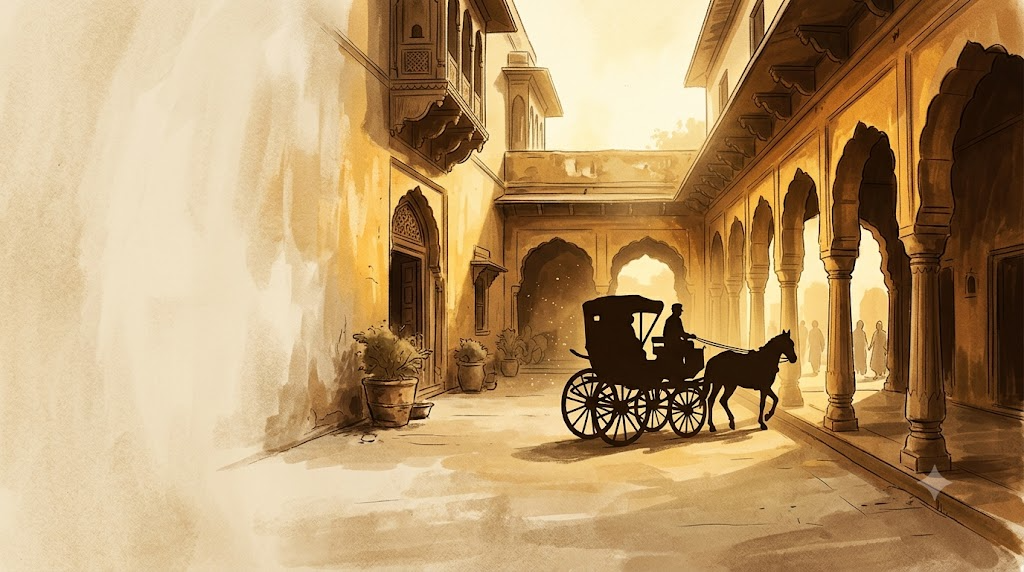
The night was far spent. The moon was overhead. It was not the full moon, and her light was not very keen. Upon a vast open plain there lay that shadowy, uncertain light, mingled with darkness. By that light one could not see from one end of the field to the other. What was upon the plain, or who, could not be seen. The field seemed endless, void of men, an abode of fear. Across that plain ran the road that leads from Murshidabad to Calcutta. By the wayside there rose a small hill.
Upon the hill grew many trees, mango and the like. The crowns of the trees, made bright by the moonlight, quivered and rustled. Their shadow lay black upon the black stone, and trembled there. The brahmachari climbed up that hill, and standing upon its summit hearkened in silence — what he hearkened for I cannot say. Even upon that seemingly boundless plain there was no sound, save only the whispering of the trees. At one place, near the hill, was a great thicket. Above was the hill, below the highway, and between them that thicket.
What sound arose therein I cannot say — but the brahmachari turned thither. He entered the dense thicket; and he saw, beneath the gloom of the trees, under the shadow of the boughs row upon row, men sitting. They were of tall stature, dark of body, and armed; and where the moonbeams fell through the breaks in the boughs, their burnished weapons gleamed. Some two hundred such men sat there — and uttered not a single word. The brahmachari, going softly in among them, made some sign — but none rose, none spake, none uttered any sound.
He passed before them all, looking upon each one in turn, scanning their faces in the gloom — as one who searches and finds not. After much searching he recognised one, and touching his body made a sign. At that sign the man arose. The brahmachari led him aside, and they stood apart. This was a young man — his moon-like countenance was veiled in a thick black moustache and beard — a person of vigorous frame and exceeding comely. He was clad in robes of ochre — and all his limbs were beautified with sandal-paste.
The brahmachari said to him, "Bhabananda, hast thou any tidings of Mahendra Singh?"
Then Bhabananda said, "Mahendra Singh, this morning, was leaving his home with his wife and child, and at the chati —"
At that point the brahmachari said, "What befell at the chati, that I know. Who did the thing?"
Bhabananda: Village peasants, I think. Nowadays the rustics of the villages, driven by hunger of belly, have turned dacoits. Who in these days is not a dacoit? We ourselves have plundered today — two maunds of rice belonging to the kotwal sahib were on the road, and we have laid hold of them and put them to the service of the Vaishnava.
The brahmachari, smiling, said, "From the hands of thieves I have rescued his wife and daughter. I have for the present lodged them in the math. Now the charge rests upon thee to seek out Mahendra and deliver his wife and child into his keeping. Were Jibananda here, the matter would be the sooner accomplished."
Bhabananda gave his assent. Then the brahmachari went his way to another quarter.
© 2026 Matribhasa Classics. Public Domain

Comments (0)
Log in to join the conversation.