Chapter Twenty Two

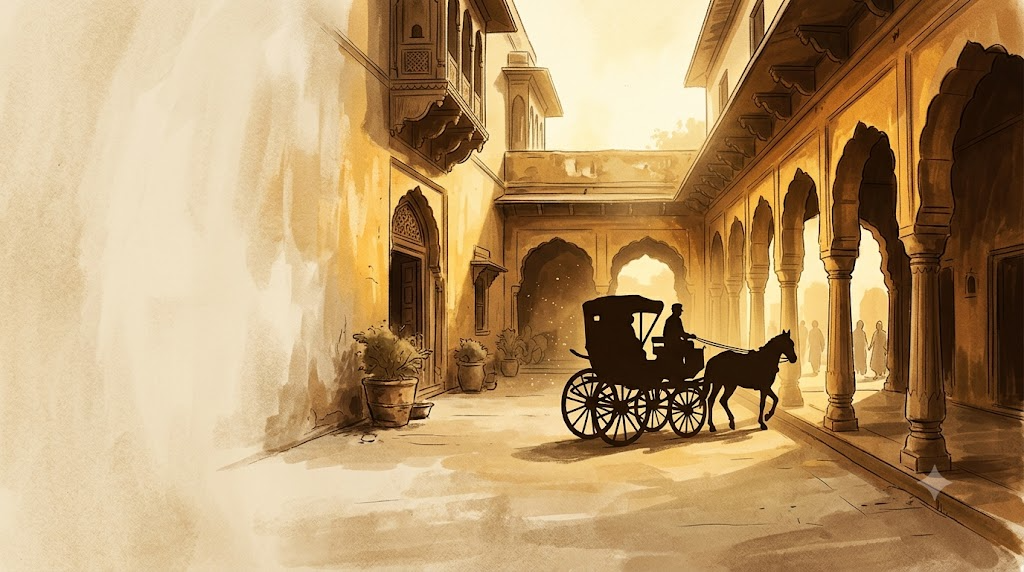
When Jagatsingh opened his eyes, he found himself lying upon a couch in a chamber of uncommon beauty. He could not recall having ever entered this room before; it was spacious and richly adorned. The floor, wrought of stone, was covered with carpets soft and pleasant to the tread; upon them stood vessels fashioned of gold, silver, and ivory, and divers other costly things. Blue curtains hung before the doorways and the windows, so that the light of day entered muted and gentle; and the chamber was filled with the soft perfume of many sweet scents.
All was still within. One handmaiden, bearing a fan sprinkled with fragrant water, waved it noiselessly over the prince; another stood at a little distance, motionless and silent as a painted figure. Beside the prince upon the ivory-inlaid couch sat a woman, who with careful hand was applying some medicament to his wounds. Upon the carpet below, a well-apparelled Pathan sat chewing betel and reading in a Persian book. Not a word was spoken; not a sound was heard.
The prince opened his eyes and looked about the chamber. He essayed to turn upon his side, but could not stir a finger's breadth; every limb was racked with pain.
The woman seated upon the couch, perceiving his endeavour, said in a voice soft and sweet as the notes of a vina: "Be still; do not disturb thyself."
The prince said in a faint voice: "Where am I?"
The same melodious voice answered: "Do not speak. Thou art in a good place. Be not anxious; do not speak."
The prince asked again, yet more faintly: "What hour is it?"
She replied in a low murmur: "Afternoon. Be still. If thou speakest, thou wilt not recover. If thou art not quiet, we shall leave thee."
The prince said with an effort: "One word more; who art thou?"
The woman answered: "Ayesha."
The prince lay still and gazed upon Ayesha's face. Had he ever seen her before? No — he was certain he had not.
Ayesha was perhaps two-and-twenty years of age. She was surpassingly beautiful; yet that beauty is not easily conveyed in a few words. Tilottama too was of rare comeliness; but Ayesha's beauty was of another order. Bimala, even in the stillness of her riper years, had possessed a radiance that fascinated all who beheld her; yet Ayesha's loveliness was unlike that also. There is a beauty in some young women like the spring jasmine — fresh-blown, modest, tender, pure, and fragrant; such was Tilottama's beauty. There is a beauty in other women like the afternoon lotus of the land — scentless, half-closed, with dry petals, yet richly adorned, more fully opened, of greater splendour, filled with honey; such was Bimala's. But Ayesha's beauty was like the water-lily in the first rays of morning — fully opened, sweet-scented, full of life and sap, bright with sunlight; neither shrinking nor withered; soft, yet radiant; light thrown back from all her open petals, yet with a smile that overflows. Good reader, hast thou ever beheld the light that beauty sheds? Peradventure not with thine own eyes, yet thou wilt have heard men speak of it. Many a fair woman is said to "illumine the ten directions" of the world. One hears of daughters-in-law who "light up the household." In Braj, and in the great battle against the demon Nishumbha, even a dark form shed its own light. In truth, thou understandest, good reader, what is meant by the radiance of beauty. Bimala shed light with her beauty — but it was like the light of a lamp: a trifle fitful, requiring oil, or it will not burn; serviceable enough for the household — keep house with it, cook the rice, spread the bedding, and it will serve; but touch it, and thou art burnt. Tilottama shed light with her beauty too — like the moonbeams of the crescent: pure, sweet, cool; but by it the household cannot be served, for it is not bright enough, and it shines from a great distance. Ayesha shed light with her beauty as well — but it was like the rays of the morning sun: brilliant and glorious, and yet, wheresoever it falls, all things smile.
As a lotus is amid a garden, so is Ayesha amid this tale; and therefore I would make her form worthy of the reader's contemplation. Were I a painter, were I able here to take up my brush, were I able to render those colours aright — were I able to paint that brow so shapely, so broad, a very arena of the god of love; were I able to trace above it the line of those softly curving tresses, clear and following the rounded form of the forehead, drawn to the ear; were I able to turn that line at the ear as she wore it — were I able to depict the hair black as silk, the parting drawn fine and straight from the brow, perfect and delicate; were I able to render the colouring of those locks, the loose knot into which they were bound; were I able to show those brows, most full and dark — how at first the two brows seemed to seek each other yet did not meet, then how they grew in breadth before reaching the middle, thickening into a bold line, and then by degrees tapering again, narrowing as they approached the line of the hair-parting, ending sharp as a needle's point — were I able to show those eyelids, trembling and soft as a dark cloud charged with lightning; were I able to trace the wide extent of those eyes, the fair curve of the upper and lower lids, that mingled hue of deep blue and dark red, those pupils deep and black as a bumble-bee — were I able to depict that nose with its proud and open nostrils, those lips full of sweetness, that neck white as stone and touched by the loosened tress, those rounded shoulders courting the pressure of her ear-ornaments, those arms soft and full adorned with jewelled bracelets, those fingers beside which the jewelled ring shone dimly, those fingers themselves, those hands soft and red as the lotus, that full and rounded bosom shaming the lustre of a pearl-necklace, the enchanting form of that somewhat tall figure — were I able to depict all this, I would yet lay down my brush untouched. The very soul of Ayesha's beauty, that jewel of the deep ocean, was her unhurried glance — slow, sweet, and gentle as a blue lotus swayed by the evening breeze. How shall I render that in words?
The prince gazed long upon Ayesha. The image of Tilottama rose in his memory. The mere thought seemed to cleave his heart asunder; the blood rushed with sudden violence through his veins; fresh blood broke anew from his deep wounds; and the prince once more lost consciousness and closed his eyes.
The beautiful woman who had sat upon the couch sprang up in alarm at once. The man who had been seated on the carpet reading his book had been raising his eyes from it from time to time to regard Ayesha with an expression of tenderness; so much so that when the young woman rose from the couch and her ear-ornaments swung and trembled, the Pathan followed their motion with unsated eyes for a long while. Ayesha rose, went quietly to the Pathan, and said to him in a low voice close to his ear: "Osman, send someone quickly for the physician."
It was none other than the fort-conqueror Osman Khan who sat upon the carpet. Hearing Ayesha's words, he rose and went out at once.
Ayesha took from a vessel on a silver tripod a little of some liquid therein, and began to sprinkle it upon the brow and face of the prince, who had again fallen insensible.
Osman Khan returned shortly, bringing the physician with him. The physician, with much care, stayed the flow of blood, and then, leaving several medicines with Ayesha, instructed her in a low voice as to how they should be administered.
Ayesha asked him in a whisper: "How do you find him?"
The physician said: "The fever is exceedingly dangerous."
As the physician took his leave and was departing, Osman followed him to the door and said to him softly: "Will he live?"
The physician answered: "It is uncertain. If he should be taken worse again, call for me."

© 2026 Matribhasa Classics. Public Domain


Comments (0)
Log in to join the conversation.