28

In truth, Apu hadn’t been asleep at all; he was awake. Lying with his eyes closed, he had heard everything his parents were saying to each other in the night. They were leaving this place, moving to Kashi. His father was telling his mother about the many advantages of living in Kashi compared to here. His father had spent a long time there when he was young; he knew everyone, had friendships with them all; they all knew him, respected him. And things were cheaper, too. His mother showed great eagerness—in that golden land, no one ever went wanting. Here, sorrow was a constant, twelve months a year; if only they had the courage to go there, all their troubles would disappear. If his mother could go today, she would; she had no desire to stay even one more day. Finally, it was decided they would leave sometime in the month of Baishakh.
Sarbajaya had a puja she had vowed to perform at the Siddheswari temple in Ganganandapur. Who was going to go all the way there—a good three kros away—just to offer a puja? For this reason, the vow had gone unfulfilled. Now, before they left the region for good, the puja had to be done, but they couldn’t find anyone to go. Apu said he would go offer the puja, and besides, his pishima lived in that village; he had never met her, and he could visit her at the same time. His mother said, “Oh, be quiet, you! As if you could go alone. It’s nearly a four-kros walk from here.”
Apu began to argue with his mother. “Am I supposed to just sit at home like this forever? Do you think I can’t go anywhere? Don’t I have eyes, ears, and feet?”
“He has everything, he does. And now he’s going all alone to Ganganandapur—such a brave hero!”
In the end, however, Apu’s relentless pleading forced them to send him.
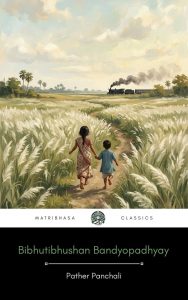
The high earthen path cut through the heart of the Sonadanga fields. On both sides of the path, the fields were filled with nothing but forests of akanda flowers, their long, whitish stalks, heavy with blossoms, bent down to lie upon the durba grass. There was no one on the path; it was not long before noon, and the shadows of the trees and plants were growing shorter. The sandy soil felt warm against Apu’s bare feet—a pleasant sensation. All sorts of flowers bloomed in the wild bushes along the path. The newly opened blossoms of the shaibabla trees had turned their faces to the sun. On a small plant of some kind, red fruits, like wild figs, had ripened in profusion, their colour a brilliant crimson. A sun-scorched, earthy smell rose from the ground. Every now and then, he would bend down and search through the bushes for boinchi berries, stuffing them into the two pockets of the red satin shirt he had sewn himself.
As he walked, his heart filled with delight. He could never tell anyone how much he loved this fresh, sun-scorched smell of the earth, this shade-filled durba grass, the sun-drenched fields, paths, trees, birds, wild bushes, the swaying clusters of flowers and fruits—the alkushi, the bankalmi, the blue aparajita. He had no desire to stay indoors; it would be wonderful if his father were to say to him, “Khoka, just roam the paths wherever you please.” Then he would walk and walk, just like this, along this very earthen path, keeping his eyes on the distant forest where the doves cooed, under the shady canopy of a thicket hung with wild flowers—just walk and walk. Perhaps there would be the rustling, shur-shur sound of bamboo branches in a grove, the afternoon sun scattering gold and vermilion, and the songs of birds of many colours.
Apu’s childhood was passing in this intimate contact with nature. One season would pass and another would fall—its tidings announced by the trees, the sky, the air, the calls of birds. His consciousness had awakened to the ever-changing forms of the Ichamati from season to season—he had come to recognise well what changes each season brought to the trees, the water, the land, the sky, the flowers, the fruits. He loved this close bond with them; he could not imagine life without them. It was with this vast, wondrous picture before his eyes that he was growing up. The solemn, beautiful spectacle of dark blue clouds massing across the whole horizon at the end of the searing heat and oppressive humidity of summer; the play of clouds of so many colours in the sky above Sonadanga at twilight; the far-stretching riverbanks at Madhabpur, covered in blooming kash flowers at the end of Bhadra; the underside of a bamboo grove on a moonlit night, checkered with patterns of moonlight—their magnificent, immense beauty had left a permanent mark on Apu’s budding adolescent mind, a mind full of fresh eagerness and purity. It had opened his eyes to the taste of beauty, had whispered in his ear, in secret, the sacred mantra of ambrosia. Apu would never forget this lesson in his life. Unbeknownst to him, open-hearted nature was slowly making him take the vow of a lifelong worshipper of beauty.
Some people were fishing in the oxbow lake at Natidanga. He stood for a while and watched. In the village, a blind beggar was playing an ektara and singing for alms. Apu knew that song—he had sung it so many times—
The moon rises at midday, The night is hard to pass away…
Bostom Dadu sang that song very well.
Entering Harishpur, he saw a small, thatched-roof pathshala by the roadside, where boys were chanting their multiplication tables. He stopped to listen. The gurumashai was not old, much younger than Prasanna Gurumashai from his own village.
And another thought kept coming to his mind. He was grown up now, not little anymore. If he were still little, would his mother have let him go anywhere alone? Now it was just walking, just moving forward. Besides, on this very day next month, how far away they would be, where would they have gone! Where was that Kashi—over there!
He reached Ganganandapur in the afternoon. As soon as he entered the neighbourhood, he was overcome by such a wave of shyness from who knows where that he couldn’t look anywhere. With great difficulty, keeping his eyes fixed on the path ahead, he somehow managed to walk on. It felt as if everyone was staring at him. As if they all knew he was coming today; perhaps they were saying to themselves, “There he is, look, look at him.” He felt they even knew that he was carrying narikel-naru tied in a bundle. He couldn’t even bring himself to ask anyone which way his pishemashai, Kunja Chakrabarti’s house was.
At last, finding an old woman by herself, he asked her, and she showed him the house. The front of the house was enclosed by a wall. Entering the courtyard, he found no one. He coughed once or twice, but how could he possibly get a word out of his mouth? There’s no telling how long he would have stood there in the outer courtyard under the harsh Chaitra sun, but a little later, a dark-complexioned girl of about eighteen or nineteen came out on some errand and, stepping onto the verandah, saw an unfamiliar, handsome boy standing shyly by the door with a bundle in his hand. The girl asked in surprise, “Who are you, khoka? Where have you come from?” Apu, like an amateur, stepped forward and, with great effort, managed to say, “My home—is in Nischindipur, my name is A-Apu.”
He was thinking it would have been better if he hadn’t come! Perhaps his pishima would be annoyed by his unexpected arrival; perhaps she would think, “Where has this new trouble come from?” And besides—who knew beforehand that talking to people in an unfamiliar place was such a difficult thing to do? His forehead broke out in a sweat.
But the girl immediately ran to him, took his hand, and with great affection, led him up to the verandah. She asked how his mother and father were. She touched his chin and said many affectionate things. Although she had never seen his Didi, she spoke of her by name and expressed great sorrow. With her own hands, she took off his shirt, washed his hands and face, wiped them with a dry gamchha, and quickly made him a glass of sugar sherbet. She was not what he had imagined a pisi to be; she was young, just a little older than Raji’s Didi.
His pishima, too, was looking at him, studying him. Perhaps she hadn’t known before that her kinsman’s nephew was so handsome, or that he was so young. So when a neighbour from the next house came over and asked who Apu was, she said with a touch of pride, “My nephew, from Nischindipur. My cousin’s son. He’s very close in relation, but we don’t visit each other, you see!” Then she looked at Apu again with pride in her eyes. The feeling was: “Look at my nephew, handsome as a prince. Now you see what kind of—what family of a girl I am…”
That evening, Kunja Chakrabarti came home. He had a tough, rugged look, his face streaked with grey. His age was impossible to guess. If he had felt shy before his pishima, he was afraid of his pishemashai. He looked just like the Prasanna Gurumashai he had studied with in his childhood. It seemed as if this man might say at any moment, “You seem like a very forward boy, don’t you?”
The next morning, Apu got up and wandered around the neighbourhood paths. The area was full of jungle; there was hardly any open land or durba grass, such was the density of the jungle. Here was a house, and then you had to follow a narrow track through the forest to get to another house far away. Often the path went right through people’s courtyards. He saw two or four boys of his own age playing, but they all stared at him so wide-eyed that, far from trying to talk to them, he couldn’t even look them in the face.
Returning to his pishima’s house was also a problem. At this time in the morning, at home, his mother would give him chira, muri, naru, or leftover rice. What would they give him here? Last night at dinner, they had bought and given him sandesh with his milk. If he went back now, they might think he was a glutton, that he had returned so early out of greed for food. Is it good to eat all the time? What should he do now? No, he wouldn’t go back to the house. He would wander the paths a little longer and go back just before lunchtime. But where could he stand on the road for so long in an unfamiliar place?
He ended up walking back to the house after all.
A girl of six or seven, holding a kansa bowl, entered the house and called out from the courtyard, “Jethima, have you cooked any bottle gourd? Will you give me some?” Apu’s pishima said from inside the room, “Who is it, Gulki? No, I’ll cook it in the afternoon, come and get some then…” Gulki put down her bowl and stood by the edge of the verandah. Her hair was tousled and shaggy, short like a boy’s. She wore a dirty dress, there was no oil in her hair, and her complexion was dark. Looking at Apu, for some reason, she giggled and then picked up her bowl and left.
Apu asked, “Whose daughter is she, Pishima?”
His pishima said, “Who, Gulki? Her family’s not from here—she has no mother or father anywhere. Nibaran Mukherji’s wife—the house right next door, she’s her distant jethi—that’s where she stays.”
The next day, a boy from the neighbourhood came up to him and made friends on his own initiative, and took him around to show him all the parts of the village. On the way back home, he saw her—that orphan girl, Gulki, sitting alone by the side of the path with her legs stretched out, eating something. Seeing him, she quickly tried to gather her anchal—it was full of half-ripe bakul flowers. Apu had, in the meantime, learned more about her from his pishima; Nibaran Mukherji’s wife didn’t treat her well, she wasn’t a good person. Pishima had said, “She’s not a jethi, she’s a raging demon. Many days she doesn’t even give her food; she goes from house to house begging for meals. She has seven mouths of her own to feed—they don’t get enough, and on top of that, an outsider!…” Apu didn’t feel shy at all with Gulki—just a tiny little girl, with no one, ah! Apu felt a great desire to make friends with her. He went closer and said, “What are you hiding in your anchal, let me see, khuki?” Gulki suddenly clutched her anchal, giggled, bent down, and ran. Her antics made Apu laugh. As Gulki ran, the bakul fruits from her anchal scattered on the ground; he started picking them up, saying, “They’re falling, they’re all falling! Take your bakul, O khuki, I won’t say anything, O khuki!” But by then, Gulki had vanished.
After bathing in the pond, he was sitting down when he saw Gulki peeking out from behind the back door, then hiding her face again. When their eyes met, Gulki giggled. Apu stood up and said, “Wait, I’m going to catch you in one run—” and he ran towards the back door. Gulki, without looking back, ran straight down the path towards the pond. But how could she outrun Apu? Seeing it was hopeless, she stopped, and Apu grabbed her shaggy hair in his fist and said, “You were running so fast, weren’t you? Do you think you can outrun me, khuki?” At first, Gulki had been afraid he might hit her. But when Apu let go of her hair and laughed, she understood it was a game. She laughed in the same way.
Apu felt a great pity for her. There was a hint in her smile that made him think she wanted to be friends with him—wanted to play with him; but being a child and not knowing how to talk, she expressed her wish by peeking, giggling, running, and fleeing. She knew no other way. She was just like his Didi! At this age, Didi was just like this—she would wander about on her own, with her anchal full of kul, bel, and boinchi berries, no one understanding her, no one seeing her, just as much of a glutton, just as much of a witless little girl!
Apu thought, “No one plays with her, let me play with her for a while. Ah, a poor, motherless, fatherless girl, wandering about on her own!” He let go of Gulki’s hair and took her hand, saying, “Will you play, khuki? Let’s go to the bank of that pond. No, do this, khuki, I’ll chase you—and you’ll run; that jackfruit tree will be the base. Come on—”
As soon as he let go, Gulki, without stopping, bent down and ran again. Apu shouted, “Alright, go on, let’s see how far you can go—I’ll definitely catch you, you’ll see. Alright, you’ve gone that far, now watch this—” and holding his breath, he sprinted—chuuuuu. Gulki looked back and, seeing Apu running, tried to run as fast as her little strength would allow—but Apu caught her after running only a short distance. “You’ve learned to run very well, haven’t you, khuki? But can you beat me? Come, will you play thief-and-guard—you be the thief—steal this jackfruit leaf and run away, understand? And I’ll be the guard and catch you.”
Gulki couldn’t stop smiling—perhaps she had been secretly wanting to make friends with this handsome boy all this time. She nodded her head and said in a reassuring tone, “Will you take some kanibichi?” Apu thought to himself that she had learned to talk like this from living in a village of peasants—just like the children of the goala or sadgop castes in his own village.
At midday, when his pishima called him, Gulki followed behind. After Apu had finished eating, his pishima asked, “Will you have some rice, Gulki? Sit down at Apu’s place—there’s some mochar ghonto—I’m giving you some dal.” Apu thought, “Ah, if I had known she was going to eat, I would have saved two pieces of fish for her.” Gulki, without a second thought, shamelessly sat down to eat. She asked for a large helping of rice, mixed it with dal, and then, after sitting for a long time, unable to eat all that rice, she pushed a large pile of it to the side of her plate. Still, she didn’t get up. Apu’s pishima laughed and said, “You don’t need to eat any more, Gulki, you’re panting—get up now, look how much rice you took! You only have an appetite with your eyes.” Then she said, “Look at her jethi’s doings—it’s so late in the day, the girl is just a child—doesn’t she even call her to eat? So what if she’s an outsider—she’s still a child, isn’t she?…”
On Saturday, Apu went to the Siddheswari temple to offer his puja. The acharya thakur had a very long white beard that fell upon his chest; he had a fine appearance. His widowed daughter would come with her father, prepare the offerings, and help him a great deal. The girl said, “Why only four paisa for the dakshina, khoka? That won’t do. For a special Saturday puja, you need two annas for the dakshina.” Apu said, “My mother only gave me four paisa, I don’t have any more.” The girl selected some bananas and radishes, wrapped them in a leaf, and gave them to him, saying, “The thakur’s prasad is in here, and I’ve also put in some bel leaves and sindur. Give them to the women of your house.” Apu thought, “These are nice people. If I had more money, I would have given another two paisa.”
Returning to his pishima’s house, he was sitting on the outer verandah in the moonlight, telling his pishima about the puja, when suddenly Gulki’s thin, sky-shattering scream was heard from the house next door. “Oh, Jethi, don’t hit me like that—oh, Baba re, oh Jethi, my back is cut and bleeding—don’t hit me, Jethi—” Along with this, a harsh voice was heard shouting, “You shameless good-for-nothing! You went to the Chaudhuri’s house for a feast, is your greed so great? If I don’t brand your greedy tongue with a hot ladle today—you go around eating at people’s houses, and those who have lost their hundred relatives turn a blind eye and say I don’t feed you—a plague and a pest from who knows where—don’t I feed you at home? Today, I’ll—”
Apu’s pishima said, “Do you see? She’s speaking with all these digs and insinuations. If you tell the truth, you can’t stay friends with people—then you become the bad one.”
Apu’s heart was churning. His throat was choked with tears, and he couldn’t get a word out.
The next day, a little before evening, after finishing his meal, Apu set off towards the goala neighbourhood. The day before, his pishemashai had arranged for him to get a ride on a cart loaded with tobacco going from this village to Nababganj. If he left in the evening, they would drop him off on the road to Nischindipur in the morning.
A little way down the road, at the corner of the Brahmin neighbourhood, he met Gulki. She was returning home after playing in the evening. Apu said, “I’m going home today, khuki. Where were you all day? You didn’t come to play or anything.” Then, seeing Gulki smile in disbelief, he said, “It’s true, I’m telling you the truth. Look, here’s my bundle. I’m going to Kartik Goala’s house to get on the cart. Won’t you come with me and see me off for a little way?”
Gulti followed him for a long way. They left the Brahminpara, and a stretch of open field began. Beyond it lay the Goalapara, the milkmen’s quarter. Gulti came as far as the edge of the field. Pointing to Apu’s red satin shirt, she asked, “How much was that red shirt of yours?”
Apu smiled. “Two rupees,” he said. “Want it?” Gulti gave a little titter of a laugh. As if to say: If you were to give it to me, I’d take it this very second…
Suddenly, as his gaze fell upon the path ahead, Apu saw that at the far end of the field, through the gaps in the trees, the world was growing luminous—and just like that, the thought struck him that on this very day next month, they would be somewhere far, far away. He turned to Gulti. “Don’t come any farther, Khuki, you go back now. You’ve come a long way—they might scold you at home. Go on, Khuki. We’ll see each other if I come again, all right? But maybe I won’t. We’re going to Kashi in the month of Baisakh, to live there.” Gulti gave another little titter of a laugh.
It was a tithi of either the full moon, Purnima, or the fourteenth lunar day, Chaturdashi. He had never come this way before, but an image from this, his first solitary childhood journey into an unfamiliar world, would remain with him for a very long time: a straight path across the field, and at its farthest end, rising through a break in the trees, the full moon (or the moon of the fourteenth day; he could never recall precisely). And following behind him, a little girl he had only recently come to know—an orphan, uncomprehending, her hair a tangled shock—who had come to see him on his way.
© 2026 Matribhasa Classics. Public Domain
Comments (0)
Log in to join the conversation.