
4

The months of Baishakh and Jyaishtha passed, giving way to Asharh. The first event in Asharh was the punyah festival at the estate office. Since I rarely saw a human face in this place, I had a fancy to invite and feed a great many people on the day of the punyah. As there were no villages nearby, we sent Ganori Tewari to invite people from the distant settlements. From the day before the punyah, the sky had been overcast and a light drizzle had begun to fall; on the day of the festival itself, the heavens broke. Meanwhile, no sooner had noon arrived than people in droves, tempted by the invitation to the feast, began to arrive at the estate office, ignoring the torrential rain, creating such a predicament that it was impossible to find a place for them to sit. Many women had come to eat, bringing their children with them; I arranged for them to sit in the records room of the office, while the men took shelter wherever they could.
There is no great fuss about feeding people in this part of the country; I had no idea a place could be this poor. However poor Bengal might be, even its poor are far better off than the common folk of this region. These people had come to eat, braving a downpour, for a meal of cheena grass seeds, sour yogurt, chunks of veli gur, and laddus. For this is what constitutes a common feast here.
An unfamiliar boy of ten or twelve had been working very hard since morning—a poor boy, named Bishua, who must have come from one of the distant settlements. At about ten o’clock, he asked for a little something to eat. The storeroom was the responsibility of the Lobtulia patwari, who brought him a small basketful of cheena seeds and a little salt.
I was standing nearby. The boy was jet-black, with a handsome face, like a stone image of Krishna. When he eagerly spread out a corner of his grimy, coarse, eight-cubit-long American cotton cloth to receive that trivial snack, the smile of sheer joy on his face was a sight to behold! I can say with certainty that no Bengali boy, however poor, would ever eat cheena seeds, let alone be happy about it. For having once tried them out of curiosity, the taste I experienced was such that I could never refer to them as a savoury delicacy.
Somehow or other, the feeding of the Brahmins was concluded amidst the rain. Towards afternoon, I saw three women sitting on leaf-plates laid out in the courtyard, getting utterly drenched—two small children were with them as well. They had cheena seeds on their plates, but no one had served them any yogurt or veli gur; they were staring expectantly towards the office building. I called the patwari and said, ‘Who is serving these women? Why are they just sitting there? And who on earth made them sit in the courtyard in this rain?’
The patwari said, ‘Huzoor, they are Dosadhs by caste. If we let them onto the veranda, all the food in the house will have to be thrown away; no Brahmin, Chhatri, or Gangota will eat it. And besides, where is the space, tell me?’
When I went and stood before those poor Dosadh women, getting soaked in the rain myself, the men bustled about and began to serve them. The quantity of simple cheena seeds, gur, and watery sour yogurt that each of them ate was something one would not believe without seeing it with one’s own eyes. Seeing such eagerness for this ‘feast,’ I decided that one day I would invite these Dosadh women and feed them a proper, civilised meal. About a week later, I had the patwari invite the women from the Dosadh quarter and their children, and what they ate that day—luchis, fish, meat, khir, yogurt, payesh, chutney—was a feast they had never even imagined eating in their lives. The astonished, joyous smiles on their faces remained in my memory for a long time. That vagrant Gangota boy, Bishua, was also in that group.
One day, I was returning on horseback from the survey camp when I saw a man in the forest, sitting beside a clump of kash grass, mixing up and eating sattu made from ground pulses. For want of a vessel, he was mixing the sattu on a corner of his grimy cloth—such a huge lump that how one person, even a Hindustani, for he was a man after all, could eat so much of it was beyond my comprehension. Seeing me, the man respectfully stopped eating, stood up, and saluted. ‘Manager Sahib,’ he said. ‘I’m having a little snack, Huzoor, please forgive me.’
A man was sitting alone in a quiet spot, peacefully eating his snack; I could find nothing in this to forgive. ‘Eat, eat, you don’t have to get up,’ I said. ‘What is your name?’
The man had still not sat down. Remaining standing, he said respectfully, ‘This poor man’s name is Dhaotal Sahu, Huzoor.’
Looking at him, I guessed his age to be over sixty. He was thin and tall, with dark skin, and was wearing an extremely grimy dhoti and a merjai, with bare feet.
This was my first acquaintance with Dhaotal Sahu.
Back at the estate office, I asked Ramjot Patwari, ‘Do you know Dhaotal Sahu?’
Ramjot said, ‘Ji, Huzoor. Who in this region doesn’t know Dhaotal Sahu? He is a huge moneylender, a lakhpati, a millionaire. Everyone around here is his debtor. His home is in Naugachhia.’ I was astounded to hear the patwari’s words. A millionaire, sitting in the forest, eating a lump of plain pulse-sattu off a corner of his dirty shoulder-cloth—it was a scene extremely difficult to imagine, at least in connection with any Bengali millionaire. I thought the patwari must be exaggerating, but whomever I asked at the office said the same thing. Dhaotal Sahu? His money is beyond counting.
After this, Dhaotal Sahu came to see me at the office many times on his own business. As our acquaintance deepened with each visit, I realised that I had come to know a most peculiar, otherworldly character. It is hard to believe, without seeing for oneself, that such a person could exist in the twentieth century.
Dhaotal’s age was, as I had guessed, about sixty-three or sixty-four. His home was in a village called Naugachhia, twelve or thirteen miles from the edge of the jungle to the south-east of the estate office. In this region, nearly everyone—tenants, landholders, zamindars, businessmen—was in debt to Dhaotal Sahu. The strange thing about him, however, was that after lending money, he could never bring himself to chase anyone for it forcefully. The number of people who had cheated him out of his money was immense! A man so gentle and good-natured should never have become a moneylender, but he could not refuse a request. He would say, moreover, that since everyone was willing to sign for a high rate of interest, it was only right to lend the money, from a business perspective. One day, Dhaotal came to see me, carrying a bundle of old deeds and documents tied up in his shoulder-cloth. ‘Huzoor,’ he said, ‘would you be so kind as to look at these documents?’
On examining them, I found that deeds worth nearly eight to ten thousand rupees had become time-barred because lawsuits had not been filed in time.
Untying another corner of his shoulder-cloth, he took out some more dilapidated papers and said, ‘Take a look at these too, Huzoor! I think of going to the district town to show them to the lawyers, but I’ve never filed a suit, it’s not worth the trouble. I send reminders, but many people just say “I’ll pay, I’ll pay” and never do.’
I saw that these too were all time-barred deeds. All told, they amounted to another four or five thousand rupees. Everyone cheats a good man. I said, ‘Sahuji, moneylending is not the work for you. In this region, moneylending is for formidable men like Rasbihari Singh Rajput, who have seven or eight club-wielding toughs, who ride out to a debtor’s field, post their men there, and collect the principal and interest by seizing the harvest. No one will repay a good man like you. Don’t lend to anyone else.’
I could not make Dhaotal understand. He said, ‘Not everyone cheats, Huzoor. The sun and moon still rise, and the Master of this world and the next is still above us. Money cannot be left to sit idle; it must be made to grow with interest, Huzoor. That is our business.’
I could not comprehend his logic; what sort of business it was to let the principal be lost for the sake of interest, I did not know. Right in front of me, Dhaotal Sahu unflinchingly tore up fifteen or sixteen thousand rupees’ worth of time-barred deeds—tore them as if they were scraps of waste paper, which, of course, they had now become. His hand did not tremble, nor did the tone of his voice.
‘I made that money by selling mustard and castor seeds, Huzoor,’ he said. ‘I earned it, and I am the one taking the loss. In business, there will always be profit and loss, Huzoor.’
There will, I admit, but I was thinking of how few people could bear such a great loss so calmly, so indifferently. I saw his pride in his wealth in only one thing: from time to time, he would take a small nutcracker and an areca nut from a red cloth pouch, cut the nut, and pop a piece into his mouth. He once looked at me with a smile and said, ‘I eat one whole areca nut every day, Babuji. My areca nut expenses are very high.’ If indifference to wealth and the ability to treat a great loss with disdain is what makes a philosopher, then I, for one, have never seen a philosopher like Dhaotal Sahu.
Whenever I passed through Phulkia, I would always go by Jaypal Kumar’s little cottage, thatched with maize leaves. Kumar here does not mean a potter, but a Bhumihar Brahmin.
Jaypal’s cottage stood right under a very large, ancient pakur tree. He was completely alone in the world, and old, with a tall, thin frame and long white hair. Whenever I went there, I would see him sitting silently at the door of his hut. Jaypal did not smoke tobacco; I don’t recall ever seeing him do any work, nor have I heard him sing—how a person can sit so still and silent, in a state of complete inaction, I do not know. I would feel a great sense of wonder and curiosity upon seeing Jaypal. Every time, I would have to stop my horse in front of his cottage and exchange a few words with him.
I would ask, ‘Jaypal, what are you doing, just sitting there?’
‘Just this, Huzoor. Sitting.’
‘How old are you?’
‘I haven’t kept count, but the year the bridge was built over the Kushi river, I was old enough to graze buffaloes.’
‘Were you married? Did you have children?’
‘My wife died twenty, twenty-five years ago. I had two daughters, they died too. That was thirteen or fourteen years ago. Now I am alone.’
‘Tell me, living here all alone, not talking to anyone, not going anywhere, not doing anything—is it good? Doesn’t it get monotonous?’
Jaypal would look at me in surprise and say, ‘Why should it feel bad, Huzoor? I am quite content. Nothing feels bad at all.’
This was something about Jaypal I could never understand. I am a man educated in a Calcutta college; I cannot understand how a person can exist without either work, or chatting with friends, or books, or cinema, or travel. I would reflect on how much the world had changed, and how little Jaypal Kumar, sitting steadfastly at his door for the last twenty years, knew of it. When I was a boy in the lower classes of school, Jaypal sat just like this; when I passed my B.A., he was still sitting just like this. I would think of the past days of his eventless, solitary life in comparison with the events of my own life, great and small, which were to me objects of the greatest wonder.
Although Jaypal’s cottage was in the very middle of the village, it was surrounded by a good deal of fallow land and maize fields, so there were no other homes nearby. Phulkia was a tiny village, home to ten or fifteen families, who all made their living by grazing buffaloes in the vast surrounding jungle. They toiled like ghosts all day, and in the evening they would light a fire of pulse husks, and the whole neighbourhood would sit around it, gossiping, chewing khaini, or smoking pikas made of sal leaves. The custom of smoking a hookah is very rare in these parts. But I never saw anyone sitting and chatting with Jaypal.
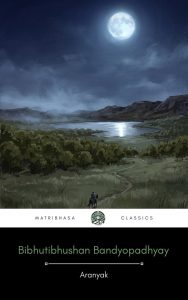
A flock of herons had made their nests in the crown of the ancient pakur tree; from a distance, it looked as if clusters of white flowers were blooming at the top of the tree. The place was full of deep shade, and secluded, and standing there, whichever way one looked, blue, blue hills stood on the distant horizon, holding hands like little children in a circle. When I stood in the dense shade of the pakur tree and spoke with Jaypal, the deep peace beneath this enormous tree and the unperturbed, detached, slow-paced life of its master would gradually cast a kind of spell over me. What is the profit in all this running around? How lovely is the shade of this dark Banyan of Krishna’s flute, how slow the waters of this Jamuna, what a comfort it is to walk back through a hundred past centuries, upstream against the river of time!
But the influence of Jaypal’s way of life and, in part, the boundless nature all around me seem to be gradually making me as placid, indifferent, and detached as Jaypal Kumar himself. And not just that; it is as if eyes that had never before opened in me have now opened, and I am being made to think thoughts I had never thought before. As a result, I have fallen so in love with these open plains and this deep green forest-nature that now, if I go to the city of Purnia or Munger on some errand, my mind grows restless and refuses to settle. I feel, when will I return to the forest, when will I once again plunge into that dense solitude, into the peerless moonlight, into the sunset, into the clouds of a Kalbaishakhi storm sweeping across the horizon, into the star-filled nights of summer!
On my way back, when I leave the civilised world far behind me and, passing Mukundi Chakladar’s acacia-wood post, enter the borders of my own jungle, the far-stretching, deep-green forest, the open plains, the rocky outcrops, the flocks of wild parakeets, the herds of nilgai, the sunlight, the open expanse of the earth—all of it overwhelms me completely in a single moment.
© 2026 Matribhasa Classics. Public Domain

Comments (0)
Log in to join the conversation.